



Healthcare CRM Market Revenue, Leading Companies, Company Technology / Innovation, Diagnostic Testing Volume, Adoption Rates, Pricing Metrics, Supply Chain Performance, Competitive Positioning, and Industry Trends
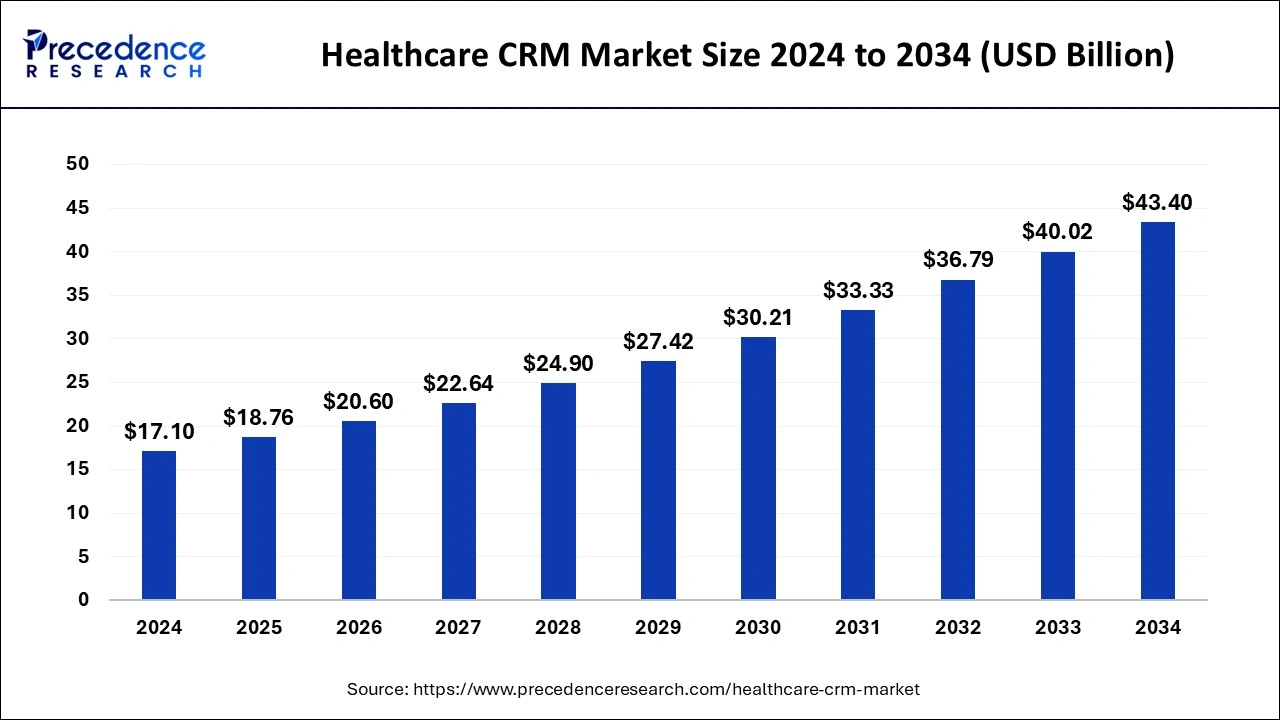
The global healthcare CRM market was valued at USD 18.76 billion in 2025 and is projected to reach USD 46.68 billion by 2035, growing at a 9.54% CAGR from 2026 to 2035. The market is driven by increasing adoption of patient-centric care, digital healthcare solutions, cloud-based CRM platforms, AI, IoT, and automation to improve patient engagement and streamline healthcare operations. North America led the market, while Asia Pacific is expected to be the fastest-growing region.
Source: https://www.precedenceresearch.com/healthcare-crm-market
 Get a Sample
 Table Of Content


What is the Healthcare CRM Market Size?
The global healthcare CRM market size is calculated at USD 18.76 billion in 2025 and is predicted to reach around USD 46.68 billion by 2035, expanding at a CAGR of 9.54% from 2026 to 2035.
Market Highlights
- By functionality, the sales segment hit a revenue share of around 21% in 2025.
- By deployment mode, the cloud/web-based segment has contributed the highest revenue share in 2025.
- By end use, the healthcare providers segment has accounted revenue share of around 44%.
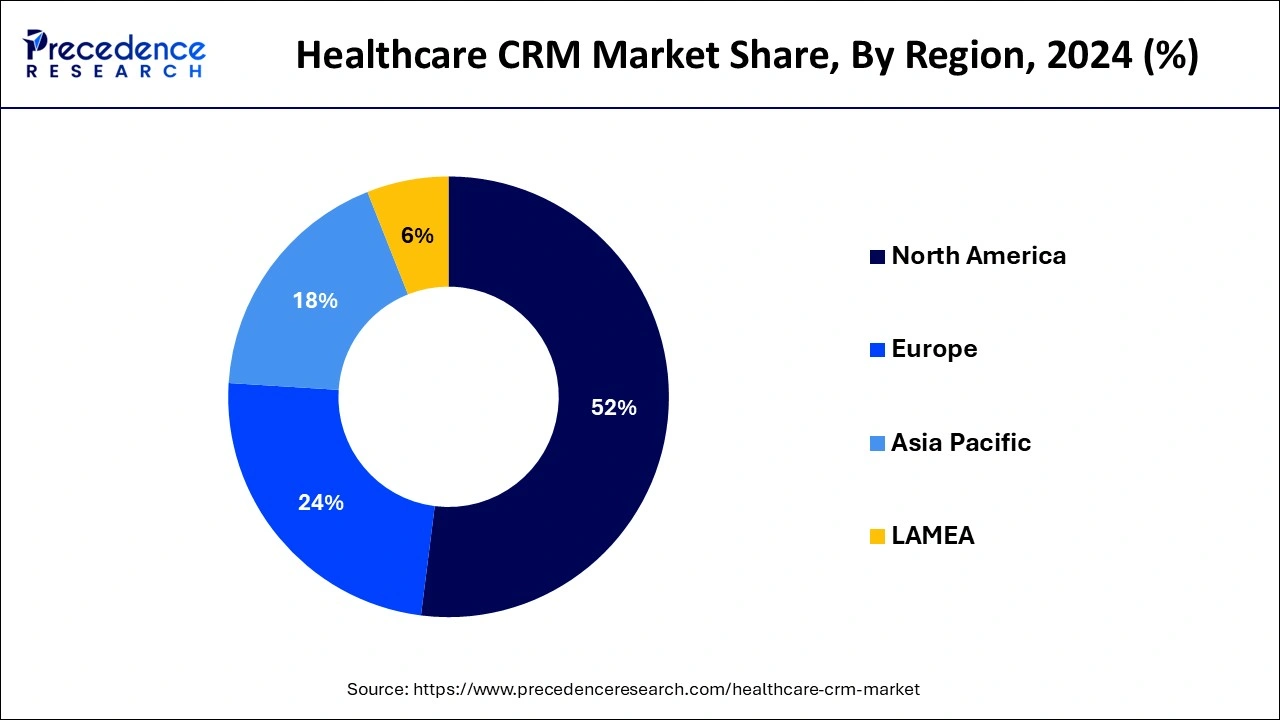
- North America held a 51.14% market share in 2025.
Market Size and Forecast
- Market Size in 2025: USD 18.76 Billion
- Market Size in 2026: USD 20.60 Billion
- Forecasted Market Size by 2035: USD 46.68 Billion
- CAGR (2026-2035): 9.54%
- Largest Market in 2025: North America
- Fastest Growing Market: Asia Pacific
What is a healthcare CRM?
Integration of Wearable Devices
Integrating wearable devices into a healthcare Customer Relationship Management (CRM) system makes data collection easy, improves communication, and facilitates proactive care. Healthcare providers can access real-time patient data, monitor vital signs remotely, and track health trends by connecting wearable devices to EHRs which leads to better patient outcomes. Better communication and collaboration among healthcare professionals, patients, and other relevant stakeholders are achieved by integrated data. Healthcare providers identify trends and intervene early using real-time access to patient data, preventing potential complications and improving patient outcomes.
Healthcare CRM Market Growth Factors
Healthcare customer relationship management services provide a wide variety of tools and services to the customer who will further optimize and improve communication between patients and healthcare providers. Also, these tools comprise of messaging services, text messages, comment forms, online forms, and emails and these services and tools are further becoming more and more popular everywhere around the world. In addition, various healthcare organizations use these channels of CRM. As these tools aids them to minimize their manpower in order to minimize risk of errors, achieve profitability, and optimize the overall channels of communication. Also, marketing automation, sales force automation, and service automation are the key features of healthcare CRM system. Healthcare customer relationship management system is utilized in public clinic, hospitals, private clinic, and various research laboratories.
Surge in demand for healthcare customer relationship management from patients in order to get easy approach for the treatments by virtual patient care mode, monitoring of mobile, home care, and counseling regarding diseases propels the growth of the global market. Major players such as Salesforce.Com Inc, IBM, and SAP SE are adopting various marketing techniques and key developmental strategy like partnership in order to improvise healthcare CRM products service portfolio. For instance, in the year 2018, the company named IBM came into a partnership with the key plyer named salesforce. This partnership brought along Salesforce Quip and Salesforce Service cloud Einstein from Watson and Cloud services from IBM in order to aid organizations to coordinate with customers more effectively.
CRM is a platform of software which is further used to address various healthcare challenges that have grown due to the pandemic. The outbreak of COVID-19 had an immense positive impact on the market growth of global healthcare CRM due to raised awareness regarding healthcare systems, and efficient healthcare systems for patients.
Market Outlook
- Industry Growth Overview: The healthcare CRM market is growing, driven by the increasing shift toward patient-centric care, growing digital acceptance, and the requirement to enhance patient engagement and operational effectiveness. Major pharmaceutical organizations are using CRMs to rationalize workflows, manage patient data, enhance communication, and lower costs.
- Global Expansion: The healthcare CRM market is experiencing global expansion, as a rise in the adoption of this equipment to manage patient data, rationalize communication, and automate administrative tasks in various countries and healthcare settings. North America is dominant in the market due to its progressive medical infrastructure and significant spending in medical care IT.
- Major investors: Large technology corporations that develop the software, and the specialized spending organizations and venture capitalists who fund innovative health-tech corporations. It includes Oracle Corporation, Microsoft Corporation, IBM Corporation, SAP SE, Accenture plc, and others.
Market Scope
| Report Coverage | Details |
| Market Size in 2025 | USD 18.76 Billion |
| Market Size in 2026 | USD 20.60 Billion |
| Market Size by 2035 | USD 46.68 Billion |
| Growth Rate from 2026 to 2035 | CAGR of 9.54% |
| Base Year | 2025 |
| Forecast Period | 2026 to 2035 |
| Segments Covered | Component, End Use, Deployment Model, and Application |
| Regions Covered | North America, Europe, Asia-Pacific, Latin America, and Middle East & Africa |
Various healthcare organizations use these channels. These tools aid to diminish the manpower in order to achieve reduced risk of errors, profitability, and thus optimize overall channels of communication. Also, service automation, marketing automation and sales force automation, are the elements of healthcare CRM system. Healthcare customer relationship management software is utilized in public & private clinic, hospitals, and research laboratories.
Concentrating on patient communication is highly essential in the face of changing healthcare coverage rules, and also in the grown burden from the pandemic. The COVID-19 pandemic has created a substantial burden over the organizations of healthcare, but leaders with forward-thinking are already leveraging technology in order to address the labor problems they are facing. In response to the COVID-19 pandemic, many healthcare organizations have applied new treatment methods to cope with the rapidly rising number of patient. Therefore, the substantial growth of the healthcare market worldwide is one of the major factors forming a positive outlook for the market. In addition, the growing requirement for effective solutions in order to improvise healthcare expertise and patient treatment is driving the growth of the market. Moreover, numerous technological advancements, such as the AI, integration of the loT, ML, and cloud computing solutions with HCRM platforms, act as other factors of the market growth as these tools also help minimize human effort, resulting in higher minimal risk of error, profitability, and streamlined communications.
Segments Insights
Component Insights
Based on the component, growing overall spending on healthcare expenditure, which is leading to rise in adoption of healthcare CRM software for effective hospital services and management drives the market growth of the healthcare CRM and makes software the dominating segment of the market. In addition, according to the statistics of U.S. Government, the healthcare expenditure in the U.S. increased by 4.5% from the years 2018 to 2019.
However, the services segment is estimated to be the fastest growing segment during the forecast period. Owing to the growing requirement of new services in the health care segment like that can improve and optimize communication between healthcare providers and patients. These tools include messaging services, text messages, online forms, emails and comment forms.
Application Insights
Customer service & support segment has generated a revenue share of more than 27% and dominated the global health care CRM market in 2023. However, the marketing segment is expected to be the fastest-growing segment during the forecast period. The moderate investment, higher profitability, and ease of operations have significantly boosted the growth of the marketing segment of health care CRM across the globe.
Type Insights
The operational segment dominated the market in 2025, mainly due to its capability of automating core front-office workflows, including sales, marketing automation, and customer as well as patient support service coordination for administrative efficiency for healthcare providers and payers. It also unifies disparate front-office and administrative tasks to optimize the daily interaction journey between providers and patients. It also reduces redundant manual touchpoints by lowering the total cost of ownership for healthcare delivery organizations.
The analytical segment is expected to have the fastest growth during the forecast period, mainly due to its strong focus on peer-reviewed clinical outcomes, data mining methodologies, and systemic healthcare framework analyses over commercial valuations. Large medical centers also leverage clinical and business analytics support, highlighting continuous integration demand. Data-driven interventions improving operational metrics, including lowering hospital readmission rates and optimizing chronic disease management.
Deployment Model Insights
The cloud segment held market dominance in 2025, mainly due to its superior scalability, cost-effectiveness, and capability to seamlessly integrate real-time patient data and AI analytics across remote platforms. Cloud environments easily connect with standardized data frameworks and support advanced machine learning tools for predictive patient outreach. Web-based cloud access empowers clinical staff, administrators, and patients to interact securely through mobile as well as web applications from any location.
The hybrid segment is anticipated to have the fastest growth during the forecast period, mainly due to its integration of on-premises security with cloud flexibility by balancing stringent patient data privacy laws with scalable, real-time patient engagement workflows. Furthermore, facilities must keep sensitive records compliant with local health laws by favoring local storage. Mixed setups support decentralized or remote patient monitoring without full cloud migration challenges.
Regional Insights
Why North America Dominates the Healthcare CRM Market?
North America was the leading region for health care CRM market. North Americas will be a significant competitor in the global healthcare CRM market with its large pool of established payers, hospitals, and rising healthcare CRM usage. A considerable number of hospitals can be found in the region, and they would thus support the market growth. There are numerous challenges associated with the global healthcare CRM market. One of the most vital development factors is the high competition in the area. Owing to the evolution of the North America region healthcare infrastructure, the healthcare CRM market will progressively see a growing demand.
U.S. Healthcare CRM Market Size Size and Growth 2026 to 2035
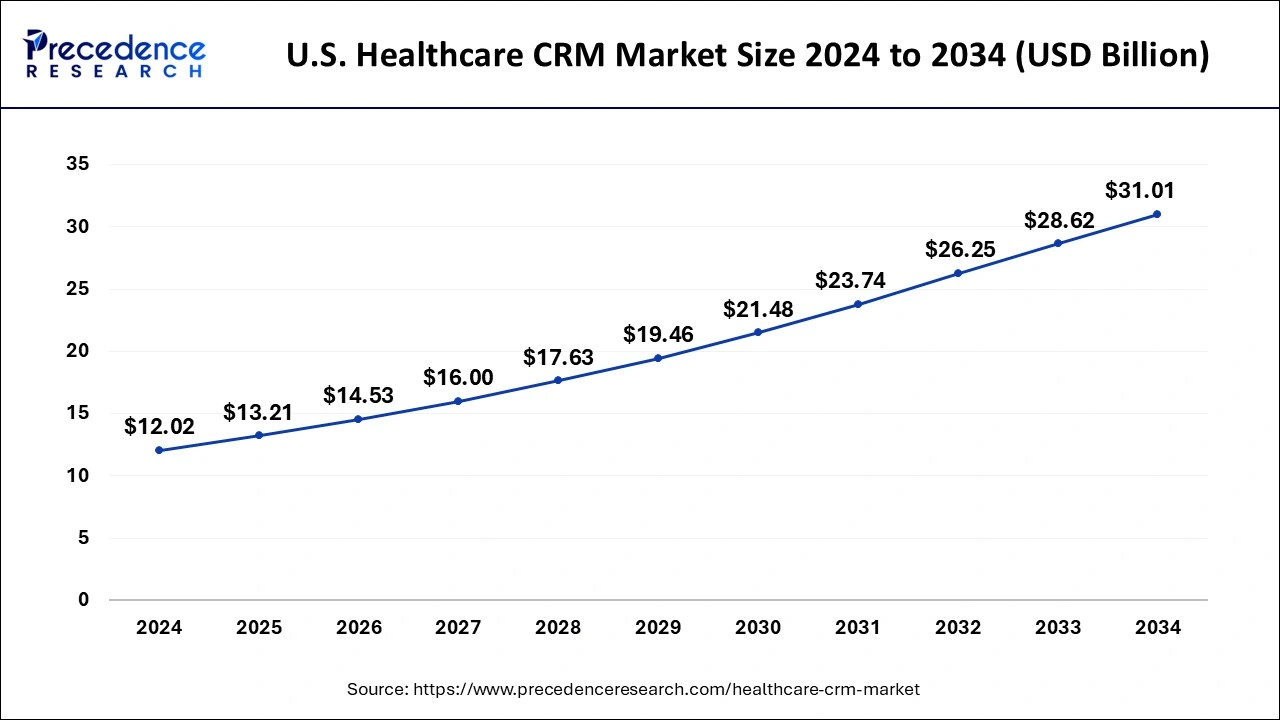
The U.S. healthcare CRM market size is evaluated at USD 13.21 billion in 2025 and is projected to be worth around USD 33.39 billion by 2035, growing at a CAGR of 9.72% from 2026 to 2035.
United States Healthcare CRM Market Trends
The presence of a well-developed healthcare infrastructure and a growing focus on digitalization increases demand for healthcare CRM. The strong presence of IT infrastructure helps in the market growth. The growing focus on patient satisfaction and management increases demand for healthcare CRM. The growing adoption of digital health technologies like wearable devices, electronic health records, and telemedicine increases demand for CRM systems. The supportive regulations, like the Health Insurance Portability and Accountability Act, require secure data management practices, increasing demand for CRM systems. The growing focus on patient-centered care helps in the market growth. The growing investment in healthcare technology increases demand for effective healthcare CRM. The strong presence of major players like IBM, Microsoft, and Salesforce drives the overall growth of the market.
Tech Drives Asia-Pacific Healthcare Investment Surge
Asia-Pacific is considered as the fastest growing region in the global health care industry owing to the rising investors' interest in the industry. The market is further becoming more transitional, driving these companies to establish operations in emerging markets such as India. This rise in the number of hospitals would require installing computerized records systems and other software to simplify the processes and therefore be attributed to market growth. Yet, the developing nations invest a substantial significance in erecting their domestic healthcare infrastructure. This development is anticipated to attract numerous investors and goad the development of the nation's industry.
China Healthcare CRM Market Trends
China is a major contributor to the healthcare CRM market. The growing prevalence of infectious and chronic diseases and demand for improved healthcare services increases the adoption of healthcare CRM systems. The strong government support for digital health solutions and growing investment in healthcare technology help the growth of the market. The growing adoption of wearable technology, telemedicine, and mobile health apps increases demand for efficient CRM systems. The growing focus on patient-centric care increases demand for CRM systems for efficient communication, better patient management, and personalised care. The growing expansion of the private healthcare sector and increasing investment in healthcare infrastructure support the overall growth of the market.
India Healthcare CRM Market Trends
India is significantly growing in the healthcare CRM market. The growing healthcare budget and increasing funds for digital healthcare infrastructure development increase the adoption of healthcare CRM systems. The growing expansion of diagnostic centers, hospitals, and clinics increases demand for a CRM system to manage administrative tasks, patient data, and appointments. The growing adoption of digital solutions like mobile health solutions, electronic health records, and telemedicine increases demand for healthcare CRM solutions. The increasing adoption of advanced technologies like telehealth platforms, AI, and data analytics increases demand for CRM solutions. The rapid growth in personalised drug delivery & online pharmacies and focus on patient-centered care drives the overall growth of the market.
Europe: Increasing aging population and chronic diseases
Europe is significantly growing in the market as there is a rising emphasis on offering targeted, patient-centered care, which CRM systems help with by better communication, appointment scheduling, and follow-up. The increasing number of aging citizens and the growing prevalence of chronic diseases such as diabetes and cardiovascular disorders need more efficient patient management systems, which CRM provides, driving the growth of the market.
UK: Technological advancements
In the UK, CRMs support streamlined administrative tasks, lower manual data entry, and minimize inefficiencies such as missed appointments. This frees up staff to focus on patient care and lowers operational expenses. The incorporation of advanced technologies such as AI, machine learning, and predictive analytics in CRM platforms enables better data analysis, risk identification, and personalized suggestions, enhancing decision-making and patient outcomes.
South America: Increasing government initiatives
South America is experiencing substantial growth in the market due to an increasing demand for operational effectiveness, the expansion of telemedicine and virtual care, and regulatory initiatives to improve healthcare access. Governments in the region are actively supporting the integration of telemedicine and improving healthcare accessibility through policy initiatives and funding.
Brazil: Industry Collaboration and R&D
In Brazil, as smartphone usage increases and consumer demand for personalized services grows, healthcare facilities are adopting CRM systems to better engage with patients, boost satisfaction, and build lasting relationships. The trend toward cloud-based CRM solutions appeals to healthcare providers because of their flexibility, easy access, strong security, and affordability, particularly for smaller institutions.
How will the Middle East and Africa Grow in the Healthcare CRM Market?
The Middle East and Africa is experiencing significant growth in the global market, mainly due to increasing burdens of non-communicable chronic diseases necessitating continuous engagement, and emerging private-sector and medical-tourism investments. Public health frameworks focus on integrated data systems, electronic health records, and patient-centric portals. Meanwhile, national transformation mandates like Saudi Vision 2030, along with growth in private hospital chains and medical tourism, increase the demand for consumer-grade digital experiences and retention tools.
The UAE Market Trends
The UAE is a key contributor within the region, mainly characterized by using intelligent automation and unified portals to optimize patient-provider communication, compliance, and clinical resource management. Aligned with the UAE 2031 and the Zero Government Bureaucracy Programme to eliminate administrative bottlenecks. The Ministry of Health and Prevention (MoHAP) implemented comprehensive digital monitoring and collection systems through unified web portals.
Value Chain Analysis – Drive by Wire Market
- R&D:
The R&D process for a healthcare CRM system is a structured strategy that integrates traditional software advancement methodologies with precise healthcare requirements, particularly concerning patient data management and regulatory compliance, such as HIPAA.
Key Players: Creatio and Innovaccer - Clinical Trials
Clinical trial processes within a healthcare CRM system involve managing patient data and incorporating it throughout a trial, from initial recruitment to post-market surveillance
Key Players: Oracle (Cerner) and SAP - Patient Services:
Patient services procedures in a healthcare CRM are a set of workflows that manage patient interactions and streamline processes, such as preparing appointments, handling communications, and offering personalized support.
Key Players: Salesforce and Microsoft
Top Vendors in the Healthcare CRM Market & Their Offerings
|
Company |
Headquarters |
Key Strengths |
Latest Info (2025) |
|
Salesforce.Com Inc |
United States |
Comprehensive platform and ecosystem |
In May 2025, Salesforce announced a network of certified life sciences partners to accelerate customer migration to Life Sciences Cloud, its HIPAA-ready, pre-validated, GxP-compliant platform. |
|
Microsoft Corporation |
Redmond, Washington |
Strong financial position |
In October 2025, Microsoft Corp. unveiled AI innovations, leveraging ambient and generative technologies, to improve the patient journey, reduce the workflow burden across care teams, and enhance the financial integrity of healthcare provider organizations. |
|
Oracle Corporation |
United States |
Comprehensive Cloud Portfolio |
Oracle Corporation is a leading American multinational technology company |
|
PegasystemsInc |
Massachusetts |
Strong Pega Cloud Business |
Pega's AI-powered decisioning and workflow automation solutions are recognized for agentic AI capabilities and helping clients achieve transformation goals.
|
|
Sage Group Plc |
England |
Strong financial position and cash flow |
Sage launched Sage Intacct Clinical eProcurement, a solution designed to streamline procurement processes for healthcare organizations. |
Key Market Developments
- In January 2021, the key player named Nuance Communications, Inc. (NASDAQ: NUAN) introduced avirtual assistant platform based on AI-powered patient engagement in order to transform digital experiences and voice across the patient journey. Furthermore, Nuance's platform assimilates into and extends the possibilities of the healthcare organization's critical financial, clinical, customer and telephony systems, including the Patient Financial systems, EHR, CRM, and patient access center telephony infrastructure.
Healthcare CRM Market Companies
- Salesforce.Com Inc
- Microsoft Corporation
- Oracle Corporation
- PegasystemsInc
- Sage Group Plc
- SAP SE
- SugarCRM
- Zoho Corporation Pvt Ltd
- Cerner Corporation
- Keona Health
Recent Developments
- In March 2025, Veeva Systems launched innovative CRM Pulse for global healthcare engagement metrics. (Source: https://finance.yahoo.com)
- In May 2025, Maharashtra Public Health Department announced to launch a 10-year concessionaire agreement with SUMEET SSG BVG Maharashtra EMS which aims to deploy the new Maharashtra Emergency Medical Services (MEMS) 108 Ambulance Programme. The total investment dedicated to this project is nearly ?1,600 crore and will provide emergency medical care across the state through a fleet of 1,756 ambulances equipped with advanced medical and communication technologies such as Customer Relationship Management (CRM), Computer-Aided Dispatch (CAD), Vehicle Tracking and Management (VTMS), and real-time patient arrival notifications. ( Source: https://www.expresshealthcare.in)
- In January 2025, Docfyn launched AI-Driven Marketing Suite and it offers CRM solutions, SEO optimization, hospital website development, chatbots, and workflow automation. ( Source: https://indiatechnologynews.in)
Segments Covered in the Report
By Component
- Software
- Services
By Application
- Customer Service & Support
- Marketing
- Sales
- CRM Analytics
- Others
By Type
- Operational
- Collaborative
- Analytical
By Deployment Model
- On-Premise
- Hybrid
- Cloud
By End User
- Healthcare Providers
- Hospitals
- Ambulatory Care Centers
- Diagnostics & Imaging Centers
- Pharmacies
- Others
- Healthcare Payers
- Private Payers
- Public Payers
By Region
- North America
- Latin America
- Europe
- Asia-pacific
- Middle and East Africa
For inquiries regarding discounts, bulk purchases, or customization requests, please contact us at sales@precedenceresearch.com
Frequently Asked Questions





Ask For Sample
No cookie-cutter, only authentic analysis – take the 1st step to become a Precedence Research client
 Get a Sample
.webp)



 sales@precedenceresearch.com
 Schedule a Meeting
