



Hydronic Underfloor Heating Market Trends, Companies, Revenue / Sales Performance, Manufacturing Yield, Fab Capacity, Export & Import Dynamics, Supply Chain Analysis, Competitive Landscape, and Growth Forecast
Hydronic Underfloor Heating Market (By Product Type (Technology): Hydronic (Wet) Systems, Electric (Dry) Systems; By Component: Heating Systems (Pipes, Cables, Mats), Control Systems (Smart Thermostats, Sensors); By Installation Type: New Installations, Retrofit/Renovation; By Application (End-Use): Residential, Commercial (Hospitality/Offices), Industrial & Institutional) - Global Industry Analysis, Size, Trends, Leading Companies, Regional Outlook, and Forecast 2026 to 2035
Source: https://www.precedenceresearch.com/hydronic-underfloor-heating-market
 Get a Sample
 Table Of Content


What is Hydronic Underfloor Heating Market Size in 2026?
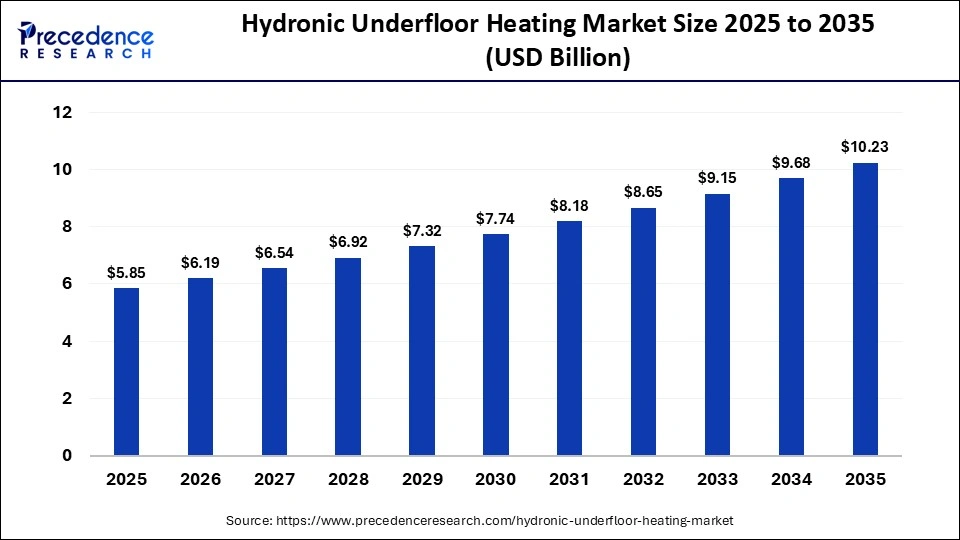
The global hydronic underfloor heating market size was calculated at USD 5.85 billion in 2025 and is predicted to increase from USD 6.19 billion in 2026 to approximately USD 10.23 billion by 2035, expanding at a CAGR of 5.75% from 2026 to 2035. Hydronic underfloor heating is an energy-efficient way to provide clean, warm, and comfortable indoor heating. The market drivers include rising construction, smart technology integration, rising energy cost, comfort and health benefits, and energy efficiency and sustainability.
Key Takeaways
- Europe dominated the hydronic underfloor heating market with a share of approximately 35% in 2025.
- Asia-Pacific is expected to grow at the fastest CAGR in the market during the forecast period.
- By product type, the hydronic (wet) systems segment registered its dominance over the global market with a share of approximately 65% in 2025.
- By product type, the electric (dry) systems segment is expected to witness the fastest growth in the market with a CAGR of approximately 8.3% over the forecast period.
- By component, the heating systems segment contributed the biggest revenue share of approximately 52% in the market in 2025.
- By component, the control systems segment is expected to expand rapidly in the market with a CAGR of approximately 9.6% in the coming years.
- By installation type, the new installations segment held a dominant position in the market with a share of approximately 68% in 2025.
- By installation type, the retrofit/renovation segment is expected to witness the fastest growth in the market with a CAGR of approximately 10% over the forecast period.
- By application (end-use), the residential segment accounted for the highest revenue share of approximately 54% in the market in 2025.
- By application (end-use), the commercial segment is expected to expand rapidly in the market with a CAGR of approximately 9.5% in the coming years.
What is the Hydronic Underfloor Heating Market?
Hydronic radiant heating systems deliver warmth by using hot water and a heat exchanger to distribute heat across residential and commercial buildings. Unlike conventional forced-air systems, which warm a space by circulating heated air through ducts and vents, hydronic systems operate by heating the surfaces within a building, such as floors, walls, or baseboards, which radiate heat gently into the surrounding area. This method of heat distribution results in a more uniform, consistent, and frequently more comfortable indoor atmosphere.
A significant health benefit of hydronic heating systems is their capability to diminish indoor allergens, thereby fostering a cleaner and healthier living space. The systems are especially advantageous for newly constructed homes and buildings, providing both flexibility and efficiency throughout the design and installation processes. Additionally, it consumed lower energy through more efficient heat delivery than traditional thermostat settings. It efficiently delivers heat directly, reducing energy losses common in forced-air systems by using a closed-loop of pipes to circulate heated water to radiators or radiant floors, enhancing the system's market adoption and fostering market growth.
What is the Role of AI in the Hydronic Underfloor Heating Market?
In the era of smart homes, artificial intelligence (AI) is transforming how we live, including how we heat our homes. AI-powered systems offer numerous advantages through data inputs for informed decision-making, such as occupancy patterns derived from motion sensors and geofencing to identify presence, weather predictions for modifying heating according to climate information, user preferences that evolve, energy costs for maximizing heating efficiency, and window/door sensors that minimize heating in open spaces to avoid energy loss.
Integrating AI is a major step towards sustainability and energy efficiency as it reduces the energy use depending on the property size and lifestyle habits, helping in environmental sustainability. Also, they can seriously integrate with other smart home platforms such as Google Home, Amazon Alexa, and Apple HomeKit for a better user experience. It also provides remote access via smartphone apps, which gives homeowners full control over their heating system, broadening the market reach.
What Are the Trends in the Hydronic Underfloor Heating Market?
- Energy Efficient and Sustainability
Hydronic heating systems are energy-efficient, operating at lower water temperatures than traditional radiators, which reduces energy consumption and utility costs while minimizing carbon footprints. Unlike forced-air systems that can cause temperature fluctuations, hydronic heating provides consistent heat distribution.
These systems can be powered by renewable sources like air-to-water heat pumps, making them an eco-friendly heating option. Investing in hydronic underfloor heating is economically beneficial over time, and they typically use refrigerants with low global warming potential, enhancing its environmental friendliness. - Integration of Smart and Digital Control
Integration of smart controls for underfloor heating includes digital thermostats that allow for managing room temperatures via smartphone, tablet, or voice commands. They work with platforms like Google Home, Amazon Alexa, and Apple HomeKit for easy automation. These systems also learn consumers' habits, adjust temperatures automatically, and improve energy efficiency, making them smarter than traditional thermostats. Furthermore, most systems come with apps, clean interfaces, and reliable customer support, catalyzing the market growth. - Compatibility With Renewable Heat Sources
Hydronic floors are an excellent heating choice for homeowners looking to reduce energy consumption while ensuring comfort. While traditional systems use gas or electric power, integrating renewable energy makes the system even more efficient.
Integrating photovoltaic solar panels and solar thermal systems can fully heat the water using solar energy. Additionally, geothermal heat pumps leverage the earth's stable temperature to heat or cool water through a ground loop, providing year-round temperature control, accelerating market growth.
Market Scope
| Report Coverage | Details |
| Market Size in 2025 | USD 5.85 Billion |
| Market Size in 2026 | USD 6.19 Billion |
| Market Size by 2035 | USD 10.23 Billion |
| Market Growth Rate from 2026 to 2035 | CAGR of 5.75% |
| Dominating Region | Europe |
| Fastest Growing Region | Asia Pacific |
| Base Year | 2025 |
| Forecast Period | 2026 to 2035 |
| Segments Covered | Product Type, Component, Installation Type, Application , and Region |
| Regions Covered | North America, Europe, Asia-Pacific, Latin America, and Middle East & Africa |
Segmental Insights
Product Type Insights
Which Product Type Segment Dominated the Hydronic Underfloor Heating Market?
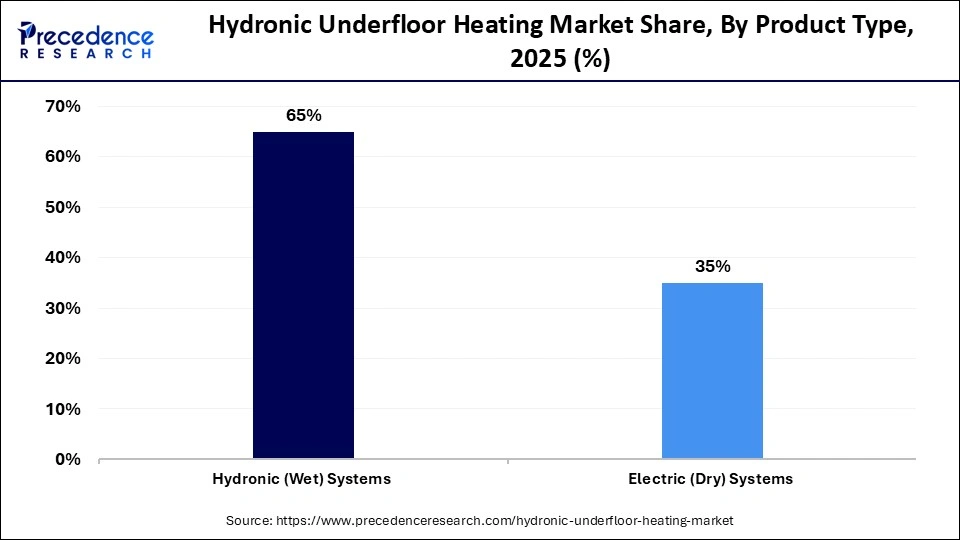
The hydronic (wet) systems segment held a dominant position in the market with a share of approximately 65% in 2025, due to its energy efficiency, thermal comfort, and versatility for residential and commercial use. These systems use water for heat transfer, making them more efficient than air-based systems, reducing operational costs and carbon emissions.
Furthermore, they enhance efficiency with modern condensing boilers or heat pumps, reduce energy losses from water's superior heat capacity, and provide consistent warmth from radiant heat. They also provide excellent zonal temperature control. Strict energy regulations and green building certifications promote sustainable infrastructure, making hydronic systems a preferred choice. In commercial settings, they are ideal for effective climate control in large spaces like offices, hospitals, and schools.
The electric (dry) systems segment is expected to show the fastest growth with a CAGR of approximately 8.3% over the forecast period, due to its accessibility and user-friendliness compared to gas dryers. Electric dryers only need a standard outlet for installation, making them ideal for homes without gas lines. They also have a lower purchase price, making it cost-effective for consumers.
Recent advancements have led to more energy-efficient electric models, including heat pump technology, meeting the demand for sustainable appliances. Additionally, the widespread availability of electricity allows for easy installation in various settings. They are also quieter than gas models, which enhances their market growth.
Component Insights
Which Component Type Led the Hydronic Underfloor Heating Market?
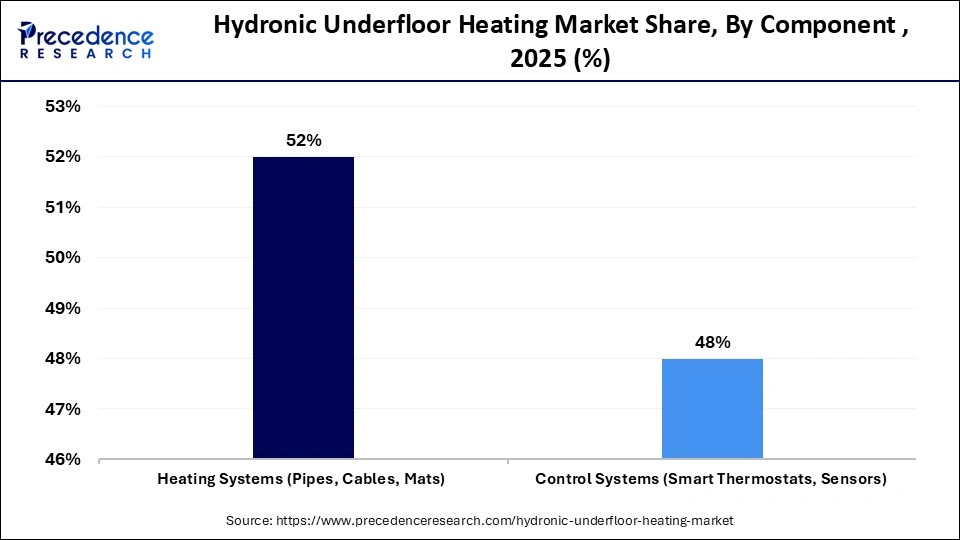
The heating systems segment led the global market with a share of approximately 52% in 2025, as electric heating cables and mats efficiently convert energy into heat. They are also preferred because of their comfort and easy installation during renovations. They also provide consistent warmth from the ground up, reducing cold spots, and often have lower operational costs in modern, well-insulated settings.
In industrial systems, cables play a crucial role in the oil, gas, chemical, and pharmaceutical industries for preventing freezing and ensuring the maintenance of process temperatures. They also help melt snow and ice on driveways and roofs for safety, broadening the market reach.
The control systems segment is expected to gain the highest share of the market with a CAGR of approximately 9.6% between 2026 and 2035. Smart thermostats automate energy use, lowering utility costs. Occupancy sensors and geofencing reduce energy waste in empty areas. They also integrate with IoT systems for voice assistants like Alexa and Google Home, providing user convenience.
Stricter energy efficiency standards and utility incentives promote its adoption, further integrating sensors to enable predictive maintenance, cutting repair costs and downtime. Modern thermostats use machine learning to adapt to user habits and environmental changes, ideal for upgrading older buildings without major renovations.
Installation Type Insights
How the New Installations Segment Dominated the Hydronic Underfloor Heating Market?
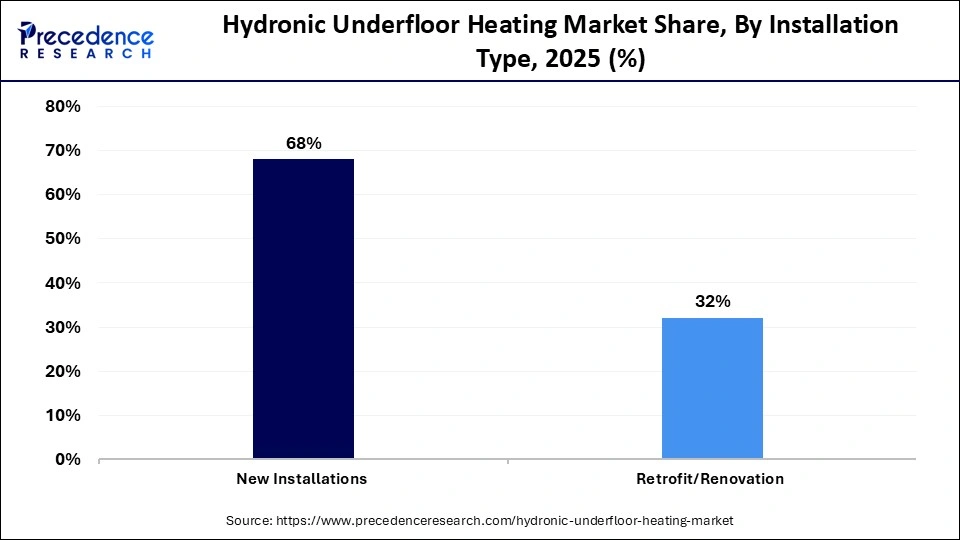
The new installations segment held a major revenue share of approximately 68% in the market in 2025, due to factors like new initiatives in infrastructure, energy, and technology that require substantial upfront investments, leading to higher revenue recognition compared to maintenance sectors. Industries are shifting towards smarter, sustainable technologies, necessitating new installations instead of simple upgrades.
In some markets, manufacturers link new equipment sales with long-term service contracts, enhancing the segment's growth. After a new system is installed, relying on the manufacturer for maintenance and parts makes this initial installation a crucial and high-value market entry point.
The retrofit/renovation segment is expected to grow with the highest CAGR of approximately 10% in the market during the studied years, due to strict building regulations. Retrofitting is essential for reducing greenhouse gas emissions and carbon footprints. Upgrading existing buildings is often more cost-effective. Improvements in energy efficiency, like HVAC systems, insulation, and lighting, significantly lower operating costs.
The commercial sector leads the market due to the need for effective facility management and tenant retention. Rapid urbanization increases the need for modernizing older structures. The integration of IoT, AI, and smart building management systems has made retrofitting more attractive by enabling real-time energy management and enhancing operational efficiency.
Application (End-Use) Insights
Why Did the Application (End-Use) Segment Dominate the Hydronic Underfloor Heating Market?
The residential segment contributed the biggest revenue share of approximately 54% in the market in 2025, as hydronic systems provide consistent, comfortable radiant heat from the ground up, while eliminating noise. They also minimize dust and allergens. Due to rising energy costs, homeowners prefer hydronic systems for their energy efficiency, operating at lower temperatures and integrating well with renewable sources like solar thermal, benefiting new constructions.
Rapid urbanization and the rise of low-profile retrofit systems have boosted their popularity in renovations. Modern systems often feature smart thermostats and IoT controls, enabling easy temperature management with smartphones. Supportive regulations and incentives encourage the adoption of systems in residential projects.
The commercial segment is expected to witness the fastest growth in the market with a CAGR of approximately 9.5% over the forecast period. Hydronic systems used in large buildings reduce operational costs. They also play a significant role in integrating effectively with renewable technologies like heat pumps.
In the hospitality and office settings, radiant heating systems provide consistent warmth, eliminating cold spots and enhancing indoor air quality by minimizing dust circulation, which is an essential factor for these environments. It is also highly used due to its quiet operation, dependability, and extended lifespan, which contribute to reduced maintenance costs.
Regional Insights
Europe Hydronic Underfloor Heating Market Size and Growth 2026 to 2035
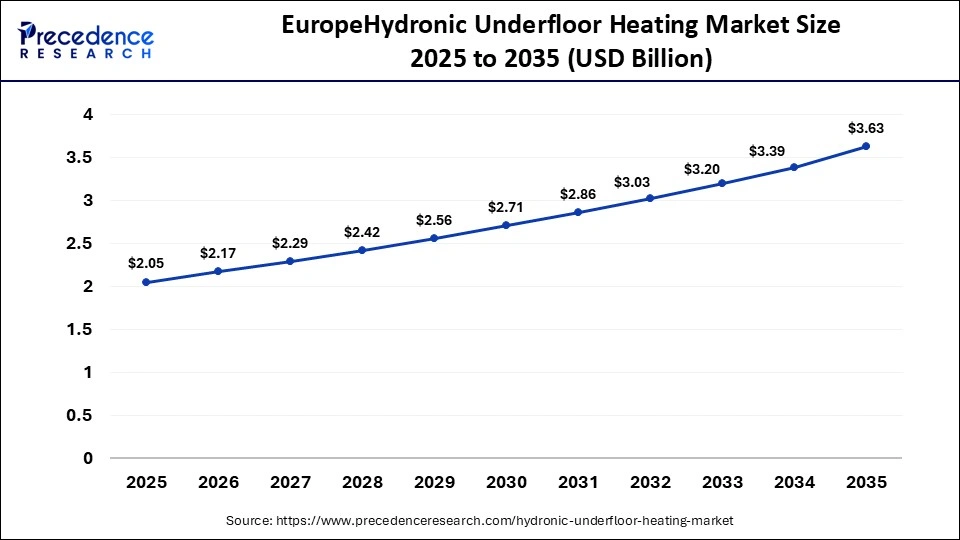
The Europe hydronic underfloor heating market size has grown strongly in recent years. It will grow from USD 2.05 billion in 2025 to USD 3.63 billion in 2035, expanding at a compound annual growth rate (CAGR) of 5.88% between 2026 to 2035
Which Factors Drive the Hydronic Underfloor Heating Market in Europe?
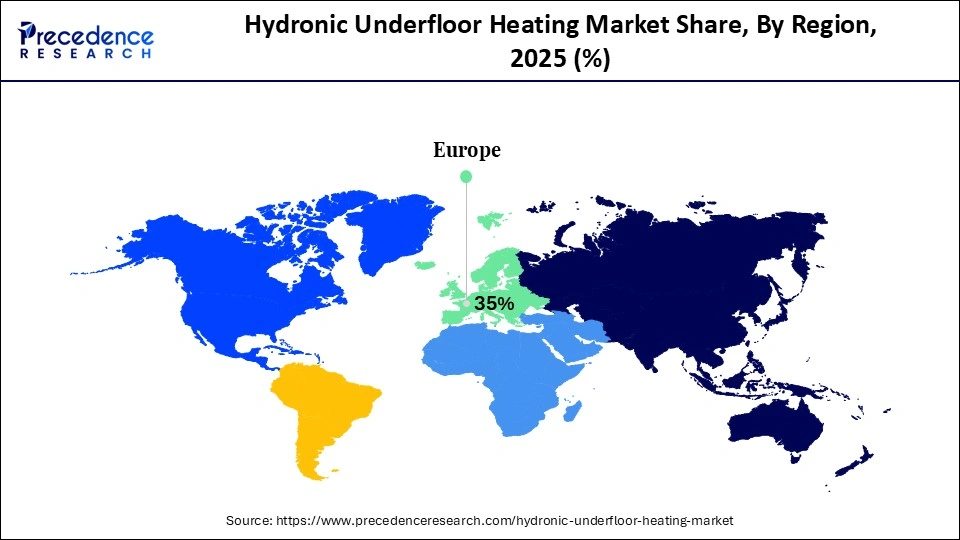
Europe held the largest revenue share of approximately 35% in the market in 2025. The growth factors include sustainability and regulation, heat pump compatibility, energy saving and comfort, construction and retrofitting, and government incentives. The market is significantly shaped due to policies that are driving a shift towards low-carbon, energy-efficient heating solutions. Consumers are increasingly opting for heating solutions that are invisible, quiet, and comfortable. Furthermore, subsidies and tax incentives for green retrofits and energy-efficient systems are enhancing the financial viability for homeowners.
Germany Market Trends
The market is exceptionally high in Germany as it is the leading hub for both consumption and production in Europe. Key factors include the combination of stringent energy regulations, rapid adoption of heat pumps, strong preference for high comfort, energy-efficient, and sustainable building solutions. The government is heavily promoting heat pumps as it operates at lower temperatures. They also offer financial incentives and subsidies for renovations for installing energy-efficient heating. Additionally, the market is further driven by strict German DIN standards for material quality and installation, boosting the adoption of underfloor heating.
How Will the Asia-Pacific Region Grow in the Hydronic Underfloor Heating Market?
Asia-Pacific is expected to be the fastest-growing market in 2025. The key reasons include cultural and lifestyle factors, rapid urbanization, energy efficiency and sustainability goals, improved air quality, dual heating and cooling capability, and compatibility with flooring materials. In many Asian cultures, users spend significant time on the floor, increasing the adoption of systems. Also, it works optimally with concrete, tile, and stone flooring found in Asian homes, providing efficient heat transfer.
China Market Trends
China is a dominant player in the APAC market, driven by rapid urbanization, large-scale construction, and government initiatives promoting green building practices and integrating renewable energy resources. Also, the capability for dual heating and cooling is boosting the market in residential developments. Rapid urbanization and the prevalence of high-rise concrete buildings make installing piping in the floor structure during construction both efficient and cost-effective.
What Makes Europe The Second Largest Region in Hydronic Underfloor Heating Market?
Europe is the second-largest market for hydronic underfloor heating because of the stringent environmental regulations throughout Europe and the emphasis on reducing energy usage within residential buildings. The increase in demand for hydronic underfloor heating systems is due, in part, to the renovation of existing older buildings as well as the increase in sustainable housing developments.
Germany Hydronic Underfloor Heating Market
Germany is the largest market for hydronic underfloor heating throughout Europe due to their commitment to reducing energy consumption and using environmentally friendly heating technology when constructing new residential homes. Many renovation projects taking place throughout Germany and due to the stringent building energy efficiency codes in Germany which do not allow for the simple addition of regular, above ground, heating systems.
Why is Latin America Emerging Steadily In Hydronic Underfloor Heating Market?
Latin America's hydronic underfloor heating sector is constantly growing due to an increase in the amount and size of new residential construction and hospitality developments in urban areas. In addition to being more aware of energy-efficient heating solutions, there are many other factors encouraging people to buy hydronic underfloor heating for their homes such as higher living standards and modern design styles in premium houses.
Brazil Hydronic Underfloor Heating Market
Brazil is leading the way for the Latin America's hydronic underfloor heating Market through increased luxury housing development and an increased need for new forms of comfort in both the office and home. In addition, the entire region has seen an increase in investment into sustainable building solutions/technologies as well as improvements in overall building systems; this includes a rapid increase in investment into energy-efficient building systems, thus allowing for increased use of cutting edge hydronic heating equipment in certain defined urban areas and higher end development projects.
Why is the Middle East experiencing notable growth in Hydronic Underfloor Heating Market?
Hydronic underfloor heating is seeing a significant increase in this industry across the Middle East and Africa primarily because of an influx of luxury apartment developments, particularly across the commercial building sector. This is being compounded by an increase in the number of cooler parts of the world and, in particular, an increase in the number of high-end hotels. There is continued government push for sustainable construction and energy efficiency building technologies.
UAE Hydronic Underfloor Heating Market Trends
United Arab Emirates holds the dominant position in the hydronic underfloor heating market in both the Middle East & Africa due primarily to a mix of new luxury homes, high-end hotels, & smart commercial facilities. As a result, the demand for advanced indoor comfort products continues to rise through high-end projects & developers have increasingly begun to install energy efficient heating devices throughout high-end residential & accommodation projects in major cities.
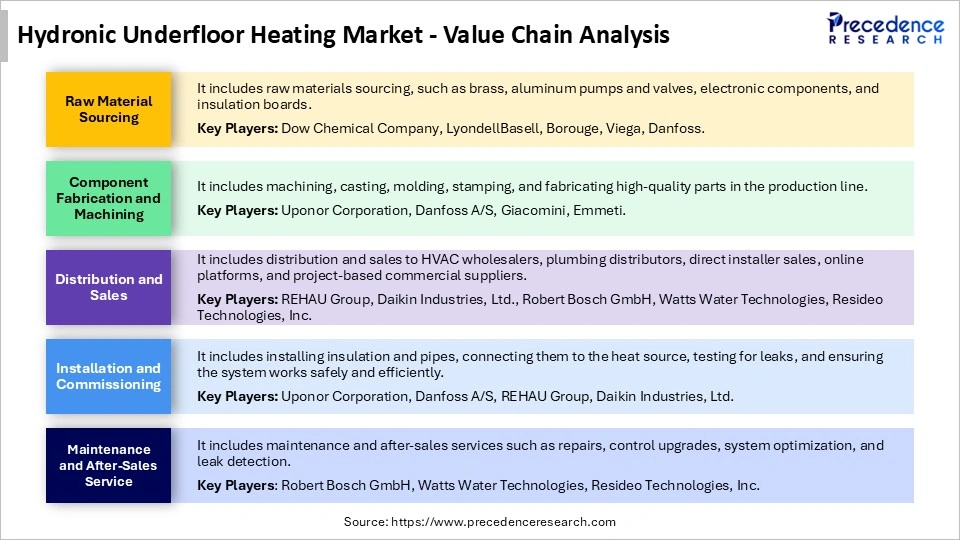
Hydronic Underfloor Heating Market Value Chain Analysis
Hydronic Underfloor Heating Market Companies
- Uponor Corporation
- Danfoss A/S
- REHAU Group
- Warmup PLC
- nVent Electric plc
- Robert Bosch GmbH
- Siemens AG
- Mitsubishi Electric Corporation
- Schneider Electric SE
Recent Developments
- In October 2025, the Japanese electronics manufacturer, Panasonic, launched its new heat pump system for centralized heating and domestic hot water installation. The newest products include the Panasonic Comfort Cloud app and Aquarea Service Cloud 2 CN-CNT connections. (Source - https://www.pv-magazine.com)
- In July 2025, Uponor announced the new launch of its intelligent room temperature control system, Uponor Smatrix Pulse, which enhances the energy efficiency of radiant underfloor heating and cooling systems, ensuring optimal comfort in every room. It is ideal for all home types, including rental properties and reconstruction. (Source - https://www.uponor.com)
Segments Covered in the Report
By Product Type (Technology)
- Hydronic (Wet) Systems
- Electric (Dry) Systems
By Component
- Heating Systems (Pipes, Cables, Mats)
- Control Systems (Smart Thermostats, Sensors)
By Installation Type
- New Installations
- Retrofit/Renovation
By Application (End-Use)
- Residential
- Commercial (Hospitality/Offices)
- Industrial & Institutional
By Region
- North America
- Europe
- Asia-Pacific
- Latin America
- Middle East & Africa
For inquiries regarding discounts, bulk purchases, or customization requests, please contact us at sales@precedenceresearch.com
Frequently Asked Questions





Ask For Sample
No cookie-cutter, only authentic analysis – take the 1st step to become a Precedence Research client
 Get a Sample




 sales@precedenceresearch.com
 Schedule a Meeting
