



Inbound Wholesale Roaming Market Trends, Companies, Contract Wins / Project Pipeline, Installed Capacity, Power Generation, Government Investment, Technology Adoption, Competitive Positioning, and Growth Forecast
Inbound Wholesale Roaming Market (By Type of Services Voice Roaming, Data Roaming, Messaging Roaming, Enterprise Roaming, Wholesale Roaming; By End-User: Mobile Network Operators (MNOs), Mobile Virtual Network Operators (MVNOs), Telecom Service Providers, Enterprises, Retail Customers; By Technology: 2G, 3G, 4G, 5G, Wi-Fi Offloading) - Global Industry Analysis, Size, Trends, Leading Companies, Regional Outlook, and Forecast 2026 to 2035
Source: https://www.precedenceresearch.com/inbound-wholesale-roaming-market
 Get a Sample
 Table Of Content


What is the Inbound Wholesale Roaming Market Size in 2026?
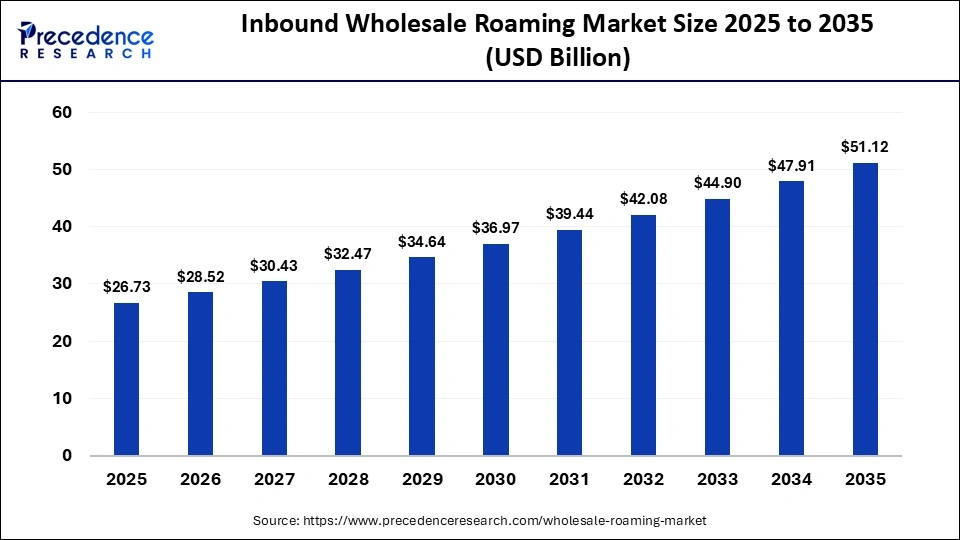
The global inbound wholesale roaming market size was calculated at USD 26.73 billion in 2025 and is predicted to increase from USD 28.52 billion in 2026 to approximately USD 51.12 billion by 2035, expanding at a CAGR of 6.70% from 2026 to 2035. As wholesale roaming continues to expand globally, the mobile communications sector has been significantly influenced by increased international travel, the rising number of IoT devices that require worldwide connectivity, and the global rollout of 5G networks. This evolution has contributed to the development of a vibrant telecommunications ecosystem.
Key Takeaways
- North America dominated the global market in 2025.
- Europe is expected to be the fastest-growing region over the forecast period.
- By type of services, the data roaming segment held a dominant position in the market in 2025.
- By type of services, the voice roaming segment is expected to grow rapidly in the forecast period.
- By end-user, the mobile network operators (MNOs) segment held the largest revenue share of the market in 2025.
- By end-user, the mobile virtual network operators (MVNOs) segment is expected to be the fastest-growing segment in the market in the coming years.
- By technology, the 4G segment contributed the biggest market share in 2025.
- By technology, the 5G segment is expected to expand rapidly over the forecast period of 2026 to 2035.
What is the Inbound Wholesale Roaming Market?
The wholesale roaming sector includes agreements established among telecom operators to guarantee uninterrupted connectivity for mobile users while they are abroad. In this collaboration, operators work together on aspects such as network access, billing systems, and technical support to deliver a smooth experience for end-users. Generally, these contracts cover services, such as voice calls, SMS messaging, and mobile internet access. Transactions are managed on a wholesale basis regarding pricing and settlement. Essential elements of the wholesale roaming structure include overseeing inter-operator billing processes, preventing fraud, optimizing networks, and maintaining regulatory compliance.
To succeed in this swiftly changing market environment, service providers are investing to improve network coverage capabilities, minimize latency issues, and refine cost structures. Developments in 4G and 5G technologies, coupled with the rapid integration of eSIMs and cloud-driven roaming solutions, are transforming market dynamics by providing scalable and efficient high-performance roaming alternatives. Additionally, globalization has stimulated cross-border business operations while escalating international travel demands that require dependable roaming services. This persistent demand is prompting mobile operators to adopt wholesale roaming strategies designed to enhance customer satisfaction alongside revenue growth.
Impact of AI in the Inbound Wholesale Roaming Market
The market is leaning toward more integrated and machine learning (ML)-supported roaming platforms, which use cloud infrastructure and the automation of analytics. In the world of mobile, AI is key to helping operators predict future roaming traffic. AI is capable of predicting the future demand for mobile roaming services using historical usage data, market trends, and travel patterns of the world, and operators can make informed decisions about capacity, pricing, and service collaboration.
Customer support is another space where AI's prowess is already tangible. However, details of international roaming can have real-time user support problems regarding billing variances, network setup, service outages, etc., where a user can help with various billing, network setups, interruption etc. AI chatbots have already been trained to handle many customer tasks in real time reduce the load of support staff.
Currently, telecommunication companies use manual procedures for controlling roaming traffic flows from a distance. However, with self-organizing networks (SON) and ML, AI can automatically enhance network performance, which means users experience near-negligible delays and congestion while travelling around the globe.
Trends Influencing the Inbound Wholesale Roaming Market
- 5G Roaming Changes the Way We Connect on Global Connectivity: In addition to speed metrics, 5G Standalone (SA) roaming is reimagining wholesale connectivity. Inbound traffic is also moving on fully cloud-native cores, with differentiated service tiers, guaranteed SLAs, and low-latency slices. For carriers, it's not just upgrade hype; it's a real revenue generator that consumers are finally willing to pay for.
- eSIM Fosters Seamless International Access: As eSIM profiles can now be downloaded on demand, inbound roaming is no longer reliant on physical SIM swaps or cumbersome activations. Both global travelers and IoT fleets can switch networks in the wild, thereby minimizing churn and increasing utilization. This transition greatly stretches roaming footprints and leads to shorter operator and partner onboarding lead times.
- IoT Roaming Unlocks Exponential Data Growth: Wholesale roaming is not just limited to phones these days; however, as connected devices spread across borders, industrial IoT, automotive telematics, and logistics sensors now generate consistent and high-volume traffic flows. As connected devices spread into many countries and more products are shipped through the country, carriers come up with custom roaming packs tailored for service availability, data robustness, and internet work flexibility in mission-critical use cases, such as carrier roaming bundles, especially as they are focused on the availability of service, the durability of data, and cross-system interoperability in mission-critical deployments.
Market Scope
| Report Coverage | Details |
| Market Size in 2025 | USD 26.73 Billion |
| Market Size in 2026 | USD 28.52 Billion |
| Market Size by 2035 | USD 51.12 Billion |
| Market Growth Rate from 2026 to 2035 | CAGR of 6.70% |
| Dominating Region | North America |
| Fastest Growing Region | Europe |
| Base Year | 2025 |
| Forecast Period | 2026 to 2035 |
| Segments Covered | Type of Services, End-User, Technology, and region |
| Regions Covered | North America, Europe, Asia-Pacific, Latin America, and Middle East & Africa |
Segmental Insights
Type of Services Insights
Why Did the Data Roaming Segment Dominate the Inbound Wholesale Roaming Market?
The data roaming segment dominated the market in 2025. This growth can be attributed to increased mobile data usage, the introduction of video streaming apps, and the increased use of cloud-based solutions during travel. Gigabytes/minute travel is much more common with the travel-users, driving wholesale partners to provide better data pricing and real-time traffic. Because the number of smartphones and connected devices rapidly grows, carriers rely on data roaming to improve their ARPU and to record current mobile behavior.
The voice roaming segment is expected to grow at the fastest CAGR in the market between 2026 and 2035, as the penetration rate with Voice over LTE (VoLTE) technology is on the rise, and call quality is enhanced by various 5G networks due to business travel on a global scale. Additionally, it is the most important connectivity service for travelers and employee members of enterprises that cross over borders, which will be further enhanced by data pricing that is high or coverage limitations. Even though per-minute rates have been declining, inbound voice volumes stand as a solid base for wholesale carriers and MNOs negotiating complex interconnect deals.
End-User Insights
Which End-User Segment Led the Inbound Wholesale Roaming Market?
The mobile network operators (MNOs) segment led the market in 2025, as MNOs directly control local spectrum, network coverage, and interconnect agreements, and thus have a monopoly on that market. Operators are in a stage where they generate data for network services, thus they have control over the future of NMT platforms. Without MNOs' involvement, there's no inbound roaming. As travel recovers and network virtualization accelerates, MNOs are shifting wholesale strategies towards data-centric pricing coupled with QoS guarantees.
The mobile virtual network operators (MVNOs) segment is expected to expand rapidly in the market in the coming years. As host networks are a cost-free solution, there is also the opportunity for extremely competitive retail and international roaming bundles. Whole roaming coverage allows MVNOs to offer retail roaming to their subscribers. Wholesale partners take advantage of volume aggregation, while subscribers enjoy pricing flexibility. MVNOs are leading the way in roaming diversification, particularly with the younger generation and budget travelers.
Technology Insights
How the 4G Segment Dominated the Inbound Wholesale Roaming Market?
The 4G segment accounted for the highest market share in 2025, due to wide access and consistent voice, messaging, and data throughput enabled by 4G. Inbound roaming on 4G is still the default service in the majority of markets, as travelers and M2M devices continue to utilize this mature technology. 4G networks can handle large volumes of cellular devices and cater to data-intensive internet activities like high-definition video streaming. They also improve performance in crowded areas.
The 5G segment is expected to witness the fastest growth in the market over the forecast period. Growth comes from enabling 5G infrastructure, increasing 5G-capable devices availability, and ultra-low latency applications for enterprise and IoT customers. It also opens massive throughput, low latency, and various levels of service. Operators are scrambling to layer up 5G roaming into IPX and cloud cores under the assumption that future roaming will be more directed towards high-data use cases, immersion-based services, and autonomous IoT.
Regional Insights
Why North America Dominated the Inbound Wholesale Roaming Market?
North America held a major market share in 2025. The region combines a mature telecom infrastructure with high inbound travel demand and strong global carrier partnerships. Given the region's deep 4G and expanding 5G footprints, it is attractive for international subscribers and MVNO traffic partners, ensuring carriers capture broad volumes of cross-border data, voice, and messaging. The U.S. and Canada are also leading markets with their centers focused on international work and tourism, and on enterprise IoT fleets that depend on constant roaming coverage. North America's wholesale carriers have developed strong interconnect frameworks and provided steady revenue streams even as retail pricing shifts.
U.S. Market Trends
The U.S. holds the largest regional share in North America, which hosts one of the largest numbers of international travelers and enterprise travelers in the world. Its sophisticated telecom backbone and early 5G commercialization deliver inbound subscribers reliable, high-speed connectivity from when they land. Robust wholesale arrangements between Tier-1 operators and global carriers allow a predictable incoming level of roaming traffic. As far as inbound roaming in North America is concerned, strong data usage and extensive LTE and 5G coverage, and a strong IPX infrastructure make the U.S. the region's largest revenue generation center, particularly in the business/high spending tourist segments.
Why is Asia-Pacific Expected to Grow Rapidly in the Inbound Wholesale Roaming Market?
Asia-Pacific is expected to host the fastest-growing market in the coming years. Cross-border travel, digital consumption, and 5G expansion are accelerating simultaneously across major economies. The region blends tourism heavyweights with manufacturing powerhouses, creating constant mobility flows that naturally inflate roaming traffic volumes year after year.
Countries such as China, Japan, South Korea, Singapore, Thailand, and Australia are witnessing rising inbound business travel and leisure tourism, both of which translate into higher data-centric roaming usage. The surge in IoT deployments from logistics tracking to connected automotive is quietly amplifying wholesale roaming demand beyond smartphones, giving Asia-Pacific a growth trajectory that outpaces mature Western markets.
China Market Trends
China is growing at a fast pace in the market due to increased cross-border traffic and the development of economic corridors, with the rapid rollout of 5G Standalone. Data-intensive and data-driven, the digital ecosystem in the country naturally helps expand inbound roaming consumption. Widespread investment in infrastructure and growing enterprise mobility, through manufacturing, logistics, and trade partners, is increasing wholesale roaming. As incoming tourism returns and IoT connectivity grows, China sees a substantial increase in roaming data traffic, and its position as the growth factor in the Asia-Pacific becomes clear.
Inbound Wholesale Roaming Market Companies
- Vodafone Group Plc
- Tata Communications
- Syniverse
- AT&T Inc.
- Deutsche Telekom AG
- Orange S.A.
- Telefónica S.A.
- T-Mobile US Inc.
- BT Group plc
- NTT Group
- China Mobile Ltd.
- Verizon Communications Inc.
- Comcast Corporation
Recent Developments
- In August 2025, Ncell, a Nepalese telco, announced the expansion of its Voice over Long-Term Evolution (VoLTE) international roaming service to include outbound travelers. The company now offers both inbound and outbound VoLTE roaming for its customers, enabling them to experience HD voice calls and high-speed data services when traveling abroad.
- In February 2025, telecom players across the Gulf region started adjusting their roaming strategies to enhance the quality of service for inbound roamers. As roaming surged in destinations like the U.A.E., Saudi Arabia, Kuwait, and Qatar, operators began revising agreements, introducing tiered speed-based tariffs, and reducing speed caps that previously throttled performance for international visitors
Segments Covered in the Report
By Type of Services
- Voice Roaming
- Data Roaming
- Messaging Roaming
- Enterprise Roaming
- Wholesale Roaming
By End-User
- Mobile Network Operators (MNOs)
- Mobile Virtual Network Operators (MVNOs)
- Telecom Service Providers
- Enterprises
- Retail Customers
By Technology
- 2G
- 3G
- 4G
- 5G
- Wi-Fi Offloading
By Region
- North America
- Europe
- Asia-Pacific
- Latin America
- Middle East & Africa
For inquiries regarding discounts, bulk purchases, or customization requests, please contact us at sales@precedenceresearch.com
Frequently Asked Questions





Ask For Sample
No cookie-cutter, only authentic analysis – take the 1st step to become a Precedence Research client
 Get a Sample




 sales@precedenceresearch.com
 Schedule a Meeting
