



India Bottling Machinery Market Trends, Leading Companies, Company Revenue / Sales Performance, Production Capacity, Equipment Utilization, Pricing Analysis, Distribution Performance, Competitive Landscape, and Demand Forecast
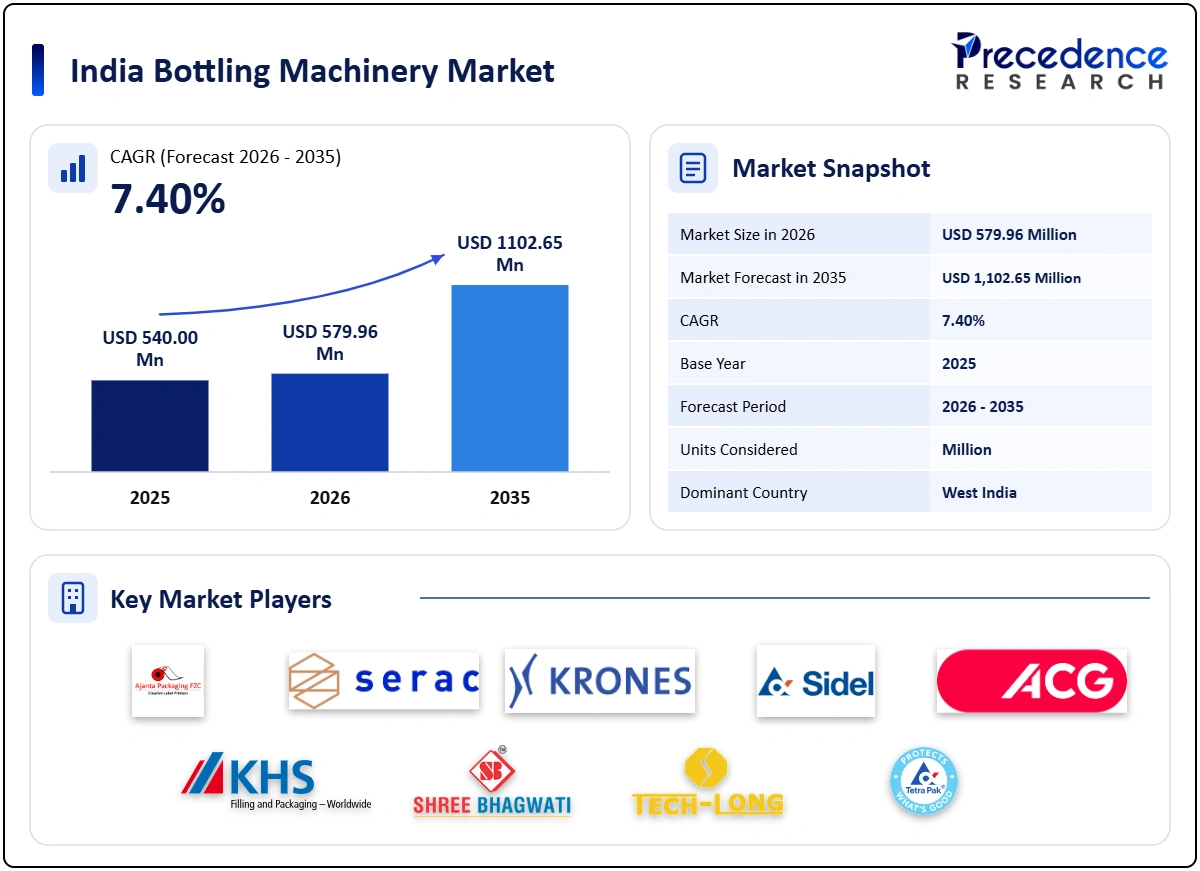
Laxmi Narayan, who specializes in the machinery and equipment industry, assesses the India bottling machinery market at USD 579.96 million in 2026 and expects it to reach USD 1,102.65 million by 2035, expanding at a CAGR of 7.40%. India bottling machinery market companies including Krones, KHS, Sidel, Tetra Pak, Shree Bhagwati Machtech remain prominent players, with demand concentrated across segments such as machine type, automation , end use and region.
Source: https://www.precedenceresearch.com/india-bottling-machinery-market
 Get a Sample
 Table Of Content


Key Takeaways
Market Size & Growth Outlook
- Market size in 2025: USD 540.00 million
- Estimated market size in 2026: USD 579.96 million
- Projected market size by 2035: USD 1,102.65 million
- CAGR (2026-2035): 7.40%
Regional Market Spotlight
- In 2025, West India dominated the market with a 33.00% share.
- North India held a 28.00% share in 2025 and is estimated to be the fastest-growing region, at a CAGR of 8.38% from 2026 to 2035.
- South India accounted for 27.00% of the market share in 2025.
Segmental Highlights
- By machine type, filling & capping accounted for the largest share of 38.00% in 2025.
- Automatic contributed 71.00% market share in 2025, and it is positioned as a leading automation segment.
- In 2025, soft drinks & juices represented the largest end use category, holding 33.00% of the market.
India Bottling Machinery Market Size, 2025-2035 (USD Million)
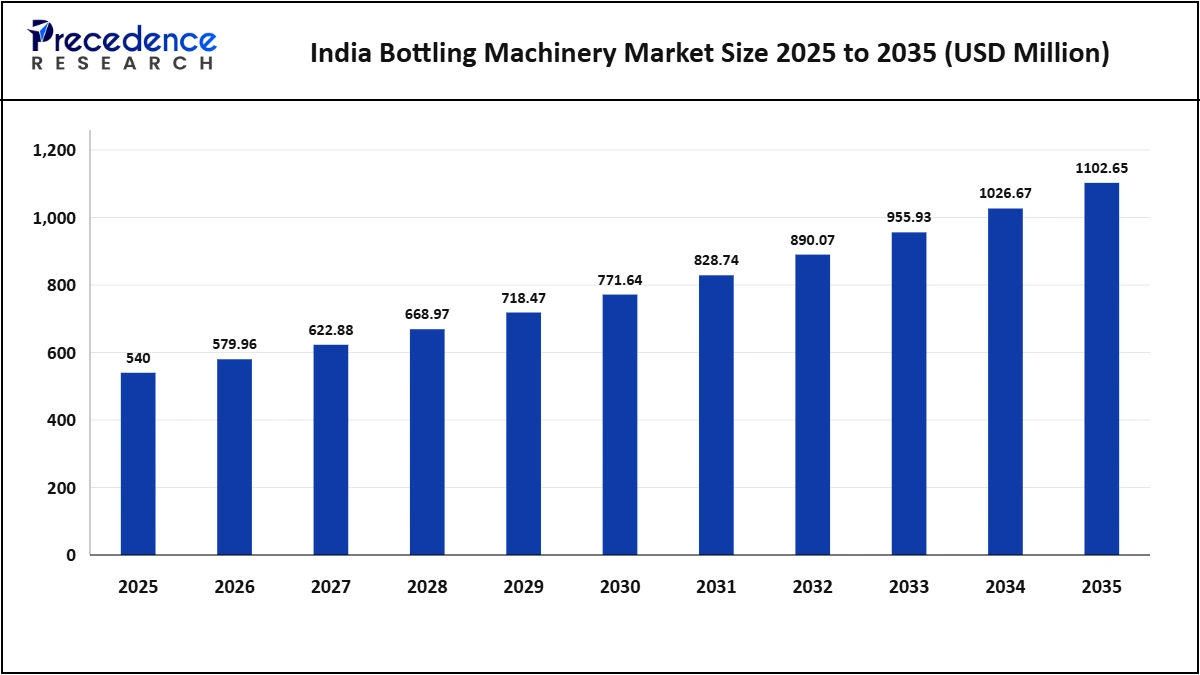
Note: 2025 is the base year; 2026-2035 values are forecasts.
Sources: Expert interviews, secondary sources, Precedence Research database, and Precedence Research analysts.
The India bottling machinery market is projected to grow from USD 540.00 million in 2025 to USD 1,102.65 million by 2035 as beverage, water, and dairy consumption continues to rise and bottlers add high-speed PET lines. Beverage growth and bottler investment support strong growth, lifting the market to USD 771.64 million by 2030 and sustaining a 7.40% CAGR from 2026 to 2035.
Analyst View: We expect the India bottling machinery market to grow steadily, driven by rising beverage, packaged water, and dairy consumption and investments in high-speed, automated PET bottling lines. Increasing demand for production efficiency, packaging quality, and flexible filling solutions will support machinery upgrades across end-use industries.
Market Trends
- High-speed PET lines: Bottlers install integrated blocks to increase production speeds and reduce downtime.
- Local manufacturing: Global machinery manufacturers expand domestic manufacturing to strengthen supply chains.
- Lightweight PET: Lighter bottles reduce resin consumption, packaging costs, and material waste, encouraging investments in machinery capable of handling lightweight containers.
- Aseptic filling: Juice and dairy producers adopt aseptic filling lines to extend shelf life, preserve product quality, and reduce reliance on preservatives.
- rPET: Recycled PET regulations and sustainability commitments influence bottle design, driving demand for compatible machinery.
Market Dynamics
The India bottling machinery market is growing with beverage, water, and dairy demand. Franchise bottlers are installing high-speed PET lines, and global manufacturers such as Krones and KHS are building local plants.
Drivers
Rising beverage consumption
Rising disposable incomes and high temperatures are driving increased consumption of carbonated soft drinks, juices, and packaged water.
Franchise bottler expansion
Coca-Cola and PepsiCo franchise bottlers are investing in new production facilities and bottling lines to expand capacity and meet growing beverage demand.
Packaged water demand
Growing concerns about drinking water quality and safety are increasing demand for packaged water, encouraging investments in bottling capacity.
Dairy and pharma capacity
Dairy and pharmaceutical manufacturers are expanding liquid processing and filling capacities to meet rising demand for packaged products.
Market Drivers - Impact & CAGR Contribution (2026-2035)
| Driver | Impact | ≈ CAGR Contribution | Time Horizon | Key Regions |
| Rising beverage consumption | High | +2.89 pp | Short to long term | All covered regions, strongest in West India |
| Franchise bottler expansion | Medium | +2.44 pp | Medium to long term | All covered regions, fastest uptake in North India |
| Packaged water demand | Medium | +2.08 pp | Short to medium term | All covered regions |
| Dairy and pharma capacity | Low | +1.63 pp | Long term | West India and North India |
Note: Contributions are indicative estimates of each factor's effect on annual growth.
Sources: Expert interviews, secondary sources, Precedence Research database, and Precedence Research analysts.
Rising beverage consumption, bottler expansion, and packaged water demand drive most growth in the India bottling machinery market.
Restraints
High capital cost
Small and medium-sized bottlers are less likely to use high-speed bottling lines due to their high upfront costs, especially when it comes to imported equipment.
Seasonality
Uneven production volumes and machinery use throughout the year are caused by seasonal variations in beverage consumption, especially higher demand during the summer.
Plastic regulation
Plastic packaging regulations and extended producer responsibility (EPR) requirements increase compliance costs and create additional operational challenges for bottlers.
Market Restraints - Impact & Negative CAGR Contribution (2026-2035)
| Restraint | Impact | ≈ Negative CAGR Contribution | Time Horizon | Key Regions |
| High capital cost | High | -0.73 pp | Short to medium term | All covered regions |
| Seasonality | High | -0.54 pp | Medium term | Smaller and price-sensitive markets |
| Plastic regulation | Medium | -0.36 pp | Short term | West India and other mature markets |
Note: Contributions are indicative estimates of each factor's effect on annual growth.
Sources: Expert interviews, secondary sources, Precedence Research database, and Precedence Research analysts.
High capital cost is the main restraint, followed by seasonality and plastic regulation in the India bottling machinery market.
Opportunities
Rural and tier-2 markets
Expanding beverage and packaged water distribution in rural areas and tier-2 cities is creating opportunities for bottling machinery manufacturers to supply cost-effective and flexible production lines.
rPET-ready lines
Demand for bottling lines that can handle recycled PET materials is being driven by the growing use of recycled PET packaging and sustainability regulations.
Export of Indian-made machines
Indian machinery manufacturers can leverage competitive production costs and growing regional demand to expand exports to emerging markets across Africa and Asia.
India Bottling Machinery Market Segmentation: 2025 Share and Size
India Bottling Machinery Market by Machine Type, 2025-2035 Share (%)
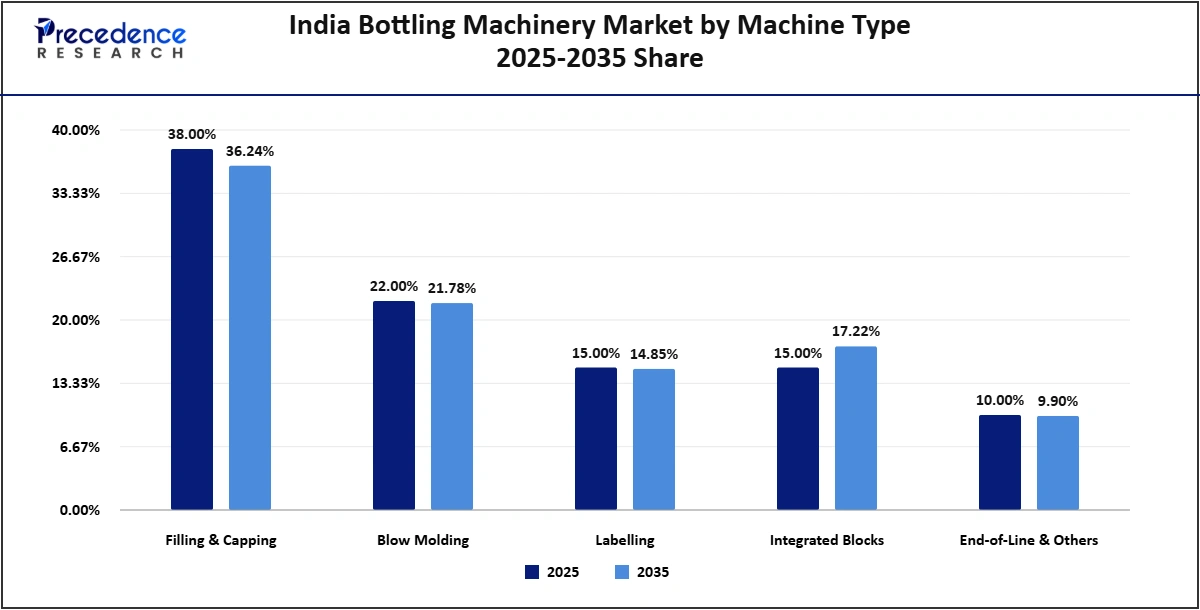
Note: 2025 is the base year; 2035 shares and CAGRs are forecasts.
Sources: Expert interviews, secondary sources, Precedence Research database, and Precedence Research analysts.
Filling and capping machines lead because they are the core of every bottling line. Integrated blow-fill-cap blocks grow fastest as Coca-Cola and PepsiCo bottlers install high-speed PET lines.
Filling & Capping: By machine type, this segment held the dominant position in the market, capturing 38% of revenue in 2025, with projected growth at a CAGR of 6.89% from 2026 to 2035. Filling and capping dominate due to their essential role in every bottling line, as filling and capping operations are required across beverage, dairy, and water.
Blow Molding: In 2025, the segment represented 22.00% of the market share and is expected to achieve a CAGR of 7.29% over the forecast period. Increasing adoption of PET bottles across beverage, packaged water, and edible oil applications is driving demand for blow molding equipment.
Labelling: The segment held a substantial 15.00% share of the market in 2025, with growth projected at a 7.29% CAGR through 2035. Growing demand for product differentiation, brand visibility, and regulatory-compliant packaging is supporting investments in automated labelling machines.
Integrated Blocks: With a market contribution of 15.00% in 2025, the segment is expected to witness sustained expansion at a CAGR of 8.89% from 2026 to 2035. Integrated blocks are growing fastest due to rising demand for compact, integrated production lines that combine blowing, filling, and capping, reducing floor space and labor requirements.
End-of-Line & Others: Representing 10.00% of the market in 2025, end-of-line & others are forecast to maintain steady growth at a CAGR of 7.29% over the forecast period. Rising automation of secondary packaging and palletizing operations is encouraging bottlers to invest in shrink wrappers.
India Bottling Machinery Market by Automation, 2025-2035 Share (%)
| Segments | 2025 Share | 2035 Share | CAGR 2026-2035 |
| Automatic | 71.00% | 72.88% | 7.68% |
| Semi-Automatic | 29.00% | 27.12% | 6.68% |
Note: 2025 is the base year; 2035 shares and CAGRs are forecasts.
Sources: Expert interviews, secondary sources, Precedence Research database, and Precedence Research analysts.
Automatic machines lead because large bottlers need high speed and hygiene. Semi-automatic machines remain common among small water and edible oil packers.
Automatic: The segment captured 71.00% of the total market in 2025 and is anticipated to register a CAGR of 7.86% between 2026 and 2035. Automatic machines lead due to their higher production speeds, consistent output, lower labor dependency, and ability to meet the growing demand for large-scale bottling operations.
Semi-Automatic: Holding a 29.00% market share in 2025, semi-automatic is expected to expand at a CAGR of 6.68% during the forecast period. Semi-automatic machines are gaining demand among small and medium-sized bottlers due to their lower upfront costs, operational flexibility, and suitability for smaller production volumes.
India Bottling Machinery Market by End Use, 2025-2035 Share (%)
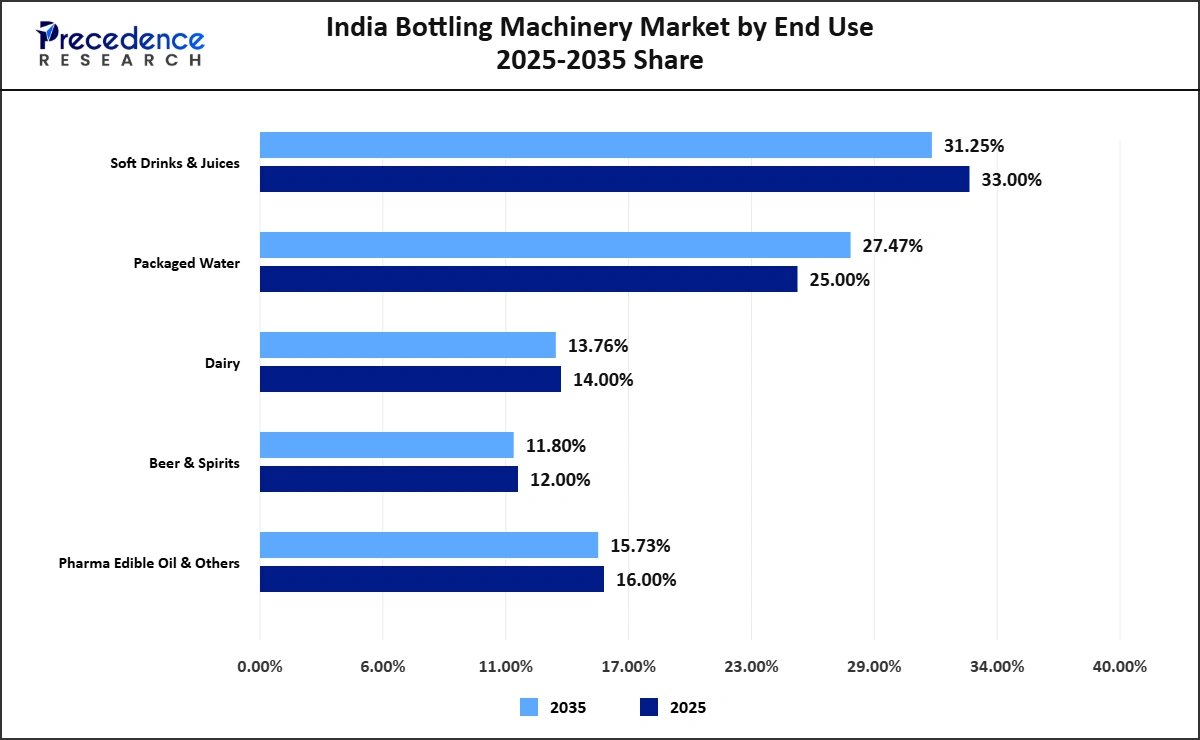
Note: 2025 is the base year; 2035 shares and CAGRs are forecasts.
Sources: Expert interviews, secondary sources, Precedence Research database, and Precedence Research analysts.
Carbonated soft drinks and juices lead because of large franchise bottler investments. Packaged water grows fastest as bottled water demand rises in cities and small towns.
Soft Drinks & Juices: This segment represented the largest share of the market, accounting for 33% of revenue in 2025, and is expected to grow at a CAGR of 6.82% from 2026 to 2035. The soft drinks and juices segment leads due to high and widespread consumption of carbonated drinks, packaged juices, and ready-to-drink beverages, driving continuous demand for large-scale bottling capacity.
Packaged Water: This segment accounted for 25.00% of the market in 2025 and is projected to grow at a CAGR of 8.42% through 2035. Rising concerns over drinking water quality, expanding distribution networks, and increasing consumption of bottled water are driving investments in high-capacity and automated bottling lines.
Dairy: Holding a 14.00% market share in 2025, this segment is expected to expand at a CAGR of 7.22% during the forecast period. Dairy is growing because of rising demand for packaged milk, flavored dairy drinks, and value-added dairy products.
Beer & Spirits: Capturing 12.00% of the market in 2025, this segment is forecast to maintain steady growth at a CAGR of 7.22% over the forecast period. Increasing consumption of alcoholic beverages and investments in modern brewing and bottling facilities are supporting demand for advanced bottling machinery.
Pharma, Edible Oil & Others: The segment held a substantial 16.00% share of the market in 2025, with growth projected at a 7.22% CAGR between 2026 and 2035. Growing demand for packaged pharmaceuticals, edible oils, and personal care products is driving investments in hygienic, precise, and efficient liquid filling.
Analyst View: Filling & capping will remain the dominant machine type, while integrated blocks will grow fastest as bottlers prioritize compact and efficient production lines. Because they demand less labor and have a better throughput, automatic systems will continue to lead. Packaged water will grow at the fastest rate due to increased consumption and increases in bottling capacity, but soft drinks & juices will continue to be the largest end use segment.
Country Analysis
Table: India Bottling Machinery Market by Country, 2025-2035 Share (%)
| Country | 2025 Share | 2035 Share | CAGR 2026-2035 |
| West India | 33.00% | 31.14% | 6.78% |
| North India | 28.00% | 30.66% | 8.38% |
| South India | 27.00% | 26.45% | 7.18% |
| East & Northeast India | 12.00% | 11.75% | 7.18% |
Note: 2025 is the base year; 2035 shares and CAGRs are forecasts.
Sources: Expert interviews, secondary sources, Precedence Research database, and Precedence Research analysts.
West India leads because it is concentrated with beverage, dairy, and pharmaceutical plants. North India grows fastest as franchise bottlers add capacity for large populous states.
Regional Insights
West India: In 2025, the region represented 33.00% of the overall market and is expected to achieve a CAGR of 6.78% over the 2026-2035 period. West India leads due to its strong concentration of beverage, dairy, and pharmaceutical manufacturing facilities, established industrial infrastructure, and presence of major bottling machinery manufacturers.
North India: The region's market share stood at 28.00% in 2025, while its growth trajectory is expected to reflect a CAGR of 8.38% during 2026-2035. Rapid expansion of beverage and packaged water production capacity, and investments in new bottling facilities across Uttar Pradesh, Haryana, and Punjab are driving the region's fastest growth.
South India: This region held 27% of revenue in 2025, with growth projected at a CAGR of 7.18% through 2035. Expanding beverage and pharmaceutical manufacturing capacity, rising packaged beverage consumption, and investments in domestic machinery production are supporting regional market growth.
East & Northeast India: The region captured 12.00% of the total market in 2025 and is anticipated to register a CAGR of 7.18% between 2026 and 2035. Increasing penetration of packaged beverages and water, alongside new bottling facility investments, is driving demand for bottling machinery across emerging regional markets.
Analyst View: Because of its well-established industrial foundation and concentration of beverage, dairy, and pharmaceutical industries, West India will continue to be the biggest market. While South and East India would gain from rising beverage consumption and new manufacturing investments, North India is predicted to develop at the fastest rate due to increased bottling capacity and packaged water demand.
Competitive Landscape
Top 10 Companies in the India Bottling Machinery Market, 2025
| Rank | Company Name | 2025 Share (%) | Key Products / Business | Headquarters |
| 1 | Krones | 18.00% | Filling, blow molding, and complete lines | Germany |
| 2 | KHS | 12.00% | PET and glass lines | Germany |
| 3 | Sidel | 10.00% | PET blow molding and filling | France |
| 4 | Tetra Pak | 6.00% | Aseptic filling | Switzerland |
| 5 | Shree Bhagwati Machtech | 4.00% | Water and beverage lines | India |
| 6 | Tech-Long | 3.00% | PET blow-fill-cap lines | China |
| 7 | SMI | 3.00% | Blow molders and end-of-line | Italy |
| 8 | Serac | 2.00% | Filling for dairy and edible oil | France |
| 9 | ACG | 2.00% | Pharma packaging machinery | India |
| 10 | Ajanta Packaging Machinery | 2.00% | Labelling machines | India |
Note: Company shares are 2025 estimates.
Sources: Company press releases, expert interviews, secondary sources, Precedence Research database, and Precedence Research analysts.
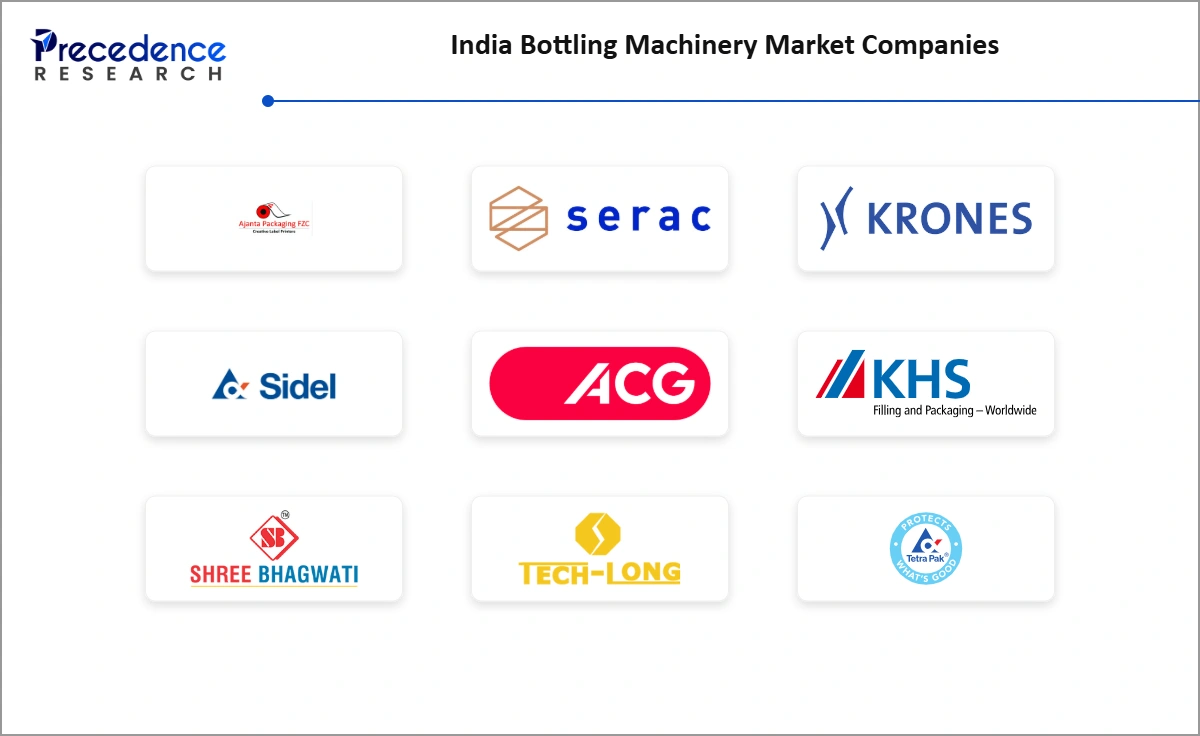
Krones led the India bottling machinery market with an 18.00% share of 2025 revenue, followed by KHS at 12.00% share and Sidel at 10.00% share. Krones leads with filling, blow molding, and complete lines; KHS competes with PET and glass lines; and Sidel offers PET blow molding and filling. Tetra Pak, Shree Bhagwati Machtech, Tech-Long, SMI, Serac, ACG, and Ajanta Packaging Machinery compete through aseptic filling, water and beverage lines, PET blow-fill-cap lines, blow molders and end-of-line filling for dairy and edible oil, pharma packaging machinery and labelling machines.
The top 10 companies accounted for an estimated 62.00% of 2025 revenue, while the remaining 38.00% was shared among many local machine builders and integrators. The India bottling machinery market is fragmented, and competition centers on line speed, price, local service, spare parts, energy efficiency, and financing for bottlers.
Company Snapshots
Krones: Headquartered in Germany, Krones held 18.00% of the India bottling machinery market in 2025, built largely on filling, blow molding, and complete lines. The Precedence Research Companies Quadrant places it as a Leader.
KHS: KHS competes mainly through PET and glass lines. From its base in Germany, it captured 12.00% of 2025 revenue and is rated a Leader in the Precedence Research Companies Quadrant.
Sidel: With 10.00% of the market in 2025, Sidel draws on PET blow molding and filling. The company is based in France and appears as a Leader in the Precedence Research Companies Quadrant.
Tetra Pak: Based in Switzerland, it accounted for an estimated 6.00% share in 2025. Its aseptic filling keeps it in the Leader group of the Precedence Research Companies Quadrant.
Shree Bhagwati Machtech: Capturing a 4.00% share in 2025 makes Shree Bhagwati Machtech a notable participant in the India bottling machinery market. It is headquartered in India, focuses on water and beverage lines, and is classed as a Leader in the Precedence Research Companies Quadrant.
Tech-Long: Subsidiary of Guangzhou Tech-Long Packaging Machinery Co., Ltd., built its estimated 3.00% position in the India bottling machinery market around PET blow-fill-cap lines. Headquartered in China, it is shown as a Leader in the Precedence Research Companies Quadrant.
SMI: Most of SMI's presence in this market comes from blow molders and end-of-line. The company is headquartered in Italy, held 3.00% of 2025 revenue, and is rated an Innovator in the Precedence Research Companies Quadrant.
Serac: Accounted for a 2.00% share of the India bottling machinery market. Its range is built around filling for dairy and edible oil, and the company, based in France, is placed as an Innovator in the Precedence Research Companies Quadrant.
ACG: Operating from India, ACG offers pharma packaging machinery. That portfolio gave it 2.00% of the market share in 2025 and a position as an Innovator in the Precedence Research Companies Quadrant.
Ajanta Packaging Machinery: With 2.00% of 2025 revenue in the India bottling machinery market went to Ajanta Packaging Machinery, whose business here centers on labelling machines. The company is headquartered in India, and the Precedence Research Companies Quadrant rates it as an Innovator.
Companies Ecosystem
The India bottling machinery ecosystem links component suppliers, machine makers, integrators & service, bottlers & brand owners, and regulators, with each stage adding value before products reach end users. Bottlers also invest in smart packaging codes, warehouse automation, and recycled plastic bottles.
India Bottling Machinery Market Ecosystem
| Ecosystem Stage | Role in the Market | Key Companies |
| Component Suppliers | Supply drives, sensors, and molds | Siemens, Festo, local suppliers |
| Machine Makers | Build machines and lines | Krones, KHS, Sidel, Indian makers |
| Integrators & Service | Install and maintain | Local integrators |
| Bottlers & Brand Owners | Buy and run lines | HCCB, Varun Beverages, SLMG, Amul |
| Regulators | Set standards | FSSAI, BIS, CDSCO |
Sources: Company press releases, expert interviews, secondary sources, Precedence Research database, and Precedence Research analysts.
Component Suppliers: Components affect reliability.
Machine Makers: Global makers are localizing production.
Integrators & Service: Service networks are key for uptime.
Bottlers & Brand Owners: Franchise bottlers make large investments.
Regulators: Food and pharma rules shape hygiene.
Value in the India bottling machinery market flows from upstream material and technology suppliers to manufacturers and service providers, then through distribution partners to end users. Companies that integrate several stages or build long-term relationships with end users capture a larger share of this value.
Precedence Research Companies Quadrant
The Precedence Research Companies Quadrant positions key participants in the India bottling machinery market by market strength, reflecting revenue scale, market share and geographic reach, and by innovation and growth strategy, reflecting product portfolio breadth, R&D intensity and partnerships. Positions reflect each company's estimated 2025 share of the India bottling machinery market and our assessment of its product innovation, portfolio breadth and partnerships.
Sources: Company press releases, expert interviews, secondary sources, Precedence Research database, and Precedence Research analysts.
Leaders: Krones, KHS, Sidel, Tetra Pak, Shree Bhagwati Machtech, and Tech-Long combine high market share with broad portfolios and strong innovation.
Innovators: SMI, Serac, ACG, and Ajanta Packaging Machinery bring newer technologies and specialized products.
Recent Developments
- November 2025: SLMG Beverages expanded PET bottling capacity at its Chhata facility in Uttar Pradesh by 35% through the installation of a KHS InnoPET TriBlock line, capable of processing up to 48,000 bottles per hour.
- August 2026: Krones officially opened its new filling and packaging machinery plant at Vemagal near Bengaluru, India, with an investment of INR 315 crore to strengthen local production and serve India's growing beverage and packaging market.
India Bottling Machinery Market Segments
By Machine Type
- Filling & Capping
- Blow Molding
- Labelling
- Integrated Blocks
- End-of-Line & Others
By Automation
- Automatic
- Semi-Automatic
By End Use
- Soft Drinks & Juices
- Packaged Water
- Dairy
- Beer & Spirits
- Pharma, Edible Oil & Others
By Region
- West India (Maharashtra, Gujarat, Goa)
- North India (Uttar Pradesh, Haryana, Punjab, Delhi, Rajasthan)
- South India (Karnataka, Tamil Nadu, Telangana, Andhra Pradesh, Kerala)
- East & Northeast India (Bihar, Odisha, West Bengal, Assam)
Research Methodology: The India bottling machinery market was defined as bottling machinery sold in India, including rinsing, filling and capping machines, stretch blow molders, labelling machines, integrated blow-fill-cap blocks, aseptic filling systems and end-of-line packaging, in automatic and semi-automatic configurations, for bottled water, carbonated soft drinks, juices, dairy, beer and spirits, edible oil, pharmaceuticals and personal care. The 2025 base year was built bottom-up from demand volumes and average prices by machine type, automation, end use and region, and checked top-down against the market-specific revenues of leading companies and public industry data. Segment, regional and company values were allocated from machine type, automation and end use and region demand. Key estimates were verified by cross-checking company disclosures, regulatory and industry data, and published third-party estimates, and inputs that could not be reconciled were excluded. All segment, regional, and company figures were reconciled to the same 2025 base year, and the 2026-2035 forecast, which applies a constant CAGR from the 2025 base, was recalculated and validated.
Analyst View: We expect the India bottling machinery market to expand steadily, supported by rising beverage and packaged water consumption, capacity expansion, and increasing automation across bottling facilities. The market will grow due to domestic manufacturing and the need for high-speed, integrated, and aseptic filling lines; however, expansion will be moderated by high capital costs, plastic packaging laws, and seasonal demand swings.
Sources and References
- Plastech. "KHS and SLMG Beverages: right on time". August 2026. News. (Source: plastech.pl)
- "Closer to the market: Krones opens new plant in India". August 2026. News. https://www.krones.com/en/company/press/press-releases/krones-opens-new-plant-in-india
For inquiries regarding discounts, bulk purchases, or customization requests, please contact us at sales@precedenceresearch.com
Frequently Asked Questions





Ask For Sample
No cookie-cutter, only authentic analysis – take the 1st step to become a Precedence Research client
 Get a Sample




 sales@precedenceresearch.com
 Schedule a Meeting
