



Inorganic Scintillators Market Size, Companies, Share, Production Capacity, Raw Material Pricing, Export & Import Analysis, Manufacturing Cost, Competitive Positioning, and Demand Forecast
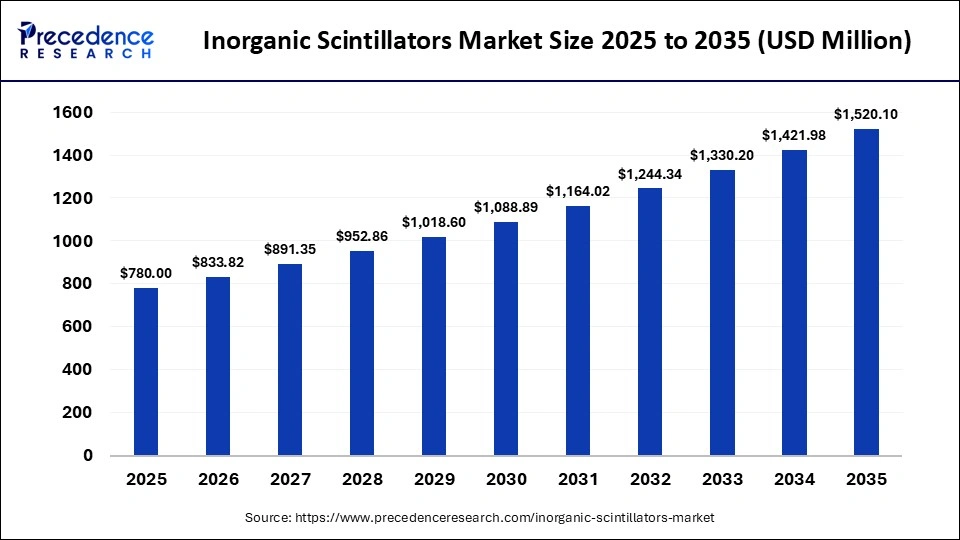
Yogesh Kulkarni, a Chemical and Materials Industry Expert, estimates the inorganic scintillators market at USD 833.82 million in 2026, with the market projected to reach USD 1,520.10 million by 2035 at a CAGR of 6.90%. Major inorganic scintillators market companies such as Saint-Gobain Crystals, Hamamatsu Photonics K.K., Hitachi Metals, Ltd., Amcrys-H Ltd are competing across key material and application segments, including By Material Type, By Application, By End-Use, By Detection Technology.
Source: https://www.precedenceresearch.com/inorganic-scintillators-market
 Get a Sample
 Table Of Content


What is the Inorganic Scintillators Market Size in 2026?
The global inorganic scintillators market size accounted for USD 780.00 million in 2025 and is predicted to increase from USD 833.82 million in 2026 to approximately USD 1,520.10 million by 2035, expanding at a CAGR of 6.90% from 2026 to 2035. The inorganic scintillators market is growing due to rising demand in medical imaging, increasing adoption in radiation detection and homeland security, and advancements in high-performance materials for improved sensitivity and accuracy.
Key Takeaways
- North America led the inorganic scintillators market, holding a 38% share in 2025.
- Asia Pacific is expected to expand at the fastest CAGR of 8.8% between 2026 and 2035.
- By material type, the sodium iodide (NaI) segment led the market with a 35% share in 2025.
- By material type, the lutetium-based scintillators (LSO/LYSO) segment is expected to grow at the fastest CAGR of about 8.5% in the upcoming period.
- By application, the medical imaging (PET, SPECT, CT) segment led the global market in 2025 with a 40% share and is expected to grow at the fastest CAGR of 7.5% between 2026 and 2035.
- By end-use, the healthcare & diagnostics segment led the global market with a 45% share in 2025 and is expected to grow at a CAGR of 7.5% in the foreseeable period.
- By detection technology, the photomultiplier tube (PMT)-based systems segment led the global market in 2025 with a 55% share.
- By detection technology, the silicon photomultiplier (SiPM)-based systems segment is expected to expand at the fastest CAGR of 9.5% between 2026 and 2035.
Inorganic Scintillators Market Overview
Scintillators are a category of substances that provide detectable photons in the visible part of the light spectrum, following the passage of a charged particle or a photon. Inorganic scintillators are a subtype of it and are usually crystals grown in high-temperature furnaces. It includes lithium iodide, sodium iodide, cesium iodide, and zinc sulfide. NaI(Tl) (thallium-doped sodium iodide) is a widely used scintillation material, generally used in instrumentation techniques in physics, particularly in nuclear and high-energy physics. Moreover, inorganic scintillators are widely used in medical imaging, where they play a key role in futuristic radiation detector technologies. These efficient and diverse applications significantly enhance their market importance.
Impact of Artificial Intelligence on the Inorganic Scintillators Market
Artificial intelligence is significantly revolutionizing the development of inorganic scintillators. It improves the design and performance of scintillators by utilizing machine learning techniques that accelerate the exploration of chemical space. AI addresses challenges associated with large datasets and significant computational expenses, providing dependable predictions for materials' linear absorption coefficients in scintillator detectors. Ongoing research is focused on developing more efficient, safer, and highly sensitive scintillators that are in line with emerging data-driven technologies.
Inorganic Scintillators Market Trends
- Emergence of Inorganic Scintillator-Based Wearable X‑Ray Detection: Emerging wearable X-ray detection technologies that utilize inorganic scintillator materials are providing flexible alternatives to traditional imaging systems. These innovations enhance detection efficiency and facilitate advanced portable solutions in contemporary medical imaging applications.
- Growing Demand for High-Performance Perovskite Nanocrystals: Inorganic perovskite nanocrystals are increasingly recognized for their exceptional light-conversion efficiency and adjustable luminescent characteristics, which are propelling advancements in high-quality X-ray imaging and improving the performance of scintillation materials.
- Expanding Use of Scintillators in Environmental Monitoring: Scintillators are being utilized more frequently to monitor water pollutants and airborne particulate matter, thereby enhancing environmental safety. They enable the effective detection of harmful substances and support the development of pollution assessment and mitigation strategies.
Market Scope
| Report Coverage | Details |
| Market Size in 2025 | USD 780.00 Million |
| Market Size in 2026 | USD 833.82 Million |
| Market Size by 2035 | USD 1,520.10 Million |
| Market Growth Rate from 2026 to 2035 | CAGR of 6.90% |
| Dominating Region | North America |
| Fastest Growing Region | Asia Pacific |
| Base Year | 2025 |
| Forecast Period | 2026 to 2035 |
| Segments Covered | Material Type, Application, End-Use, Detection Technology, and Region |
| Regions Covered | North America, Europe, Asia-Pacific, Latin America, and Middle East & Africa |
Market Dynamics
Drivers
Rising Demand in Medical Imaging
The increasing use of advanced diagnostic techniques such as CT scans, PET scans, and X-ray imaging is driving demand for inorganic scintillators. These materials play a critical role in detecting and converting radiation into visible light, enabling accurate imaging. Rising prevalence of chronic diseases and the need for early diagnosis are further accelerating their adoption in healthcare.
Increasing Need for Radiation Detection and Homeland Security
Heightened concerns around nuclear safety, border security, and radiological threats are driving the adoption of scintillation detectors. Governments and defense agencies rely on these materials for reliable radiation monitoring and threat detection.
Restraint
High Initial Cost and Performance Limitations
High initial costs associated with inorganic scintillators, including material synthesis, crystal growth, and integration into detection systems, can limit adoption, particularly among cost-sensitive end users. Additionally, certain performance limitations, such as afterglow effects, temperature sensitivity, and limited scalability, impact detection efficiency and operational reliability. These factors collectively restrain market growth by increasing total ownership costs and limiting broader application potential.
Opportunity
Advancements in High-Performance Scintillator Material
Ongoing research and development are leading to the creation of more efficient, durable, and high-sensitivity inorganic scintillator materials. Innovations such as improved crystal structures and faster response times are enhancing performance across applications. These advancements are opening new opportunities in sectors like nuclear security, high-energy physics, and next-generation medical imaging systems.
Segment Insights
Material Type Insights
Inorganic Scintillators Market Share, By Material Type, 2025-2035 (%)
| Material Type | 2025 | 2035 | CAGR (%) |
| Sodium Iodide (NaI) | 35.00% | 32.00% | 5.8% |
| Cesium Iodide (CsI) | 20.00% | 19.00% | 6.2% |
| Bismuth Germanate (BGO) | 15.00% | 14.00% | 6.0% |
| Lutetium-based Scintillators (LSO/LYSO) | 20.00% | 24.00% | 8.5% |
| Other Advanced Inorganic Scintillators | 10.00% | 11.00% | 7.2% |
The Sodium Iodide (NaI) Segment Dominated the Market With a 35% Share in 2025
The sodium iodide (NaI) segment dominated the inorganic scintillators market with about 35% share in 2025, driven by its cost-effectiveness, high light yield, and widespread use in radiation detection and medical imaging. NaI is favored for its relatively high effective atomic number and its capacity to absorb up to 90% of photons emitted by Technetium-99m. This makes sodium iodide scintillators widely utilized in gamma cameras and PET scanners for diagnostic imaging and nuclear medicine applications. In addition, it is deployed in environmental monitoring systems to measure radiation levels in surrounding ecosystems.
The lutetium-based scintillators (LSO/LYSO) segment held a 20% market share in 2025 and is anticipated to grow at the fastest CAGR of 8.5% during the forecast period. This is mainly due to their exceptional performance in PET imaging systems, where they provide enhanced resolution and quicker response times. Lutetium-based scintillators present numerous advantages over traditional scintillation materials, including high density, short decay times, and a remarkably high photon-emission rate. These characteristics render them ideal for applications requiring increased throughput, improved timing accuracy, and superior energy resolution, thereby supporting segmental growth.
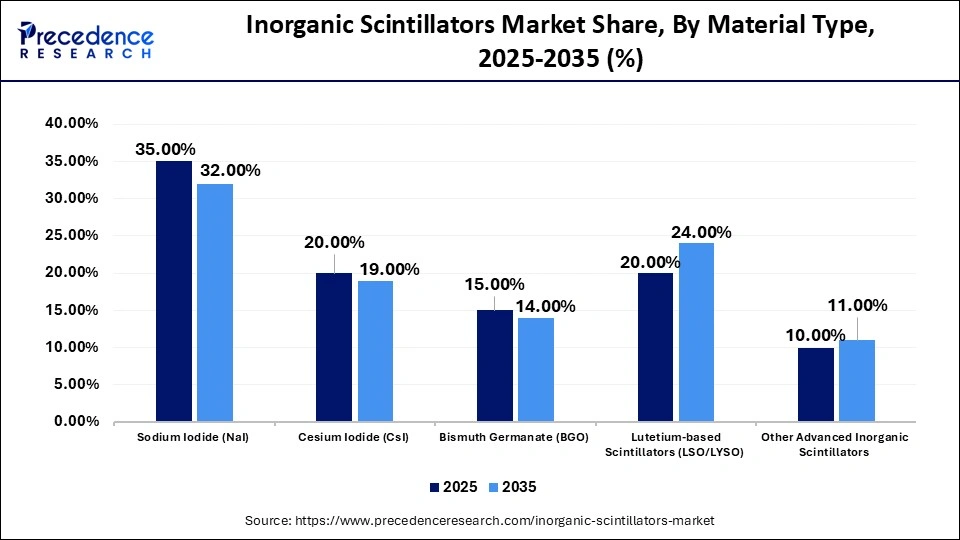
The cesium iodide (CsI) segment captured 20% share of the market in 2025 and is expected to grow at a CAGR of 6.2% in the upcoming period, driven by its durability and exceptional efficiency in gamma ray detection. CsI demonstrates excellent stopping power, is mildly hygroscopic, and possesses advantageous mechanical characteristics. Additionally, cesium iodide is extensively utilized as a scintillator material in indirect detectors for cassette-less digital imaging systems, effectively converting X-ray energy into visible light. These performance benefits and varied applications are contributing to its increased adoption.
The bismuth germanate (BGO) segment captured approximately 15% market share in 2025 and is projected to grow at a CAGR of 6% throughout the forecast period. This growth is primarily attributed to its applications in high-energy physics and medical imaging, where its high density, elevated atomic number, and exceptional stopping power render it highly effective for gamma radiation detection. BGO is a rugged, nonhygroscopic crystalline material with favorable room-temperature scintillation properties, further supporting its continued uptake in advanced detection systems.
Application Insights
Inorganic Scintillators Market Share, By Application, 2025-2035 (%)
| Application | 2025 | 2035 | CAGR (%) |
| Medical Imaging (PET, SPECT, CT) | 40.00% | 42.00% | 7.5% |
| Nuclear Power & Radiation Detection | 25.00% | 24.00% | 6.5% |
| Homeland Security & Defense | 15.00% | 14.50% | 6.0% |
| High Energy Physics Research | 10.00% | 9.50% | 6.8% |
| Oil & Gas Exploration | 10.00% | 10.00% | 6.5% |
The Medical Imaging Segment Led the Market in 2025
The medical imaging segment dominated the inorganic scintillators market with nearly 40% share in 2025 and is projected to grow at the fastest CAGR of 7.5% in the coming years. This is mainly due to the increasing demand for advanced diagnostic imaging systems and the rising prevalence of chronic diseases. Inorganic scintillators are essential for efficient, large-area radiation detection and are therefore widely used in X-ray CT (computed tomography), SPECT (single photon emission computed tomography), and PET (positron emission tomography) systems, supporting their strong adoption in medical imaging.
The nuclear power & radiation detection segment held the second-largest market share of 25% in 2025 and is anticipated to grow at a CAGR of 6.5% throughout the forecast period. This growth is largely attributed to the essential function of scintillators in nuclear power facilities and radiation monitoring systems, which are vital for safety and operational oversight. Single-crystal inorganic scintillators are especially favoured in scenarios that demand dependable radiation detection in extreme conditions, such as high radiation levels, elevated temperatures, humidity, vibrations, and monitoring within nuclear reactors. These demanding use cases are promoting the continued adoption of inorganic scintillators in the nuclear power and radiation detection market.
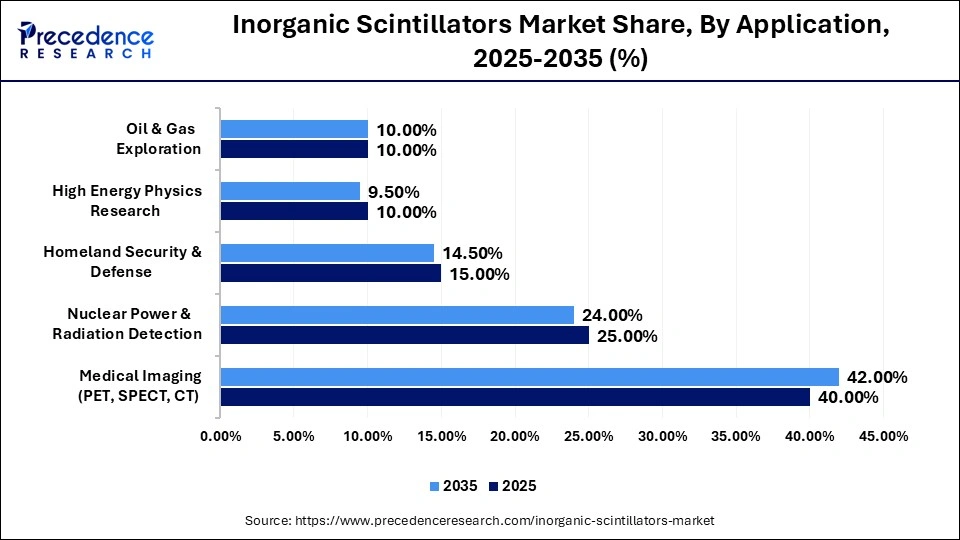
The homeland security & defense segment held a 15% share of the market in 2025 and is projected to grow at a CAGR of nearly 6% over the forecast period, driven by high usage of scintillators by security agencies for border control, radiation detection, and threat identification. These materials are incorporated into security systems at airports and other vital checkpoints. Additionally, inorganic scintillators play a crucial role in evaluating detection media for positron emission tomography (PET) instrumentation and in assessing radioisotope identification devices for homeland security threat analysis.
The high-energy physics research segment captured the 10% share of the market in 2025 and is anticipated to grow at a CAGR of 6.8% throughout the forecast period. This growth is primarily fueled by research institutions utilizing scintillators in particle physics experiments and advanced scientific inquiries. In the realm of high-energy physics, detector technology has evolved to include inorganic scintillation detectors, which offer rapid response times and brief decay times. These performance benefits are critical factors driving their acceptance in high-energy physics research.
End-Use Insights
The Healthcare & Diagnostics Segment Led the Market in 2025 With a 45% Share
The healthcare & diagnostics segment led the inorganic scintillators market while holding a 45% share in 2025 and is anticipated to expand at the fastest CAGR of 7.5% in the coming years, driven by the widespread use of scintillators in diagnostic imaging systems such as PET and CT scanners. Scintillators play a crucial role in gamma cameras and positron emission tomography (PET) scanners, which are essential tools in diagnostic imaging and nuclear medicine. These scintillator crystals absorb radiation emitted by radiopharmaceuticals and transform it into visible light, facilitating accurate detection and mapping of radioactive tracers within the body.
The energy & nuclear industry segment accounted for a 20% share of the market in 2025 and is projected to grow at a CAGR of 6.0% during the projection period. The energy sector relies on scintillators for radiation monitoring and safety compliance. Scintillators are used in radiation detectors such as handheld meters, fixed radiation monitors, and portal monitors to measure and detect gamma rays and other forms of ionizing radiation, thereby promoting their continued use in this segment.
Inorganic Scintillators Market Share, By End-Use, 2025-2035 (%)
| End-Use | 2025 | 2035 | CAGR (%) |
| Healthcare & Diagnostics | 45.00% | 47.00% | 7.5% |
| Energy & Nuclear Industry | 20.00% | 19.00% | 6.0% |
| Defense & Security Agencies | 15.00% | 14.50% | 6.2% |
| Research Institutes & Laboratories | 10.00% | 9.50% | 6.8% |
| Industrial Applications | 10.00% | 10.00% | 6.5% |
The defense & security agencies segment held nearly 15% share of the market in 2025 and is expected to grow at a CAGR of 6.2% over the forecast period. The growth of the segment is fueled by defense applications that depend on radiation detection systems for security and military operations. Inorganic scintillators play a crucial role in these systems, utilized at airports, border crossings, and other high-security locations to detect potential radioactive materials that could pose a threat. This broadens their application in the fields of defense and security.
The industrial applications segment captured approximately 10% market share in 2025 and is expected to grow at a CAGR of 6.5% throughout the forecast period. This growth is driven by industrial applications, including material testing, inspection, and process monitoring, that utilize radiation detection technologies. In addition, scintillators are employed in industrial environments, including nuclear power plants and research facilities, to monitor and measure radiation levels to ensure safety and regulatory compliance, thereby expanding their use in this segment.
Detection Technology Insights
The Photomultiplier Tube (PMT)-Based Systems Segment Held a 55% Market Share in 2025
The photomultiplier tube (PMT)-based systems segment held a dominant position in the inorganic scintillators market in 2025, holding approximately 55% share. This is mainly due to their exceptional sensitivity and established presence in radiation detection applications across various industries. PMTs are extensively utilized in medical equipment, analytical instruments, and industrial measurement systems, known for their high reliability and stability.
Inorganic Scintillators Market Share, By Detection Technology, 2025-2035 (%)
| Detection Technology | 2025 | 2035 | CAGR (%) |
| Photomultiplier Tube (PMT)-based Systems | 55.00% | 50.00% | 5.8% |
| Silicon Photomultiplier (SiPM)-based Systems | 30.00% | 36.00% | 9.5% |
| Hybrid Detection Systems | 15.00% | 14.00% | 7.0% |
The silicon photomultiplier (SiPM)-based systems segment held a 30% market share in 2025 and is expected to grow at the fastest CAGR of 9.5% in the upcoming period, driven by their compact size, improved efficiency, and increasing adoption in modern imaging systems. It is a sensor designed to effectively detect, time, and quantify low-light signals, reaching down to the single-photon level, thereby enhancing its widespread adoption.
The hybrid detection systems segment held a 15% market share in 2025 and is expected to grow at a CAGR of 7% in the upcoming period, as they combine the advantages of multiple detection technologies for enhanced performance in specialized applications and achieve unprecedented performance for mixed-field radiation detection. Their low-temperature deposition and inexpensive techniques make them the preferred choice.
Regional Insights
North America inorganic scintillators Market Size and Growth 2026 to 2035
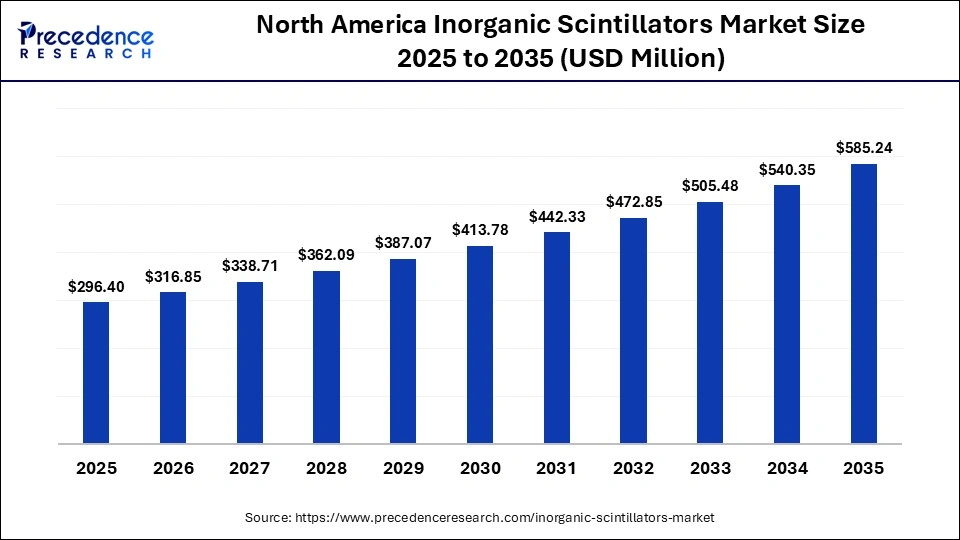
The North America inorganic scintillators market size is estimated at USD 296.40 million in 2025 and is projected to reach approximately USD 585.24 million by 2035, with a 7.04% CAGR from 2026 to 2035.
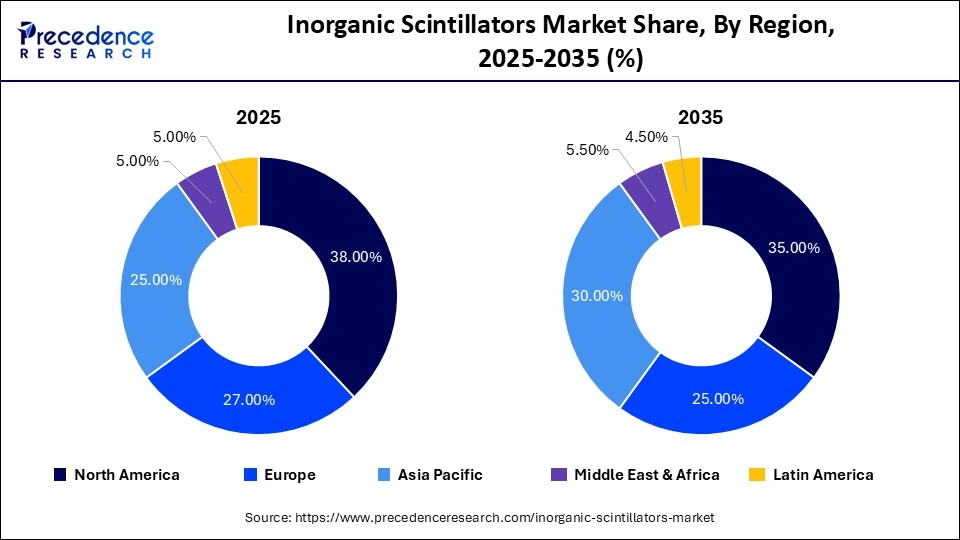
North America Dominated the Market With a 38% Share in 2025
North America dominated the inorganic scintillators market with approximately 38% share in 2025. This dominance is attributed to a robust healthcare infrastructure, advanced research facilities, and a high rate of adoption of imaging technologies. Additionally, the region benefits from significant investments in research and development, alongside the presence of key industry players. Regulatory support from agencies such as the FDA and NRC also contributes to market growth by ensuring safety and efficacy in applications.
U.S. inorganic scintillators Market Size and Growth 2026 to 2035
The U.S. inorganic scintillators market size is calculated at USD 222.30 million in 2025 and is expected to reach nearly USD 441.86 million in 2035, accelerating at a strong CAGR of 7.04% between 2026 and 2035.
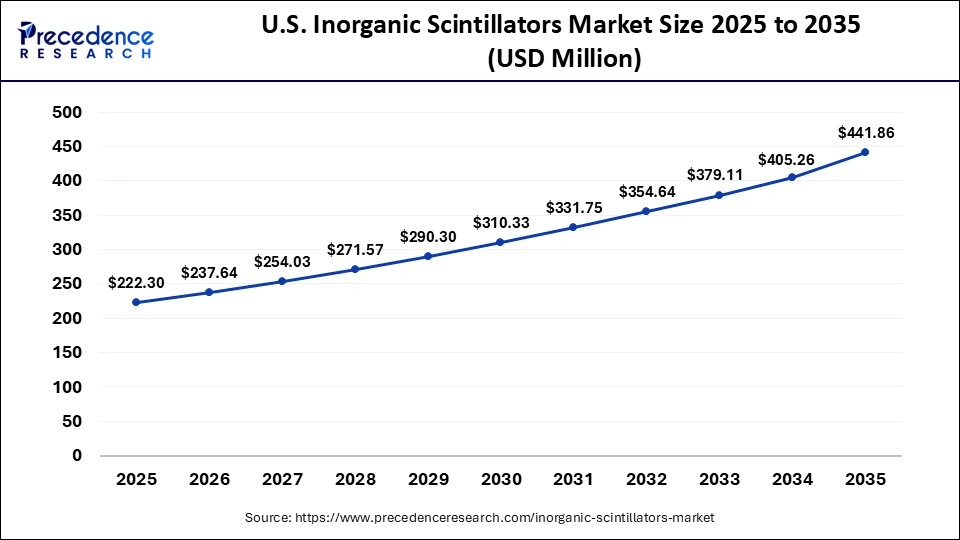
U.S. Inorganic Scintillators Market Analysis
The U.S. is a major contributor to the North American market, characterized by a competitive landscape that emphasizes product development and strategic partnerships. The presence of well-established companies not only enhances market stability but also supports a strong supply chain.
Asia Pacific: The Fastest-Growing Region
Asia Pacific held a 25% market share in 2025 and is anticipated to grow at the fastest CAGR of approximately 8.8% in the coming years. This growth is fueled by the expansion of healthcare infrastructure, advancements in nuclear energy projects, and a diverse array of industrial applications. Key drivers of this expansion include rapid industrialization and an increasing awareness of radiation safety. Countries throughout the region are progressively adopting advanced scintillation technologies for both medical imaging and industrial purposes.
China Inorganic Scintillators Market Analysis
China is a major player in the Asia Pacific inorganic scintillators market, bolstered by its growing healthcare infrastructure, heightened investments in nuclear energy, and a rising number of local manufacturers entering the sector. The competitive landscape is characterized by collaborations between domestic and international companies, emphasizing innovation and the development of cost-effective solutions.
Europe: A Significant Region
Europe held a 27% market share in 2025 and is projected to expand at a significant CAGR of 6.2% throughout the forecast period. This growth is supported by ongoing investments in nuclear safety, healthcare imaging, and research initiatives. The presence of robust healthcare systems and rigorous regulatory standards for radiation safety has further stimulated demand for inorganic scintillators. Regulatory frameworks, including the European Union's REACH regulation and the Euratom Treaty, facilitate the safe use of materials, thereby boosting market demand and fostering innovation in scintillator technologies.
UK Inorganic Scintillators Market Analysis
The UK stands out as a key player in the European inorganic scintillators market, benefitting from its advanced medical infrastructure and a vibrant research community. The competitive landscape is evolving, featuring a blend of established companies and startups dedicated to developing advanced materials and high-value applications.
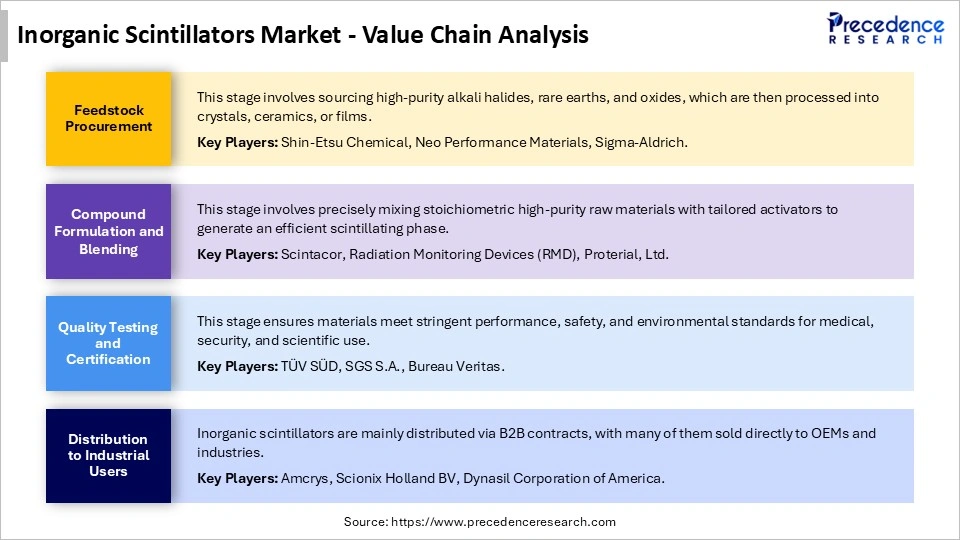
Inorganic Scintillators Market Value Chain Analysis
Inorganic Scintillators Market Companies
- Saint-Gobain Crystals
- Hamamatsu Photonics K.K.
- Hitachi Metals, Ltd.
- Amcrys-H Ltd.
- Rexon Components, Inc.
- Scionix Holland B.V.
- EPIC Crystal Company Limited
- Shanghai SICCAS High Technology Corporation
- Alpha Spectra, Inc.
- Dynasil Corporation of America
- Radiation Monitoring Devices, Inc.
- Korth Kristalle GmbH
- Zecotek Photonics Inc.
- Crytur, spol. s r.o.
- Detec Europe Ltd.
Recent Developments
- In January 2026, a study on highly luminescent organic–inorganic hybrid antimony halide scintillators marked a major step forward in real-time dynamic and 3D X-ray imaging. For the first time, a flexible scintillator screen based on CP2 crystals was fabricated and used for real-time dynamic and 3D X-ray imaging with Sb³âº-based OIHH scintillators, greatly expanding their potential for advanced imaging applications.(Source: https://www.nature.com)
- In June 2025, a study on all‑inorganic meta fabric scintillators for conformally flexible and wearable X‑ray detection and imaging established a new paradigm in scintillator system design. The technology preserves the high performance of inorganic scintillators while introducing added benefits of comfort and flexibility.(Source: https://www.science.org)
Segments Covered in the Report
By Material Type
- Sodium Iodide (NaI)
- Cesium Iodide (CsI)
- Bismuth Germanate (BGO)
- Lutetium-based Scintillators (LSO/LYSO)
- Other Advanced Inorganic Scintillators
By Application
- Medical Imaging (PET, SPECT, CT)
- Nuclear Power & Radiation Detection
- Homeland Security & Defense
- High Energy Physics Research
- Oil & Gas Exploration
By End-Use
- Healthcare & Diagnostics
- Energy & Nuclear Industry
- Defense & Security Agencies
- Research Institutes & Laboratories
- Industrial Applications
By Detection Technology
- Photomultiplier Tube (PMT)-based Systems
- Silicon Photomultiplier (SiPM)-based Systems
- Hybrid Detection Systems
By Region
- North America
- Latin America
- Europe
- Asia-pacific
- Middle and East Africa
For inquiries regarding discounts, bulk purchases, or customization requests, please contact us at sales@precedenceresearch.com
Frequently Asked Questions





Ask For Sample
No cookie-cutter, only authentic analysis – take the 1st step to become a Precedence Research client
 Get a Sample




 sales@precedenceresearch.com
 Schedule a Meeting
