



Colorants Market Size, Key Companies, Trends and Forecast, 2026–2035
Colorants Market Size (By Application: Textile, Automobiles, Food and beverages, Paper and printing, Building and construction; By Color: Natural, Synthetic; By Composition: Organic, Inorganic; By Form: Dyes, Pigments, Color concentrates, Masterbatches) - Global Industry Analysis, Size, Trends, Leading Companies, Regional Outlook, and Forecast 2026 to 2035
Source: https://www.precedenceresearch.com/colorants-market
 Get a Sample
 Table Of Content


What is the Colorants Market Size?
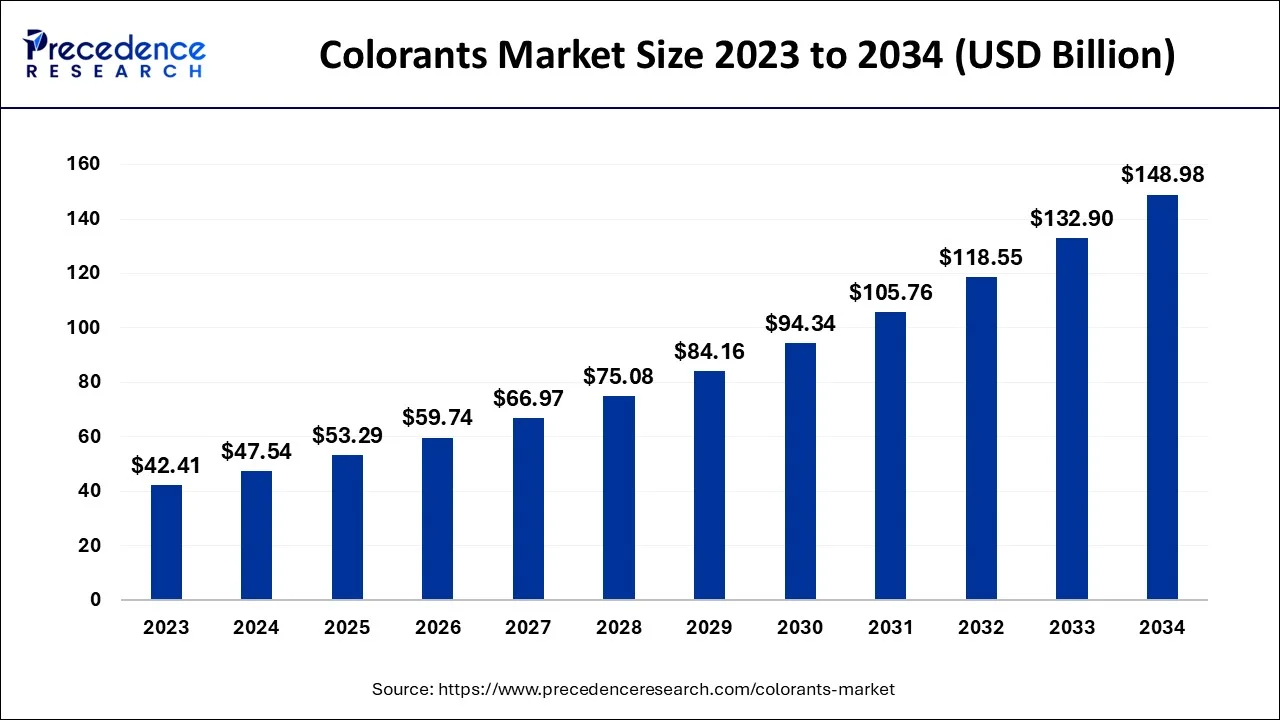
The global colorants market size is calculated at USD 59.74 billion in 2026 to approximately USD 163.91 billion by 2035, expanding at a CAGR of 11.89% from 2026 to 2035.
Market Highlights
- The textile segment is expected to reach a CAGR of 6.1% over the forecast period 2026 to 2035.
- The pigment type segment has accounted for 54% of revenue share in 2026.
- The packaging segment is expected to grow at a CAGR of 6% from 2026 to 2035.
- The packaging end-user segment had the highest market share of over 37% in 2026.
- The North America region has accounted for 43% market share in 2026.
What are Colorants?
As the disposable income of the households has increased there has been an increase in the spending power of the consumers. Increasing population and rapid urbanization has also led to an increased spending on various food products that are packed. Increased purchasing power of the people staying in the developed as well as the developing nations shall lead to an increased demand for the textiles or fashion garments. All of these factors are expected to drive the market growth of the colorants market during the forecast period.
A colorant is added or it is applied to various materials or surfaces and this substance helps in changing the color of all of these materials. There's a growing demand for colorants for the plastics and the foods. All the colors available in the market are either made-up of inorganic compounds or the organic compounds. Increased use and increased demand for the colorants in the cosmetics, inks, textiles, papers and the plastics market will be beneficial for the growth of the market in the coming years. Most of the colors are obtained from the mineral agricultural and the biological sources.
Colors are used in the form of the pigment which is helpful in the manufacturing process where this pigment is used as a material which helps in transforming or changing the color of the reflected or transmitted light. The tinting strength of the pigment needs to be more when it Checked in comparison to the materials that are colored. For the production of plastics and paints, fine powder is used as a colorant these pigments are dry colorants. Pigments have major applications in the manufacturing of ink, food, paint, coloring fabric and different materials. Dye and pigment are completely different things. The difference between the two can be compared in terms of their solubility. The former one is soluble and the latter one is insoluble.
The outbreak of the COVID-19 pandemic there were strict lockdowns imposed across many nations and there were stringent policies and acted for the restraining of trade as well as movement. Just like most of the industries the colorants industry was also affected due to the pandemic. Constant lockdowns and restricted movements had negatively affected the market. The production activities in this industry had come down or they were even halted for a temporary period of time. Major manufacturers in the industry are increasing the number of investments made for the research and development purposes. Constant research and development activities will be instrumental in occupying the market.
Strategic partnerships shall be helpful in the sustainable growth of the market. Even though the market is expected to grow well during the forecast period there are few factors that will hinder the growth of the market in the coming years. The presence of a few toxic elements in these colorants have been proven to cause various health ailments and one of them is cancer. Long term exposure to these colorants may have a negative impact on the workers. Even though these products are available at affordable rates one of the major challenges in the growth of the market is the manufacturing of colorants that do not pose any health threats to the human beings or even the animals.
How is AI contributing to the Colorants Industry?
AI transforms colorants by doing things like rapid color matching, sustainable pigment discovering, formulation optimization, and shade prediction for both wet and dry states. It has the power to take away the darkness of subjective judgment by introducing accuracy backed by data; it wipes out waste, and the policies of consistency increase, and eco-friendly pigments receive support from the machine, and it all happens simultaneously in the case of the textile, coatings, automotive, electronics, and creative sectors.
What are the Growth Factors in the Colorants Market?
The parents of the industrial grade are used in many industries and they are manufactured on a large scale. This industrial grade paint is used in the construction, building and the automotive market. Different types of coatings and paints are available in the market and provided by the manufacturers because these coatings or paints play a very important role in preventing the material or the metals from rusting or corroding. These paints or the coatings play a vital role in preventing any damage to the surface. It also provides constant protection from various elements that may damage the paint or the coatings of these equipment. And most of all the use of these paints is expected to grow during the forecast period as they help in improving the look of various materials that are colored or coated.
Increased disposable income and growing geriatric population across the developing as well as the developed nations will create a greater demand for the market in the coming years. There is a growing demand for various high-end brands of clothing that are available in the market and there is also a good demand for the food items that are provided in the packed form. The textiles industry and the food industry are expected to be a large consumer of the colorants during the forecast period.
Colorants are used in the food industry for improving the look of the confectionery and bakery items. Colorants that are available in the market in the edible format are used in the manufacturing of baked goods. Increased use of these edible colors will be attractive and it shall improve the sales of various food products. These colors are widely used in the packaged food products and other food products that are ready to eat. As the ready to eat products are in great demand across the developing as well as the developed nations due to the dual income households and lesser time available for cooking the market for the currency is expected to grow well during the forecast period.
There is a growing demand for these food products especially in the developed nations across the globe. Increase in the geriatric population and the consumption of unhealthy food have caused early graying of hair. There is a growing demand for the hair dyes or hair colors in the developing as well as the developed nations due to the wide range of products that are offered in the market.
Many manufacturers have come up with affordable hair dyes or hair colors that make use of these colorants in their manufacturing and the market for the colorants is expected to grow well during the forecast period. There has been an increase in the amount invested for the development and research purposes as the manufacturers see that there is a growing need for innovative colorants or organic colorants that cause less damage to the user. And they are also focusing on coming up with colorants that will be used across most of the industries.
What are the Major Trends in the Colorant Market?
- Shift Toward Sustainable Colorants: Manufacturers are increasingly adopting natural, biodegradable, and low-VOC colorants to meet environmental regulations and consumer demand for eco-friendly products.
- Rising Demand from Emerging Industries: Growth in packaging, textiles, cosmetics, and construction sectors is driving the adoption of specialty and high-performance colorants.
- Technological Advancements in Formulations: Innovations in pigment dispersion, nano-colorants, and application-specific formulations are enhancing color performance, stability, and product appeal.
Colorants Market Outlook
- Industry Growth Overview: Between 2026 and 2035, the colorants sector will serve as a positive side effect of growing demand for high-performance pigments, specialty dye formulations, and functional color additive technologies. Overall consumption growth will derive from increased industrial activities in the packaging, textiles, plastics, and cosmetics sectors, with Asia-Pacific and North America continuing to be the regions driving the industry growth through industrial upgrading and the greater use of value-added durable color solutions.
- Sustainability Trends: Sustainability is redefining the colorants industry as producers are now producing greater volumes of bio-based dyes, low-toxicity pigments, and water-based products. Regulations throughout Europe and the USA are forcing producers to eliminate or limit their use of hazardous chemicals and improve biodegradability via heavy investment into research and development of renewable raw materials and green dispersible technologies to meet the increased demand arising from sustainable/green packaging, food-grade colorants, and sustainable fashion.
- Global Expansion: Leading corporate players in the colorants sector have formed strategic partnerships with manufacturers in Southeast Asian Countries, Eastern European nations, and Latin American countries to capitalise on lower manufacturing costs, increased levels of manufacturing activity, and favourable regulatory regimes in these regions. Recent investments have focused on pigment dispersion businesses, specialty dye manufacturing plants, and distribution networks.
- Major Investors: Due to high profit margins, difficult barriers to entry via technology, and increased demand for sustainable pigments and specialty dyes, private equity and strategic investment firms are taking a larger role in the sector. These investors are focused primarily on functional additives and eco-friendly color technologies, specifically in cosmetic pigments. Investment companies are looking for companies with strong intellectual property portfolios, scalable production, and products that align with the environmental, social, and governance (ESG) criteria.
- Startup Ecosystem: The startup ecosystem has reached a level of maturity thanks to increasing innovation related to bio-derived dyes, nano-pigments, digital printing inks used for textiles, and enzyme coloration technology. A number of companies based in the United States, India, and Europe have received increased amounts of funding to create cleaner, safer, and high-performing alternatives to petrochemical-based colorants.
Segment Insights
Application Insights
Depending upon the basis of application, the demand for the colorants in the textile market is expected to drive the market growth in the coming years this segment is expected to grow well in the coming years due to a growing demand for this product and its maximum usage in the textiles industry. This segment has dominated the market in the past with the highest market share in terms of revenue. Dual income households and increased purchasing power has led to the growth in the demand for branded garments as well as clothing. There is a growing demand for the use of eco-friendly dies for the clothing and garments. The overall demand for the coloring agents is expected to grow well during the forecast.
There shall be a good amount of demand for these coloring agents in the Asia Pacific region as there has been a change in the preference of the consumer for the innovative colors or different colors. There shall be an increased consumption of these coloring agents in the food industry and the beverages industry as these products are used on a large scale for many confectionaries, bakery items and in the manufacturing of ice creams as well as chocolates. Growing demand for these products in the printing process will also be responsible for the growth of the market in the coming years. Different types of colors are available for printing for the different forms of materials. Printing is used for the plastics, metals, paper, glass ceramics and coverings.
Form Insights
Depending upon the form of the colorants, the pigments market is expected to have the largest market share during the forecast period. The pigments segment has dominated the market in the past as the demand for pigments was more.
Increased investments for improving the technologies which are used in the manufacturing of various colorants shall be one of the major factors which shall be beneficial in creating greater demand for the colorants in the coming years. The demand for the pigments has grown in the recent years due to its increased usage in the coatings of various materials and for painting of different materials.
By Application
The building and construction segment is the fastest-growing in the colorants market due to rapidly developing infrastructure. Colorants are used not only for their aesthetic purposes but also for the enhancement of durability and protection of surfaces. So, there is a growing demand for weather-resistant finishes. The growing urbanization is supporting the usage of paints and coatings in residential and commercial structures, while also making use of cement and decorative applications.
By Color
Synthetic segment dominated the colorants market primarily because of the reasons that they are able to consistently produce good quality and have a wide range of shades available. They also have a very good pigment strength and stability. The companies that produce for large-scale production highly prefer them. The areas of application are very wide such as textiles, plastics, paints, coatings, and automotive finishes, all where the color performance has to be reliable.
By Composition
The organic segment is expected to be the fastest-growing market, the driving force being sustainability preferences. Thus, they are becoming more and more popular in the clean-label and eco-conscious markets. Their usage is getting expanded in food, textiles, and packaging. Regulatory support and consumer awareness are the factors that are making plant-derived and naturally sourced coloring solutions more acceptable and, hence, widely used.
Regional Insights
What is the U.S. Colorants Market Size?
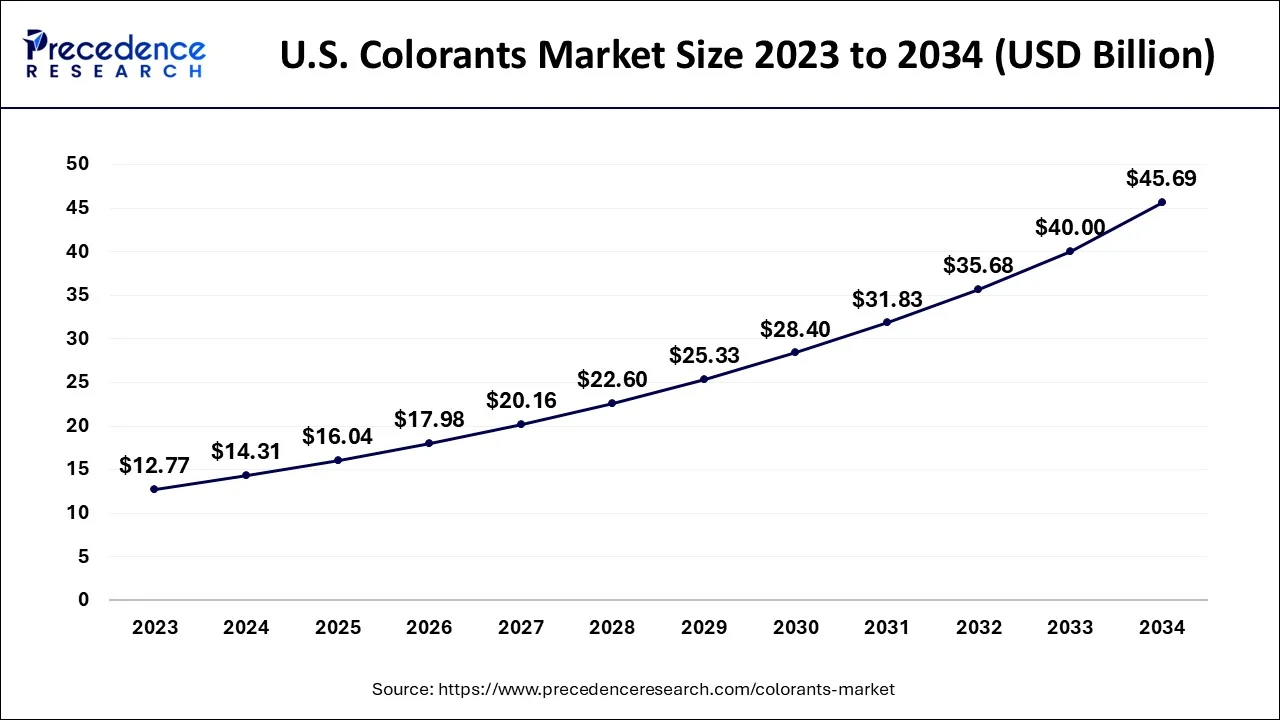
The U.S. colorants market size is evaluated at USD 17.98 billion in 2026 and is predicted to be worth around USD 50.47 billion by 2035, rising at a CAGR of 12.15% from 2026 to 2035.
North American region held the highest demand for these products in the past. The North American region is expected to dominate the market in the coming years due to a growing demand for these products across many industries. As though appearance or visual aspect of various materials or the products are enhanced by the use of the colorants the market is expected to grow well during the forecast period and it is expected to generate a lot of revenue due to its usage in many industries. It has also been playing an extremely important role in increasing the sales of various products as it makes the products attractive.
Apart from its growth in the North American region the colorants market is expected to grow well in the European region. Colorants are used on a large scale in the automotive industry of the European region. As many automotive manufacturing companies are based in the European region the demand for the currency is expected to grow well in the coming years as it is used in many parts. Apart from its usage in the automotive industry there has also been an increased use of colorants in the food and beverages industry textiles industry and the paper industry. All of these colorants are expected to have a good demand for the currency especially in the Asia Pacific region. The demand for the currency is expected to be high in the nations like India China and South Korea of the Asia Pacific region.
Why did the Asia-Pacific Region Experience the Fastest Growth in the Colorants Market?
The colorants market in the Asia Pacific exhibited the fastest growth rate due to the region's rapid pace of industrialization, coupled with its high textile manufacturing activity and its high demand for packaging materials, thus enabling it to take full advantage of the region's relatively low labor costs and abundant supply chain. Countries were able to invest in new technologies and equipment to support their expanding digital printing ink and food-safe dye industries, as well as their cosmetic pigment offerings.
Why did the European Region Experience Rapid Growth in the Colorants Market?
The colorants market in Europe is flourishing due to environmental regulations and the growing demand for safe, sustainable, and high-quality pigments. To satisfy this demand, many companies are using renewable raw materials and producing eco-friendly dyes. The automotive, packaging, and cosmetics industries are some of the biggest drivers of demand for these advanced color solutions. Additionally, there is an opportunity in creating bio-based formulations, developing nanotechnology pigment offerings, and advancing digital printing inks as companies look to provide products that meet increasing safety and performance standards.
Germany Colorants Market Trends
Germany has been at the forefront of this growth due to its extremely developed chemical industry, high levels of research and development funding, and stringent standards for all products produced. The country has focused on the development of premium pigments for automotive, plastics, coatings, and cosmetics.
Due to strong innovation in developing sustainable and high-performance colorant products, Germany continues to have a competitive advantage in this market, and its robust export market and skilled labor force have allowed it to remain an outstanding contributor to the overall growth of the colorants market in Europe.
Why did the Latin American Region Experience Rapid Growth in the Colorants Market?
Latin America has benefited from the growth experienced due to the increased demand for many of its food processing, packaging, plastics, and textile industries. Additionally, local companies have expanded their production capabilities while also investing in new distribution systems with multinational companies. This caused the Latin American region to further advance towards the use of more sustainable and safer pigments.
As the economies of Latin America continue to experience increased spending by consumers and industrial activity within each of the region's major markets, many new opportunities exist for the development of food-grade colorants, pigments for cosmetics, and low-cost dyes for textiles.
Brazil Colorants Market Trends
Brazil was the leading country in the region in the colorants market. Localized growth was achieved through significant growth in the food processing, cosmetic, and textile industries. Localized companies made investments in newly developed colorant technologies as well as improvements in their supply chain capabilities. The increased demand for consumer packaging materials contributed to the overall growth of this market.
The localized market also continues to be associated with increased use of lower-toxic and environmentally friendly colorants. These factors led to Brazil continuing to be the leading contributor to the region's colorants market.
Why did the Middle East & Africa region experience the fastest growth in the colorants market?
The growth of the colorants industry is being driven primarily by the rising demand for colorants from the construction sector, as well as for the packaging, textiles, and food sectors. In addition, urbanization and increased infrastructure development across the region are providing a strong foundation for the growth of the colorants market. As the region is experiencing rapid growth in the manufacturing infrastructure, many countries have been building new manufacturing plants and importing higher-quality pigments from abroad.
The United Arab Emirates (UAE) is leading the region's colorants industry due to its dominant position in the construction, packaging, and cosmetics sectors. The large infrastructure investments and premium products being produced in the UAE are increasing demand for colorants. The UAE has focused heavily on importing the highest quality pigments available and on building local production capacity. The UAE has created a strong and stable business climate that has attracted international companies and has allowed the UAE to maintain its position as the leading colorants market in the region.
Colorants Market Value Chain Analysis
- Raw Material Supply: This initial stage involves the procurement of basic chemicals, natural pigments, or other precursors.
Major Players: BASF SE, Clariant AG. - Colorant Synthesis & Manufacturing: The core manufacturing process involves chemical reactions and physical processes that transform raw materials into the desired colorants (pigments or dyes).
Major Players: DIC Corporation, Lanxess AG - Refinement & Dispersion: Synthesized colorants are further refined to achieve the required particle size and dispersed into specific carriers or matrices to ensure uniform application in end products.
Major Players: PolyOne (now Avient), Ampacet. - Application & End-User Delivery: Colorants are applied in various end-user industries to color their products. Performance and stability feedback from these users informs future product development cycles.
Major Players: AkzoNobel, PPG Industries.
Top Companies in the Colorants Market & Their Offerings
- BASF SE: The company provides a broad spectrum of high-performance organic and inorganic pigments, dyes, and preparations.
- Huntsman Corporation: They offer specialized textile dyes and general-purpose pigments, focusing on performance, color consistency, and addressing the specific needs of industrial fabrics and consumer goods.
Other Major Companies
- Clariant AG (Switzerland)
- LANXESS AG (Germany)
- Cabot Corporation (US)
- du Pont de Nemours & Company (US)
- Flint Group (Europe)
- PolyOne Corporation (US)
- Sun Chemical Corporation (US)
- DIC Corporation (Japan)
Recent Developments
- In September 2025, Californian startup Michroma partners with CJ CheilJedang to scale up its fermentation-derived red dye for food and cosmetics. This addresses the shift from artificial dyes to safer, natural coloring alternatives. (Source: https://www.greenqueen.com.hk )
- In July 2025, Prodalim introduced VivaPro Coloring Foodstuffs and NaturaPro Natural Colors. These products meet the rising demand for clean-label, sustainable, and plant-based color solutions in the food and beverage sectors.(Source: https://vegconomist.com )
Colorants Market Segments
By Application
- Textile
- Automobiles
- Food and beverages
- Paper and printing
- Building and construction
By Color
- Natural
- Synthetic
By Composition
- Organic
- Inorganic
By Form
- Dyes
- Pigments
- Color concentrates
- Masterbatches
By Region
- North America
- Europe
- Asia Pacific (APAC)
- Latin America
- Middle East & Africa (MEA)
For inquiries regarding discounts, bulk purchases, or customization requests, please contact us at sales@precedenceresearch.com
Frequently Asked Questions
Tags





Ask For Sample
No cookie-cutter, only authentic analysis – take the 1st step to become a Precedence Research client
 Get a Sample




 sales@precedenceresearch.com
 Schedule a Meeting
