






 Request Consultation
AI code tools are transforming software development by automating coding, debugging, and testing processes. They enhance productivity, reduce errors, and enable faster, more efficient development workflows.
What are AI Code Tools?
AI code tools are a type of tool that leverages artificial intelligence, primarily LLMs, to produce computer code automatically from natural language instructions or snippets. Generative AI solutions can generate computer code to help streamline the software development process and make it easier for developers to write all levels of code. The best part of such tools is that they can further modernize legacy code and translate it from one programming language to another.
By integrating AI into the developer toolkit, these solutions can generate high-quality code recommendations based on user input. Such autogenerated code enhances developer productivity by offering straightforward solutions, handling mundane tasks, and reducing context switching, which clears mental fog and conserves team energy for tasks that require higher cognitive abilities.
Inside Generative AI for Developers: Understanding the Workflow
Generative AI code tools rely heavily on publicly available open-source code as their foundational training data. Their recent rise is powered by advancement in large language models (LLMs) and natural language processing, which use deep learning and neural networks trained on massive datasets of existing source code.
Developers can simply enter plain-text prompts describing the functionality they need, and the AI generates code snippets or even full functions, helping to streamline development and handle repetitive, time-consuming tasks. While AI-generated code can accelerate productivity, it may still contain bugs or vulnerabilities, so it must be reviewed and refined by human developers for accuracy and reliability.
Many AI coding tools also provide unit testing and debugging features, allowing developers to quickly identify and fix errors. This makes the process of generating and refining code more efficient, less time-consuming, and highly effective for modern software development teams.
What is the AI Code Tools Market Size in 2026?
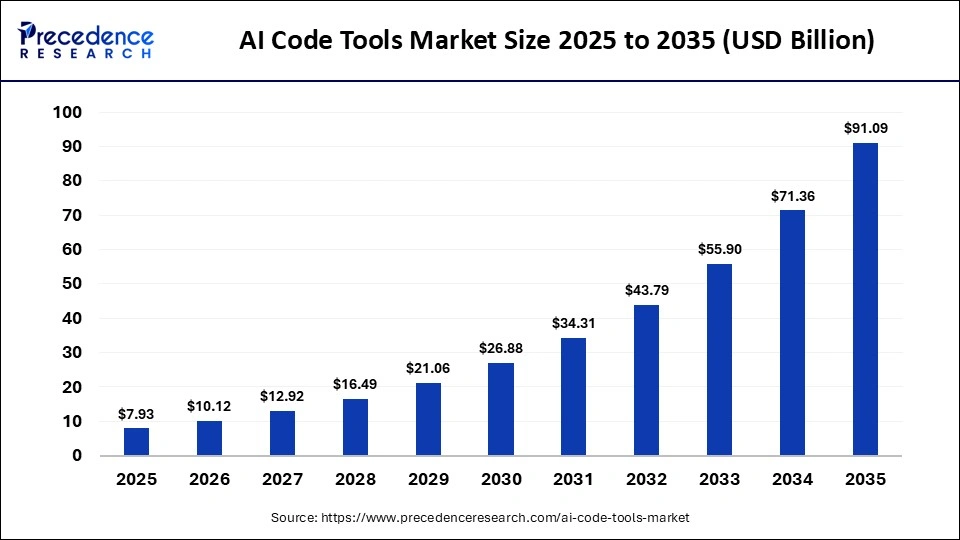
The global AI code tools market was valued at USD 7.93 billion in 2025 and is projected to grow from USD 10.12 billion in 2026 to approximately USD 91.09 billion by 2035, registering a CAGR of 27.65% during the forecast period from 2026 to 2035. The market growth is primarily driven by the increasing pace of software development, advancements in generative AI and large language models (LLMs), and the growing need to manage complex codebases efficiently.
Get a Free Sample Report with Key Market Trends: https://www.precedenceresearch.com/sample/8207
Advantages of AI-Powered Coding in Today’s Tech Era
AI code generation is one of the most revolutionary developments in software development, enabling even non-programmers to tackle complex coding tasks using plain-text prompts instead of relying solely on professional developer skills. These tools support multiple programming languages and frameworks, offering unprecedented benefits, including:
- Time Savings: Developers can generate code faster without writing it line by line manually, freeing up time for high-value and productive tasks.
- Efficient Debugging: AI can test and debug code in real-time, reducing errors and work pressure while preventing small mistakes from becoming costly issues.
- Accessibility for Non-Developers: Even those without programming expertise can handle complex coding tasks, making AI code tools a revolutionary force in modern technology.
GenAI vs. Low/No-Code: Understanding the Key Differences
All these tools that claim to offer quick coding snippets are working with the same principle, though their results differ from each other based on their core modelling. AI code tools are ideal for people who have knowledge of programming languages at least on a basic level. On the other hand, low-code or no-code tools are still popular in the market as they do not require prior skills in a programming language. They are totally built on readymade templates and components of libraries. The tools allow people to leverage visual interfaces and intuitive control by using the drag-and-drop method. People can create and modify applications easily with maximum efficiency while the actual code is hidden behind the bar. However, no-code or low-code are generally built for non-developers and business users; both professional developers and common people can utilize the functionalities of AI code tools with the same results.
Popular Generative AI Code Creation Tools
- IBM Watsonx Code Assistant
This tool helps developers write code by using AI-generated suggestions irrespective of their educational background or experience level. Developers can type a prompt in a simple plain text format or simply use existing source code to generate code for defined use cases. Moreover, watsonx code assistant offers pre-trained models based on specific programming languages that support precision and efficiency while code generation, which is a crucial part of coding.
- GitHub Copilot
It's one of the highly popular tools among developers due to its pretrained models and code completion features that enable developers to write code in various languages such as Go, Pearl, PHP, Ruby, JavaScript, Typescript, and work with HTML and CSS. The software runs machine learning algorithms to suggest code based on the context and further analyzes code for potential vulnerabilities. It is also available as an extension for integrated development environments such as Studio Code, Visual Studio, and JetBrains. GitHub Copilot leverages publicly available code from GitHub repositories and is operated by OpenAI code based on GPT-3.
- TabNine
It is an AI code assistant that can learn from the codebase solely without developers' intervention and offers real-time code completion, chat, and code generation. It encompasses code formatting, language detection, and documentation. Additionally, TabNine supports Java, Python, SQL, and other various popular languages and is able to connect to code editors like VSCode, IntelliJ, and PyCharm.
- Cursor
It is an AI-first code editor developed on top of VS Code. It is primarily designed to easily integrate AI assistants into the development workflow. It facilitates writing, refracting, and understanding code way faster than conventional methods, along with context-aware recommendations and inline explanations. Despite its superiority, it may introduce friction in terms of a time-consuming debugging process or context-loss. Thus, AI-created code still needs human sight, especially in a security-scrutinized environment. However, the best part of this tool is its ability to support complex engineering tasks like generating highly scalable backend APIs by using tools like Prisma and MongoDB, making it excellent for enterprise-level systems. Developers who are building Flutter or React Native apps may leverage the cursor’s potential to produce cross-platform UIs that account for platform-centric nuances.
- Replit
It is a cloud-based AI-powered development tool that lets users code, collaborate, and deploy applications directly from the user's browser. It supports real-time collaboration and offers built-in hosting, making it easier to build and share projects publicly in less time. However, frequent use of Replit may become expensive later, with costs more than $40 per basic app. However, it is a top choice among educators and learners due to its AI-guided explanation and simplification of coding concepts. It is ideal for small apps and teaching environments by allowing users to deploy stable Node.js or Python APIs with less friction.
Some of the Other AI Coding Tools with Pros and Cons
| Tool Name | Usability | Pros | Cons |
| Windsurf | In-editor AI coding assistant | Easy to program in VS Code | Need strong API support as compared to similar tools |
| VO | Design-to-code without human support | Figma to React component creation | Limited custom logic handling |
| VS Code AI | Useful for general development productivity | Local base, context-aware AI coding assistance | Not built for full-stack generation |
| Bolt.New | AI/ML projects experiments | GPU-backed and self-reliant dev workflows | High learning curve |
Expert Opinion
According to our industry experts, AI code tools are no longer experimental technologies, they have become strategic assets for businesses seeking to accelerate software development and optimize operational efficiency. By leveraging large language models and advanced machine learning, these tools allow development teams to generate high-quality code, automate repetitive tasks, and debug efficiently, significantly reducing time-to-market for software products. From a business perspective, this translates into cost savings, higher productivity, and faster innovation cycles, enabling companies to respond more quickly to market demands.
Moreover, AI code tools democratize software development by empowering non-developers and cross-functional teams to participate in coding workflows, lowering dependency on specialized talent while maintaining quality and compliance. Enterprises in sectors such as fintech, healthcare, and e-commerce are increasingly integrating these tools into their development pipelines to manage complex, high-volume projects with greater agility.
However, the adoption of AI code tools requires a human-in-the-loop approach to ensure reliability, security, and adherence to regulatory standards. When implemented strategically, AI-assisted development can shift the focus of engineering teams from routine coding to architectural planning, innovation, and high-value tasks, positioning organizations for sustainable growth and competitive advantage in a fast-evolving digital landscape.
Wrapping Up
AI code tools have moved from novelty applications to essential co-developers, transforming the software development lifecycle, from basic syntax writing to high-level architectural guidance and code curation. While they provide significant productivity boosts, these tools are not infallible and require human review to prevent technical glitches, security issues, or fragile code. They function best as co-assistants rather than fully autonomous agents, complementing developers’ work rather than replacing it.
Modern AI coding tools have evolved into context-aware systems that understand project structures and code requirements using massive reference files. They can take natural language prompts to create plans, write multiple files, run tests, fix errors, and even modernize legacy code by updating libraries or translating between programming languages.
The rise of prompt engineering allows users to specify their requirements in plain language, breaking down barriers for those without extensive coding expertise. As a result, AI code tools are becoming fully integrated into development workflows, enabling developers to focus more on architecture and design rather than manual coding. The future of AI-assisted coding promises a revolution where these tools drive innovation and efficiency across the software development landscape.
About the Authors

Aditi Shivarkar
Aditi, Vice President at Precedence Research, brings over 15 years of expertise at the intersection of technology, innovation, and strategic market intelligence. A visionary leader, she excels in transforming complex data into actionable insights that empower businesses to thrive in dynamic markets. Her leadership combines analytical precision with forward-thinking strategy, driving measurable growth, competitive advantage, and lasting impact across industries.



Aman Singh
Aman Singh with over 13 years of progressive expertise at the intersection of technology, innovation, and strategic market intelligence, Aman Singh stands as a leading authority in global research and consulting. Renowned for his ability to decode complex technological transformations, he provides forward-looking insights that drive strategic decision-making. At Precedence Research, Aman leads a global team of analysts, fostering a culture of research excellence, analytical precision, and visionary thinking.

Piyush Pawar
Piyush Pawar brings over a decade of experience as Senior Manager, Sales & Business Growth, acting as the essential liaison between clients and our research authors. He translates sophisticated insights into practical strategies, ensuring client objectives are met with precision. Piyush’s expertise in market dynamics, relationship management, and strategic execution enables organizations to leverage intelligence effectively, achieving operational excellence, innovation, and sustained growth.