






 Request Consultation
Applied AI is revolutionizing retail and e-commerce by enabling personalized shopping, predictive analytics, and automated operations. It helps businesses improve efficiency, reduce costs, and deliver better customer experiences at scale.
What is Applied AI?
Applied AI refers to the branch of AI that enables computers and computer-controlled robots to perform real-time tasks. Applied AI is highly beneficial in improving software applications with the help of advanced ML models that provide high-level accuracy and adaptation in real-time and external conditions. Businesses are increasingly leveraging applied AI to contextualize their operations, optimize industry processes, and transform interactions with customers, products, and services, driving greater efficiency and innovation across sectors.
Applied AI Benefits to Businesses
- Applied AI enables rapid decision-making and provides human-like judgment to reduce errors and predict precise outcomes. It supports end-to-end automation of repetitive processes and integrates seamlessly with smart device ecosystems.
- Applied AI bridges the physical and digital worlds while addressing challenges such as model errors, ethical concerns, and human biases, which are critical considerations in AI adoption today.
- In retail and e-commerce, applied AI improves operational efficiency and output, directly saving time and reducing costs.
- Applied AI benefits businesses by freeing employees from manual tasks and enabling large-scale process automation.
- It enhances profitability by identifying issues that are difficult to detect manually and supports complex problem-solving through machine learning and adaptive capabilities.
How Applied AI is Reshaping the Retail and E-Commerce Sectors?
The integration of applied AI into retail and e-commerce is transforming how consumers discover products and how value is delivered across digital platforms. Many shoppers now prefer using precise keywords or product images rather than browsing aimlessly, saving both time and effort. As a result, AI-powered digital assistants have become standard features in e-commerce search functions. Additionally, AI-driven labor scheduling, task automation, and real-time support are becoming essential for engaging consumers and resolving their queries efficiently.
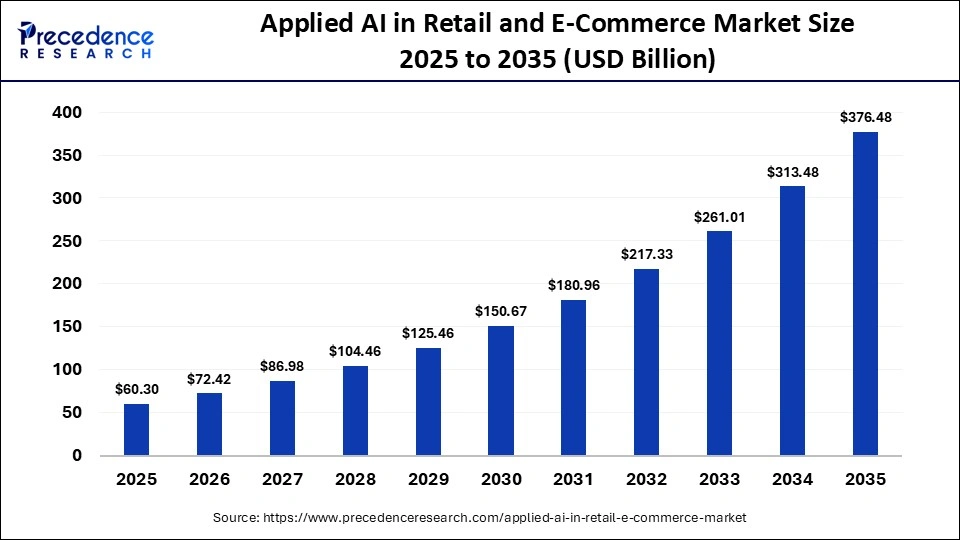
What is the Applied AI in Retail and E-Commerce Market Size in 2026?
The global applied AI in retail and e-commerce market was valued at USD 60.30 billion in 2025 and is projected to grow from USD 72.42 billion in 2026 to approximately USD 376.48 billion by 2035, registering a CAGR of 20.10% during the forecast period from 2026 to 2035. This growth is driven by the increasing demand for personalized shopping experiences and a strong focus on enhancing supply chain oprations.
Application of AI in Different Retail Subdomains
- Fashion Retail
In the fast-paced fashion industry, trends evolve rapidly, and retailers must adapt quickly to remain competitive. To address this, fashion retailers are increasingly adopting predictive analytics to provide precise outfit recommendations. AI-driven tools, such as virtual fitting rooms, allow consumers to visualize how clothes will look, making it easier to select suitable items while delivering a highly personalized shopping experience.
- Sports Retail
AI is transforming the sports and recreation sector by predicting which gear and equipment are most suitable for different customer segments. It enables retailers to gain deeper insights into consumer preferences, whether for outdoor equipment or fitness apparel, and delivers highly targeted, personalized recommendations that enhance the shopping experience.
- Home and Living Room Retail
AI is also making a significant impact on home and living room product purchasing by helping consumers to visualize what a new product will look like in their area to predict which type of home decor will be highly suitable, as per the external environment and consumer preferences. It is possible to use AR tools that offer the ability to visualize virtual products' look and space required in the home.
- Common Pitfalls in Adopting AI for Retail Businesses
Despite having many benefits and unmatched offerings of applied AI, some concerns are still present and need to be resolved as technologies evolve with time. Here are a few challenges to the implementation of AI in retail and e-commerce businesses.
- Data Privacy Issue
AI is highly reliant on a huge number of datasets that raise the question of sensitive data privacy and consumer security. Retailers must ensure robust security deployment before collecting the data from consumers and stay transparent about AI policies for security and data privacy to gain consumers' trust.
- Substantial Initial Investment
The initial cost of AI implantation is a major barrier for some small-scale businesses, as it requires training for employees and a huge investment to integrate AI with existing systems. This may be resolved by starting from a small-scale AI implementation, like customer service or inventory management.
How Can AI be Practically Implemented in Retail and E-Commerce?
AI implementation is a crucial aspect for existing infrastructure and requires strategies to adopt AI without completely removing existing systems. A strategic roadmap based on practices and data-driven insights is as follows:
- Recognizing the Initial Point: Before starting the AI journey, it is highly crucial to evaluate current technologies and their capacity for AI-readiness. According to sources, only 12% of retailers fully understand their readiness capacity by conducting an AI readiness audit and detecting capability issues in technology, skillsets of employees, and data infrastructure.
- Selection of the Right Project: Selecting the right project is crucial to saving investment. This is possible by setting clear ROI potential, minimum disruption, and defining goal settings like rapid learning. AI can be used for high-impact use cases like demand forecasting, chatbot customer support, and personalized marketing. It helps define clear success metrics and avoid confusion on AI implementation.
- Developing Agile and Scalable Infrastructure: The ongoing change in AI technology is confusing and requires a robust infrastructure to handle every update with flexibility. Thus, leading tech giant, IBM, has revealed that retailers are highly adopting cloud-based AI infrastructures for higher scalability. Investing in cloud platforms can offer seamless updates and reduce operational costs to maintain the working structure.
- Refining and Measuring AI Impact: This is a highly crucial step after AI deployment to ensure its performance and ROI visibility for constant improvement. Thus, nearly 30% of productivity improvements have been recorded by the retailers who have tracked their AI efficiency and its outcomes.
Future Trends of Applied AI in Retail and E-commerce
- Hyper-personalization: Today’s consumers expect personalized shopping experiences when browsing online products. To meet these expectations, retailers are increasingly leveraging AI to deliver tailored recommendations, attract more customers, and drive higher profits. For retailers, this approach enhances customer loyalty, encourages repeat visits, and creates opportunities for cross-selling and upselling.
- Intelligent Search: AI also enables retailers to understand the motive behind shoppers’ search questions and offer relevant results based on this evaluation. AI can detect patterns in both online and offline search data to meet consumer demand. ML algorithms take analysis further and create data with precise context.
- AI-based Customer Service and Chatbots: AI-based chatbots are mainly handling conversations between consumers and retailers and support 24/7 for consumer query resolution. The AI assistant will respond in no time in the upcoming period and will dominate the customer services in e-commerce and Retail without manual intervention. Furthermore, the advanced conversational shopping solutions will go beyond only replies and engage customers across entire websites to get maximum conversion and leads.
- Dynamic Price Optimization: The integration of AI will further affect dynamic pricing in real-time with automation and adjust prices based on product demand, competitor pricing, inventory availability, and customer behavior. ML can analyze vast amounts of market data in real-time and help optimize prices for maximum profitability and keep them competitive.
- Predictive Analytics and Demand Forecasting: Predictive analytics will be a crucial part of the AI in retail and e-commerce to pull data from various sources, like transactional data, behavioral data, and how consumers interact with chatbots. By leveraging technologies like ML, data mining, optimization algorithms, and neural networks, retailers can analyze vast datasets and identify patterns to make precise predictions. Predictive analytics will be highly applicable for inventory management, seasonal predictions, supply chain management, and delivery optimization.
- Fraud Detection and Security support: A fraud detection system is highly crucial while implementing AI to reduce false positive signals in rule-based systems and enhance consumer security. Thus, advanced AI fraud detection systems include real-time transaction monitoring and risk scoring, behavioral analysis to identify suspicious activities, account takeover prevention via pattern recognition, and others, as financial implications on retail and e-commerce are substantial.
Expert Opinion
According to our industry experts, applied AI is revolutionizing the retail and e-commerce sectors by enabling companies to deliver highly personalized, data-driven experiences at scale. AI-powered solutions, ranging from virtual assistants and chatbots to predictive analytics and automated content generation, allow businesses to optimize inventory, pricing, marketing, and customer engagement in real time. This level of automation reduces operational costs, minimizes human error, and enhances decision-making, while also improving customer satisfaction through personalized product recommendations and seamless shopping experiences.
Agentic AI, the next frontier of applied AI, introduces autonomous agents that can perform complex tasks traditionally handled by human employees, including managing orders, coordinating omnichannel operations, and providing intelligent customer support. For businesses, this translates into faster response times, higher operational efficiency, and the ability to scale services without proportionally increasing labor costs.
However, organizations must carefully address challenges such as data privacy, ethical AI usage, and bias mitigation to maintain consumer trust and regulatory compliance. Ultimately, businesses that strategically integrate applied AI with human expertise are positioned to achieve stronger customer loyalty, enhanced profitability, and a sustainable competitive advantage in a rapidly evolving digital marketplace.
Conclusion
Applied AI is rapidly transforming retail and e-commerce through virtual assistants, content creation, product descriptions, behavior predictions, personalized recommendations, and more. The future of these sectors lies in agentic AI and autonomous agents capable of performing complex tasks and seamlessly integrating online and offline shopping experiences like human employees.
While AI offers significant benefits, it is crucial to address challenges such as data privacy, ethical operations, and bias mitigation through high-quality datasets. Although AI excels at generating high-volume product content and personalized recommendations, human creativity and direct consumer interaction remain essential, as AI is not yet fully capable of nuanced understanding and may introduce biases or misunderstandings. A balanced approach that combines AI capabilities with human expertise is key to maintaining long-term customer trust, enhancing engagement, and fostering brand loyalty.
About the Authors

Aditi Shivarkar
Aditi, Vice President at Precedence Research, brings over 15 years of expertise at the intersection of technology, innovation, and strategic market intelligence. A visionary leader, she excels in transforming complex data into actionable insights that empower businesses to thrive in dynamic markets. Her leadership combines analytical precision with forward-thinking strategy, driving measurable growth, competitive advantage, and lasting impact across industries.



Aman Singh
Aman Singh with over 13 years of progressive expertise at the intersection of technology, innovation, and strategic market intelligence, Aman Singh stands as a leading authority in global research and consulting. Renowned for his ability to decode complex technological transformations, he provides forward-looking insights that drive strategic decision-making. At Precedence Research, Aman leads a global team of analysts, fostering a culture of research excellence, analytical precision, and visionary thinking.

Piyush Pawar
Piyush Pawar brings over a decade of experience as Senior Manager, Sales & Business Growth, acting as the essential liaison between clients and our research authors. He translates sophisticated insights into practical strategies, ensuring client objectives are met with precision. Piyush’s expertise in market dynamics, relationship management, and strategic execution enables organizations to leverage intelligence effectively, achieving operational excellence, innovation, and sustained growth.