



Applied AI in Retail and E-Commerce Market Trends, Companies, Revenue / Sales Performance, Subscriber Growth, Pricing Strategies, Cloud Adoption, Infrastructure Expansion, Competitive Landscape, and Industry Outlook
Applied AI in Retail and E-Commerce Market (By Solution Type: Personalized recommendations, Search and discovery, Dynamic pricing, Demand forecasting, Inventory optimization, Fraud detection, Customer service automation, Visual search, Marketing automation, Supply chain optimization; By Component: Software, Services; By Deployment: Cloud On-premises; By End-use Vertical: Grocery and food retail, Fashion and apparel, Consumer electronics, Beauty and personal care, Home and furniture, General merchandise, Others) - Global Industry Analysis, Size, Trends, Leading Companies, Regional Outlook, and Forecast 2026 to 2035
Source: https://www.precedenceresearch.com/applied-ai-in-retail-and-e-commerce-market
 Get a Sample
 Table Of Content


What is the Applied AI in Retail and E-Commerce Market Size in 2026?
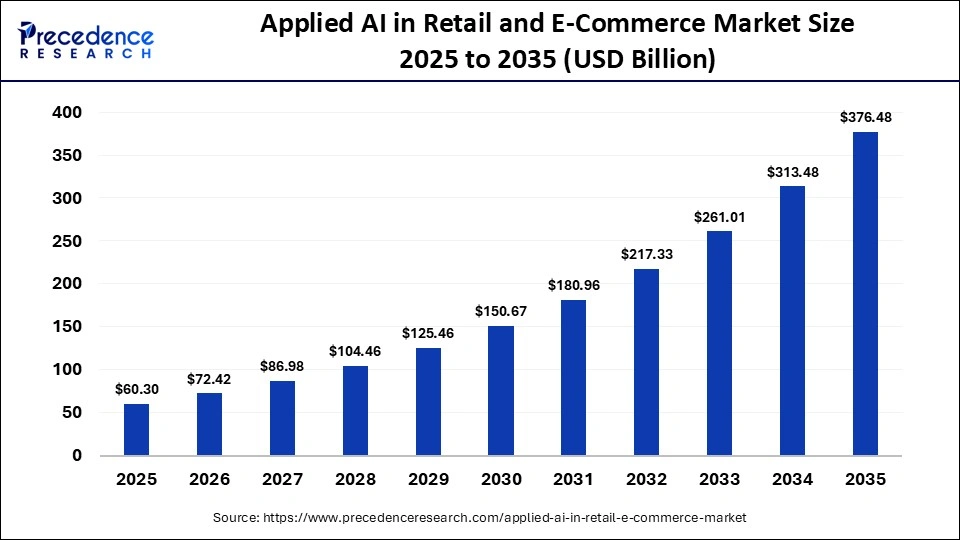
The global applied AI in retail and e-commerce market size was calculated at USD 60.30 billion in 2025 and is predicted to increase from USD 72.42 billion in 2026 to approximately USD 376.48 billion by 2035, expanding at a CAGR of 20.10% from 2026 to 2035. The market is driven by rising demand for a personalized shopping experience and a strong focus on improving supply chain operations.
Key Takeaways
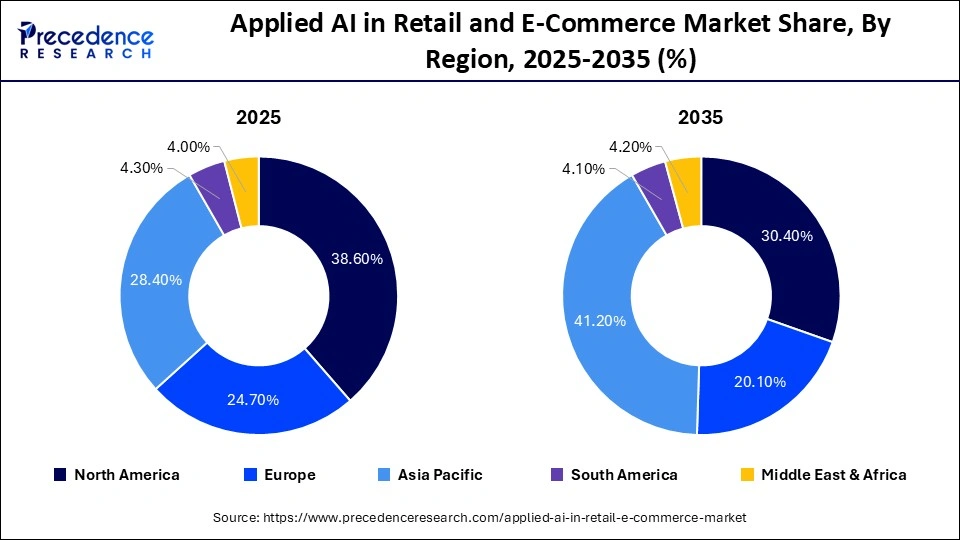
- North America held the largest market share of 38.60% in 2025.
- The Asia Pacific is projected to grow at the fastest CAGR during the foreseeable period.
- By solution type, the personalized recommendations segment held a 18.70% share in 2025.
- By solution type, the visual search segment is projected to grow at the fastest CAGR during the foreseeable period.
- By component, the software segment held the largest market share of 71.60% in 2025.
- By component, the services segment is projected to grow at the fastest CAGR during the foreseeable period.
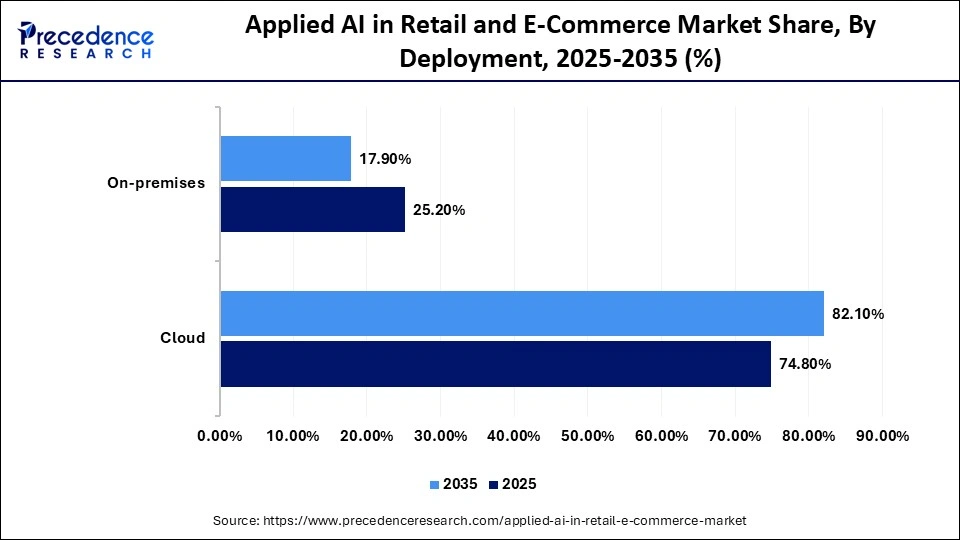
- By deployment, the cloud segment held the largest market share of 74.80% in 2025 and is projected to grow at the fastest CAGR during the foreseeable period.
- By end-use vertical, the general merchandise segment held the largest market share of 26.10% in 2025.
- By end-use vertical, the grocery and food retail segment is projected to grow at the fastest CAGR during the foreseeable period.
Market Overview
The applied AI in retail and e-commerce market covers software platforms and services that use artificial intelligence to improve merchandising, pricing, demand sensing, fulfilment, fraud control, customer engagement, and post-purchase support across digital and physical retail channels. It includes machine learning, computer vision, natural language processing, recommendation engines, and generative AI tools deployed through cloud or on-premises environments. The rapid expansion of online shopping and omnichannel retail further fuels demand for AI-powered solutions that improve customer engagement and business performance.
Applied AI in Retail and E-Commerce Market Trends
- Hyper-personalization is a major trend in the market, where AI analyzes browsing history and behavior to offer personalized product suggestions based on individual preferences.
- Increasing use of generative AI by retailers to create marketing content, product descriptions, and personalized product videos to maximize consumer engagement.
- Growing adoption of conversational AI is boosting the market. Conversational AI has become an integral part of the commerce and retail sector, with AI-powered chatbots and virtual assistants handling consumer queries and providing personalized shopping experiences to improve service efficiency.
- There is a high adoption of AI in the e-commerce sector to improve operations. AI algorithms can dynamically adjust product pricing in real time based on competitors' prices, market conditions, demand-supply ratios, and product availability.
- Growing focus on improving consumer experience drives the market. Computer vision facilitates visual search tools that allow consumers to find exact products using precise images, while AR provides virtual try-on options for a better experience and enhanced customer satisfaction.
Market Scope
| Report Coverage | Details |
| Market Size in 2025 | USD 60.30 Billion |
| Market Size in 2026 | USD 72.42 Billion |
| Market Size by 2035 | USD 376.48 Billion |
| Market Growth Rate from 2026 to 2035 | CAGR of 20.10% |
| Dominating Region | North America |
| Fastest Growing Region | Asia Pacific |
| Base Year | 2025 |
| Forecast Period | 2026 to 2035 |
| Segments Covered | Solution Type, Component, Deployment, End-use Vertical, and Region |
| Regions Covered | North America, Europe, Asia-Pacific, Latin America, and Middle East & Africa |
Market Dynamics
Drivers
Growing Shift Toward Hyper Personalization
The market is largely driven by the increasing preferences for a personalized shopping experience by consumers. Thus, many retailers are increasingly adopting AI-driven recommendation engines, live conversational chatbots, along with predictive analytics that can analyze huge datasets in real-time and offer expected product suggestions.
Restraint
Data Security Concerns
The growing reliance on sensitive consumer data for AI training is creating significant challenges, including data privacy concerns and the need for ethical data sourcing, which increases the risk of data breaches. Additionally, AI-driven personalization raises issues related to compliance with data protection regulations such as GDPR, potentially leading to legal penalties and diminished consumer trust.
Opportunity
Increasing Demand for AI Agents
The rapid shift from predictive AI to agentic commerce creates immense opportunities in the market. Autonomous AI agents, capable of browsing, comparing, completing purchases, and managing supply chains without human intervention, are in high demand, creating significant growth opportunities for market expansion.
Segment Insights
Solution Type Insights
Why Did the Personalized Recommendations Segment Dominate the AI in Retail and E-Commerce Market?
The personalized recommendations segment dominated the market with a 18.70% share in 2025, as it directly converts data into a revenue stream by improving conversion rates, consumer experience, and increasing average order value. Many retailers rely on these solutions to resolve issues like high cart abandonment rates and offer tailored shopping experiences. Amazon's recommendation engine is one of the best examples of personalized suggestion engines. Also, personalized experience fosters a sense of understanding among consumers, which translates into repeated purchases and boosts consumer retention.
Applied AI in Retail and E-Commerce Market Share, By Solution Type, 2025-2035 (%)
| Solution Type | 2025 | 2035 |
| Personalized Recommendations | 18.70% | 16.40% |
| Search And Discovery | 12.60% | 11.80% |
| Dynamic Pricing | 9.80% | 10.70% |
| Demand Forecasting | 11.70% | 10.60% |
| Inventory Optimization | 12.40% | 11.30% |
| Fraud Detection | 10.60% | 9.20% |
| Customer Service Automation | 11.30% | 14.70% |
| Visual Search | 4.80% | 8.60% |
| Marketing Automation | 5.90% | 4.80% |
| Supply Chain Optimization | 2.20% | 1.90% |
The visual search segment is projected to grow at the fastest CAGR during the foreseeable period as it supports digital discovery of products and easy purchasing options, directly influencing the visual-first shopping habits of modern consumers. By allowing users to snap a photo instead of describing their desired product in text, visual search solutions reduce friction in the buying process and shorten the time needed to find exact products. According to sources, nearly 85% of consumers trust visual information over text when shopping for products on mobile applications.
Component Insights
Applied AI in Retail and E-Commerce Market Share, By Component, 2025-2035 (%)
| Components | 2025 | 2035 |
| Software | 71.60% | 66.30% |
| Services | 28.40% | 33.70% |
What Made Software the Leading Segment in the Applied AI in Retail and E-Commerce Market?
The software segment led the market while holding the largest share of 71.60% in 2025. This is mainly due to its ability to deliver scalable, high-ROI solutions that directly enhance business operations and customer experiences. AI software supports personalized marketing, dynamic pricing, and inventory optimization while integrating easily with cloud-based platforms and software-as-a-service models. Additionally, advancements like generative AI enable real-time analytics and automation of complex tasks, making software indispensable for modern and omnichannel retail strategies.
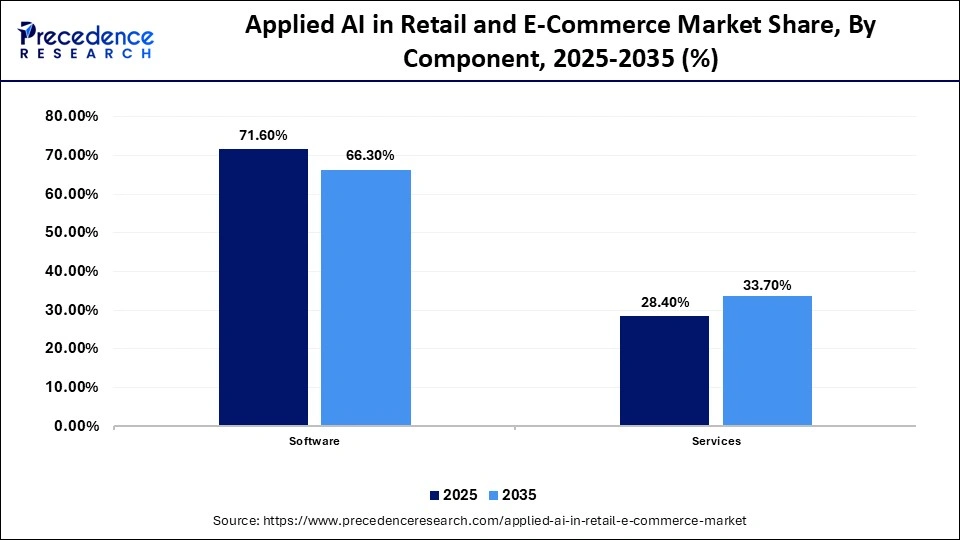
The services segment is projected to grow at the fastest CAGR during the foreseeable period because it provides critical support for the deployment, integration, and maintenance of AI solutions. AI services further automate crucial back-end processes like demand forecasting, dynamic pricing, and inventory management that reduce overstocking or understocking costs and improve profitability. AI services include chatbots and virtual assistants, which provide 24/7 backup to resolve consumer queries. Additionally, ongoing services such as training, support, and performance monitoring enable businesses to maximize ROI and adapt quickly to evolving market trends.
Deployment Insights
Applied AI in Retail and E-Commerce Market Share, By Deployment, 2025-2035 (%)
| Deployment | 2025 | 2035 |
| Cloud | 74.80% | 82.10% |
| On-premises | 25.20% | 17.90% |
Why is the Cloud Segment Dominating the Applied AI in Retail and E-Commerce Market?
The cloud segment dominated the market with the highest share of 74.80% in 2025 and is projected to grow at the fastest CAGR during the foreseeable period. This is primarily due to its ability to provide instant scalability for increasing shopping traffic, cost efficiency through pay-as-you-go models, and access to advanced AI tools without heavy infrastructure requirements. Retailers are increasingly adopting cloud platforms such as AWS and Azure, which offer the computational power needed for real-time personalization, demand forecasting, and inventory optimization.
End-Use Vertical Insights
Why Did the General Merchandise Segment Lead the Applied AI in Retail and E-Commerce Market?
The general merchandise segment led the market, holding a 26.10% share in 2025, owing to its huge inventory scale, the requirement for complex supply chain optimization, and the increasing volume of various customer data that needs advanced automation to drive hyper-personalization with operational efficiency. As general merchandise retailers handle a wide range of products, AI algorithms are highly crucial to processing such a huge dataset while managing its complexity to boost conversion rates. Thus, general merchandise players are largely investing in AI to manage their stocks as per demand and avoid losses.
Applied AI in Retail and E-Commerce Market Share, By End-use Vertical, 2025-2035 (%)
| End-Use Vertical | 2025 | 2035 |
| Grocery and Food Retail | 14.70% | 17.90% |
| Fashion and Apparel | 16.80% | 15.70% |
| Consumer Electronics | 13.60% | 12.80% |
| Beauty and Personal Care | 9.40% | 10.10% |
| Home and Furniture | 11.20% | 10.80% |
| General Merchandise | 26.10% | 24.60% |
| Others | 8.20% | 8.10% |
The grocery and food retail segment is projected to grow at the fastest CAGR during the foreseeable period, as they manage high-volume transactions and complex, perishable inventories that require real-time, accurate optimization. AI plays a key role in reducing food waste and streamlining supply chains for faster deliveries. Additionally, grocery retailers manage large datasets that allow AI to analyze consumer behavior and support data-driven decisions for maximizing profit.
Regional Insights
North America Applied AI in Retail and E-Commerce Market Size and Growth 2026 to 2035
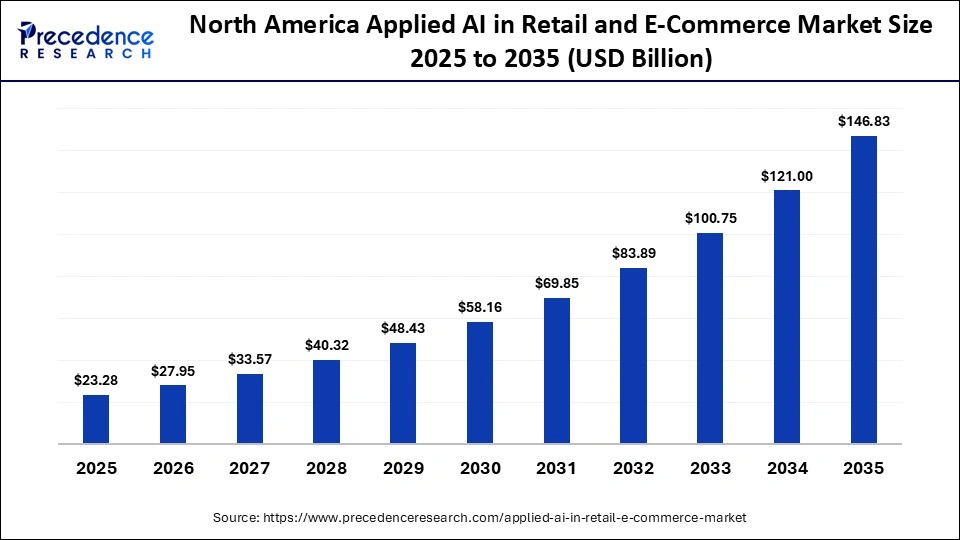
The North America applied ai in retail and ecommerce market size is estimated at USD 23.28 billion in 2025 and is projected to reach approximately USD 146.83 billion by 2035, with a 20.22% CAGR from 2026 to 2035.
What Made North America the Dominant Region in the Applied AI in Retail and E-Commerce Market?
North America dominated the AI in retail and e-commerce market with a share of 38.60% in 2025. This is mainly due to the early adoption of AI in several sectors, including retail and e-commerce, along with its robust digital infrastructure. The region also benefits from the presence of leading tech giants like Google and Microsoft. Retailers in the region benefit from advanced digitalization and seamless AI integration with existing systems, while growing consumer demand for personalized, 24/7 services drives adoption of AI solutions like chatbots, inventory management, and predictive analytics. Additionally, stringent data privacy regulations such as CCPA and GDPR positively influence AI-based strategies in the region.
U.S. Applied AI in Retail and E-Commerce Market Size and Growth 2026 to 2035
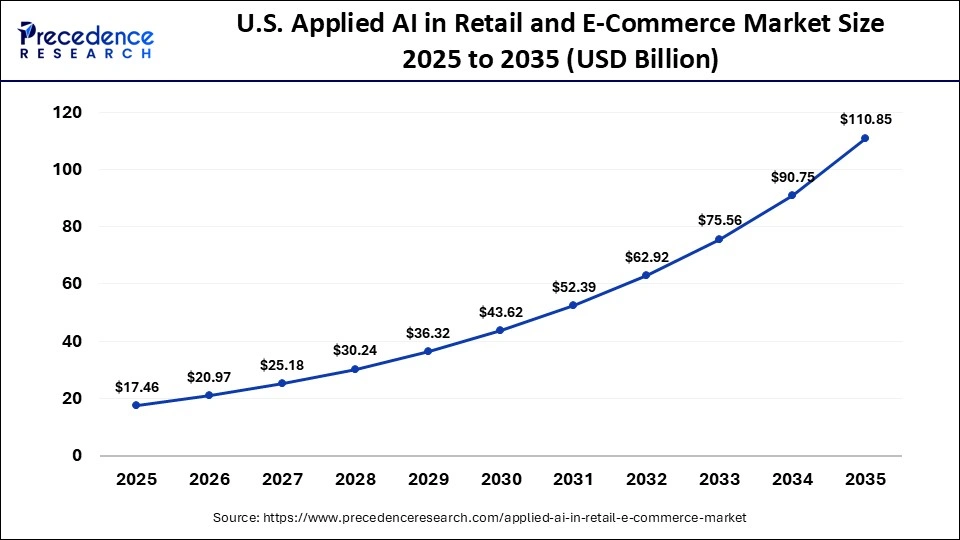
The U.S. applied ai in retail and ecommerce market size is calculated at USD 17.46 billion in 2025 and is expected to reach nearly USD 110.85 billion in 2035, accelerating at a strong CAGR of 20.30% between 2026 and 2035.
U.S. Applied AI in Retail and E-Commerce Market Analysis
The U.S. is a major contributor to the North American market, driven by substantial investments in AI technologies, rapid integration, and increased adoption in the retail and e-commerce sectors, including supply chain and inventory automation. Leading U.S. retailers are shifting to an AI-first model, with nearly 50% of e-commerce businesses embracing AI, fueling the region's growth exponentially.
Why is Asia Pacific Growing in the Applied AI in Retail and E-Commerce Market?
Asia Pacific is projected to grow at the fastest CAGR during the foreseeable period, driven by a massive digital consumer base with a mobile-first approach and an innovative ecosystem supported by government funding for AI research, enabling advanced global supply chains. The region accounts for nearly 60% of the world's consumer base, with many retailers adopting hyper-personalized and tailored product recommendations. AI is widely applied in retail and e-commerce across demand forecasting, inventory management, and robotics, further supporting market growth.
China Applied AI in Retail and E-Commerce Market Analysis
The market in China is primarily driven by recognition of AI's potential to transform the retail and e-commerce sectors. Intense competition among marketers encourages the adoption of cost-saving strategies and large super app ecosystems that generate vast amounts of data, requiring robust AI systems to provide accurate consumer insights and recommendations. Platforms like Alibaba and WeChat have established seamless, integrated ecosystems with high user adoption, enabling effective AI algorithms and hyper-personalization in China's e-commerce and retail sectors.
Applied AI in Retail and E-Commerce Market Companies
- Microsoft
- Amazon Web Services
- Google Cloud
- Salesforce
- Adobe
- Oracle
- SAP
- IBM
- NVIDIA
- Shopify
- Dynamic Yield
- Algolia
- Criteo
- Bloom reach
- Coveo
Recent Developments
- In March 2026, a U.S.-based technology leader, Coupang, announced its collaboration with NVIDIA at the NVIDIA AI conference and Expo, aiming to build AI factory to accelerate innovations across the company's e-commerce logistics and delivery services.
- In March 2026, a leading marketer, CATCHES, introduces GenAI with physics-based sizing technology curated for fashion e-commerce in a partnership with NVIDIA.(Source: https://www.businesswire.com)
Segments Covered in the Report
By Solution Type
- Personalized recommendations
- Search and discovery
- Dynamic pricing
- Demand forecasting
- Inventory optimization
- Fraud detection
- Customer service automation
- Visual search
- Marketing automation
- Supply chain optimization
By Component
- Software
- Services
By Deployment
- Cloud
- On-premises
By End-use Vertical
- Grocery and food retail
- Fashion and apparel
- Consumer electronics
- Beauty and personal care
- Home and furniture
- General merchandise
- Others
By Region
- North America
- Latin America
- Europe
- Asia-pacific
- Middle and East Africa
For inquiries regarding discounts, bulk purchases, or customization requests, please contact us at sales@precedenceresearch.com
Frequently Asked Questions





Ask For Sample
No cookie-cutter, only authentic analysis – take the 1st step to become a Precedence Research client
 Get a Sample




 sales@precedenceresearch.com
 Schedule a Meeting
