



Applied AI in Energy and Utilities Market Trends, Companies, Revenue / Sales Performance, Subscriber Growth, Pricing Strategies, Cloud Adoption, Infrastructure Expansion, Competitive Landscape, and Industry Outlook
Applied AI in Energy and Utilities Market (By Component: Software, Services, Hardware; By Deployment Mode: Cloud, On premises, Hybrid; By Application: Renewable Energy Forecasting, Grid Optimization, Demand Forecasting, Predictive Maintenance, Outage Management, Energy Trading, Customer Analytics, Fraud Detection; By End Use: Power Generation, Transmission, Distribution, Retail Energy, Water and Wastewater Utilities; By Technology: Machine Learning, Deep Learning, Natural Language Processing, Computer Vision, Digital Twin, Predictive Analytics, Reinforcement Learning) - Global Industry Analysis, Size, Trends, Leading Companies, Regional Outlook, and Forecast 2026 to 2035
Source: https://www.precedenceresearch.com/applied-ai-in-energy-and-utilities-market
 Get a Sample
 Table Of Content


What is the Applied AI in Energy and Utilities Market Size in 2026?
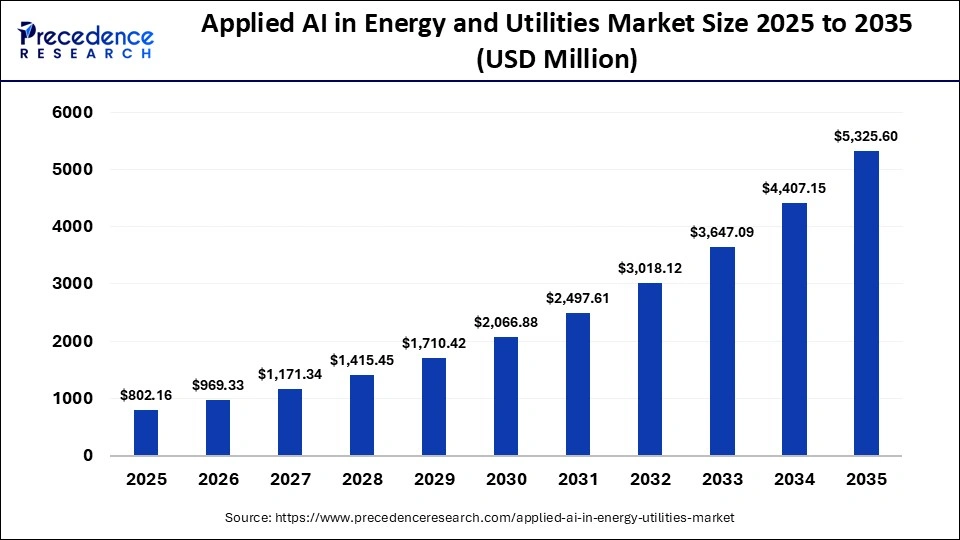
The global applied AI in energy and utilities market size was calculated at USD 802.16 million in 2025 and is predicted to increase from USD 969.33 million in 2026 to approximately USD 5,325.60 million by 2035, expanding at a CAGR of 20.84% from 2026 to 2035. The market growth is attributed to the increasing need for intelligent grid management solutions as utilities integrate renewable energy, digital infrastructure, and electrified energy systems.
Key Takeaways
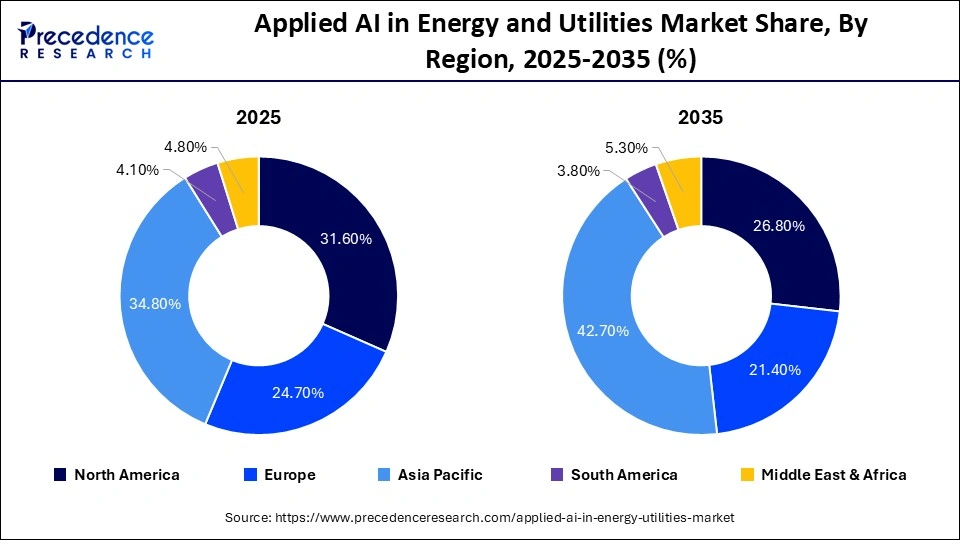
- North America dominated the market with 31.6% of the market share in 2025.
- Asia-Pacific is expected to grow at the fastest CAGR between 2026 and 2035.
- By component, the software segment contributed the highest applied AI in energy and utilities market share of 56.7% in 2025.
- By component, the services segment is expected to grow at a strong CAGR of 22.7% between 2026 and 2035.
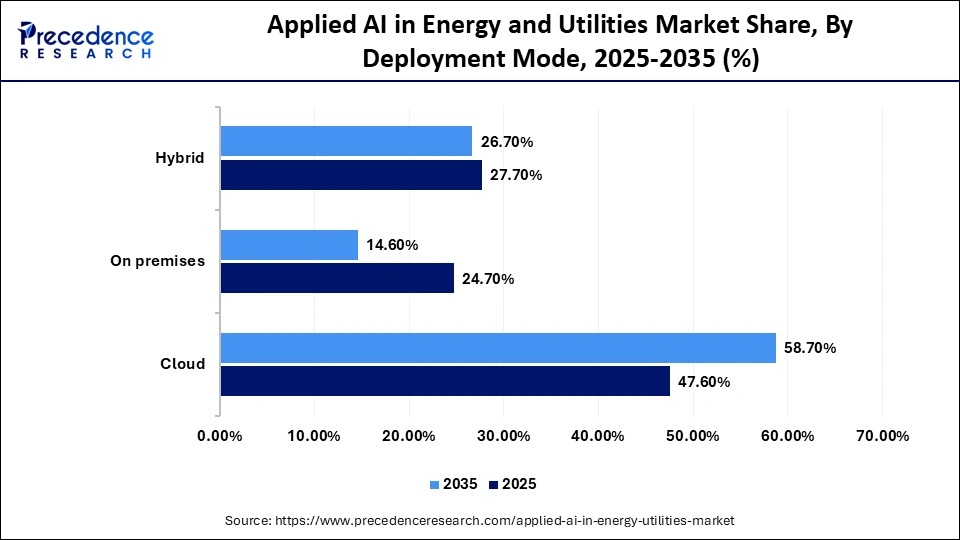
- By deployment mode, the cloud segment held a dominant revenue share of 47.6% in the market in 2025, and is expected to sustain its position with a CAGR of 23.80% in the upcoming period.
- By application, the grid optimization segment captured the highest market share of 19.6% in 2025.
- By application, the renewable energy forecasting segment is poised to grow at a healthy CAGR of 24.6% between 2026 and 2035.
- By end use, the distribution segment generated the biggest market share of 31.7% in 2025.
- By end use, the transmission segment is expected to expand at the fastest CAGR of 24.1% between 2026 and 2035.
- By technology, the machine learning segment accounted for the largest market share of 24.8% in 2025.
- By technology, the reinforcement learning segment is projected to grow at a solid CAGR of 24.8% between 2026 and 2035.
Which Factors Drive the Applied AI in Energy and Utilities Market?
The growing need for efficient, resilient, and intelligent energy systems is a major driver accelerating the global applied AI in energy and utilities industry. Such technologies assist utilities in predicting power demand, controlling power production, spotting equipment malfunctions, and enhancing grid reliability. Artificial intelligence (AI) systems assist operators in working with real-time grid information and react rapidly to the evolving state of energy supply and demand.
The International Energy Agency states that up to 175 GW of the additional transmission capacity of the current electricity grids can be unlocked by using advanced AI-based analytics. This further optimizes operations and detects new types of digital monitoring. Moreover, the increasing deployment of digital grid technologies is driving the adoption of applied AI solutions for real-time monitoring and operational optimization.
Applied AI in Energy and Utilities Market Trends
- Rising AI-Driven Electricity Demand from Data Centers Accelerating Intelligent Grid Management: The rapid expansion of AI computing infrastructure is increasing electricity demand from hyperscale data centers worldwide. This wave is prompting utilities to consider applying AI solutions to the demand projection, grid balancing, and efficient power allocation.
- Electrification Trends Increasing the Need for AI-Based Energy Forecasting : The growth of electric cars, electrified industries, and renewable energy is causing a sharp rise in electricity demand in global power systems. This trend is encouraging utilities to deploy applied AI platforms capable of forecasting demand, optimizing energy generation, and improving grid reliability.
Growth Factors
- Growing Use of Advanced Analytics in Energy Trading Markets: AI-enabled forecasting and market analytics platforms are boosting efficiency in electricity trading and energy market operations.
- Rising Cybersecurity Requirements in Digital Power Systems: Increasing cyber threats targeting energy infrastructure are fuelling the deployment of AI-based grid security monitoring solutions.
AI Momentum Surges as Energy and Utility Leaders Accelerate Digital Transformation Strategies
- According to a 2024 industry study by IBM, approximately 74% of energy and utility companies globally have already implemented or are actively exploring AI technologies across operational processes such as grid monitoring, asset management, and predictive analytics.
- A 2024 survey of utility executives conducted by Itron reported that around 82% of utility leaders stated their organizations are currently adopting or deploying AI and machine learning technologies, particularly for smart grid analytics, network optimization, and infrastructure monitoring.
- Technology leadership surveys released in 2025 found that 94% of power and utility CIOs plan to increase investments in AI initiatives, with organizations reporting an average AI spending increase of roughly 38% in 2025 to support digital transformation and automated grid operations.
- Venture funding for AI startups, including those focused on utilities and power-grid technologies, reached approximately USD 427.1 million globally in 2025, highlighting increasing private investment into AI platforms that support grid automation, predictive maintenance, and advanced energy analytics.
Market Scope
| Report Coverage | Details |
| Market Size in 2025 | USD 802.16 Million |
| Market Size in 2026 | USD 969.33 Million |
| Market Size by 2035 | USD 5,325.60 Million |
| Market Growth Rate from 2026 to 2035 | CAGR of 20.84% |
| Dominating Region | North America |
| Fastest Growing Region | Asia Pacific |
| Base Year | 2025 |
| Forecast Period | 2026 to 2035 |
| Segments Covered | Component, Deployment Mode, Application, End Use, Technology, and Region |
| Regions Covered | North America, Europe, Asia-Pacific, Latin America, and Middle East & Africa |
Segmental Insights
Component Insights
How Did the Software Segment Dominate the Applied AI in Energy and Utilities Market?
The software segment dominated the global market in 2025, accounting for an estimated 56.7% market share, due to the rapid expansion of digital grid management platforms and advanced analytics systems used by power operators.
AI-based software was used more in utilities to make load forecasting, generation optimization, and real-time grid monitoring. Furthermore, the renewable integration and electricity demand forecasting on complex power systems were implemented using AI software platforms more by energy companies.
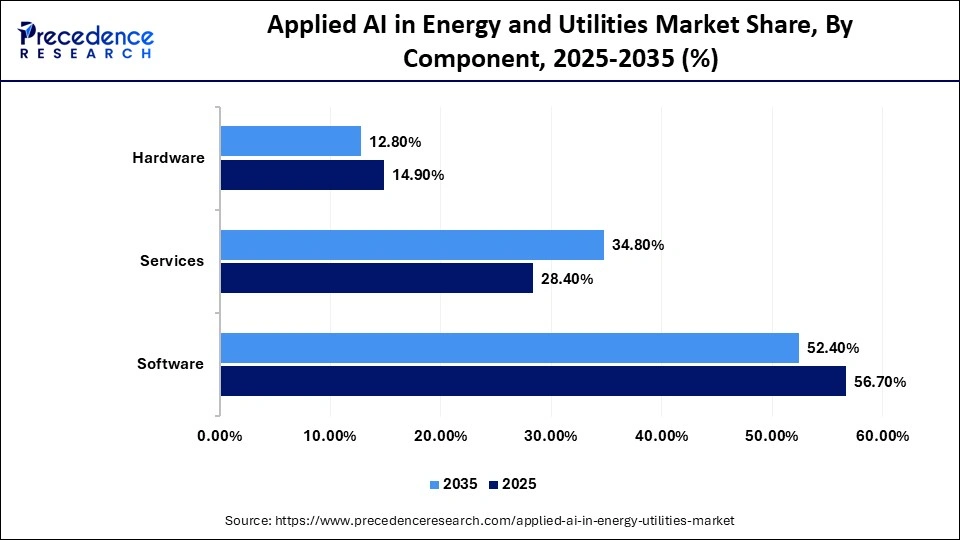
The services segment is expected to grow at the fastest CAGR of 22.7% in the coming years, owing to the growth in the necessity to implement system integration, AI consulting, and advanced analytics implementation support.
Utilities typically operate complex legacy infrastructure, requiring specialized technical expertise to integrate AI platforms with existing grid management systems. Additionally, the increasing complexity of electricity markets and grid administration settings is projected to speed up the need to hire specialized AI advice services in the coming years.
Deployment Mode Insights
Why the Cloud Dominated the Applied AI in Energy and Utilities Market?
The cloud segment held a dominant revenue share of 47.6% in the market in 2025 and is expected to expand rapidly with a CAGR of 23.8% in the upcoming period, due to the growing need for scalable computing infrastructure capable of processing large energy datasets. Cloud environments are being increasingly used to execute machine learning algorithms used to analyze grid operations.
Large cloud infrastructure providers also provide better cybersecurity structures and automated management of systems to utilities. The International Renewable Energy Agency in 2025 stated that the amount of renewable energy available worldwide hit more than 4,000 GW This further exceeds large data demands in forecasting and grid balancing activities, thus further fuelling the segment's growth.
Application Insights
Which Application Segment Dominated the Applied AI in Energy and Utilities Market?
The grid optimization segment registered its dominance in the market in 2025, accounting for an estimated 19.6% market share, due to the increasing complexity of modern electricity networks and the rapid growth of distributed energy resources.
Power system operators are incorporating AI-based analytics to measure transmission congestion and address operational anomalies. Furthermore, the development of smart grid infrastructure and automated energy management systems enhances grid optimization as the most common use of AI integration within the energy industry.
The renewable energy forecasting segment is expected to grow at the fastest CAGR of 24.6% in the coming years, owing to the swift rise in the installation of solar and wind power plants across the globe. Energy firms are also incorporating AI predictive software with weather analytics systems to optimize the planning of the renewable facility operations. Moreover, the growing investment in renewable infrastructure is likely to fuel AI-based forecasting platforms as a critical application for energy system management in the coming years.
End Use Insights
Which End Use Segment Led the Applied AI in Energy and Utilities Market?
The distribution segment held the largest revenue share of 31.7% in the global market in 2025, due to the growing digitalization of the local electricity infrastructure and the fast adoption of smart grid technologies.
The AI-based monitoring systems assess voltage stability, faults, and load distribution in cities and rural power systems. Furthermore, the use of smart meters and other connected grid equipment is expected to enhance the dominance of distribution networks within the programs of utility modernization with the help of AI.
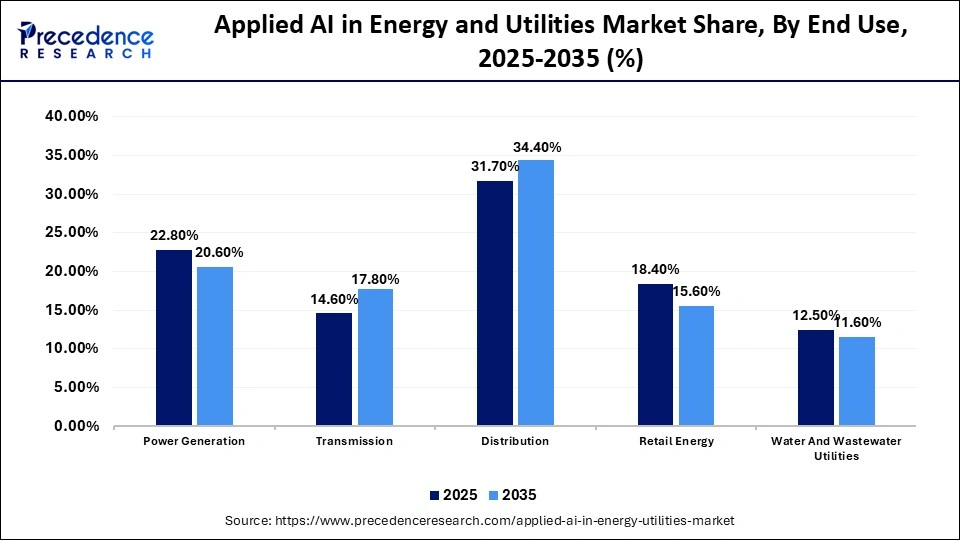
The transmission segment is expected to show the fastest growth with a CAGR of 24.1% over the forecast period, owing to the rapid development of high-capacity power networks that aim to connect renewable generation facilities and population centers.
Analytics platforms that operate based on AI are thus projected to enhance the visibility of the operations in extensive transmission corridors. Growing interconnection between national energy systems is therefore likely to position transmission infrastructure as the fastest-growing application area for AI technologies within modern electricity networks.
Technology Insights
How the Machine Learning Segment Dominated the Applied AI in Energy and Utilities Market?
The machine learning segment accounted for the highest market share of 24.8% in 2025, due to the increased demand for advanced data analytics that process massive data types produced by power systems. Additionally, the use of smart grids and interrelated energy appliances is expected to strengthen machine learning as the leading technology in assisting the running of intelligent utilities.
The reinforcement learning segment is expected to expand rapidly in the market with a CAGR of 24.8% in the coming years, owing to the growing demand for autonomous decision-making algorithms with the capacity to operate complex electrical networks. The further expansion of the implementation of distributed energy resources and battery storage systems is then likely to drive the faster adoption of reinforcement learning technologies in digital energy networks in the coming years.
Regional Insights
Asia Pacific Applied AI in Energy and Utilities Market Size and Growth 2026 to 2035
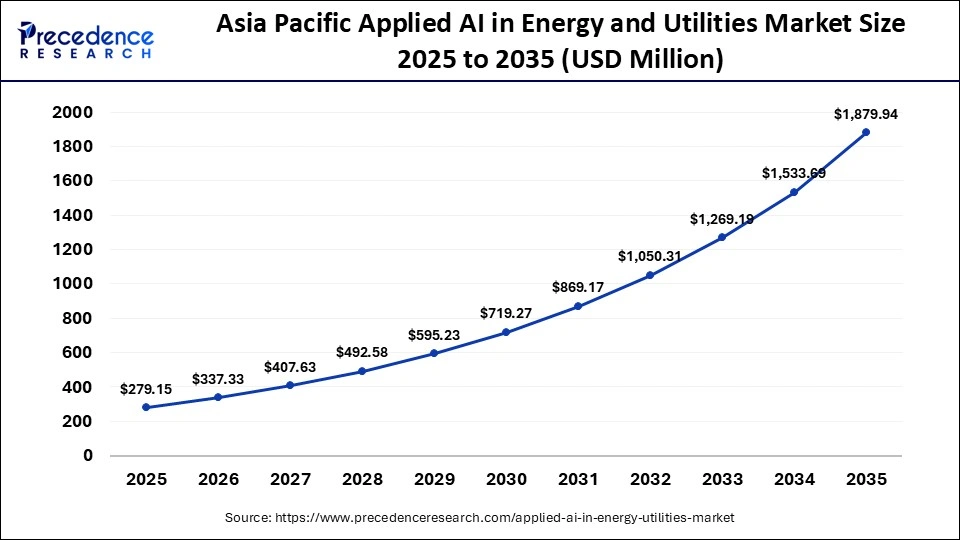
The Asia Pacific applied AI in energy and utilities market size is expected to be worth USD 1,879.94 million by 2035, increasing from USD 279.15 million by 2025, growing at a CAGR of 21.01% from 2026 to 2035.
Why is Asia-Pacific Growing in the Applied AI in Energy and Utilities Market?
Asia-Pacific is expected to experience the fastest growth during the predicted timeframe, owing to the growth of electricity infrastructure and the accelerating renewable energy investments in the top economies in the area, China, India, Japan, and South Korea.
The International Energy Agency reported that much of the electricity demand growth in the world was propelled by the Asia-Pacific. This has placed a strain on utilities to embrace modern digital technologies in managing their grids. Additionally, the rapid infrastructure expansion and accelerating digital transformation across regional utilities are projected to boost the Asia-Pacific regional market in the coming years.
China: Powering the Rapid Growth of AI-Enabled Energy Systems in Asia-Pacific
China is leading the charge in the Asia-Pacific market, driven by the presence of the largest power infrastructures in the world. Reports indicate the country could add more than 500 GW of new renewable capacity in 2025, including about 380 GW of solar and 140 GW of wind installations.
What Factors Enabled North America to Lead the Applied AI in Energy and Utilities Market?
North America held a major revenue share of 31.6% in the market in 2025, due to the early deployment of smart grid technologies and advanced digital infrastructure across the U.S. and Canada. Energy companies in the region are actively uniting AI-based analytics systems to regulate the electricity demand and enhance predictive maintenance processes.
According to the U.S. Energy Information Administration, America had over 120 million advanced metering infrastructure units in 2025. This leads to the production of large volumes of real-time data to monitor and optimize the grid. Furthermore, strong investments in grid modernization programs and digital energy technologies are anticipated to sustain North America's leadership position in applied AI deployment across energy infrastructure.
U.S. Driving AI Expansion in North America's Energy and Utilities Sector
U.S. leads the market, driven by the strong growth in energy demand from electrification and digital infrastructure. The U.S. Energy Information Administration reported that in 2025, electricity consumption was approximately 4,195 billion kilowatt hours.
AI platforms are being implemented by more energy operators in the country to handle the increasing electricity demand. Furthermore, major utilities such as NextEra Energy and Duke Energy are expanding AI-driven analytics platforms that evaluate grid performance and predict equipment failures before outages occur.
Applied AI in Energy and Utilities Market Supply Chain Analysis
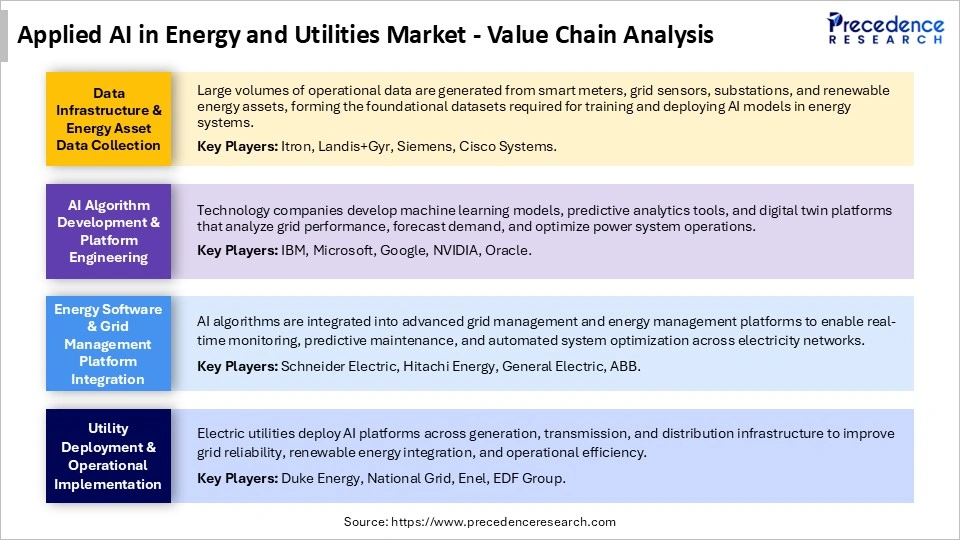
Applied AI in Energy and Utilities Market Companies
- Schneider Electric
- GE Vernova
- ABB
- Honeywell
- Siemens
- Amazon Web Services
- IBM
- Microsoft
- Oracle
- SAP
- Hitachi Energy
- Bidgely
- C3 AI
- Google Cloud
- Palantir
Recent Developments
- In January 2026, Snowflake introduced Energy Solutions, a unified platform combining governance tools, partner solutions, and industry datasets to support AI adoption across the energy sector. The offering enables utilities and oil & gas companies to securely connect IT, OT, and IoT data environments, modernizing infrastructure, improving operational efficiency, and supporting lower-carbon energy systems.(Source: https://www.snowflake.com)
- In March 2026, WinDC partnered with Armada to deploy Australia's first network of portable AI factories powered by renewable energy. The initiative aims to attract global technology investment by leveraging Australia's abundant clean energy resources to support AI computing infrastructure. The first portable AI factory unit has already been deployed within the country.(Source: https://www.businesswire.com)
Segments Covered in the Report
By Component
- Software
- Services
- Hardware
By Deployment Mode
- Cloud
- On premises
- Hybrid
By Application
- Renewable Energy Forecasting
- Grid Optimization
- Demand Forecasting
- Predictive Maintenance
- Outage Management
- Energy Trading
- Customer Analytics
- Fraud Detection
By End Use
- Power Generation
- Transmission
- Distribution
- Retail Energy
- Water and Wastewater Utilities
By Technology
- Machine Learning
- Deep Learning
- Natural Language Processing
- Computer Vision
- Digital Twin
- Predictive Analytics
- Reinforcement Learning
By Region
- North America
- Latin America
- Europe
- Asia-pacific
- Middle and East Africa
For inquiries regarding discounts, bulk purchases, or customization requests, please contact us at sales@precedenceresearch.com
Frequently Asked Questions





Ask For Sample
No cookie-cutter, only authentic analysis – take the 1st step to become a Precedence Research client
 Get a Sample




 sales@precedenceresearch.com
 Schedule a Meeting
