



Generative AI in Fulfillment and Logistics Market Trends, Companies, Revenue / Sales Performance, Subscriber Growth, Pricing Strategies, Cloud Adoption, Infrastructure Expansion, Competitive Landscape, and Industry Outlook
Generative AI in Fulfillment and Logistics Market (By Component: Software, Services; By Deployment Mode: Cloud, On Premises, Hybrid; By Function: Warehousing, Transportation Management, Inventory Management, Procurement and Supplier Collaboration; By Application: Demand Forecasting and Replenishment, Route and Load Optimization, Customer Communication and Order Status Automation; By End Use Industry: Ecommerce and Retail, Third Party Logistics and Fourth Party Logistics, Manufacturing, Consumer Electronics, Others;) - Global Industry Analysis, Size, Trends, Leading Companies, Regional Outlook, and Forecast 2026 to 2035
Source: https://www.precedenceresearch.com/generative-ai-in-fulfillment-and-logistics-market
 Get a Sample
 Table Of Content


What is the Generative AI in Fulfillment and Logistics Market Size in 2026?
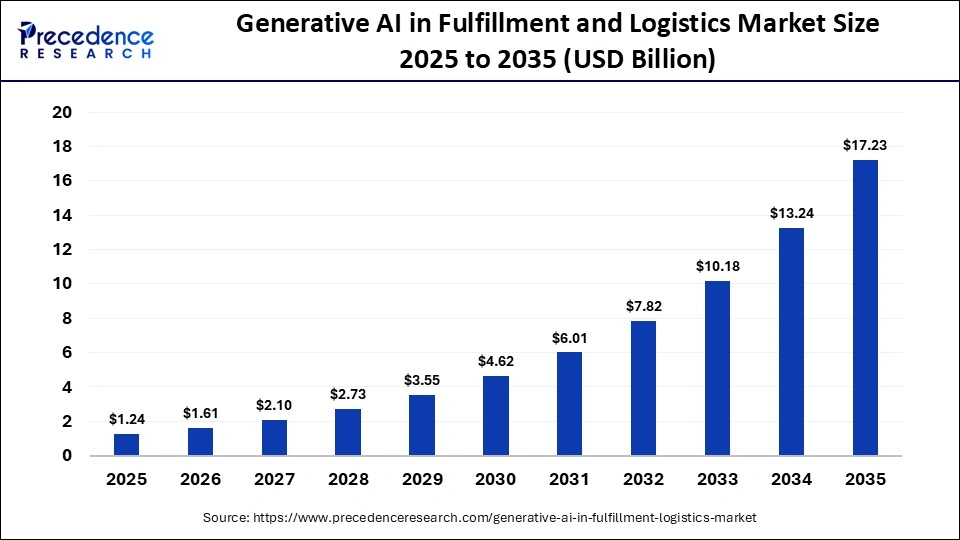
The global generative AI in fulfillment and logistics market size was calculated at USD 1.24 billion in 2025 and is predicted to increase from USD 1.61 billion in 2026 to approximately USD 17.23 billion by 2035, expanding at a CAGR of 30.10% from 2026 to 2035.The generative AI in fulfillment and logistics market is growing rapidly due to the propelling demand by the industry for ease in management of complex supply chains, cost reduction, and easy warehouse management. Cloud services also help the industry automate workflows of the shippers, retailers, and product manufacturers.
Key Takeaways
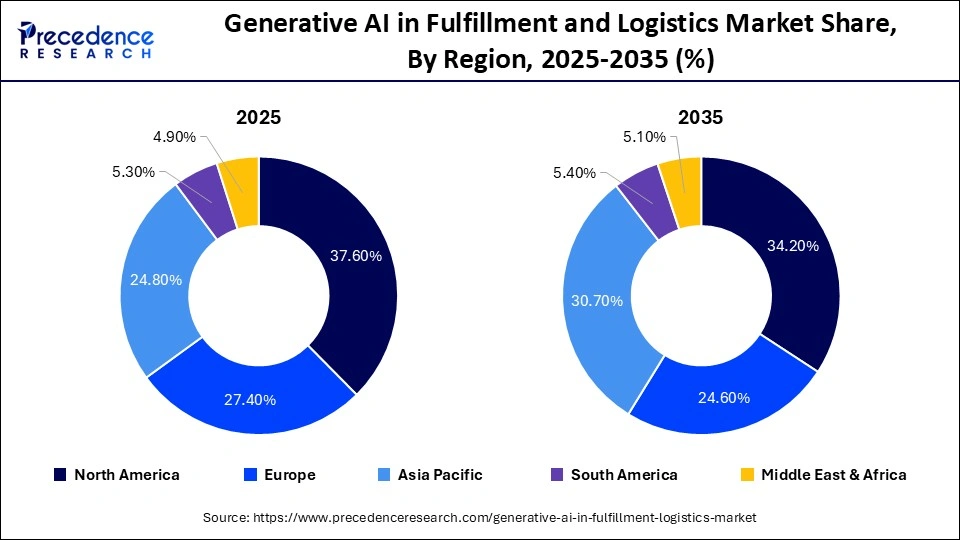
- North America led the global generative AI in fulfillment and logistics market with a share of 37.6% in 2025.
- Asia-Pacific is expected to be the fastest-growing region in the foreseeable period.
- By component, the software segment held a major dominance over the global market in 2025 with 72.5% share.
- By component, the services segment is expected to be the fastest-growing segment with the highest CAGR of 31.7% in the forecast period.
- By deployment mode, the cloud segment held a dominant position in the market with a share of 61.7% in 2025.
- By deployment mode, the hybrid segment is expected to grow at the fastest CAGR of 34.6% in the market between 2026 and 2035.
- By function, the transportation management segment accounted for a considerable revenue share of 22.4% in the market in 2025.
- By function, the fulfillment orchestration segment is expected to grow with the highest CAGR of 34.2% in the market during the studied years.
- By application, the route and load optimization segment led the global market with 20.3% share in 2025.
- By application, the control tower and scenario simulation segment is expected to expand rapidly with the highest CAGR of 34.8% in the coming years.
- By end use industry, the e commerce and retail segment dominated the global market with a share of 24.8% in 2025.
- By end use industry, the healthcare and pharmaceuticals segment is expected to show the fastest growth with a CAGR of 35.1% over the forecast period.
Role of AI in Generative AI in Fulfillment and Logistics
- Simulation and Risk Mitigation: The advanced technology helps in creating synthetic datasets to simulate, model, and optimize supply chain scenarios for building resilient strategies.
- Automated Customer Service: AI-powered, context-aware chatbots are ideal to handle complex situations, along with providing real-time tracking and managing customer queries.
- Intelligent Documentation: GenAI helps handle complex and vital paperwork, such as customs paperwork, invoices, and shipping contracts, to lower manual errors.
What is Generative AI in Fulfillment and Logistics Market?
The generative AI in fulfillment and logistics industry comprises software platforms, models, and related services that use generative artificial intelligence (GenAI) to improve warehouse operations, transportation planning, inventory decisions, order orchestration, customer communication, document processing, and supply chain control. The market includes cloud and on-premises deployments used by shippers, retailers, manufacturers, and logistics providers to automate workflows, generate recommendations, simulate scenarios, and enhance productivity, service levels, cost efficiency, and decision quality across fulfillment and logistics value chains.
Generative AI in Fulfillment and Logistics Market Trends
- Growing Autonomous Agents: Growing usage of AI agents, helpful for multi-step reasoning, tool usage, and managing complex logistical tasks, is a major market driver.
- Warehouse Automation: Use of advanced technology to improve warehouse activities and enhance the pace of activities such as picking, sorting, arranging, and managing other logistical activities better than manual efforts also propels the market's growth.
- Enhanced Route Planning: Another major benefit of GenAI for the industry involves dynamic route planning for cost savings, fuel efficiency, improved last-mile deliveries, and improved delivery timelines.
Market Scope
| Report Coverage | Details |
| Market Size in 2025 | USD 1.24 Billion |
| Market Size in 2026 | USD 1.61 Billion |
| Market Size by 2035 | USD 17.23 Billion |
| Market Growth Rate from 2026 to 2035 | CAGR of 30.10% |
| Dominating Region | North America |
| Fastest Growing Region | Asia-Pacific |
| Base Year | 2025 |
| Forecast Period | 2026 to 2035 |
| Segments Covered | Component, Deployment Mode, Function, Application, End Use Industry, and Region |
| Regions Covered | North America, Europe, Asia-Pacific, Latin America, and Middle East & Africa |
Market Dynamics
Drivers
Operational Efficiency and Cost Reduction
Technological advancements help the industry by streamlining workflows, enhancing operational management, and smoothing the complex logistical systems with ease. GenAI can eliminate delays in transportation and logistics, thereby significantly decreasing costs and enhancing supply chain reaction time. Operational efficiency is achieved by automated document processing and compliance checking that reduces administrative burden while reducing legal risks. Thus, companies can save costs in real estate and operations by reducing space requirements and improving resource utilization.
Restraint
Higher Implementation Costs
Implementing GenAI involves higher capital investment to develop an AI infrastructure, along with costs related to specialized software licensing and cloud computing services. It is available in an annual subscription-based format. This limits the affordability of several business owners with small- and mid-sized businesses.
Opportunity
Integration with Advanced Technologies
The market future is promising, driven by the increasing integration of GenAI with advanced technologies, such as machine learning and computer vision. Apart from warehouse management and order distribution, GenAI enhances robotic systems and processes. Machine learning analyzes vast amounts of data and identifies equipment defects on a prior basis, enabling professionals to make effective decisions. Additionally, computer vision-based robotics can observe and understand their environment, improving operational accuracy.
Segmental Insights
Component Insights
Generative AI in Fulfillment and Logistics Market Share, By Component, 2025-2035 (%)
| Component | 2025 | 2035 |
| Software | 72.50% | 66.40% |
| Services | 27.50% | 33.60% |
The Software Segment Led the Market With 72.5% Share in 2025
The software segment led the generative AI in fulfillment and logistics market with a share of 72.5% in 2025, as software helps in proper planning, optimizing, and warehouse management. Software also focuses on route planning, demand forecasting, and inventory management. It also has a higher demand as the advanced technology helps the logistics industry in faster decision-making, enhancing warehouse productivity, and improving delivery times. Real-time tracking and automated material handling to lower the wastage and maintain product quality also boost the segment's growth.
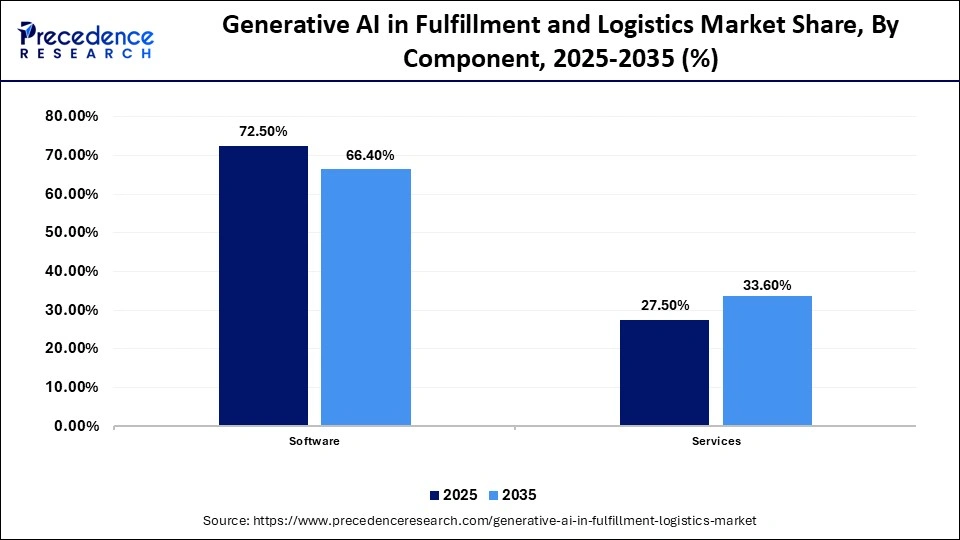
The services segment is expected to show the fastest growth with a CAGR of 31.7% over the forecast period, as services help the industry to apply the theoretical knowledge into practicality and propel its multiple operations. GenAI helps the industry to bridge the gap between traditional logistical methods and GenAI platforms. It aids seamless warehouse management, further propelling the growth of the segment. Service providers also help logistics companies to identify the right AI tools, rather than rushing into the wrong choices, leading to rising costs. The segment also helps in data cleaning, structuring, and governance for tracking inconsistent logistics data.
Deployment Mode Insights
Generative AI in Fulfillment and Logistics Market Share, By Deployment Mode, 2025-2035 (%)
| Deployment Mode | 2025 | 2035 |
| Cloud | 61.70% | 56.30% |
| On Premises | 23.60% | 15.80% |
| Hybrid | 14.70% | 27.90% |
The Cloud Segment Dominated the Market With 61.7% Share in 2025
The cloud segment held the largest generative AI in fulfillment and logistics market share of 61.7% in 2025, as it provides enhanced scalability, cost-effective infrastructure, and real-time data integration. Hence, logistics companies can get enhanced route optimization and predictive analysis, along with automated fulfillment with major capital investments. Cloud-based tools enable logistics companies to manage their resources accordingly and lower wastage to manage costs. They also help handle sudden market fluctuations and demands. The enhanced technology seamlessly integrates with warehouse management systems and streamlines supply chains.
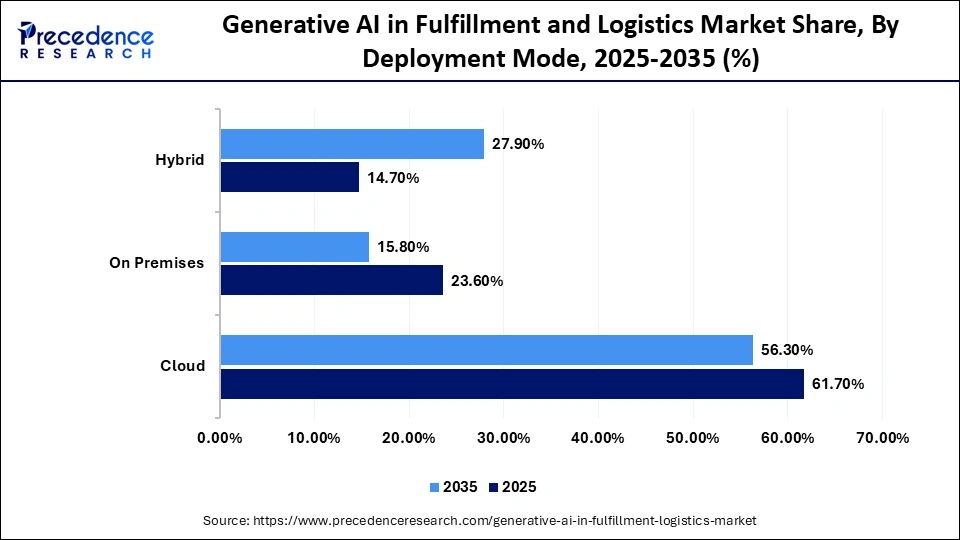
The hybrid segment is expected to gain the highest market share with a CAGR of 34.6% between 2026 and 2035. Hybrid tools involve an ideal balance between cloud-based services and on-premises deployment. They help manage the industry perfectly by providing the benefits of both systems. The segment helps logistics companies to balance the need for high-speed, data-intensive AI processing, along with maintaining data privacy. The segment also aids factors such as tailored picking processes, mass picking for DTC, and bulk handling for B2B, which is helpful for modern e-commerce.
Function Insights
The Transportation Management Segment Contributed the Highest Market Share of 22.4% in 2025
The transportation management segment registered its dominance over the global generative AI in fulfillment and logistics market with a share of 22.4% in 2025, due to the shifting trend towards passive-based tracking to proactive, autonomous optimization. GenAI analyzes large datasets involving factors such as traffic, weather, port capacity, and driver behavior. Predictive maintenance helps manage situations before failure occurs and lowers repair costs by approximately 10%. GenAI also helps analyze vehicle utilization for understanding its maximum input by gathering details such as load details, weight constraints, and destination to utilize the last mile effectiveness.
Generative AI in Fulfillment and Logistics Market Share, By Function, 2025-2035 (%)
| Function | 2025 | 2035 |
| Warehousing | 18.20% | 17.60% |
| Transportation Management | 22.40% | 20.10% |
| Inventory Management | 15.30% | 14.20% |
| Order Management | 11.60% | 10.80% |
| Fulfillment Orchestration | 12.70% | 16.40% |
| Customer Service and Exception Management | 10.50% | 12.80% |
| Procurement and Supplier Collaboration | 9.30% | 8.10% |
The fulfillment orchestration segment is expected to witness the fastest growth in the market with a CAGR of 34.2% over the forecast period, as it aids faster decision-making, optimizing warehouse robotic coordination, and synchronizing inventory, transport, and labor. GenAI helps analyze vast datasets and suggest ideal routes and warehouse operations to avoid bottleneck situations. It also helps automate time-consuming tasks such as generating shipping documentation, analyzing contract compliance, and managing inventory replenishment.
Application Insights
The Route and Load Optimization Segment Dominated the Market With 20.3% Market Share in 2025
The route and load optimization segment led the generative AI in fulfillment and logistics market with a share of 20.3% in 2025, as it can analyze company datasets and live weather conditions to suggest ideal routes for enhanced optimization, lower fuel consumption, and lower delivery times. GenAI helps suggest alternative routes to manage the delivery time in case of a road accident or any similar time-consuming issues. It can effectively manage hundreds of deliveries in a way that lowers the fuel consumption, manages delivery times, and decreases costs in dense urban areas. Such programs are ideal for improving delivery time management and accuracy.
Generative AI in Fulfillment and Logistics Market Share, By Application, 2025-2035 (%)
| Application | 2025 | 2035 |
| Demand Forecasting and Replenishment | 17.40% | 16.20% |
| Route and Load Optimization | 20.30% | 18.40% |
| Warehouse Slotting, Picking, and Labor Optimization | 18.60% | 17.80% |
| Document Automation and Customs Workflow | 11.20% | 10.40% |
| Returns and Reverse Logistics | 8.40% | 9.60% |
| Control Tower and Scenario Simulation | 12.50% | 15.90% |
| Customer Communication and Order Status Automation | 11.60% | 11.70% |
The control tower and scenario simulation segment is expected to expand rapidly in the market with a CAGR of 34.8% in the coming years. The segment majorly focuses on transforming the warehouse data into an ideal and effective strategy for the market. It also helps in providing real-time shipment tracking and analyzing vendor performance. AI-driven towers help analyze probable issues, such as key supplier shutdown, and suggest alternative suppliers or reroute ships. Such tools also help to lower manual work and lower the inventory costs by approximately 25%.
End Use Industry Insights
The E commerce and Retail Segment Led the Market With 24.8% Share in 2025
The e-commerce and retail segment accounted for the highest revenue share of 24.8% in the generative AI in fulfillment and logistics market in 2025, as GenAI helps companies predict future consumer demands, fluctuating choices, enhance speed, accuracy, and last-mile delivery. It is used by retailers for intelligent, dynamic slotting, facilitates human-robot collaboration, and transforms warehouses into agile fulfillment centers. The AI-driven route optimization helps optimize last-mile deliveries, optimize routes for quicker deliveries, and improve fuel efficiency. Customized experiences based on user input, along with conversational shopping, also augment the segment's growth.
Generative AI in Fulfillment and Logistics Market Share, By End Use Industry, 2025-2035 (%)
| End Use Industry | 2025 | 2035 |
| E commerce and Retail | 24.80% | 22.10% |
| Third Party Logistics and Fourth Party Logistics | 19.60% | 18.30% |
| Manufacturing | 14.70% | 14.20% |
| Food and Beverages | 11.30% | 10.70% |
| Healthcare and Pharmaceuticals | 9.20% | 12.10% |
| Automotive | 8.30% | 7.80% |
| Consumer Electronics | 7.40% | 7.20% |
| Others | 4.70% | 7.60% |
The healthcare and pharmaceuticals segment is expected to grow with the highest CAGR of 35.1% in the market during the studied years, as GenAI enables pharmaceutical companies to analyze real-time IoT data to prevent spoilage in case of vaccines and other sensitive biologics. It can analyze vast datasets of patient health records and accurately forecast demand and optimize inventory. The technology is also used in clinical control towers to simulate supply chain disruptions and generate contingency plans in real-time.
Regional Insights
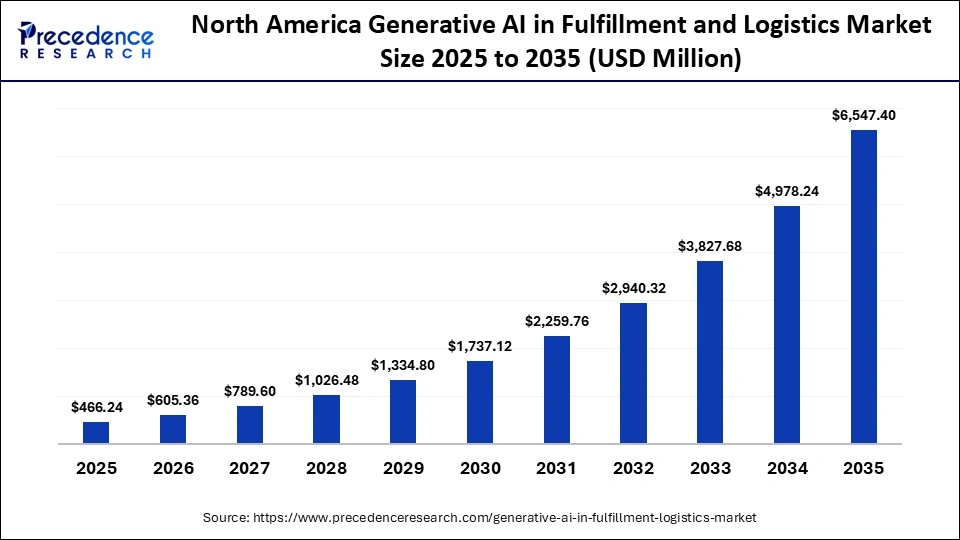
North America Generative AI in Fulfillment and Logistics Market Size and Growth 2026 to 2035
The North America generative AI in fulfillment and logistics market size is estimated at USD 466.24 million in 2025 and is projected to reach approximately USD 6.547.40 million by 2035, with a 30.24% CAGR from 2026 to 2035.
Why Did North America Dominate the Generative AI in Fulfillment and Logistics Market?
North America held a major market share of approximately 37.6% in 2025. The market growth is driven by factors such as the increasing adoption of automation in e-commerce and warehouses. Data analytics, demand forecasting, inventory management, and route optimization are other major factors fueling the market's growth. The advanced technology helps an AI-powered robot picking for sorting to enhance speed and accuracy. Growing demand for cost reduction, real-time decision support, and the increasing need for resilient supply chains in the region also contribute to market growth.
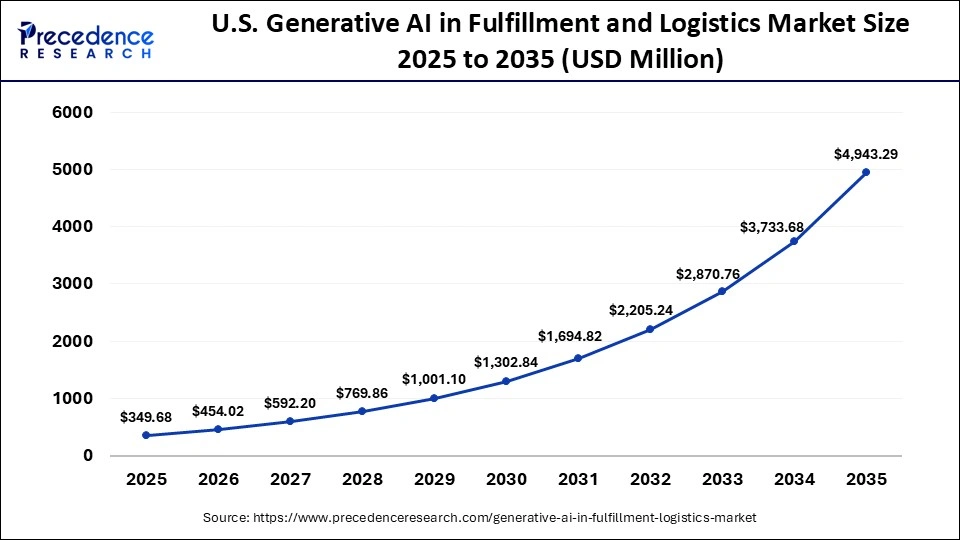
U.S. Generative AI in Fulfillment and Logistics Market Size and Growth 2026 to 2035
The U.S. generative AI in fulfillment and logistics market size is calculated at USD 349.68 million in 2025 and is expected to reach nearly USD 4,343.29 million in 2035, accelerating at a strong CAGR of 30.33% between 2026 and 2035.
U.S. Market Trends
The U.S. has a major contribution in the growth of the market by optimizing supply chains with the help of predictive analytics, demand forecasting, autonomous warehouse picking, and dynamic route optimization. Growing demand of logistic companies in the region to train their AI agents to give a tough competition to competitors is another major factor propelling the market's growth.
Why is Asia-Pacific Growing in the Generative AI in Fulfillment and Logistics Market?
Asia-Pacific is expected to experience the fastest growth during the predicted timeframe. Expansion in e-commerce platforms, improved last mile deliveries, demand forecasting, and warehouse automation, with the help of AI, IoT, and robotics, are some of the major market drivers. Growing demand for operational efficiency, cost reduction, and high e-commerce customer expectations are accelerating the demand for GenAI. Cloud-based deployments and large language models are also aiding the market's growth in the region by aiding advanced and real time data analysis.
China Market Trends
China leads the market in Asia-Pacific due to the growing adoption of automated and smart warehouses. Such warehouses are able to manage warehouse inventories, daily packages, route optimization, and demand prediction. Such warehouses are also the companies of the region, making it easy to sort, pick, and lift, to boost productivity.
Generative AI in Fulfillment and Logistics Market Companies
- Microsoft Corporation
- Amazon Web Services, Inc.
- Google Cloud
- SAP SE
- Oracle Corporation
- International Business Machines Corporation
- NVIDIA Corporation
- Manhattan Associates, Inc.
- Blue Yonder Group, Inc.
- Kinaxis Inc.
- o9 Solutions, Inc.
- project44
- FourKites, Inc.
- The Descartes Systems Group Inc.
- Infor, Inc.
Recent Developments
- In March 2026, Yusen Logistics entered into an exclusive, multiyear partnership with Rabot Inc. to deploy Vision AI technology aimed at improving packing accuracy, productivity, and compliance across its U.S. contract logistics operations. The agreement combines Yusen's fulfillment capabilities with Rabot's real-time imaging and analytics tools as distribution centers seek greater consistency in order processing.(Source- https://www.ttnews.com)
- In June 2025, Amazon deployed its 1 millionth robot as the world's largest manufacturer and operator of mobile robotics. This milestone robot was delivered to a fulfillment center in Japan, joining its global network spanning more than 300 facilities worldwide. The new GenAI model can make its entire fleet of robots smarter and more efficient.(Source- https://www.aboutamazon.com)
Segments Covered in the Report
By Component
- Software
- Services
By Deployment Mode
- Cloud
- On Premises
- Hybrid
By Function
- Warehousing
- Transportation Management
- Inventory Management
- Order Management
- Fulfillment Orchestration
- Customer Service and Exception Management
- Procurement and Supplier Collaboration
By Application
- Demand Forecasting and Replenishment
- Route and Load Optimization
- Warehouse Slotting, Picking, and Labor Optimization
- Document Automation and Customs Workflow
- Returns and Reverse Logistics
- Control Tower and Scenario Simulation
- Customer Communication and Order Status Automation
By End Use Industry
- Ecommerce and Retail
- Third Party Logistics and Fourth Party Logistics
- Manufacturing
- Food and Beverages
- Healthcare and Pharmaceuticals
- Automotive
- Consumer Electronics
- Others
By Region
- North America
- Latin America
- Europe
- Asia-pacific
- Middle and East Africa
For inquiries regarding discounts, bulk purchases, or customization requests, please contact us at sales@precedenceresearch.com
Frequently Asked Questions





Ask For Sample
No cookie-cutter, only authentic analysis – take the 1st step to become a Precedence Research client
 Get a Sample




 sales@precedenceresearch.com
 Schedule a Meeting
