



Generative AI in Testing Market Trends, Companies, Revenue / Sales Performance, Subscriber Growth, Pricing Strategies, Cloud Adoption, Infrastructure Expansion, Competitive Landscape, and Industry Outlook
Generative AI in Testing Market (By Component: Software, Services, By Deployment, Cloud , On-premise; By Application: Test Case Generation , Bug Detection and Reporting, Test Script Generation, Code Generation and Review , Other Applications; By End-User Industry; IT and Telecomm , BFSI, Retail and E-commerce, Automotive, Healthcare, Others) - Global Industry Analysis, Size, Trends, Leading Companies, Regional Outlook, and Forecast 2026 to 2035
Source: https://www.precedenceresearch.com/generative-ai-in-testing-market
 Get a Sample
 Table Of Content


What is the Generative AI in Testing Market Size in 2026?
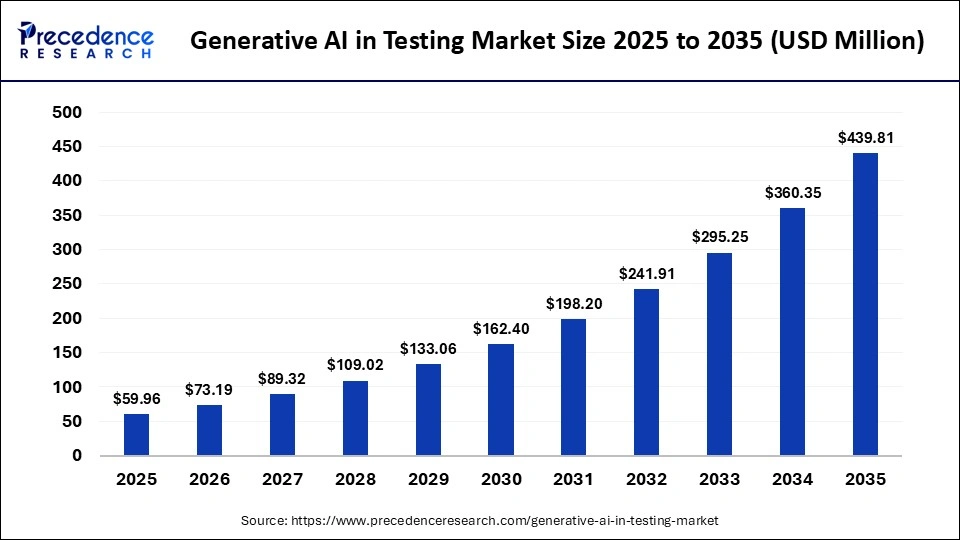
The global generative AI in testing market size was calculated at USD 59.96 million in 2025 and is predicted to increase from USD 73.19 million in 2026 to approximately USD 439.81 million by 2035, expanding at a CAGR of 22.05% from 2026 to 2035.The market growth is anticipated due to increasing demand for software solutions with fewer defects and the delivery of a continuous model of software development and accelerated delivery cycles, among escalating software complexity.
Key Takeaways
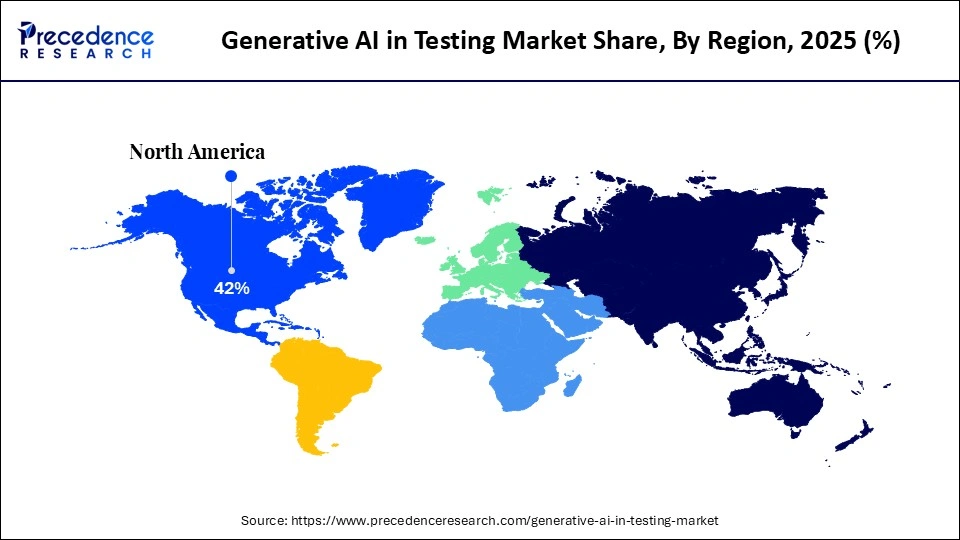
- North America dominated the generative AI in testing market with the highest share of 42% in 2025.
- Asia Pacific is expected to grow at the fastest CAGR in the market during the forecast period.
- By component, the software segment held a dominant position in the market with 73% of share in 2025.
- By component, the services segment is expected to grow at the fastest CAGR in the market during the forecast period.
- By deployment, the cloud segment held a dominant position in the market with the highest share of 82% in 2025.
- By deployment, the on-premise segment is expected to grow at the fastest CAGR in the market during the forecast period.
- By application, the test case generation segment held a dominant position in the market, accounting for a 29% share in 2025.
- By application, the bug detection and reporting segment is expected to grow at the fastest CAGR in the market during the forecast period.
- By end-user industry, the IT and telecom segment held a dominant position in the market with largest share of 35% in 2025.
- By end-user industry, the BFSI segment is expected to grow at the fastest CAGR in the market during the forecast period.
Market Overview
The generative AI in testing market is growing rapidly with the rising need for software delivery, increasing software complexity, and demand for automation. Generative AI works at a faster pace compared to traditional manual testing, which is time-consuming and resource-intensive. Generative AI enhances testing by automatically creating test cases, generating data, and simulating scenarios based on code changes, improving efficiency, accuracy, and overall test coverage. By identifying bugs, vulnerabilities, and performance issues early, it minimizes risks and enhances software reliability. Industries such as finance, healthcare, and automotive are embracing these tools to meet rigorous quality and regulatory requirements. Integration of generative AI with cloud platforms and DevOps pipelines further accelerates continuous testing and time-to-market.
Role of AI in Generative AI in Testing Market
AI is reshaping the generative AI testing market by making software testing faster, intelligent, and automated. AI can study code, requirements, and historical test data to generate test cases, scripts, and realistic test data automatically, reducing manual effort and speeding up test cycles. By identifying edge cases and risk-prone areas, it enhances test coverage and supports continuous testing in agile and DevOps pipelines by adapting tests to evolving code. During reporting and analytics, AI helps in prioritizing tests and detecting bugs early. AI enables faster releases, improved accuracy, and greater testing efficiency by combining machine learning and natural language processing.
Generative AI in Testing Market Trends
- Organizations are integrating generative AI tools early in the software development lifecycle (SDLC) to enable faster feedback, early bug detection, reduce rework costs, and improve software quality.
- Rising Explainable AI (XAI) with growing demand for transparency in AI-generated test cases. It helps understand why specific tests are created, increasing trust, accountability, and collaboration between AI systems and human testers.
- The rising shift toward continuous testing and DevOps alignment is supporting automation, adaption and real-time testing in agile environments.
- Companies are focusing on bias reduction and diverse training datasets to ensure AI-generated test scenarios reflect wide-ranging user demographics.
- Growing cloud-based and scalable AI testing platforms enable flexible and cost-effective deployment of generative AI testing solutions.
Market Scope
| Report Coverage | Details |
| Market Size in 2025 | USD 59.96 Million |
| Market Size in 2026 | USD 73.19 Million |
| Market Size by 2035 | USD 439.81 Million |
| Market Growth Rate from 2026 to 2035 | CAGR of 22.05% |
| Dominating Region | North America |
| Fastest Growing Region | Asia Pacific |
| Base Year | 2025 |
| Forecast Period | 2026 to 2035 |
| Segments Covered | Component, Application, End-User Industry, and region |
| Regions Covered | North America, Europe, Asia-Pacific, Latin America, and Middle East & Africa |
Segment Insights
Component Insights
How Did the Software Segment Lead the Generative AI in Testing Market?
The software segment led the generative AI testing market in 2025. It delivers the intelligence that influences automated, scalable, and adaptive testing. These tools create test cases, generate realistic test data, and simulate complex user interactions by using generative AI. The dominance of the segment that requires smarter and faster testing solutions is driven by the growing complexity of modern applications, including cloud-native systems, APIs, and AI-driven platforms. AI-assisted testing software has become essential, as organizations aim to reduce bugs and accelerate time-to-market. Further, the segment is driven by the integration of generative AI tools with DevOps and agile environments.
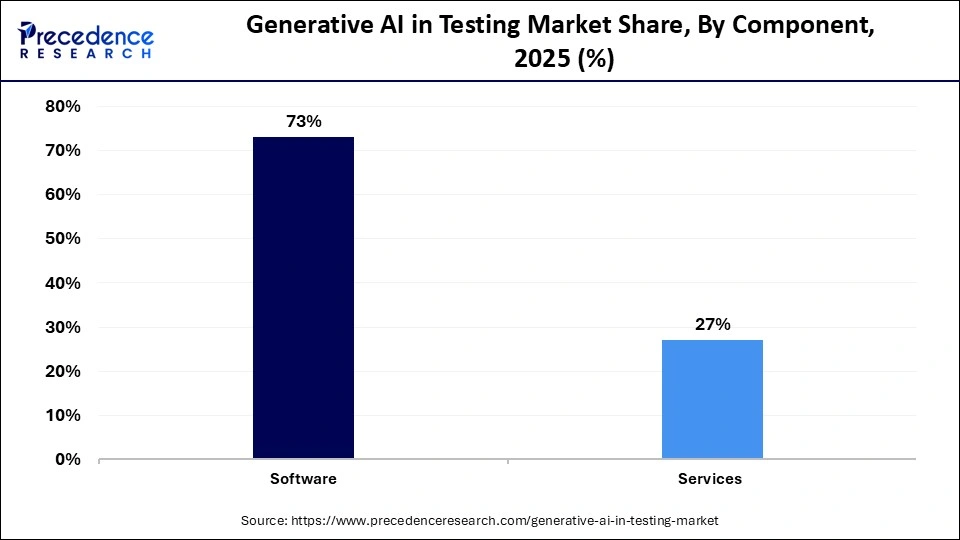
The services segment is expected to grow at a faster CAGR in the market during the forecast period. Organizations need expert support to successfully implement and optimize these advanced technologies. The demand is rising for consulting, customization, integration, training, and managed services, as adoption increases. Companies seek professional guidance with increasing concerns around data privacy, model accuracy, and governance. The rising need for expertise and end-to-end support with continuous monitoring, model fine-tuning, and performance optimization services is accelerating the expansion of the services segment.
Deployment Insights
How did the Cloud Segment Dominate the Generative AI in Testing Market?
The cloud segment dominated the market in 2025. Modern software demands flexibility, scalability, and cost efficiency, which is offered by the cloud. It eliminates the need for hefty upfront infrastructure investment, making advanced AI testing tools accessible to startups and large enterprises. Digital transformations across organizations prefer cloud environments that enable continuous integration. Cloud platforms provide the significant computational power and storage on demand required by generative AI models without capital expenditure. Cloud deployments enable seamless updates, faster innovation, remote collaborations, and easy integration with DevOps pipelines.
The on-premise segment is expected to grow at a faster CAGR during the forecast period, due to increasing concerns around data privacy, security, and regulatory compliance. Highly regulated industries such as banking, healthcare, government, and defense prefer to keep sensitive data within their organization rather than cloud environments. It allows enterprises to maintain full control over proprietary source code, confidential user data, and critical business logic, essential to minimize cybersecurity risks. Demand for secure, internally managed AI testing solutions is driving the growth in the on-premise segment as security and governance become priorities.
Application Insights
How did the Test Case Generation Segment Dominate the Generative AI in Testing Market?
The test case generation segment dominated the market in 2025. Designing effective test cases is one of the most time-consuming and critical parts of software testing, which is addressed by this segment. Generative AI automates the generation of test scenarios by analyzing code, requirements, and user behavior with minimal human intervention. Cloud-native systems and integrated platforms present various complexities, where covering every possible scenario manually is nearly impossible, driving the dominance of the segment. Automated test case generation is essential in DevOps and agile environments, where rapid releases and continuous integration are essential.
The bug detection and reporting segment is expected to grow at the fastest CAGR during the forecast period. To reduce costly post-release failures, organizations are prioritizing early defect identification. Generative AI enhances the detection of hidden vulnerabilities and edge-case defects by analyzing code patterns, historical data, and system behavior. Generative AI reporting tools enable detailed insights, root cause analysis, and automated documentation for development teams to resolve issues quickly and easily. To improve consumer satisfaction and improve product quality, faster bug detection is essential.
End-User Industry Insights
How did the IT and Telecomm Segment Dominate the Generative AI in Testing Market?
The IT and telecom segment dominated the market in 2025. These organizations are rapidly undergoing digital transformations, constantly testing large-scale applications, cloud platforms, network systems, and communication services to ensure reliability and security. The increased network complexity due to the rollout of 5G, the expansion of IoT ecosystems, and increasing data traffic is driving the demand for generative AI by simulating diverse network conditions, user behaviors, and traffic loads, enabling comprehensive and efficient testing. The sector is witnessing strong adoption of DevOps, automation, and continuous integration practices, driving demand for AI-assisted testing tools.
The BFSI segment is expected to grow with a higher CAGR in the market during the forecast period. The segment is dependent on secure, reliable, and continuously available digital platforms. Rigorous testing of applications with the rapid rise of digital banking, mobile payments, fintech platforms, and online insurance services by financial institutions to prevent system failures, fraud, and data breaches. Generative AI enables BFSI organizations to automatically generate complex test scenarios, simulate fraud patterns, and validate high transaction volumes. Financial institutions are rapidly adopting advanced AI-powered testing solutions due to increasing cybersecurity threats and the need for seamless customer experiences.
Regional Insights
North America Generative AI in Testing Market Size and Growth 2026 to 2035
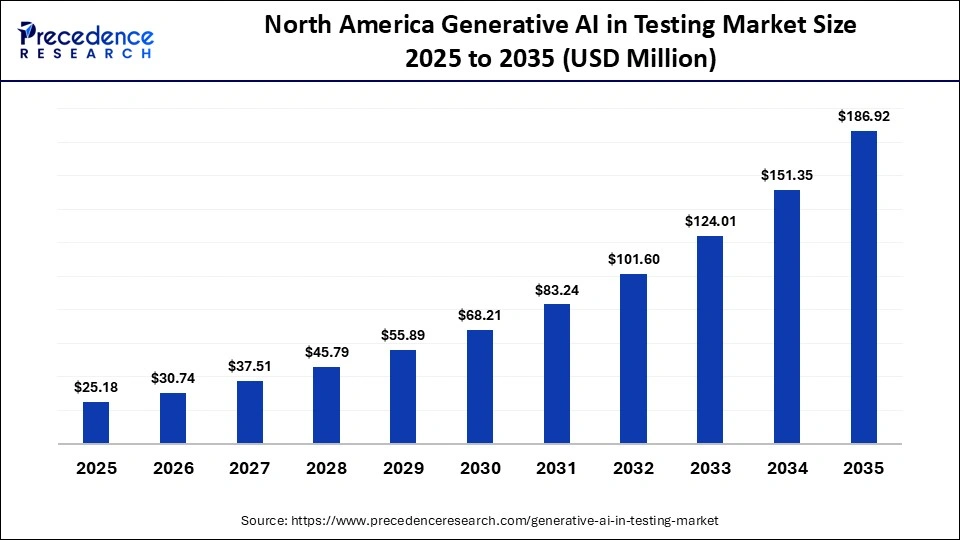
The North America generative AI in testing market size is estimated at USD 25.18 million in 2025 and is projected to reach approximately USD 186.92 million by 2035, with a 22.20 % CAGR from 2026 to 2035.
What Factors Have Driven the Dominance of North America in the Generative AI in Testing Market?
North America dominated the generative AI in testing market in 2025, due to technological leadership, early adoption of advanced technologies, and substantial investment capacity. The region has a robust technological infrastructure and a mature software ecosystem, enabling integration of advanced AI-driven testing solutions across industries. The extensive investment in research and development related to AI and machine learning technologies has accelerated innovation in automated testing tools, enabling management of complex, dynamic software environments in industries like finance and technology, where system reliability and security are critical.
Further, strict regulatory requirements around data protection, cybersecurity, and compliance mandate rigorous testing standards to ensure software reliability and security, which has necessitated the adoption of efficient and effective testing technologies. Rising digital transformation and widespread adoption of DevOps and cloud technologies support the strong growth of AI-powered testing solutions in the region.
U.S. Generative AI in Testing Market Size and Growth 2026 to 2035
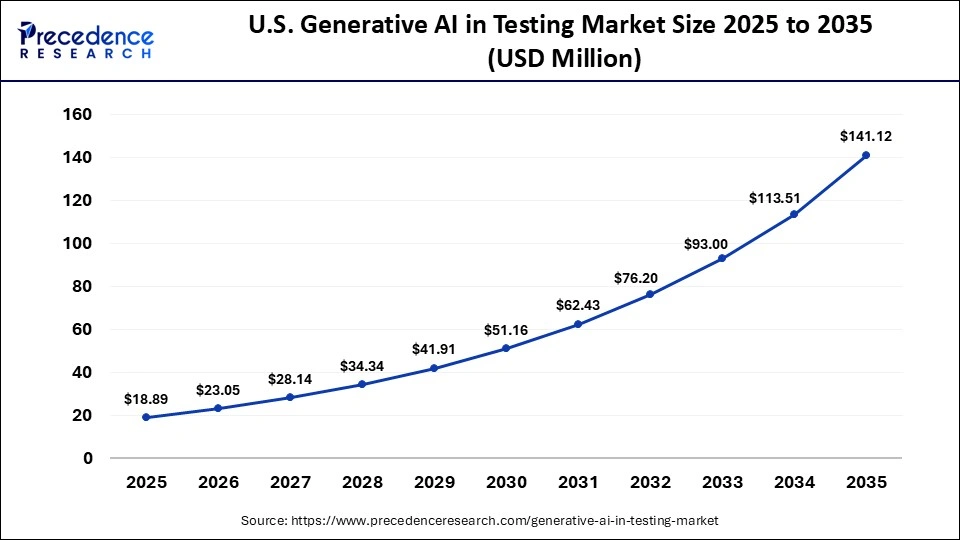
The U.S. generative AI in testing market size is calculated at USD 18.89 million in 2025 and is expected to reach nearly USD 141.12 million in 2035, accelerating at a strong CAGR of 22.27% between 2026 and 2035.
U.S. Generative AI in Testing Market
The U.S. has a strong technological ecosystem, early adoption, and a high density of leading software and AI companies. The country also hosts major cloud providers, AI innovators, and enterprise software firms that are highly invested in generative AI tools for automation and quality assurance. Further, the accelerated development and commercialization of advanced AI-powered testing tools is due to substantial funding in artificial intelligence research, with an established startup ecosystem. U.S. enterprises such as BFSI, healthcare, e-commerce, and IT heavily rely on digital platforms, boosting the demand for automated testing solutions. The widespread adoption of DevOps, agile technologies, and cloud-native architectures is driving the market growth. Strict regulatory standards and cybersecurity and data protection encourage organizations to implement AI-powered testing tools.
What makes the Asia Pacific the Fastest Growing Region in the Generative AI in Testing Market?
Asia Pacific is expected to grow at a faster CAGR in the market during the forecast period, due to rapid digital transformation, growing IT and software development hubs, increased cloud and DevOps adoption, cost advantage, outsourcing, and government investments. Increasing demand for automated and intelligent testing solutions, with the digitization of industries support complex software ecosystems. Strong adoption of AI testing tools by the tech services industry, a large developer talent pool, and an expanding startup ecosystem. The region is shifting toward cloud infrastructure and continuous integration and continuous deployment pipelines. IT outsourcing is encouraging companies to adopt and develop generative AI testing tools.
China's Generative AI in Testing Market
China is rapidly adopting generative AI technologies as the market shifts toward digital transformation and automated quality assurance. The region is highly invested in generative AI infrastructure and cloud services, reflecting broad adoption of AI tools across industries such as software development and testing. AI-driven automation is rapidly incorporated into traditional automation testing frameworks, enabling defect detection and continuous integration practices, supported by a shift toward DevOps and cloud-native development, which demands intelligent testing solutions.
Generative AI in Testing Market Companies
- KaneAI
- Testim
- mabl
- Global App Testing
- Applause
- QC Wolf
- MobiDev
- Applitools
- ACCELQ Inc.
- Applitools Ltd.
- BlinqIO
- ContextQA
- Functionize Inc.
- GitHub Inc.
- Globant SA
- LambdaTest
- Momentic AI.
- Qualiti
- Relicx Inc.
- TestCollab Software LLC.
Recent Developments
- In October 2025, CEN and CENELEC confirmed their full commitment to deliver comprehensive, inclusive, and high-quality European Standards in support of the Artificial Intelligence Act (AIA), to accelerate the development of key standards for artificial intelligence. (Source: https://www.cencenelec.eu)
- In December 2024, Gentrace, a developer platform for testing and monitoring artificial intelligence applications, raised $8 million in an early-stage funding round led by Matrix Partners to expand Large Language Model (LLM) testing product capabilities beyond engineering teams. (Source: https://siliconangle.com)
Segments Covered in the Report
By Component
- Software
- Services
By Deployment
- Cloud
- On-premise
By Application
- Test Case Generation
- Bug Detection and Reporting
- Test Script Generation
- Code Generation and Review
- Other Applications
By End-User Industry
- IT and Telecomm
- BFSI
- Retail and E-commerce
- Automotive
- Healthcare
- Others
By Region
- North America
- Latin America
- Europe
- Asia-pacific
- Middle and East Africa
For inquiries regarding discounts, bulk purchases, or customization requests, please contact us at sales@precedenceresearch.com
Frequently Asked Questions





Ask For Sample
No cookie-cutter, only authentic analysis – take the 1st step to become a Precedence Research client
 Get a Sample




 sales@precedenceresearch.com
 Schedule a Meeting
