






 Request Consultation
Australias Safeguard Mechanism requires major industries to cut emissions through declining baselines, carbon credits, and clean technologies, supporting the countrys 2030 and long-term net-zero climate goals.
Safeguard Mechanism Coverage 2030: Industrial Acceleration, Deployment of EBIT, Carbon Pricing Risks, Government Support, and Facility Strategies
Outline:
Australia’s Safeguard Mechanism is heating up with its rapid reformation, industrial acceptance, and regulatory miniaturization. Safeguard Mechanism is a major element for Australia to incentivise its largest industrial facilities to reduce their greenhouse gas emissions percentage. Australia has mandated these facilities, including mining, manufacturing, energy, and oil & gas production, to reduce their emission and comply with the reduction baseline. The Safeguard Mechanism is a key tool enabling industrial facilities to surrender carbon credits.
The Safeguard Mechanism has backed up spectacularly to the Australian Carbon Credit Units (ACCU) market. Several industries are involved in safeguarding Mechanism facilities by reducing over 100,000 tons of carbon dioxide equivalent per year. With long-scale industrial step-ups to meet policy requirements, the ACCU market’s demand growth is expected to reach around 6 million tonnes in 2025. This industrial acceptance and support are likely to make the ACCU market an undersupplied market by 2028.
What is Baseline?
Baseline in the Australian Safeguard Mechanism is an annual emission limit of the Safeguard Mechanism facilities; in general, baseline is expected to decrease by 4.9% each year till 2030. The baseline enables industries to facilitate for contributing to Australia’s emission reduction goal. The baselined decline is applied to every Safeguard facility, even to existing and new facilities.
As a trade-exposed baseline-adjusted facility can be classified, different rates can be approved for facilities. Baselines are legislated to reduce limits on net greenhouse gas emissions for industrial facilities emitting every year.
How Safeguard Mechanism Being Applied in Australia’s Key Industries?
More than 200 major industrial facilities, including mining, oil and gas, manufacturing, electricity, and transport has been mandated by Australia's safeguard mechanism. The law has mandated these industries to reduce their greenhouse gas emission By applying Mandatory protocols and reducing emission limit which is called baselines.
Australian industry facilities are required to reduce emission intensity annually. These facilities need to surrender Safeguard Mechanism Credits (SMCs) to the Australian Carbon Credit Units (ACCUs) if they exceeded their baseline or failed to reduce the emission intensity.
| Industries | Safeguard Mechanism Impact on Industries |
| Mining | Strict limits require investments in cutting-edge technologies. |
| Oil and Gas Production | Upgrading and development of advanced technologies, such as electrifying operations and managing methane emissions, is crucial. |
| Manufacturing Industry | Industry facility is preferring energy efficiency and giving preference to less-emission fuels. |
| Transport | Safeguard Mechanism mandatory transport industry to switch toward biodiesel and hydrogen. |
| Waste Landfills | Enhancing methane-capturing technologies for reducing emissions to reduce the baseline range. |
| Electricity | Applies 198 million tonnes as per a separate sector-wide baseline. |
The electricity industry is also a major sector seeking Safeguard Mechanism applications. However, one of Australia’s main electricity grids can be applied as a single ‘sectoral’ baseline across all electricity generator connections. The Safeguard Mechanism covered only emissions from waste deposited after 1 July 2016.
What is the Industrial Decarbonization Market Size in 2026?
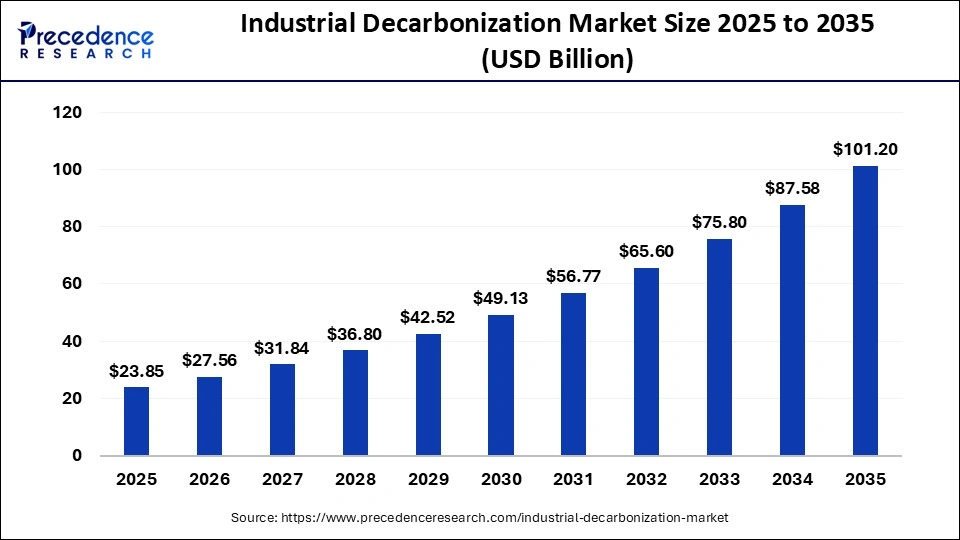
The global industrial decarbonization market size accounted for USD 23.85 billion in 2025 and is predicted to increase from USD 27.56 billion in 2026 to approximately USD 101.20 billion by 2035, expanding at a CAGR of 15.55% from 2026 to 2035. The market is witnessing substantial growth due to strict regulations and a demand for sustainable manufacturing. The market is also driven by innovations in CCUS and green technologies.
Key Takeaways
- Asia Pacific dominated the market with a major share of around 42% in 2025.
- Europe is expected to grow at the fastest CAGR between 2026 and 2035.
- By technology pathway, the renewable energy integration segment contributed the highest market share of around 30.3% in 2025.
Which Strategies Australian Industry Facilities Applying to Support Safeguard Mechanism?
The following are the key strategies Australian industry facilities are deploying to support the government for deep decarbonization:
- Renewable Energy Procurement and PPAs: Australian facilities are rapidly switching from fossil fuels to renewable sources. Major industries are focusing on secure long-term power purchase agreements (PPAs0 for reducing their scope 1 and scope 2 emissions profiles.
- Mining Fleet Electrification: the trend of battery electric vehicles (BEVs) is rapping Australian industrial facilities. The large-scale mining industries are replacing diesel-driven fleets with BEVs to eliminate major sources of onsite operations, which has potential to cause emissions.
- Carbon Capture and Storage (CCS): CCS is mainly being implemented by heavy industries such as gas processing and manufacturing for capturing significant emissions at the source and storing them geologically.
- Electrification Process and Efficiency: Industrial heat pumps are being optimized by electric facilities. These industries are also upgrading legacy hardware to enhance energy efficiency and intentionally reducing carbon emissions in their production process.
- Hydrogen Direct Reduction for Steel: The green hydrogen is replacing metallurgical coal (coke) as a primary pathway toward reducing emissions, especially for hard-to-abate sectors like steel.
What Risks to Watch in Australia’s Carbon Pricing?
- Under the reformed Safeguard Mechanism (SGM) and the Australian Carbon Credit Unit (ACCU) market, there are several risks to watch in Australia’s carbon pricing, including carbon leakage, price volatility, high compliance costs for industry, potential for liquidity, and regulatory volatility.
- Policy Tightening Risk – the creation of a “wait-and-see” approach among investors, created by the ongoing reviews of the Safeguard Mechanism and ACCu policy, has the potential to stop or delay required investments until 2028 and further.
- ACCU Market Volatility – the potential price volatility can occur in the ACCU market. Several industrial projects are suggesting flat or reduced ACCU prices around A$30-35/tCO2e for the next 2 to 3 years, to reduce investments in high-cost abatement projects, which can be followed by the increased prices to around A$70 by 2035.
- Carbon Leakage – A 2026 review is predicting the risk of high-emitting, trade-exposed industries moving their operations to countries with weaker climate regulation. This review has proposed a Border Carbon Adjustment (BCA) for addressing potential carbon leakage risk, especially for commodities like steel and cement.
- Supply Risk – The nature-based projects carry risks of non-delivery, which can invalidate credits and force compliance to search for replacement, which can be more expensive and require additional credits.
What are the Key Aspects of Earnings Before Interest and Tax (EBIT) in the Australia Safeguard Mechanism?
Australia’s safeguard mechanism is rapidly taking force toward the earnings before interest and tax (EBIT), which is used to calculate the qualification of a trade-exposed facility for a Trade-Exposed Baseline-Adjusted (TEBA) determination. The manufacturing industries whose compliance costs exceeding of 3% of their EBIT calculation become eligible for a reduced baseline decline rate, which is 1% annually.
| Earnings Before Interest and Tax (EBIT) Key Aspects | Scheme Description |
| Function | Facility which get heavily impacted by compliance costs supported by TEBA by offering a 3-year lower decline rate. |
| Guidelines for Calculation | Published guidance, factoring in operating costs, tax, salaries, and depreciation, are major element for the calculation of EBIT. |
| Manufacturing against non-manufacturing | The use of EBIT for manufacturers and non-manufacturing facilities is diverse. Manufacturers and non-manufacturers use EBIT as the metric, 3% thresholds, and as a percentage of revenue, respectively. |
| Application | Clean Energy Regulators process the applications for TEBA determinations. |
Australian Government Actions on the Safeguard Mechanism for the Next Year
| Key Elements | Action Plans |
| Funding and Support | Through the Safeguard Transformation Stream, the Australian government is offering $600 million to support and $400 million for critical decarbonization investments, especially for trade-exposed and energy-intensive (EITE) facilities. |
| Declining Baselines | Australia’s baselines for more than 200 is likely to decrease by a set rate of 4.8% annually, with the largest emitters to align with a 43% fall by 2030. |
| Potential Deadlines | In 2026, the data from 2024-25 will be reported with highlights of rewired applications of Multi-Year Monitoring Periods (MYMP), to borrow from future baselines and surrender credits. |
Major Question Asked for Australia’s Safeguard Mechanism:
1. How Australia’s Safeguard Mechanism Interacts with National Net Zero Goals?
Ans: Australia’s Safeguard Mechanism scheme is created for limiting total covered emissions to 100 million tonnes CO2-e by 2029-2030. Scheme supporting the national 5-year rolling average to reduce total emissions over time to ensure compliance with the 2030 and 2050 net-zero goals.
2. What are Safeguard Mechanism Credits (SMCs)?
Ans: Safeguard Mechanism Credits (SMCs) are a primary tool to reduce its emission intensity to a declining baseline to generate SMCs. These credits are majorly useful to compliance in the upcoming years to cover facilities and create an internal carbon market.
3. What Strategies is Australia Deploying to Overcome Potential Carbon Pricing Risks?
Ans: Australia’s industrial system has faced pressure to accelerate abatement in early 2026 to comply with the 2035 goals. The reforming of the Safeguard Mechanism, investments in low-carbon technology, improved carbon market integration, and the deployment of the Carbon Border Adjustment Mechanism (CBAM) are the key strategies the Australian government is leveraging to overcome potential carbon pricing risks by 2050.
Conclusion:
Australia is applying the Safeguard Mechanism as a critical policy to reduce greenhouse gas emissions across the nation’s largest industrial facilities, like energy, transport, mining, oil & gas, and manufacturing. The Mechanism is created to support Australia’s 2030 and 2050 net-zero goals, with industrial deployment of key strategies like fleet electrification, carbon capture, green hydrogen, and renewable energy to meet regulatory requirements. Overall, Australia’s Safeguard Mechanism is enabling industrial deep decarbonization along with developing a strong carbon market.
About the Authors

Aditi Shivarkar
Aditi, Vice President at Precedence Research, brings over 15 years of expertise at the intersection of technology, innovation, and strategic market intelligence. A visionary leader, she excels in transforming complex data into actionable insights that empower businesses to thrive in dynamic markets. Her leadership combines analytical precision with forward-thinking strategy, driving measurable growth, competitive advantage, and lasting impact across industries.



Aman Singh
Aman Singh with over 13 years of progressive expertise at the intersection of technology, innovation, and strategic market intelligence, Aman Singh stands as a leading authority in global research and consulting. Renowned for his ability to decode complex technological transformations, he provides forward-looking insights that drive strategic decision-making. At Precedence Research, Aman leads a global team of analysts, fostering a culture of research excellence, analytical precision, and visionary thinking.

Piyush Pawar
Piyush Pawar brings over a decade of experience as Senior Manager, Sales & Business Growth, acting as the essential liaison between clients and our research authors. He translates sophisticated insights into practical strategies, ensuring client objectives are met with precision. Piyush’s expertise in market dynamics, relationship management, and strategic execution enables organizations to leverage intelligence effectively, achieving operational excellence, innovation, and sustained growth.