



Industrial Decarbonization Market Trends, Companies, Contract Wins / Project Pipeline, Installed Capacity, Power Generation, Government Investment, Technology Adoption, Competitive Positioning, and Growth Forecast
Industrial Decarbonization Market (By Technology Pathway: Renewable Energy Integration, Green Hydrogen (Electrolysis), Carbon Capture, Utilization and Storage (CCUS), Industrial Electrification; By End-User Industry: Automotive and Transportation, Energy and Utility, Iron and Steel, Cement and Concrete; By Service Category: Consulting and Advisory, Carbon Removal and Negative Emissions, Waste Reduction and Circular Economy; By Strategy/Pillar: Energy Efficiency, Low-Carbon Feedstocks/Fuels) - Global Industry Analysis, Size, Trends, Leading Companies, Regional Outlook, and Forecast 2026 to 2035
Source: https://www.precedenceresearch.com/industrial-decarbonization-market
 Get a Sample
 Table Of Content


What is the Industrial Decarbonization Market Size in 2026?
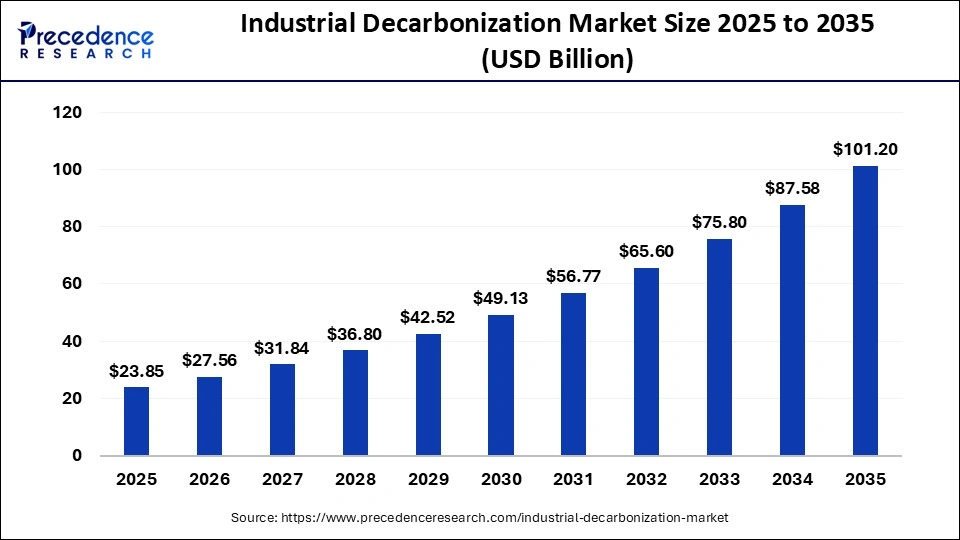
The global industrial decarbonization market size accounted for USD 23.85 billion in 2025 and is predicted to increase from USD 27.56 billion in 2026 to approximately USD 101.20 billion by 2035, expanding at a CAGR of 15.55% from 2026 to 2035. The market is witnessing substantial growth due to strict regulations and a demand for sustainable manufacturing. The market is also driven by innovations in CCUS and green technologies.
Key Takeaways
- Asia Pacific dominated the market with a major share of around 42% in 2025.
- Europe is expected to grow at the fastest CAGR between 2026 and 2035.
- By technology pathway, the renewable energy integration segment contributed the highest market share of around 30.3% in 2025.
- By technology pathway, the green hydrogen electrolysis segment is expected to grow at a strong CAGR between 2026 and 2035.
- By end-user industry, the automotive and transportation segment held a major market share of around 46% in 2025.
- By end-user industry, the energy and utility segment is expected to expand at a notable CAGR from 2026 to 2035.
- By service category, the consulting and advisory segment generated the biggest market share of around 22% in 2025.
- By service category, the carbon removal and negative emissions segment is expanding at the fastest CAGR between 2026 and 2035.
- By strategy/pillar, the energy efficiency segment accounted for the largest market share of about 45% in 2025.
- By strategy/pillar, the low-carbon feedstocks / fuels segment is projected to grow at a solid CAGR between 2026 and 2035.
What is Industrial Decarbonization?
The industrial decarbonization market encompasses technologies, services, and infrastructure that help heavy industries transition to net-zero emissions. Industrial decarbonization is the process of reducing or eliminating carbon dioxide and other greenhouse gas emissions directly from industrial manufacturing processes, such as cement, steel, chemicals, and mining. It involves shifting from fossil-fuel-based energy to low-carbon or renewable alternatives, increasing energy efficiency, and deploying technologies like Carbon Capture, Utilization, and Storage (CCUS). The market is growing due to corporate ESG commitments and consumer preference for environmentally responsible products, which are pushing companies to invest in industrial decarbonization technologies to enhance sustainability and long-term operational efficiency.
How is AI Transforming the Industrial Decarbonization Market?
Artificial intelligence (AI) is transforming the global market by optimizing energy efficiency, reducing waste, and improving process stability in heavy industries like steel and cement, cutting emissions by thousands of tons annually per plant. AI algorithms analyze operational data in real time to minimize fuel use and improve efficiency in high-emission sectors, such as cement and steel. AI enables predictive maintenance, enhances renewable energy integration, and maps supply chain emissions, serving as a practical tool for immediate, data-driven emission reductions. By forecasting equipment failures, AI reduces unplanned downtime, which enhances energy efficiency and extends machinery life.
Major Trends in the Industrial Decarbonization Market
- Electrification of Industrial Processes: Converting fossil-fuel-powered machinery to electric alternatives, particularly as renewable energy becomes more accessible. This involves replacing boilers and furnaces with technologies that significantly reduce emissions.
- Scaling Green Hydrogen in Hard-to-Abate Sectors: Hydrogen, specifically green hydrogen produced via electrolysis with renewable electricity, is being adopted as a fuel and chemical feedstock to replace fossil fuels in industries that cannot be easily electrified.
- Carbon Capture, Utilization, and Storage: CCUS is emerging as a critical, albeit high-cost, technology for removing carbon emissions directly from industrial sites and reducing process emissions, particularly in the cement and chemical sectors.
- Digitalization and Smart Manufacturing: The integration of IoT, AI, and digital twins is enabling smarter energy management. These tools support predictive maintenance, optimize process efficiency, and enable real-time emissions tracking.
Market Scope
| Report Coverage | Details |
| Market Size in 2025 | USD 23.85 Billion |
| Market Size in 2026 | USD 27.56 Billion |
| Market Size by 2035 | USD 101.20 Billion |
| Market Growth Rate from 2026 to 2035 | CAGR of 15.55% |
| Dominating Region | Asia Pacific |
| Fastest Growing Region | Europe |
| Base Year | 2025 |
| Forecast Period | 2026 to 2035 |
| Segments Covered | Technology Pathway, End-User Industry, Service Category, Strategy/Pillar, and Region |
| Regions Covered | North America, Europe, Asia-Pacific, Latin America, and Middle East & Africa |
Segment Insights
Technology Pathway Insights
How Did the Renewable Energy Integration Segment Dominate the Industrial Decarbonization Market?
The renewable energy integration segment dominated the market with about 30.3% share in 2025. This is primarily due to rapid technological advancements, declining costs, and stringent emission regulations. Manufacturing units are increasingly installing solar panels and wind turbines on-site to reduce their reliance on the grid and fossil fuels. Large industries are signing long-term Power Purchase Agreements (PPAs) with renewable energy developers to secure a consistent, low-cost supply of clean energy. To address the intermittency of solar and wind energy, energy storage systems are being integrated, ensuring a stable, round-the-clock renewable supply and transforming high-emission industrial operations into low-carbon systems.
The green hydrogen electrolysis segment is expected to experience the fastest growth in the coming years. The growth of this segment is mainly driven by falling renewable energy costs, substantial government policy support for net-zero targets, and advancements in proton exchange membrane and alkaline electrolyzer technologies. Green hydrogen is crucial for decarbonizing high-heat industrial processes, such as steel, chemicals, and cement, which cannot easily rely on direct electrification. The scaling up of electrolyzer manufacturing is driving down costs, making green hydrogen more competitive with fossil-fuel-based gray hydrogen as renewable energy prices decline.
End-User Industry Insights
What Made Automotive and Transportation the Leading Segment in the Industrial Decarbonization Market?
The automotive and transportation segment led the market while holding 46% share in 2025. This is primarily due to massive investments in EV adoption and stringent emission regulations, along with rising demand to decarbonize the entire value chain, from manufacturing processes to the end-use phase of vehicles. Automakers are increasingly focusing on reducing carbon footprints in their manufacturing, sourcing sustainable materials, and utilizing renewable energy in production. Stricter government policies are compelling manufacturers to accelerate their decarbonization efforts, particularly the push to electrify commercial vehicles to meet sustainability targets.
The energy and utility segment is anticipated to grow at the fastest CAGR in the foreseeable future. This growth is largely due to its significant role as both a major carbon emitter and the primary enabler of electrification, which is essential for hard-to-abate industries where direct electrification is not viable. The most critical lever in industrial decarbonization is shifting from fossil fuels to electric heating and process equipment. To achieve net-zero emissions, the electricity supplied to industries must be decarbonized, and governments are imposing stricter emissions standards on power generation.
Service Category Insights
Why Did the Consulting and Advisory Segment Dominate the Industrial Decarbonization Market?
The consulting and advisory segment dominated with about 22% market share in 2025, as it serves as the essential bridge between ambitious net-zero targets and their technical implementation. The rise in carbon border adjustment mechanisms and mandatory emission reporting necessitates specialized knowledge for developing essential emissions inventories and navigating complex environmental frameworks. This expertise is crucial for effectively analyzing, selecting, and implementing new technologies, including deploying advanced AI-driven tools for real-time carbon tracking, monitoring, and scenario modeling.
The carbon removal and negative emissions segment is expected to experience the fastest growth during the forecast period. This is largely due to its optimal role in offsetting unavoidable emissions, technological advancements of high value, and increasing policy support. Rapid developments in Direct Air Capture, Biomass with Carbon Removal and Storage, and enhanced mineralization are scaling capacity in this segment. It is critical for sectors with hard-to-abate emissions that need to offset emissions that cannot be reduced through energy efficiency alone and CCUS, making it an essential, high-growth, long-term solution.
Strategy/Pillar Insights
What Made Energy Efficiency the Leading Segment in the Industrial Decarbonization Market?
The energy efficiency segment led the market with about 45% share in 2025, primarily due to its role in margin protection. Energy efficiency is often the lowest-cost abatement option, frequently providing a net-positive economic outcome. The market is shifting from merely replacing hardware to identifying hidden inefficiencies. Smart manufacturing and AI technologies now unlock potential that was previously invisible, making it possible to achieve reductions in energy intensity across heavy industries. Material efficiency and circularity strategies within energy efficiency help to lower the embodied carbon of products by reducing raw material inputs.
The low-carbon feedstocks/fuels segment is expected to grow at the fastest rate during the forecast period. This growth stems from its ability to address hard-to-abate sectors that cannot easily electrify, positioning low-carbon fuels as a primary and viable transition pathway. High-temperature industrial processes and chemical reactions require high energy density. Additionally, government policies are driving a shift from voluntary to mandatory adoption, enhancing the competitiveness of cleaner alternatives, which often align with waste-to-energy initiatives that utilize agricultural residues, industrial wastes, and captured carbon.
Regional Insights
How Did Asia Pacific Dominate the Industrial Decarbonization Market?
Asia Pacific dominated the market by capturing about 42% share in 2025. This is mainly due to its massive, energy-intensive industrial sector, intense regulatory pressure to meet net-zero targets, and significant investment in renewable technologies. The region, particularly China and India, has high GHG emissions, requiring aggressive decarbonization of heavy industries to meet Paris Agreement goals. Rapid adoption of green technologies in the mobility and energy sectors is driving industrial decarbonization. Ambitious NDC commitments across ASEAN and strong consumer demand for sustainable products are forcing industries to adopt low-carbon solutions.
India Industrial Decarbonization Market Trends
India plays a dominant role within the Asia Pacific market, serving as a critical, large-scale market for deploying decarbonization technologies. India is positioning itself as a global hub for green hydrogen production and export, aiming to reduce dependence on fossil fuels in hard-to-abate sectors like steel, fertilizer, and chemicals. The Perform, Achieve and Trade scheme and the upcoming Indian Carbon Market are designed to encourage energy-intensive industries to adopt cleaner technologies. With its large working-age population, India is bridging the global green skills gap.
Why is Europe Considered the Fastest-Growing Region in the Industrial Decarbonization Market?
Europe is expected to grow at the fastest rate during the forecast period. This is mainly due to an urgent, policy-driven imperative to secure energy independence and maintain industrial competitiveness. The EU has binding targets under the European Green Deal, aiming to reduce net greenhouse gas emissions. The EU accelerated decarbonization to reduce dependence on imported fossil fuels, driving investment into domestic, sustainable alternatives like green hydrogen and electrification. The EU Emissions Trading System (ETS) creates a high carbon price, making low-carbon alternatives more economically viable and ensuring a level playing field.
Germany Industrial Decarbonization Market Trends
The market in Germany is expanding mainly due to advanced engineering, automation, and green technologies. Germany provides substantial funding for infrastructure projects, including solar farms and green hydrogen production. German companies like Thyssenkrupp Nucera and SFC Energy are directly investing in India, transferring expertise in electrolyzers and fuel cells, and operating through various platforms, leveraging its own experience with the EU Emissions Trading System (EU ETS).
Industrial Decarbonization Market Companies
- Siemens Energy
- ABB
- Climeworks
- Carbon Clean
- Aker Carbon Capture
- Schneider Electric
- Carbon Engineering
- Air Liquide
- Linde
- General Electric (GE) Vernova
- TotalEnergies
- bp (British Petroleum)
- Svante
- Bloom Energy
- Carbfix
Recent Developments
- In February 2026, ABB launched its first fully integrated gas analyzer package for CCUS applications. This solution combines Sensi+ CCUS laser gas analyzer, GCP100 process gas chromatograph, and ACF5000 FTIR infrared analyzer into a single package for real-time CO2 impurity detection across the CCUS value chain. It aims to support decarbonization in hard-to-abate industries by ensuring CO2 stream quality and compliance with purity standards.
(Source: https://new.abb.com) - In February 2025, ClimeFi launched its Due Diligence Coverage platform, offering free access to executive summaries of independent assessments of carbon removal projects. This platform aims to enhance transparency in carbon removal markets, helping corporate sustainability leaders make informed procurement decisions based on structured insights. Paolo Piffaretti, ClimeFi's CEO, highlighted the need for standardized assessments to reduce uncertainty in a rapidly evolving market.(Source https://onestopesg.com)
- In February 2026, Absolute Climate introduced a certification pathway for low-carbon products, allowing verified climate benefits to be certified separately from physical products through Environmental Attribute Certificates (EACs). CEO Peter Minor stated this framework addresses barriers to accessing low-carbon materials, enabling companies to claim climate benefits even when direct sourcing is not feasible.(Source https://esgpost.com)
Segment Covered in the Report
By Technology Pathway
- Renewable Energy Integration
- Green Hydrogen (Electrolysis)
- Carbon Capture, Utilization and Storage (CCUS)
- Industrial Electrification
By End-User Industry
- Automotive and Transportation
- Energy and Utility
- Iron and Steel
- Cement and Concrete
By Service Category
- Consulting and Advisory
- Carbon Removal and Negative Emissions
- Waste Reduction and Circular Economy
By Strategy/Pillar
- Energy Efficiency
- Low-Carbon Feedstocks/Fuels
By Region
- North America
- Europe
- Asia-Pacific
- Latin America
- Middle East & Africa
For inquiries regarding discounts, bulk purchases, or customization requests, please contact us at sales@precedenceresearch.com
Frequently Asked Questions





Ask For Sample
No cookie-cutter, only authentic analysis – take the 1st step to become a Precedence Research client
 Get a Sample




 sales@precedenceresearch.com
 Schedule a Meeting
