



Digital Twin Market Size, Key Companies, Company Market Share, User Adoption, Technology Deployment, Revenue Growth, Competitive Positioning, and Demand Forecast
Digital twin technology is becoming a critical component of Industry 4.0 by creating real-time virtual models of physical assets and processes. Rising investments in smart manufacturing, connected infrastructure, and AI-powered analytics are fueling market growth. As organizations seek greater efficiency, predictive maintenance, and data-driven decision-making, the digital twin market is poised for significant long-term expansion.
Source: https://www.precedenceresearch.com/digital-twin-market
 Get a Sample
 Table Of Content


What Is Driving the Growth of the Global Digital Twin Market?
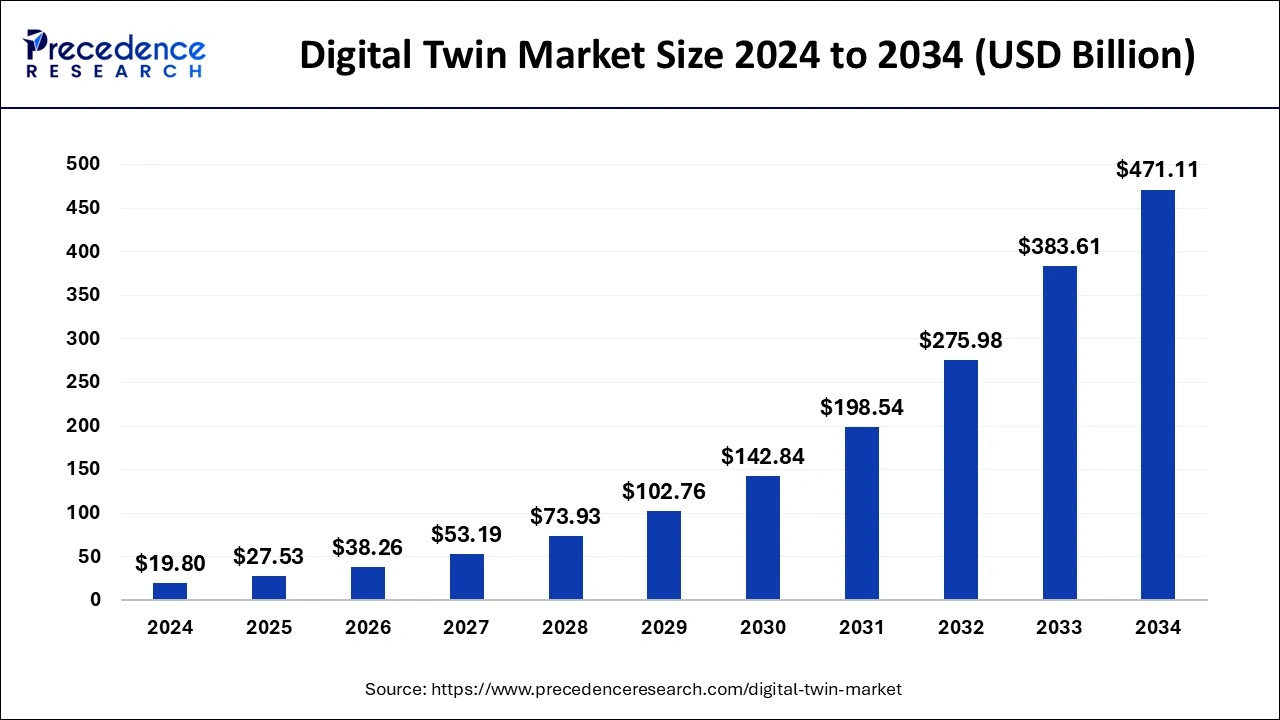
The global digital twin market size is calculated at USD 27.53 billion in 2025 and is predicted to increase from USD 38.26 billion in 2026 to approximately USD 572.03 billion by 2035, expanding at a CAGR of 35.44% from 2026 to 2035. The market is gaining momentum as organizations increasingly replicate physical assets, processes, and systems in virtual environments to enhance operational efficiency, predict failures, and accelerate data-driven decision-making across industries.
Market Highlights
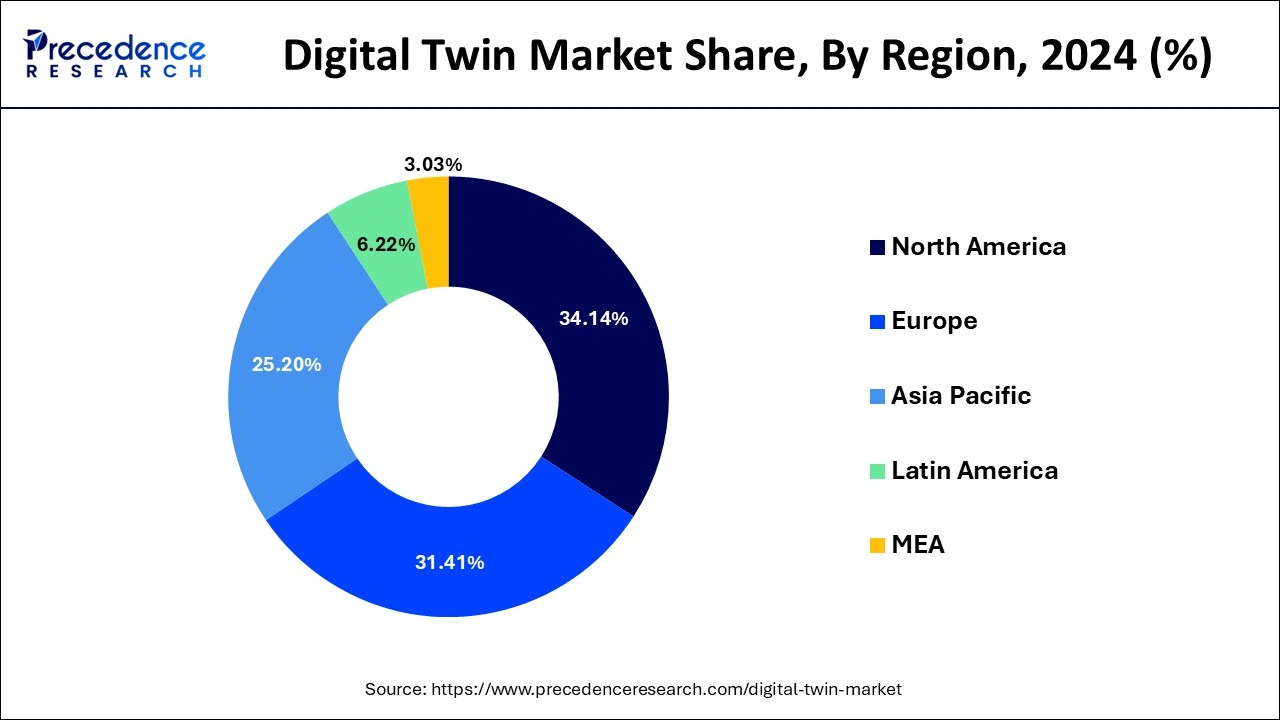
- Asia Pacific led the global market with the highest market share of 35.91% in 2025.
- By solution, the process segment has held the largest market share in 2025.
- By application, the automotive and transport segment captured the biggest revenue share in 2025.
Market Overview
The digital twin market has evolved from a niche engineering idea into an essential technological framework utilized in multiple industries, including manufacturing, healthcare, automotive, aerospace, energy, and smart infrastructure. A digital twin serves as a virtual counterpart to a tangible product or system by enabling organizations to track key metrics and simulate possible outcomes for better foresight on operations, which can be adjusted in real time. The rise of IIoT (Industrial Internet of Things) solutions alongside advancements in cloud computing technologies like artificial intelligence (AI) and advanced analytics have significantly broadened the capabilities offered by digital twin solutions.
Organizations are gradually moving to the use of such models to improve predictive maintenance practices, reduce disruption, and make better-informed decisions about asset lifecycles. Greater emphasis on operational efficiency, sustainability initiatives, and digital transformation efforts is driving market growth. By leveraging the efficiency and visibility that organizations seek in complex systems and the need for improved prediction of system performance, digital twins are increasingly being implemented as a critical element in contemporary industrial structures and enterprise operations, leading to sustained investment and innovation throughout the world.
How is AI Impacting the Digital Twin Market?
The role of artificial intelligence (AI) is changing the digital twin business by helping to develop virtual twins instead of physical models into complex decision-making tools. In the era of AI with digital twin applications, digital twins have gone beyond the mirroring of tangible assets to include data analysis, trend analysis, and forecasting. This is particularly beneficial in industries such as manufacturing, energy, healthcare, and transportation, where real-time information can help organizations minimize downtime and optimize resource usage.
These AI-enabled digital twins can generate different possible scenarios so that they can perform risk assessments and fine-tune their execution before modifying the physical context. Moreover, innovative generative AI tools are enhancing the digital twins via automated recommendations and autonomous operations. To achieve predictive analytics innovation and operational resilience in the next iterations of enterprise digital transformation, the alignment between AI technology and digital twins becomes a crucial area.
Digital Twin Market Growth Factors
The market is on the rise with the shift in industries from legacy surveillance systems to data-driven operational intelligence. Much of this, researchers believe, is attributed to rapidly growing connected devices and industrial sensors that consistently deliver the information to virtual models. Globally, it is thought that there will be close to 40 billion IoT installations expected by the end of the decade, creating a critical data foundation required to provide accurate digital twin simulations.
At the same time, enterprise investment in cloud infrastructure is increasing; by Q3 of 2025, global spend on cloud infrastructure exceeded USD 102.6 billion, with the continued growing necessity of scalable platforms, which are capable of handling complex digital twin structures. In manufacturing, for example, Industry 4.0 technologies are being combined with AI-driven predictive maintenance solutions to increase market growth by reducing downtime and improving the efficiency of these assets. Such advancements will drive significant commercial scale-up, and the global digital twin market is expected to grow to USD 49.5 billion by 2026, emphasizing the digital twin's strategic importance in industrial ecosystems.
How are Government Initiatives Supporting the Digital Twin Market?
This aspect is largely attributed to the government that supports and encourages the fast adoption of digital twin technology, particularly in smart city projects, climate adaptation, and the modernization of the digital infrastructure. In India, the Smart Cities Mission has made tech-driven urban planning in 100 cities possible, creating an ecosystem conducive to digital twin applications for traffic control, utility management, and public services.
Varanasi was awarded the Smart City Innovation Award in 2025 for the project with a 3D Urban Spatial Digital Twin on a city scale of 160 square kilometers and its contribution to enhancing the planning and operation process. At the same time, the European Union has advanced via its Destination Earth (DestinE) initiative an ambitious endeavour to develop a large-scale digital twin leveraging artificial intelligence and computational technologies to model environmental and climate systems. These investments from the government sectors not only demonstrate the efficacy of this technology but also encourage wider commercial use in multiple sectors of the economy.
Market Report Coverage and Key Metrics
| Report Coverage | Details |
| Market Size in 2025 | USD 27.53 Billion |
| Market Size in 2026 | USD 38.26 Billion |
| Market Size by 2035 | USD 572.03 Billion |
| Growth Rate from 2026 to 2035 | CAGR of 35.44% |
| Largest Market | Asia Pacific |
| Fastest Growing Market | North America |
| Base Year | 2025 |
| Forecast Period | 2026 to 2035 |
| Segments Covered | Solutions, Applications, Enterprises, and Region |
| Regions Covered | North America, Europe, Asia-Pacific, Latin America, and Middle East & Africa |
Market Dynamics
Driver
Growing Adoption of Predictive Maintenance Across Industries
Digital twin adoption is increasing because digital twins help organizations predict equipment failures, minimizing costly downtime and maximizing asset reliability. Manufacturing, energy, aerospace, and transportation sectors are using real-time operational models that extend equipment life and optimize maintenance schedules. This trend positions predictive maintenance as a significant driver for market growth.
Restraint
Data Security and Privacy Concerns
Digital twin systems rely heavily on continuous acquisition and sharing of operational data from interlinked assets. Because of such dependency, it is much more prone to cybersecurity risks or unauthorized access incidents, and potential data breaches. Securing proprietary information alongside critical infrastructure data is extremely challenging and is preventing the extensive implementation.
Opportunity
Integration with AI and Generative Analytics
Combining digital twins with advanced AI techniques is opening up the door to increased automated decision-making functions. AI-assisted digital twins can spot trends, advise on action points, and adjust performance dynamically on the fly, all empowering organizations to fully benefit from their investment in digitization activities.
Market Segmentation Analysis
Solution Insights
The Process Segment Dominated the Digital Twin Market in 2025
The process segment held a major revenue share in the market in 2025, due to its extensive use in optimizing industrial workflows, production lines, and operational efficiency. Process twins became more common in large manufacturing firms for visualizing and simulating complex processes prior to implementing changes in live environments. The fact that this technology helps to identify where the bottlenecks are, remove wasted resources, and optimize the use of assets through this makes process-oriented digital twins highly useful in sectors including manufacturing, energy production, chemicals processing, and logistics. Process twins emerged as an attractive medium to improve productivity while reducing operational risks as companies sought greater operational insight and cost efficiency.
The system segment is expected to grow at the fastest CAGR in the market between 2026 and 2035, due to the increase in complexity linked to interconnected assets and infrastructure. While the process twins model processes execution on a functional level, the system twins provide an overall view of how various assets are interlinked within a more complete system. They are being used for real-time decision improvement, predictive analytics, and cross-functional optimization, and are increasingly implemented in smart factories, transportation networks, utility providers, and urban development projects. An increase in investments to connect the Internet of Things (IoT) up front, cloud computing technologies, coupled with AI-based analytical models, can accelerate systems-level adoption of digital twin applications.
Applications Insights
Which Application Segment Dominated the Digital Twin Market?
The automotive and transport segment accounted for a considerable revenue share in the market in 2025, because of their widespread adoption across vehicle design, manufacturing processes, fleet management, and infrastructure planning. Digital twins have been increasingly adopted by automotive manufacturers to simulate vehicle performance scenarios, streamline production processes, and reduce product development timelines. At a similar level, transportation providers used this technology to monitor conditions in their fleets, predict maintenance needs, and enhance operational efficiency. With its forward-looking integration of new technologies and higher needs in terms of connectivity and autonomous mobility, the sector has established itself as the leading application domain for the global digital twin.
The healthcare and lifesciences segment is expected to grow at the fastest CAGR in the market over the coming years, as healthcare providers and researchers increasingly explore virtual representations of patients, medical devices, and clinical processes. Digital twins are appealing in that they can allow for bespoke treatment strategies, predictive diagnostics capabilities, and optimization of medical devices. Pharmaceutical companies also use this technology to improve drug development, as well as to improve manufacturing. As precision medicine matures in harmony with AI-powered healthcare with data-informed clinical decisions, this will demand a huge expansion of digital twin solutions across the entire healthcare space.
Enterprises Insights
Why Did the Large Enterprises Segment Lead the Digital Twin Market?
The large enterprises segment led the market in 2025, due to their ample resources, advanced digital infrastructure, and the size of their asset portfolio. These firms were among the earliest adopters of digital twin technology to increase productivity, drive asset performance, and enable widespread digitization initiatives throughout an organization. Industries including manufacturing, aerospace, energy, and automotive enjoyed the benefits of mass applications. By building digital twins in conjunction with their other IoT systems, cloud services, and analytical platforms, the companies achieved real operational improvements while solidifying their dominant position within the industry.
The small enterprises segment is expected to show the fastest growth over the forecast period, as digital twin technologies become more accessible through cloud-based deployment models and subscription-driven pricing structures. Smaller enterprises are historically hampered by implementation costs that are so high, but increasingly they adopt these solutions for improved operational efficiency and enhanced asset monitoring for better decision-making supported by real-time information. Better software scalability and affordable alternatives for digital transformation are drastically lowering entry barriers. Growing knowledge of this technology's benefits among small organizations across sectors has led to stronger expectations that they will be the fastest-growing user demographics across many sectors.
Market Regional Analysis: North America, Europe, Asia-Pacific
What is the Asia Pacific Digital Twin Market Size?
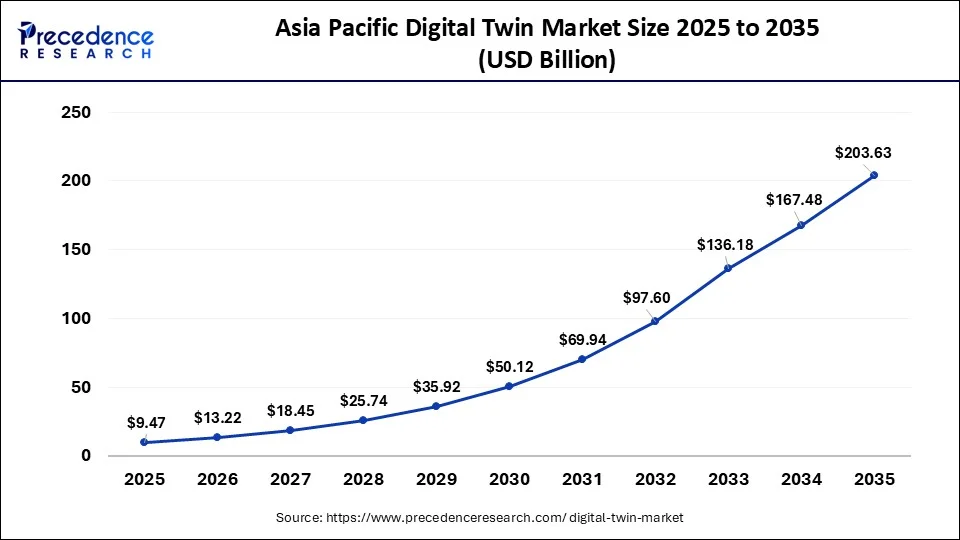
The Asia Pacific digital twin market size is evaluated at USD 13.22 billion in 2026 and is projected to be worth around USD 203.63 billion by 2035, growing at a CAGR of 35.91% from 2026 to 2035.
Why Did Asia-Pacific Dominate the Digital Twin Market?
Asia-Pacific dominated the global digital twin market with the largest market share in 2025, due to rapid industrialization, heavy manufacturing activities, and infrastructure development, along with investments into smart infrastructure initiatives. Countries in this region are working towards implementing digital twins on an unprecedented scale for greater operational efficiency, better production methods, and digital transformation efforts. The growing numbers of IoT devices, 5G networks, and government-backed smart city initiatives are other important drivers of this. Moreover, major technology providers are already being added to and growing industrial automation capabilities have a great impact with positive effects on market development at the regional level.
The supportive government framework to boost infrastructure development is likely to propel the market's revenue in the region during the forecast period. For instance, in February 2025, the Department of Telecommunications (DoT) of India signed a Letter of Intent (LoI) with the International Telecommunication Union (ITU) to enhance infrastructure planning through AI-driven digital twin technologies. The agreement aimed at reinforcing India's role in global digital connectivity.
China Market Trends
China dominated the Asia-Pacific market owing to its extensive manufacturing ecosystem and strong government support for industrial digitalization. The country, in general, through national measures focused on smart manufacturing strategies, industrial automation, and innovative technology, has encouraged businesses to adopt digital twin solutions in production centers or infrastructure installations. Moreover, increasing investments in smart cities, transportation systems, and energy infrastructure strengthened demand for digital twin technologies.
Why is North America Experiencing the Fastest Growth in the Digital Twin Market?
North America is expected to grow at the fastest CAGR during the forecast period, as expanding demands help to drive the market growth with an enhanced growth rate. The market is experiencing significant growth in the region, owing to the rising adoption of the Internet of Things (IoT), 5G connectivity, cloud computing, and big data analytics. Numerous industries, from healthcare and manufacturing to construction and others, are implementing digital twins to increase operational efficiencies as well as make the real-time decision-making process quicker and prioritize predictive maintenance. Many influential businesses in this space are increasingly utilizing acquisitions, collaborations, and partnerships in a bid to expand their influence and position in the industry.
- For instance, in May 2025, American Bureau of Shipping (ABS), a leader in providing classification services for marine and offshore assets, announced to strengthen its collaboration with Akselos S.A., with the joint completion of a technical assessment for structural digital twin technology. This marks an advancement in the application of digital twin technology for Floating Production Storage and Offloading (FPSO) units, enabling more accurate and reliable assessments of structural integrity.
U.S. Market Trends
The U.S. led the North American market, as it's not just being applied in the auto business but also in other fields, such as aerospace, automotive, healthcare, energy, among other organizations, all of which use these technologies to make themselves more effective while limiting downtime, as well as streamlining the workflow to become easier for product development. Top software suppliers have gathered a lot of cloud service providers, and so have the biggest AI developers, making progress in this market.
What are the Advancements in the Digital Twin Market in Europe?
Europe is expected to experience significant growth over the forecast period because of its commitment to sustainability and enhancements in supply chain efficiency, generating substantial demand for novel solutions. Policies like the EU Green Deal promote the application of digital technologies to improve operational efficiencies while also lowering carbon emissions. One of the common trends is to couple the use of digital twins to enable various AI types of applications, edge computing, and industrial Internet of Things (IoT), which in turn create highly connected manufacturing ecosystems. Also, EU investments made into programs for digital transformation and climate initiatives are stimulating a search for a solution that utilizes digital twin technology to conserve energy and carbon output and reinforce the resilience of infrastructure.
Germany Market Trends
Germany is leading Europe's market with its strong manufacturing sector. German manufacturers are at the forefront of bringing together the use of digital twin with AI-powered analytics and industrial IoT. Spending on smart factories and sustainable production technologies has propelled these advancements toward broader acceptance by large corporates and mid-sized enterprises alike, resulting in a new leadership position for Germany in the digital economy in this field.
What are the Key Trends in the Digital Twin Market in Latin America?
Latin America is expected to have substantial growth in the market as companies look for more operational efficiencies and digital transformation. Digital twins are becoming popular among a variety of industries, ranging from manufacturing to mining to energy generation to infrastructure and more, all with specific objectives of enhancing asset performance and minimizing operational disruptions. In recent times, businesses across the region have been increasingly adopting cloud-based digital twin solutions; this is helping to reduce budget conflicts and streamline execution time for organizations. All digital twin platforms have the same goal: to simplify operations through operational integration and optimize for scale. In addition, both government and private sectors are investing in smart city projects and infrastructure developments in general, and new markets.
Brazil Market Trends
The country's manufacturing, mining, and energy sectors increasingly leveraged digital twins to monitor critical assets, improve operational efficiency, and support predictive maintenance programs. Furthermore, continuing infrastructure development and smart city programs in high-density urban areas have also created an enabling climate for the widespread use of these technologies.
How is the Middle East and Africa Region Growing in the Digital Twin Market?
The Middle East and Africa region is expected to grow at a considerable CAGR in the upcoming period, driven by substantial investments in infrastructure and technological capabilities, particularly in countries like the UAE, Saudi Arabia, and South Africa. This momentum is further fueled by the government's push for the digital transformation of logistics. At the same time, higher investment in renewable energy initiatives and digitalization of oil and gas sectors and industrial automation also help expand this market. There are also significant initiatives on smart logistics systems and supply chain optimization across the region.
Saudi Arabia Market Trends
The country has actively incorporated digital twin technologies into smart city projects, large-scale infrastructure developments, and energy sector modernization efforts. The emergence of massive developments such as NEOM has highlighted the growing importance of digital twins in urban planning, resource management optimization, and infrastructure monitoring. Firms in all markets are becoming increasingly aware of Digital Twin as a means of streamlining operations and cutting costs, thus leading to wider market space across different applications.
Digital Twin Market Companies
- General Electric
- Microsoft Corporation
- Hitachi Ltd
- Dassault Systems SE
- Autodesk Inc.
- SAP SE
- Siemens AG
- ANSYS Inc
- PTC Inc
- IBM Corporation
- ABB
- Hexagon AB
- Oracle Corporation
- Rockwell Automation Inc
- Schneider Electric
- Accenture plc
- Bentley Systems
- Robert Bosch
- Emerson
- Honeywell
- Altair
- River Logic
- ANDRITZ
Recent Developments in the Digital Twin Market (2025–2026)
- In January 2026, Siemens AG built an advanced collaboration framework through collaboration with NVIDIA Corporation to develop an Industrial AI Operating System. Siemens recently launched Digital Twin Composer, a tool combining simulation with real-time operational data and artificial intelligence to create highly accurate digital twins targeted for use in industry, as part of this collaboration.
(Source: https://press.siemens.com/) - In March 2026, Teamcenter Digital Reality Viewer and Digital Twin Composer were launched by Siemens AG in India. These solutions marry Siemens software with NVIDIA Omniverse technologies to deliver digitally immersive and physics-driven digital twins, which enable engineering validation, lifecycle management, and operational optimization.
(Source: https://press.siemens.com/) - In the year 2021 March, the Collaboration of ANSYS, Inc, and Engine with the supply of energy-efficient services. Developed Ansys twin technology is utilized in the Engine Lab Green with enhanced fidelity and to provide 3D Computational Fluid Dynamics which involved real-time processes.
- In the year 2021 April, Autodesk introduced Autodesk Tandem which is the virtual twin technology to improve the flow with real-time data collection and analyzing the data. It involves integration between the Architectural, engineer, and contract teams and enhances twinning technology.
Segments Covered in the Report
By Solutions
- Component
- Process
- System
By Applications
- Agriculture
- Manufacturing
- Telecommunication
- Aerospace & Defense
- Retail & Consumer Goods
- Residential & Commercial
- Healthcare & Lifesciences
- Energy & Utilities
- Automotive & Transport
- Other Industries
By Enterprises
- Large Enterprises
- Medium Enterprises
- Small Enterprises
By Region
- North America
- Europe
- Asia-Pacific
- Latin America
- Middle East & Africa (MEA)
For inquiries regarding discounts, bulk purchases, or customization requests, please contact us at sales@precedenceresearch.com
Frequently Asked Questions
Tags





Ask For Sample
No cookie-cutter, only authentic analysis – take the 1st step to become a Precedence Research client
 Get a Sample




 sales@precedenceresearch.com
 Schedule a Meeting
