



Digital Classroom Market Size, Key Companies, Company Market Share, User Adoption, Technology Deployment, Revenue Growth, Competitive Positioning, and Demand Forecast
Digital Classroom Market (By Product Type: Digital classroom hardware, Digital classroom content, Digital classroom software; By Application: K-12, Higher Education) - Global Industry Analysis, Size, Trends, Leading Companies, Regional Outlook, and Forecast 2026 to 2035
Source: https://www.precedenceresearch.com/digital-classroom-market
 Get a Sample
 Table Of Content


What is the Digital Classroom Market Size?
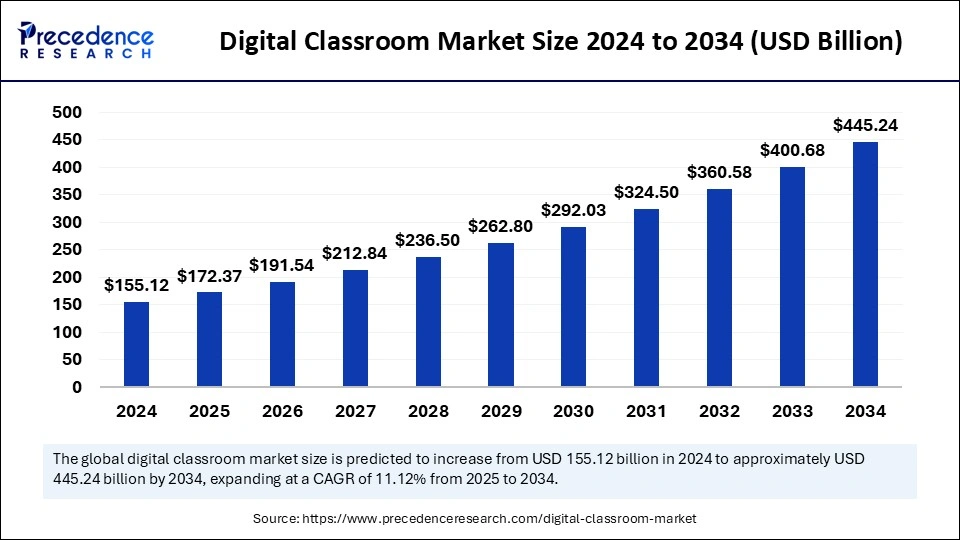
The global digital classroom market size accounted for USD 172.37 billion in 2025 and is predicted to increase from USD 191.54 billion in 2026 to approximately USD 486.83 billion by 2035, expanding at a CAGR of 10.94% from 2026 to 2035. The market is expanding due to enhanced accessibility, hybrid and online learning approaches, individualized education, AI incorporation, and unconventional techniques such as gamification and virtual reality, fueled by technological progress and student needs.
Digital Classroom Market Key Takeaways
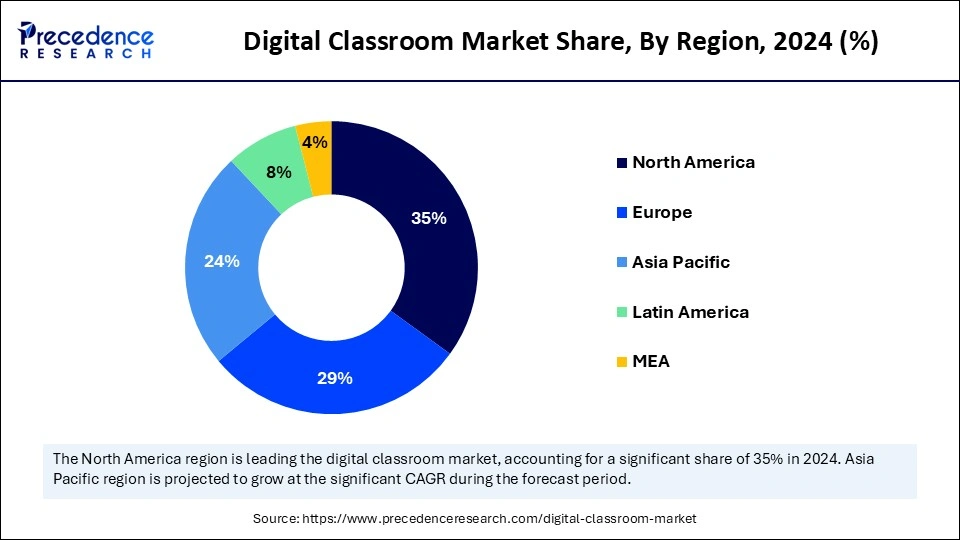
- North America dominated the market with the largest share of 35% in 2025.
- Asia Pacific is anticipated to grow at the fastest CAGR during the forecast period.
- By product type, the digital classroom hardware segment held the biggest market share of 42% in 2025.
- By product type, the digital classroom software segment is projected to grow with the fastest CAGR in the studied period.
- By application, the higher education segment contributed the biggest market share of 55% in 2024.
- By application, the K-12 segment is projected to expand rapidly in the coming years.
Market Overview
A digital classroom is an educational environment that incorporates technology to improve the learning experience, making use of multimedia tools such as videos, interactive simulations, and e-books. This setting encourages teamwork between students and teachers, improving overall learning results. The market encompasses hardware, software, and services such as smartboards, virtual classrooms, learning management systems, and e-learning tools designed to enhance teaching effectiveness, boost student involvement, and optimize learning results.
The digital classroom market represents a significant change in educational settings, incorporating technology to improve teaching and learning experiences. Notably, the market has revolutionized conventional educational approaches into contemporary, engaging, and effective strategies, catering to various learning requirements and difficulties via the vibrant environment fostered by technology-based solutions.
Artificial Intelligence: Transforming Education and Accessibility in Classrooms
Artificial intelligence is transforming the digital classroom market by offering personalized learning opportunities and automating administrative duties. It assesses the performance and learning preferences of each student, enabling educational platforms to customize content and teaching approaches to address varying requirements. This customization boosts student involvement and enhances academic performance by helping suit individual difficulties. AI-powered tools simplify grading and assessment tasks, offering educators important insights while minimizing their workload. Real-time analytics assist in pinpointing areas that require additional assistance, while tools such as speech-to-text and language translation improve accessibility for students facing disabilities or language obstacles.
- In September 2024, David Game College in London launched the inaugural AI-powered classroom in the UK, providing a tailored learning experience for 20 GCSE students. AI algorithms evaluate strengths, provide customized plans, and facilitate interactive activities, while AI-driven learning coaches boost involvement and results.
Digital Classroom Market Growth Factors
- Increased e-learning adoption: The emergence of e-learning platforms, enabled by internet access and smart devices, has greatly impacted the digital classroom industry. The transition from conventional classroom instruction to online learning, especially during the COVID-19 pandemic, has resulted in hybrid educational models and digital classrooms.
- Increasing demand for personalized learning: Personalized learning is an emerging trend in education that employs AI algorithms to assess the strengths and weaknesses of students by offering customized exercises and resources while addressing various learning styles, like DreamBox Learning and SMART Learning Suite.
- Expansion of Internet and smartphone penetration: The expansion of the Internet, especially in developing countries, has greatly risen, closing the digital gap and enhancing educational access, particularly in isolated and rural regions due to inexpensive smartphones and data services.
- Technological advancements: Technological advancements featuring Artificial Intelligence (AI), Augmented Reality and Virtual Reality are transforming educational approaches, enhancing the immersion and efficacy of learning. These technologies improve the effectiveness and attractiveness of virtual classrooms, facilitating tailored learning, better assessment methods, and effortless access to resources via cloud computing solutions.
- Government investments and initiatives: Government funding for educational infrastructure, especially in rural regions, promotes the incorporation of digital technologies. Initiatives such as the Digital India Campaign of India and the Digital Education Action Plan of the European Union enhance the adoption of digital classrooms.
Market Scope
| Report Coverage | Details |
| Market Size by 2035 | USD 486.83 Billion |
| Market Size in 2025 | USD 172.37 Billion |
| Market Size in 2026 | USD 191.54 Billion |
| Market Growth Rate from 2026 to 2035 | CAGR of 10.94% |
| Dominated Region | North America |
| Fastest Growing Market | Asia Pacific |
| Base Year | 2025 |
| Forecast Period | 2026 to 2035 |
| Segments Covered | Product Type, Application, and Regions |
| Regions Covered | North America, Europe, Asia-Pacific, Latin America and Middle East & Africa |
Market Dynamics
Drivers
Increasing Demand for Interactive and Personalized Learning
The increasing demand for interactive and personalized learning experiences is driving the digital classroom market. This demand is mostly driven by technological improvements, particularly the incorporation of AI, augmented reality (AR), and virtual reality (VR) into educational settings. These technologies increase engagement and tailor learning to specific student needs, resulting in a more engaging and personalized learning experience.
- In January 2024, Class Technologies Inc. and Microsoft joined forces to introduce Class for Microsoft Teams, with the goal of enhancing virtual learning experiences using cloud computing and productivity resources of Microsoft.
Restraint
Disparate technology access and the digital divide
The digital divide, a major restraint to the digital classroom market, has been exacerbated by discrepancies in internet connectivity, availability of affordable devices, and digital literacy levels. Rural and undeveloped areas frequently lack reliable high-speed internet, cutting students and instructors off. Infrastructure issues such as power outages and a lack of technology-based classrooms aggravate the digital divide, limiting access to digital learning opportunities.
- In 2024, Google and UNICEF initiated the Digital Reach initiative to close the digital divide in South Asia, offering schools cost-effective devices, subsidized internet access, and digital literacy training by highlighting the importance of collaborative methods.
Opportunity
Integration of AI and Personalized Learning Technologies
The outlook for education is encouraging because of the incorporation of AI and Machine Learning technologies. These technologies provide tailored experiences, streamlining administrative duties and delivering predictive analytics. This collaboration improves educational results by customizing learning to meet the specific needs of each student, thus boosting engagement and effectiveness in the digital classroom market.
- In February 2025, Google for Education and Edmodo collaborated to develop customized learning pathways for students through AI. The platform connects with Google Classroom, enabling teachers to assess student performance data and tailor learning experiences by improving the overall educational journey.
Segment Insights
Product Type Insights
The digital classroom hardware segment held a dominant presence in the digital classroom market in 2025, mainly because of its contribution to establishing efficient digital learning spaces. Essential tools such as interactive whiteboards, projectors, tablets, and laptops boost classroom participation and simplify teaching approaches. Educational institutions are allocating resources to these instruments to enhance interactive and multimedia-enriched content, promoting a more captivating learning environment. The emphasis on developing intelligent classrooms and providing students with contemporary learning resources boosts the need for digital classroom equipment in schools.
- In January 2025, Google introduced new features for ChromeOS, such as control for Chromebooks via facial expressions, helping users with mobility challenges. More than 20 new Chromebooks have been launched, featuring the Samsung Galaxy Chromebook Plus and the Lenovo Chromebook Plus 2-in-1.
The digital classroom software segment is projected to grow with the fastest CAGR in the market, influenced by the need for engaging and customized learning experiences. Advanced technologies such as Learning Management Systems (LMS), online learning platforms, and AI-enhanced educational software are fueling this expansion. The transition to blended and online learning formats hastened by the COVID-19 pandemic has increased the demand for strong software solutions. Support services, such as educator training, IT assistance, and consulting, are crucial for the integration and enhancement of digital learning tools in educational establishments.
Application Insights
The higher education segment dominated the digital classroom market in 2025. This is due to the increasing use of modern digital technologies, such as virtual lecture platforms, collaboration software, and mobile learning systems, to address the growing need for flexible and accessible education. The shift to hybrid learning models, which blend in-person and online instruction, boosts student engagement and prepares them for a technology-driven workforce, aligning educational outcomes with industrial objectives. This educational transition guarantees that students have the digital skills they need to work in a technology-driven workforce.
- In February 2025, the Rotman School of Management at the University of Toronto announced that its AI assistant, All Day Teaching Assistance, effectively managed 12,000 student inquiries during a semester, showcasing its ability to enhance personalized learning and administrative productivity in higher education.
The K-12 segment is projected to expand rapidly in the market in the coming years. This is because of its demand for personalized learning experiences, government funding for educational technology, and a shift toward hybrid and remote learning models. Interactive whiteboards, learning management systems, and gamified content are critical for increasing student engagement and meeting a variety of learning demands. The COVID-19 pandemic has hastened the adoption of these technologies, with virtual reality headgear and AI-powered personalized learning solutions revolutionizing classrooms.
Regional Insights
What is the U.S. Digital Classroom Market Size?
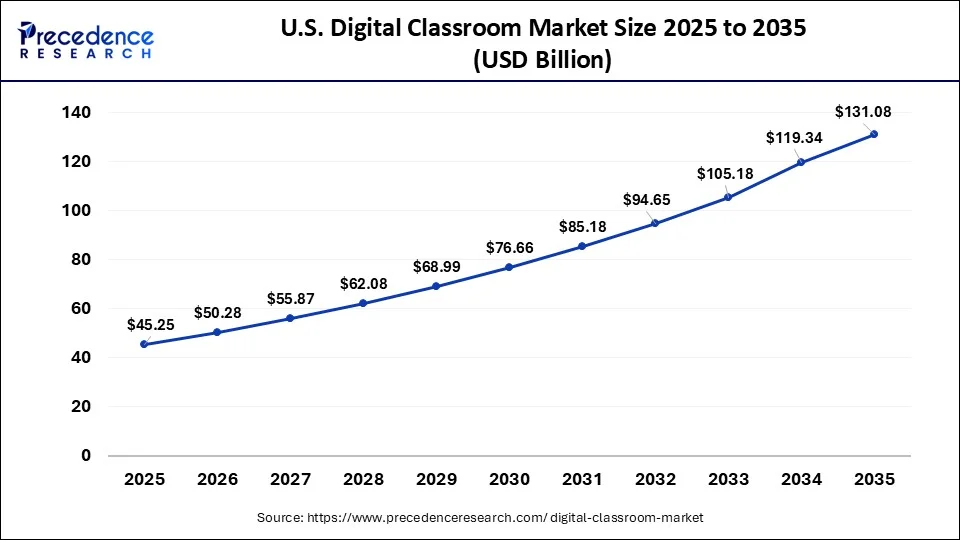
The U.S. digital classroom market size was exhibited at USD 50.28 billion in 2026 and is projected to be worth around USD 131.08 billion by 2035, growing at a CAGR of 11.22% from 2026 to 2035.
The Dominance of North America in the Digital Classroom Market
North America dominated the digital classroom market with the largest share in 2025. This is because of its strong technological framework and extensive incorporation of digital tools in education. The educational institutions in the area are pioneers in utilizing advanced technologies bolstered by considerable investment from both the public and private sectors. This dedication to innovation has resulted in the widespread adoption of hybrid learning models that blend conventional in-person teaching with online elements. Extensive internet access and the presence of advanced devices facilitate the smooth execution of digital classrooms by improving the entire educational experience. The implementation of hybrid learning models focusing on tailored education has further propelled market expansion.
- In September 2024, Arizona State University launched virtual reality-driven learning environments, boosting student interaction through immersive narratives and highlighting the role of North America in incorporating advanced technologies into education.
Hybrid Learning Boosts U.S. Market Dominance
The U.S. led the digital classroom market in 2025, driven by substantial investments from both government and private sectors. Federal financial support for high-speed internet and devices has improved digital infrastructure in educational institutions. The focus on STEM education has heightened the utilization of interactive resources like virtual laboratories. Moreover, the growth of hybrid and remote education has increased the need for cloud-based solutions.
- In early 2024, Google partnered with U.S. school districts to enhance digital learning spaces utilizing Google Workspace for Education tools, reinforcing the dominance of the country in this market.
Asia Pacific: Driving Digital Education Transformation
Asia Pacific is anticipated to grow at the fastest rate in the market during the forecast period because of government programs that encourage digital transformation in education. Nations such as India, China, and Japan are focusing on advancing digital infrastructure to enhance access to education and cultivate a digitally empowered community. The rising popularity of mobile devices and cost-effective internet access has allowed e-learning platforms to reach both urban and rural regions. The growing middle-class demographic and focus on quality education boost the need for sophisticated learning tools, including gamification and virtual reality-enhanced content. Cooperative initiatives among governments and private entities are also broadening the scope and efficacy of digital classrooms in the area.
- In October 2024, BYJU and Microsoft collaborated to enhance individualized learning experiences in India, incorporating AI-driven analytics and gamification tools for millions of learners. Additionally, China and South Korea are adopting blockchain technology to enhance transparency and security in digital education platforms.
India: Powering Digital Classrooms with Innovation
India stands as a prominent participant in the digital classroom sector, propelled by governmental efforts, increased internet access, and a rising need for quality education. The Digital India program, which has set aside approximately USD 2 billion from 2021 to 2026, seeks to enhance digital infrastructure and foster digital literacy. The presence of budget-friendly smartphones and internet connectivity, especially in rural regions, has enhanced the accessibility of e-learning platforms. The increasing middle-class demographic and focus on STEM education have further boosted the growth of tailored and engaging learning solutions.
China: Key Driver in the Digital Classroom Market
The digital classroom market in China is growing because of governmental backing, investments in tech, and an emphasis on merging technology with education. The Smart Education initiative and the broad access to inexpensive devices and fast internet have enabled the uptake of e-learning. The competitive education culture in China and the need for online tutoring platforms have further increased market penetration. The embrace of innovative technologies by the government, such as blockchain, and the implementation of interactive tools in STEM education have enhanced market expansion. Collaborations between technology firms and academic organizations highlight the dedication of China to progress in digital classroom innovations.
Europe: A Notable Region in the Digital Classroom Market
Europe is expected to grow at a considerable growth rate in the upcoming period, characterized by a strong educational framework, high internet access, and governmental backing at the forefront of the digital classroom industry. Nations such as Germany, the UK, and France are implementing digital tools and platforms. The Digital Education Action Plan 2021-2027 of the European Union seeks to enhance high-quality, inclusive digital education and training. The emphasis of the region on hybrid learning approaches, STEM education, and AI integration reinforces its position as a leader in innovative classroom solutions.
- In March 2024, the UK collaborated with Google for Education to incorporate AI-driven tools into primary and secondary schools, positioning Europe as the leading and most innovative region in advancing the digital classroom sector.
The UK Digital Classroom Market Trends
In the UK market in 2025, investment in digital learning technologies continues to rise as schools and colleges adopt interactive platforms, cloud-based tools, and AI-powered educational resources to enhance engagement and personalized learning. Government initiatives and funding programs are supporting infrastructure upgrades, increased device access for students, and teacher training to improve digital literacy and effective technology integration.
What are the Advancements in the Digital Classroom Market in Latin America?
Latin America is expected to witness substantial growth in the market, fueled by increasing internet penetration, rising mobile device usage, and growing investments in digital education initiatives. Countries such as Brazil and Mexico are rapidly transforming their education sectors through large-scale adoption of e-learning platforms and government-backed digital learning programs.
Brazil Digital Classroom Market Trends
The country is witnessing a rise in collaborations between government bodies and private sector players, expanding access to digital classrooms in both urban and rural areas. The increasing role of local startups and innovation hubs is further accelerating the region's market landscape. Teacher training and professional development in digital pedagogy are expanding to help educators effectively use new technologies.
MEA's Growing Digital Classroom Industry
The Middle East and Africa are expected to witness steady growth over the upcoming years. This market growth is propelled by the increasing prevalence of smartphones, interactive displays, and other digital learning tools in classrooms. Governments in the region are seen strategically and actively embracing smart education for economic development and prosperity, thus fueling market growth. Countries such as the UAE, Saudi Arabia, and Egypt are leading players.
Egypt Digital Classroom Market Trends
The country has actively embraced digital transformation in education, showcasing notable advancements in digital classroom adoption. The region also benefits from strong governmental backing, a tech-savvy youth population, expanding digital connectivity, and a thriving startup ecosystem.
Digital Classroom Market Companies
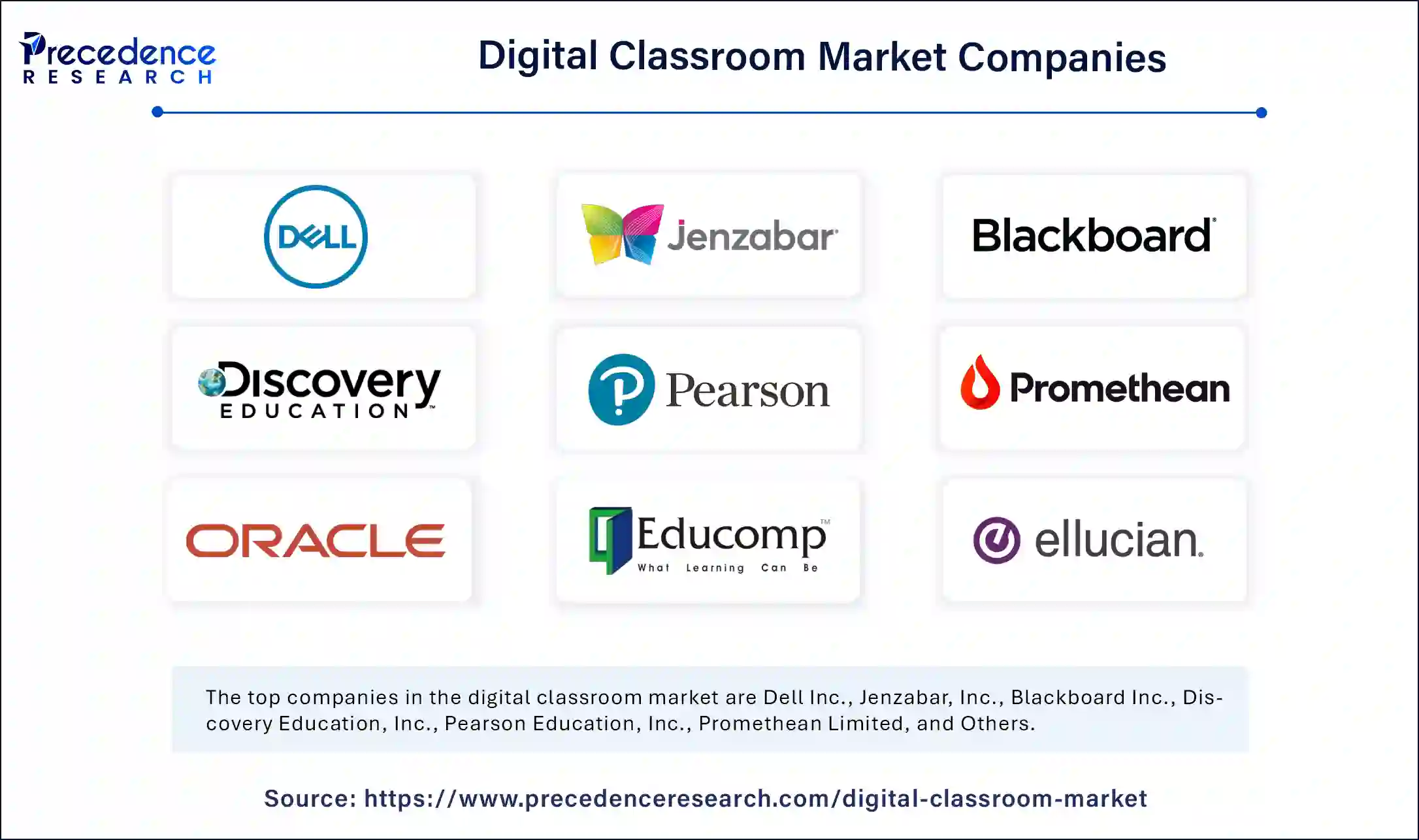
- Dell Inc.
- Jenzabar, Inc.
- Blackboard Inc.
- Discovery Education, Inc.
- Pearson Education, Inc.
- Promethean Limited
- Oracle Corporation
- Educomp Solutions Ltd.
- Ellucian Company L.P.
- Echo360, Inc.
- D2L Corporation
- Unit4
- APG and Co
- SMART Technologies ULC
- Dreambox Learning, Inc.
- McGraw Hill
Leaders Announcements
- In January 2024, Google launched 15 new Chromebooks and 30 additional features for Google Classroom and Google Workspace for Education, emphasizing accessibility and AI-driven tailored learning experiences.
- In May 2024, Tencent announced a USD 200 million investment in digital education projects in China, emphasizing AI-powered tools, virtual laboratories, and cloud learning platforms to improve individualized education.
- In April 2024, the Indian government announced increased funding for the Digital India initiative to extend its services to underserved rural regions, which includes collaborations with private edtech companies for AI-driven educational solutions.
Recent Developments
- In April 2024, the Prayagraj administration in India revealed intentions to implement digital smart classrooms in 48 primary schools, focusing on enhancing educational results in underprivileged regions by incorporating ICT tools such as projectors and interactive whiteboards.
- In September 2025, the AI Leap initiative of Estonia, collaborating with tech firms OpenAI and Anthropic, initiated workshops for 3,000 educators and 20,000 secondary school students.
- In early 2024, Google partnered with U.S. school districts to enhance digital learning settings by utilizing Google Workspace for Education tools, emphasizing virtual lectures, group projects, and classroom management.
Segments Covered in the Report
By Product Type
- Digital classroom hardware
- Digital classroom content
- Digital classroom software
By Application
- K-12
- Higher Education
By Geography
- North America
- Europe
- Asia Pacific
- Latin America
- Middle East and Africa
For inquiries regarding discounts, bulk purchases, or customization requests, please contact us at sales@precedenceresearch.com
Frequently Asked Questions
Tags





Ask For Sample
No cookie-cutter, only authentic analysis – take the 1st step to become a Precedence Research client
 Get a Sample




 sales@precedenceresearch.com
 Schedule a Meeting
