






 Request Consultation
Catheter stabilization devices play a vital role in modern healthcare by ensuring secure vascular access and reducing complications. They enhance patient comfort, improve treatment efficiency, and support safer clinical outcomes across care settings.
Why Catheter Stabilization Devices Are Crucial for Safe Vascular Care?
Catheter stabilization devices (CSDs) are a medical necessity to secure the catheters when performing intravenous treatment, hemodialysis, chemotherapy, and heart surgeries. These devices are applied to avert the occurrence of accidental catheter discharge, reduce the degree of patient distress, and reduce the risk of infection, which ensures safer and more reliable vascular access. CSDs are generally made out of materials of medical quality, which include silicone, polyurethane, and polyethylene, and may contain adhesive pads, clamps, or locking devices to provide the stability of the catheter. As they help to ensure the correct positioning of the catheter, support the effectiveness of the treatment, and ensure the safety of the patient in general, they are indispensable parts of modern vascular care.
Leading Manufacturers Driving Innovation in Catheter Stabilization Devices
| Companies | Offerings |
| Becton Dickinson (BD) | Provides adhesive securing products, stabilization clamps, and catheter anchoring products. |
| Smiths Medical | Specializes in PICC line stabilization systems, adhesive securement dressings, and advanced vascular access solutions. |
| C.R. Bard, Inc. (BD) | Provides securement devices using a locking mechanism and antimicrobial coating. |
| Teleflex Incorporated | Provides hospitals and home care catheter securement solutions such as PICC and IV stabilizers |
| 3M Healthcare |
Provides skin-friendly catheter adhesives and stabilizing technology in the short and long term. |
| B. Braun Melsungen AG |
It manufactures mechanical securement and adhesive systems for vascular and urinary catheters. |
Popular Catheter Stabilization Devices and Their Key Features
- Adhesive Stabilizers: They are the machines that add skin adhesives that are of medical grade to stabilize the catheters. They are simple to use, the intensity of discomfort to the patient is minimized, and the possibility of dislodgement is lowered. They can be used in the short term due to the high levels of stability and flexibility of patient movement.
- Mechanical Clamp Devices: Mechanical clamps are applicable as an option to provide high-profile, permanent catheter fixation, which possesses locking features. They are useful, particularly when the patients require prolonged treatment or when the patients are very mobile, so that the catheter is secure in its place. The devices assist in reducing complications and securing accurate vascular access during long procedures.
- Integrated Securement Systems: Combinations of the adhesives, mechanical clamps, and, in most instances, antimicrobial coating are known as the integrated systems that offer the highest stability of the catheter and infection prevention. These devices are equipped with a mixture of various stabilization methods that would make the patient safer and reduce the likelihood of complications.
What is the Catheter Stabilization Device Market Size in 2026?
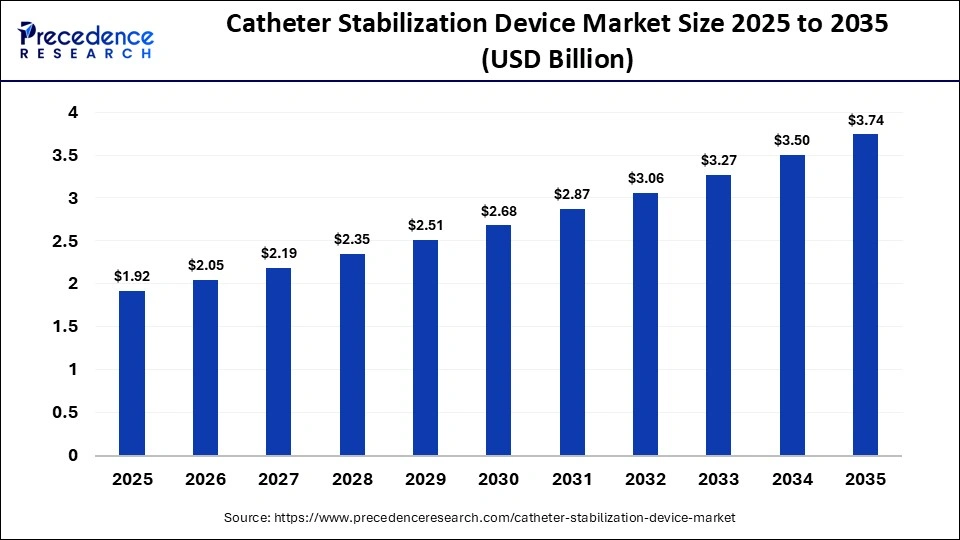
The global catheter stabilization device market was valued at USD 1.92 billion in 2025 and is expected to grow from USD 2.05 billion in 2026 to approximately USD 3.74 billion by 2035, registering a CAGR of 6.90% during the forecast period from 2026 to 2035. The market growth is driven by the increasing need to prevent catheter-related complications and infections, a rise in hospitalizations, and advancements in patient-centric securement technologies.
Applications: How Catheter Stabilization Devices Improve Patient Care?
- Hospitals & Clinics: Catheter stabilization devices are used in hospitals and clinics, and they make IV therapy, hemodialysis, and cardiac operations convenient. They reduce the unwanted dislodgement and complications and improve the treatment results. Hospitalizations worldwide require vascular access, and the application of these devices is very crucial in delivering quality, efficient, and effective patient care in areas of medicine.
- Home Healthcare: Patient home healthcare is a key area driving the demand for catheter stabilization devices, particularly for patients receiving chemotherapy, IV antibiotics, and long-term infusion treatments. These devices help secure catheters effectively outside hospital settings, preventing complications and enhancing patient comfort.
- Emergency and Critical Care Units: Catheters are inserted in intensive care units and during surgical procedures with the assistance of catheter stabilization devices. These devices are essential for immediate treatment, accurate drug administration, and continuous patient monitoring. They ensure secure and consistent vascular access, even in high-pressure and critical care environments.
- Pediatric/Geriatric Care: Children and elderly patients require special attention due to their sensitive skin. Catheter stabilization devices designed with soft adhesives, ergonomic structures, and reliable locking mechanisms provide safe and comfortable vascular access. These features help ensure effective treatment compliance and positive patient outcomes in both pediatric and geriatric care.
Expert Opinion
According to Precedence Research, catheter stabilization devices are emerging as a critical growth segment within the broader medical devices industry due to rising demand for safe, reliable, and patient-friendly vascular access solutions. The increasing prevalence of chronic diseases such as cancer, renal failure, and cardiovascular conditions has fueled the need for long-term intravenous therapy, hemodialysis, and chemotherapy, creating a steady and expanding demand for these devices. Hospitals, specialty clinics, and home healthcare providers are prioritizing patient safety and treatment efficacy, which drives the adoption of stabilization devices that reduce complications such as catheter dislodgement, infections, and skin irritation.
Investments in innovation, including adhesive technologies, antimicrobial coatings, and IoT-enabled smart securement systems, are improving device performance and patient comfort, enhancing their value proposition to healthcare providers. From a business standpoint, companies that can combine high-quality clinical outcomes with cost-effective production and robust distribution networks are likely to gain a competitive edge. Furthermore, government initiatives, private funding, and rising healthcare expenditures are enabling wider access, especially in developing regions. Overall, catheter stabilization devices represent both a vital clinical solution and a lucrative opportunity for businesses seeking to capitalize on the growing demand for advanced, patient-centric medical technologies.
How Do Government Initiatives and Institutional Investments Drive Innovation in Catheter Stabilization Devices?
Government initiatives and institutional investments play a crucial role in driving innovation in catheter stabilization devices by providing funding for research and development of safer and more effective solutions. These investments support advanced material development, ergonomic designs, and enhanced locking mechanisms that improve patient comfort and treatment outcomes. Additionally, regulatory incentives and financial backing encourage healthcare providers and manufacturers to adopt and implement these innovations, facilitating widespread adoption.
For instance, the European Commission approved EUR 403 million (approximately US $471 million) of public funding in 2025 to fund medical device innovation. The result of this funding is predicted to open another EUR 826 million (a total of about US 966 million) of private investments in the development of medical technologies such as devices used in vascular access and the fixation of catheters.
Driving Forces Shaping Catheter Stabilization Technology
- Rising Chronic Disease Rates: The increasing prevalence of cancer, renal disease, and heart conditions has boosted demand for catheters. Catheterization and stabilization devices are essential as more patients require intravenous treatment, hemodialysis, or long-term vascular access. These devices provide safe and reliable treatment, helping achieve better patient outcomes in hospitals and clinics.
- Patient Safety Initiatives: Hospitals and healthcare providers prioritize infection control and prevention of accidental catheter dislodgement. Catheter stabilization devices enhance patient safety, reduce complications, and support compliance with stringent safety regulations. Growing awareness of hospital-acquired infections is driving innovation toward higher-quality stabilization solutions in clinical settings.
- Growth of Home Healthcare: The rise of at-home IV therapy, chemotherapy, and long-term catheter treatments has increased the need for secure catheter methods. Stabilization devices enable patients to receive effective and safe care at home, reducing the frequency of hospital visits.
Challenges Limiting Broader Adoption
- High Costs of Devices: Advanced catheter stabilization devices with features such as built-in clamps, adhesives, or antimicrobial properties are expensive. High prices can limit adoption in cost-sensitive hospitals, clinics, or home healthcare systems, particularly in developing regions. Limited budgets and reimbursement options remain a barrier, despite the clear clinical benefits of these devices.
- Issues of Compatibility: Catheter stabilization devices must accommodate a wide variety of catheters and align with patient anatomy. This need for customization can make selection and implementation challenging and complicate standardization within medical institutions, as clinicians must ensure devices meet the specific needs of each patient.
- Distribution Hurdles: Limited distribution networks and logistical challenges restrict access to advanced catheter stabilization equipment in remote or underdeveloped areas. Slow market penetration is further hindered by low awareness among healthcare providers and patients in these regions.
The Future of Catheter Stabilization Devices: New Innovations and Future Growth
The development of adhesive-based catheter stabilization products is making devices more comfortable, reducing skin irritation, and minimizing wear and tear, while antimicrobial coatings help lower the risk of infection and improve patient care. IoT-enabled smart securement systems can monitor catheter positions in real time, alerting healthcare professionals to dislodgement or potential complications. Minimally invasive procedures are becoming the standard, driven by global demand for effective treatment of chronic diseases, particularly in cancer, kidney, and cardiovascular patients.
Wrapping Up
The use of catheter stabilization devices is increasingly becoming an essential component of modern healthcare, ensuring safe and effective vascular access in hospitals, home care, and specialized treatment facilities. Rising chronic disease rates, the growing reliance on home-based treatments, and patient safety initiatives are key drivers of this trend. Improved accessibility, supported by government subsidies, increased investment, and expanded distribution channels, is further boosting adoption. As the future of vascular care, catheter stabilization devices are transforming design standards to deliver better patient outcomes, reduce complications, and enhance overall comfort.
About the Authors

Aditi Shivarkar
Aditi, Vice President at Precedence Research, brings over 15 years of expertise at the intersection of technology, innovation, and strategic market intelligence. A visionary leader, she excels in transforming complex data into actionable insights that empower businesses to thrive in dynamic markets. Her leadership combines analytical precision with forward-thinking strategy, driving measurable growth, competitive advantage, and lasting impact across industries.



Aman Singh
Aman Singh with over 13 years of progressive expertise at the intersection of technology, innovation, and strategic market intelligence, Aman Singh stands as a leading authority in global research and consulting. Renowned for his ability to decode complex technological transformations, he provides forward-looking insights that drive strategic decision-making. At Precedence Research, Aman leads a global team of analysts, fostering a culture of research excellence, analytical precision, and visionary thinking.

Piyush Pawar
Piyush Pawar brings over a decade of experience as Senior Manager, Sales & Business Growth, acting as the essential liaison between clients and our research authors. He translates sophisticated insights into practical strategies, ensuring client objectives are met with precision. Piyush’s expertise in market dynamics, relationship management, and strategic execution enables organizations to leverage intelligence effectively, achieving operational excellence, innovation, and sustained growth.