






 Request Consultation
Cloud native storage is transforming IT infrastructure by enabling scalable, automated, and flexible data management. It supports modern applications, containers, and multi-cloud environments, helping businesses improve performance and efficiency.
The way businesses develop and maintain their IT infrastructure has completely changed due to the quick development of digital technologies. The emergence of cloud computing, microservices, and containerization has rendered traditional storage systems insufficient to manage distributed and dynamic workloads. Due to this change, cloud native storage has become an essential component of contemporary IT environments.
Cloud native storage provides scalability, flexibility, and automation and is specifically made to function in cloud-based and containerized ecosystems. It supports real-time applications and high-performance workloads while enabling enterprises to manage data seamlessly across hybrid and multi-cloud environments.
Why Traditional Storage Falls Short in Modern IT
Legacy storage systems, originally built for static, monolithic applications, are increasingly ill-suited for today’s dynamic and rapidly evolving IT environments. They struggle to efficiently support containerized workloads, offer limited scalability, and often rely on manual intervention for management and maintenance. As a result, these constraints can hinder agility, slow down innovation, and create operational inefficiencies in modern infrastructure.
In contrast, modern IT infrastructure demands:
- On-demand scalability to handle fluctuating workloads.
- High availability for mission-critical applications.
- Seamless integration with DevOps and CI/CD pipelines.
- Efficient data mobility across multiple cloud platforms.
Cloud native storage addresses these requirements by offering a flexible, automated, and highly scalable approach to data management, enabling organizations to operate with greater agility and efficiency.
What is the Cloud Native Storage Market Size in 2026?
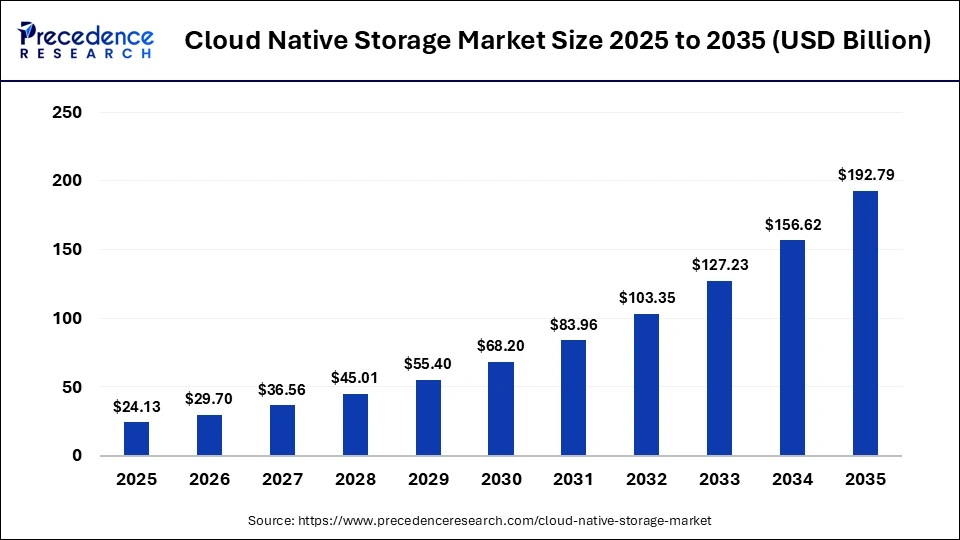
The global cloud native storage market was valued at USD 24.13 billion in 2025 and is projected to grow from USD 29.70 billion in 2026 to approximately USD 192.79 billion by 2035, registering a CAGR of 23.10% during the forecast period from 2026 to 2035. This growth is driven by the increasing demand for scalable and flexible data storage solutions.
Get a Free Sample Report with Key Market Trends: https://precedenceresearch.com/sample/8197
What is Cloud Native Storage?
Storage options designed especially for cloud native architectures are referred to as cloud native storage. These solutions enable automated storage resource provisioning, scaling, and management through integration with container orchestration platforms such as Kubernetes.
Key characteristics include:
- Container-aware storage management
- Software-defined architecture
- Automation and orchestration
- Support for persistent storage in containers
This makes cloud native storage ideal for organizations adopting microservice-based application development.
Core Technologies Behind Cloud Native Storage Innovation
- Container Storage Interface (CSI): CSI provides a standardized way to integrate storage systems with container orchestration platforms, improving interoperability and flexibility.
- Software-Defined Storage (SDS): SDS decouples storage from physical hardware, allowing organizations to scale storage resources efficiently without infrastructure constraints.
- Persistent Volume Management: Ensures that data remains intact even when containers are restarted, scaled, or moved across environments.
- Multi-Cloud Storage Solutions: Enable seamless data movement and management across multiple cloud providers, reducing dependency on a single vendor.
- Edge and Distributed Storage: Supports low-latency applications by processing data closer to the source, which is critical for IoT and real-time analytics.
Why Legacy Storage Systems Can’t Keep Up with Modern Demands?
The demands for contemporary IT environments are severely constrained by traditional storage systems. These systems are less appropriate for dynamic and distributed applications because they are usually built for stable and predictable workloads. As a result, they frequently need a lot of manual configuration and struggle to scale effectively.
Additionally, the incompatibility of legacy storage solutions with containerized environments restricts their capacity to accommodate contemporary application architectures because of their complexity and limited automation capabilities; they also typically entail higher operational and maintenance costs. Organizations are moving toward more sophisticated cloud native storage solutions as a result of these difficulties.
Why Businesses Are Moving Beyond Traditional Storage Systems?
The scalability, flexibility, and efficiency of cloud native storage are made possible by several critical technologies. By standardizing how storage systems interface with container orchestration platforms and streamlining development and management procedures, the container storage interface plays a critical role. By separating storage functionality from physical hardware, software defined storage enables businesses to scale resources more effectively and adjust to changing demands.
Reliability for crucial applications is ensured by persistent storage solutions, which guarantee that data stays intact even when containers are restarted or moved across environments. Object storage is a popular method for handling massive amounts of unstructured data, which makes it perfect for workloads involving analytics and artificial intelligence. Furthermore, by processing data closer to the source, edge storage solutions lower latency and enhance performance for real-time applications.
Key Cloud Native Storage Technologies and Their Strategic Impact
| Technology | Role in Cloud Native Environment | Business Value | Future Impact |
| Container Storage Interface (CSI) | Standardizes storage integration with Kubernetes | Simplifies deployment and reduces complexity | Enables multi-platform compatibility |
| Software-Defined Storage (SDS) | Separates storage from hardware | Improves scalability and cost efficiency | Supports flexible cloud architectures |
| Persistent Volumes | Maintains data across container lifecycles | Ensures application reliability | Critical for stateful applications |
| Object Storage | Stores unstructured and large-scale data | Supports analytics, AI, and big data | Backbone for data-driven enterprises |
| Edge Storage | Processes data closer to the source | Reduces latency and bandwidth usage | Essential for IoT and real-time apps |
Role of Kubernetes in Storage Evolution
Kubernetes has emerged as a key component of the contemporary cloud native infrastructure, revolutionizing the deployment and management of applications. The demand for storage solutions that work with Kubernetes has increased dramatically as more businesses adopt it, because cloud native storage is built to work seamlessly with Kubernetes. Storage resources can be managed automatically and dynamically.
Applications can scale effectively with consistent data availability thanks to this integration. Additionally, by offering a single framework for both computer and storage resources, it makes managing complicated, dispersed environments easier. Therefore, a new era of flexible and robust IT infrastructure is being propelled by Kubernetes and cloud native storage.
Real-World Use Cases
Many industries are adopting cloud native storage to support data-intensive workloads and modern applications. By offering high-speed data access, it facilitates fraud detection and real-time transaction processing in the financial industry. It facilitates the safe management and storage of medical imaging data and patient records in the healthcare industry, guaranteeing accessibility and compliance.
Retail businesses are using cloud native storage to provide individualized customer experiences by using sophisticated data analytics. It is essential for handling the enormous amounts of data produced by 5G networks in the telecom sector. Similar to this, cloud native storage improves productivity and efficiency in manufacturing by supporting IoT-enabled operations and smart factory initiatives.
AI, Automation, and the Future of Storage
The development of cloud native storage automation and artificial intelligence is becoming more and more significant. AI-driven analytics are being used by contemporary storage systems to improve performance, anticipate possible malfunctions, and more effectively manage resources. These systems can dynamically allocate storage by examining usage patterns, which lowers expenses and boosts overall effectiveness. These capabilities are further improved by automation, which reduces human intervention and simplifies repetitive tasks. This keeps their storage infrastructure dependable and efficient while enabling businesses to concentrate on innovation. AI technologies will be crucial in determining how storage systems will develop in the future.
Emerging Trends to Watch
The landscape of cloud native storage is changing quickly, and a number of new trends are influencing its future. Serverless storage is changing quickly, and a number of new trends are influencing its future. Serverless storage architecture is becoming increasingly popular because they let businesses handle data without worrying about the underlying infrastructure. Because edge-native storage allows for faster data processing and lower latency, it is becoming increasingly crucial for Internet of Things applications.
Additionally, data fabric and unified storage platforms are gaining popularity, which offer smooth data integration across various environments. As businesses look to safeguard sensitive data in distributed systems, security and compliance are becoming increasingly important. Another major trend is sustainability, with businesses looking into energy-efficient storage options to lessen their environmental impact.
Opportunities for Businesses
Businesses across numerous industries stand to gain a great deal from the use of cloud native storage. Organizations can improve overall efficiency and lower operating costs by updating their storage infrastructure. Improved performance and scalability allow companies to respond swiftly to market demands and provide better user experience.
By facilitating the creation of sophisticated applications driven by artificial intelligence and data analytics, cloud native storage also fosters innovation. With the increasing demand for flexible and scalable storage solutions, this market presents significant growth potential for technology providers.
Expert Opinion
According to our industry experts, cloud native storage is no longer just a technical upgrade; it is a strategic enabler of digital transformation. Organizations adopting cloud native storage benefit from enhanced scalability, cost efficiency through pay-as-you-go models, and the agility needed to support modern, containerized applications. It allows businesses to respond quickly to changing market demands, streamline operations, and reduce reliance on complex, manual infrastructure management.
Moreover, cloud native storage strengthens data accessibility and resilience across multi-cloud environments, which is critical for maintaining business continuity and delivering seamless customer experiences. As data volumes continue to grow, investing in cloud native storage positions enterprises to leverage advanced analytics, improve decision-making, and maintain a competitive edge in an increasingly data-driven economy.
Conclusion: Building Future-Ready IT Infrastructure
Cloud native storage is quickly emerging as a key component of contemporary IT infrastructure. It is crucial for businesses undergoing digital transformation because of their capacity to support dynamic workloads to facilitate automation and guarantee high availability. The need for cutting-edge storage solutions will only increase as companies continue to use cloud-based technologies.
Organizations can create robust, scalable, and future-ready IT environments that can handle changing business requirements by investing in cloud native storage. In addition to increasing operation to increase operational effectiveness, this shift fosters innovation and positions companies for long-term success in the digital era.
Furthermore, early adoption of cloud native storage will give businesses a competitive edge through quicker time to market and better service delivery as industry competition increases. In an increasingly data-driven world, the capacity to effectively manage data across distributed environments will become a critical differentiator, allowing businesses to remain flexible and responsive.
In addition, the significance of cloud native storage will be further reinforced by the ongoing development of cloud technologies and growing dependence on digital ecosystems. Businesses that match their storage plans with cutting-edge technologies like edge computing, artificial intelligence, and real-time analytics will be in a better position to take advantage of new growth prospects and maintain long-term innovation.
About the Authors

Aditi Shivarkar
Aditi, Vice President at Precedence Research, brings over 15 years of expertise at the intersection of technology, innovation, and strategic market intelligence. A visionary leader, she excels in transforming complex data into actionable insights that empower businesses to thrive in dynamic markets. Her leadership combines analytical precision with forward-thinking strategy, driving measurable growth, competitive advantage, and lasting impact across industries.



Aman Singh
Aman Singh with over 13 years of progressive expertise at the intersection of technology, innovation, and strategic market intelligence, Aman Singh stands as a leading authority in global research and consulting. Renowned for his ability to decode complex technological transformations, he provides forward-looking insights that drive strategic decision-making. At Precedence Research, Aman leads a global team of analysts, fostering a culture of research excellence, analytical precision, and visionary thinking.

Piyush Pawar
Piyush Pawar brings over a decade of experience as Senior Manager, Sales & Business Growth, acting as the essential liaison between clients and our research authors. He translates sophisticated insights into practical strategies, ensuring client objectives are met with precision. Piyush’s expertise in market dynamics, relationship management, and strategic execution enables organizations to leverage intelligence effectively, achieving operational excellence, innovation, and sustained growth.