






 Request Consultation
Introduction
Digital therapeutics are generally evidence-based software interventions that treat, manage, or prevent medical conditions, usually with FDA clearance, and have lived through one of the most dramatic boom-bust-boom cycles in modern healthcare technology. Pear Therapeutics, an FDA-cleared pioneer that went public via SPAC in 2021, probably filed for Chapter 11 bankruptcy in April 2023 after only 58% of prescriptions written for its products were ever filled at a pharmacy, following almost exactly in the footsteps of Proteus Digital Health, which had raised over $500 million before its own 2020 collapse.
In May and June 2025, Hinge Health and Omada Health both completed successful IPOs, each backed by strong revenue growth, enhancing margins, and a fundamentally different distribution strategy.
This report draws entirely on firm SEC filings, bankruptcy disclosures, FDA regulatory records, and even official press releases to map who the market's competitors are, which business models have actually worked, and why the difference between prescription-driven and employer-channel distribution has proven so consequential.
Key Takeaways
- The digital therapeutics (DTx) sector has swung between spectacular failure and spectacular success within a five-year window: Proteus Digital Health (2020) and
- Pear Therapeutics (2023) both filed for bankruptcy after raising hundreds of millions in funding, while Hinge Health and Omada Health both completed successful IPOs in 2025.
- Hinge Health went public on the NYSE in May 2025, thus raising $437 million at a valuation exceeding $3 billion, with trailing twelve-month revenue of $432 million, gross margins above 80%, and 117% net dollar retention.
- Pear Therapeutics, holding FDA clearance for its reSET and reSET-O prescription digital therapeutics, saw only 58% of the nearly 31,000 prescriptions written for its products actually filled at a pharmacy in the first nine months of 2022, thus illustrating a fatal gap between regulatory approval and real-world revenue.
- The two 2025 IPO successes and the two earlier bankruptcies split cleanly along business model lines: the failed firms relied on physician prescriptions filled via pharmacies, while the successful firms sell directly to employers and health plans as a covered benefit, thus bypassing the prescription-to-pharmacy conversion gap entirely.
- Omada Health went public on the Nasdaq in June 2025, raising $150 million at nearly a $1.1 billion valuation, with 2024 revenue of $170 million (up 38% from $123 million in 2023) along with Q1 2025 revenue growth of 57% year-over-year.
- Digital therapeutics reimbursement in the US now flows via specific CPT Category III codes (0704T-0706T) for device supply and setup, and CPT codes 98975-98981 for remote therapeutic monitoring, though a proposed Access to Prescription Digital Therapeutics Act remains pending to establish clearer and permanent reimbursement pathways.
- EndeavorRx (Akili Interactive) became the first FDA-authorized digital therapeutic for any pediatric condition via the De Novo pathway in June 2020, later expanding to an over-the-counter version (EndeavorOTC) cleared via the 510(k) pathway in June 2024, yet the firm itself has since pursued a going-private transaction amid continued commercialization challenges.
- Proteus Digital Health raised more than $500 million in funding and then reached a $1.5 billion valuation before its June 2020 bankruptcy, following the loss of its development collaboration with Otsuka Pharmaceuticals and a 2019 layoff of 292 employees, establishing the template that Pear Therapeutics would follow almost exactly three years later.
- Customer concentration thus remains a structural risk even for the sector's success stories: Omada Health's top five health plan and also PBM customers accounted for 69% of its 2024 revenue, as per the company's own IPO registration statement.
- Digital health M&A activity has continued alongside these public-market swings, which includes Teladoc Health's $18.5 billion acquisition of Livongo (2020), Aptar Pharma's acquisition of Voluntis (2022), along with ResMed's acquisition of Propeller Health (2022).
Visual Intelligence: 15 Data Stories on Digital Therapeutics Competitors & Business Models
The Digital Therapeutics Boom-Bust-Boom Cycle, 2020-2025
| Date | Key Event |
| Jun-20 | Proteus Digital Health Files bankruptcy after raising $500M+ |
| Dec-21 | Pear Therapeutics Goes public via SPAC on Nasdaq |
| Apr-23 | Pear Therapeutics Files Chapter 11 bankruptcy; stock down 99.28% |
| May-25 | Hinge Health IPOs on NYSE; raises $437M, reaches >$3B market cap |
| Jun-25 | Omada Health IPOs on Nasdaq; raises $150M, reaches ~$1.1B valuation |
This timeline traces five defining events in digital therapeutics from Proteus Digital Health's 2020 bankruptcy through Hinge Health's and Omada Health's successful 2025 IPOs.
- In June 2020, Proteus Digital Health filed for bankruptcy after raising $500M+.
- In December 2021, Pear Therapeutics went public via SPAC on Nasdaq.
- In April 2023, Pear Therapeutics filed for Chapter 11 bankruptcy, with its stock down 99.28%.
- In May 2025, Hinge Health IPOs on NYSE, raising $437M.
- In June 2025, Omada Health IPOs on Nasdaq, raising $150M.
Key Insight: The nearly identical five-year gap between Proteus's 2020 collapse as well as Pear's 2023 collapse, followed by another roughly two-year gap before Hinge Health's along with Omada Health's 2025 IPOs, suggests the DTx sector has moved via a genuine business-model correction rather than simply cycling via unrelated company-specific failures; the survivors adopted a fundamentally different distribution strategy than the firms that failed.
Source: Multiple (see below) - "STAT News, Axios, Fierce Healthcare, and Healthcare Dive reporting," 2020-2025.
Pear Therapeutics' Fatal Funnel: Only 58% of Prescriptions Were Ever Filled
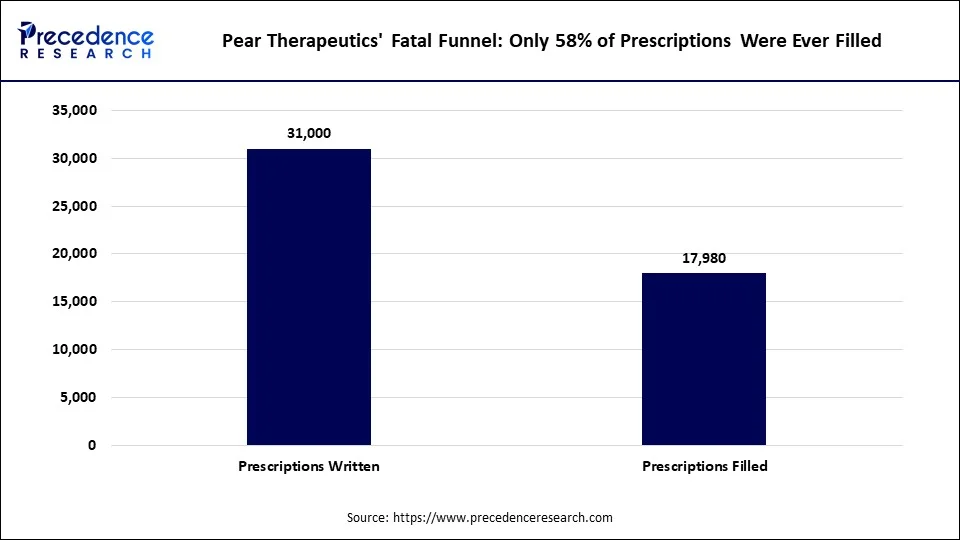
This chart shows the gap between prescriptions written and prescriptions actually filled for Pear Therapeutics' digital therapeutic products during the first nine months of 2022, based on the firm's own disclosures ahead of its bankruptcy filing.
There are 31,000 prescriptions written, which serve as a binding legal document that fixes professional accountability for the treatment offered.
There are 17,980 prescriptions filled. Pharmacists review your filled prescription to catch dangerous drug interactions. Regular refills prevent dangerous gaps in your daily treatment supply.
Key Insight: A 42% drop-off between prescription and fill represents a uniquely severe leak in the revenue funnel that traditional pharmaceutical firms rarely experience at this magnitude. It reflects both low patient knowledge of digital therapeutics as a legitimate treatment category and inconsistent pharmacy-level support for dispensing software rather than pills, a structural friction point specific mainly to the prescription DTx model.
Source: Pear Therapeutics, Inc. - "Investor and public disclosures, cited in industry analysis of the company's Chapter 11 filing," 2022-2023.
Proteus Digital Health: The Original DTx Cautionary Tale
This highlight states Proteus Digital Health's funding history and the circumstances of its June 2020 bankruptcy filing.
Proteus Digital Health filed for Chapter 11 bankruptcy protection. The Silicon Valley firm was valued at one point at $1.5 billion. The firm was considered one of the first digital health "unicorns," or worldwide VC-backed digital health startup firms valued at $1 billion or more. Proteus develops ingestible sensors along with a wearable sensor patch to track medication-taking behavior.
The company commercialized a service called Proteus Discover, a digital medicine solution that connects drug ingestions to results and is designed to allow patients to engage in their own healthcare and be rapidly assessed.
According to the case filed in the U.S. Bankruptcy Court for the District of Delaware, the firm has $100 million to $500 million in assets and $50 million to $100 million in liabilities.
Key Insight: Proteus's collapse three years before Pear's, thus following an almost identical pattern- heavy fundraising, a lost pharma collaboration, workforce reductions, then bankruptcy- shows that a well-funded firm pursuing a similar model was always likely to encounter the same wall.
Source: Healthcare.Digital - "What's Next for Digital Therapeutics After It All Went PEAR Shaped?" May 17, 2023.
Hinge Health's IPO: Redefining Digital Health Success
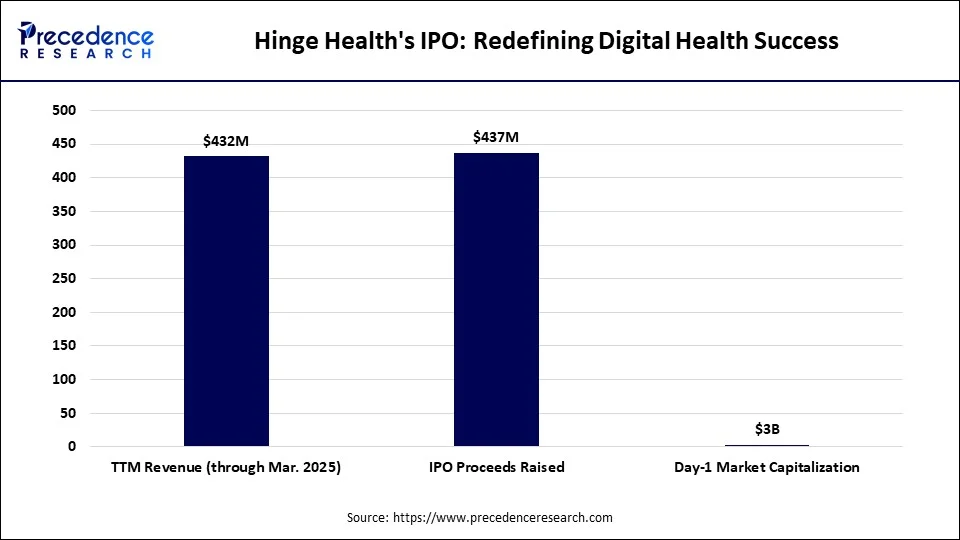
This chart summarizes Hinge Health's trailing twelve-month revenue, IPO proceeds raised, and day-one market capitalization following its May 2025 NYSE listing.
In March 2025, digital musculoskeletal clinic Hinge Health was trending at an estimated $432 million in trailing twelve-month (TTM) Revenue, demonstrating robust commercial momentum as it prepared for its public market entry.
IPO Proceeds Raised: $437M, and Day 1 Market capitalization is $3B.
Key Insight: Hinge Health's IPO stood out from the SPAC-based digital health listings of 2020-2021 specifically because the firm was already free-cash-flow positive and did not need the capital. Management explicitly framed the IPO as a validation and liquidity event rather than a fundraising necessity, thus a meaningfully different signal to public investors than earlier, cash-hungry digital health listings sent.
Source: Hinge Health, Inc. (NYSE: HNGE) - "IPO disclosures, cited in Fierce Healthcare," May 2025.
Omada Health's Revenue Grew 38% in the Year Before Its IPO
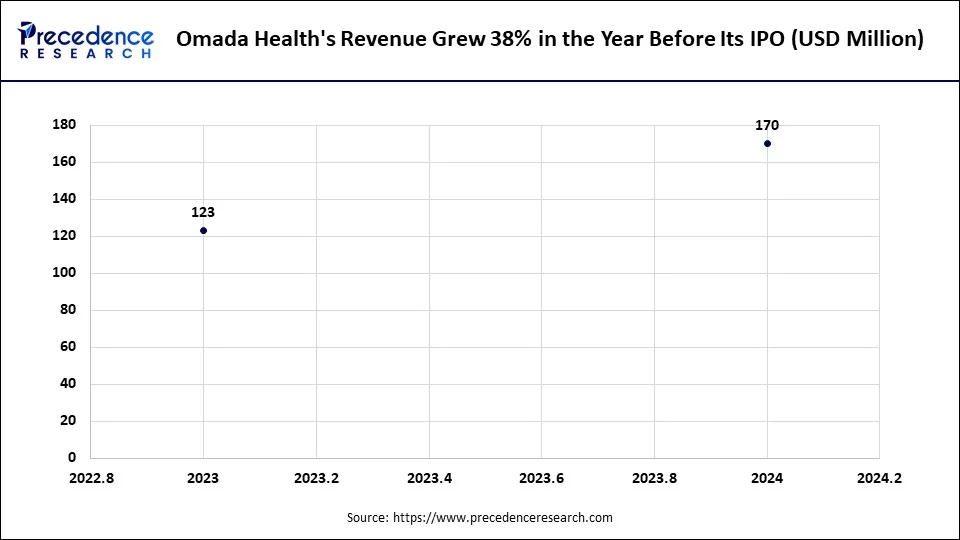
This chart shows Omada Health's annual revenue for 2023 and 2024, based on the firm's own S-1 registration statement filed ahead of its June 2025 IPO.
In 2023, Omada Health's annual revenue was $123M due to the scaling of its virtual-first care programs targeting chronic conditions such as diabetes, hypertension, and even musculoskeletal issues.
In 2024, Omada Health's annual revenue was $170M by capitalizing on its enterprise-focused business model, a 38% year-over-year growth rate from $123 million in 2023. The firm achieves this financial scale via specific strategic drivers, distribution channels, and monetization strategies.
Key Insight: Omada's revenue growth accelerated further after this period, thus, reaching 57% year-over-year in Q1 2025, meaning the firm's growth rate was still increasing, not decelerating, in the immediate run-up to its public listing, a pattern that gave underwriters such as J.P. Morgan, Morgan Stanley, Goldman Sachs, and Barclays, confidence to price the deal despite the firm's continued net losses.
Source: Omada Health, Inc. - "S-1 Registration Statement and FY2024 financial disclosures," 2025.
Two Business Models: Employer-Channel B2B2C vs. Pharma-Style Prescription
| Business Model | Companies | Key Characteristics |
| Employer-Channel B2B2C | Hinge Health, Omada Health | Sold directly to self-insured employers or health plans as a covered benefit; no individual prescription or pharmacy fill required; revenue tied to member enrollment/engagement rather than physician prescribing behavior |
| Prescription Digital Therapeutic (PDT) | Pear Therapeutics, Akili | Requires a physician prescription and is filled through a pharmacy like a drug; depends on payer reimbursement decisions and CPT/HCPCS coding; revenue vulnerable to the gap between prescriptions written and actually filled |
This comparison contrasts the two dominant business models in digital therapeutics: employer- or health-plan-channel B2B2C used by Hinge Health and Omada Health versus the prescription digital therapeutic model used by Pear Therapeutics and, in part, Akili Interactive.
Hinge Health and Omada Health use a B2B2C health-plan channel model to sell their digital care solutions via employers, health plans, and even pharmacy benefit managers (PBMs) rather than marketing directly to individual consumers.
The B2B2C health plan channel is mainly used by Pear Therapeutics and, in part, Akili Interactive, and is the Prescription Digital Therapeutics (PDT) model.
Under this specific reimbursement framework, the software is treated like a traditional pharmaceutical asset. The digital therapeutic firm negotiates with health plans such as commercial insurers, Medicaid, or employers to secure coverage and then get listed on digital formularies.
Key Insight: The employer-channel model's key structural advantage is eliminating an entire step from the revenue funnel; there is no equivalent to Pear's 42% prescription-to-fill drop-off, as the contract is negotiated once at the employer or health-plan level and enrollment follows automatically as a covered benefit, rather than demanding millions of individual physician-patient prescribing decisions to each convert successfully.
Source: Synthesized from official sources -"Company S-1 filings and business model disclosures," 2023-2025.
FDA Regulatory Pathways for Digital Therapeutics
| Regulatory Pathway | Purpose / Requirements | Key Characteristic | Example |
| De Novo Classification | For novel, lower-to-moderate-risk devices with no existing predicate | Creates a new device classification that becomes a predicate for future 510(k) submissions | EndeavorRx (DEN200026), June 2020 - first-ever authorization |
| 510(k) Clearance | For devices demonstrating “substantial equivalence” to an existing predicate device | Generally faster than De Novo once a predicate exists | EndeavorOTC, June 2024 - used EndeavorRx as predicate |
This comparison summarizes the two primary FDA regulatory pathways used by digital therapeutics companies: De Novo classification and 510(k) clearance.
De Novo Classification is utilized for groundbreaking digital therapeutics with the latest technological features or intended uses where no prior equivalent software exists.
510(k) clearance is used for follow-on digital therapeutics that build upon an existing, cleared predicate device, which could be an older 510(k) or a granted De Novo device.
Key Insight: The De Novo-then-510(k) sequence Akili used with EndeavorRx and EndeavorOTC- thus establishing a novel device classification first, then utilizing it as a predicate for a follow-on product has become something of a template pathway for digital therapeutics companies, since it enables a single company's first product to effectively lower the regulatory bar for its own subsequent products in the same therapeutic category.
Source: US FDA - "De Novo classification request DEN200026; Akili Interactive FDA clearance announcements," 2020, 2024.
EndeavorRx: The First FDA-Cleared Video Game Therapeutic
| Date | Company / Event | Details |
| 2017 | Akili | Confirms it is pursuing FDA submission for Project: Evo |
| Jun-20 | EndeavorRx | Receives FDA De Novo clearance - first-ever for a video-game therapeutic, for ages 8-12 |
| Oct-22 | Akili | Completes SPAC merger; approximately $1B post-money valuation and $412M gross proceeds |
| Dec-23 | EndeavorRx | Label expanded to ages 8-17, based on a 162-adolescent study |
| Jun-24 | EndeavorOTC | Receives FDA 510(k) clearance - first OTC digital ADHD treatment for adults via video game |
This timeline traces EndeavorRx's regulatory and corporate history from Akili's initial 2017 FDA submission confirmation through EndeavorOTC's 2024 clearance.
Akili Interactive Labs thus spans a pioneering era in digital therapeutics (DTx). Further, it details a journey from securing the first-ever prescription video game clearance to the drastic restructuring of its corporate model to survive in the over-the-counter (OTC) market.
Key Insight: The roughly three-year gap between Akili's 2017 submission confirmation and its June 2020 De Novo clearance illustrates how much regulatory lead time a genuinely novel digital therapeutic category requires, far longer than the FDA's typical 510(k) review timeline for devices with existing predicates, a lead time that later-stage digital therapeutics firms pursuing entirely new mechanisms should expect to face as well.
Source: MobiHealthNews; Akili Interactive - "Press releases and FDA clearance announcements," 2017-2024.
The Reimbursement Challenge: CPT and HCPCS Codes for Digital Therapeutics
| Code / Status | Description |
| 0704T-0706T | CPT Category III codes for DTx device supply and initial setup |
| 98975-98981 | CPT codes for Remote Therapeutic Monitoring (RTM) treatment management |
| Pending | Access to Prescription Digital Therapeutics Act — proposed federal legislation |
This infographic summarizes the specific CPT Category III codes and remote therapeutic monitoring codes currently utilized for digital therapeutics reimbursement in the US, along with pending federal legislation.
CPT Category III codes are used for emerging, experimental, or novel medical services and procedures and assist the American Medical Association (AMA) in collecting data on new clinical uses before deciding to upgrade them to permanent Category I codes.
RTM codes cover device setup and supply, along with treatment management performed by qualified healthcare professionals such as physicians, physical therapists, and even occupational therapists.
Key Insight: The fact that digital therapeutics reimbursement still depends on Category III codes, such as temporary tracking CPT codes rather than permanent Category I codes, reflects the sector's continued struggle to demonstrate the volume and consistency of use that CMS typically demands before granting a service permanent coding status, which is itself a direct downstream consequence of the low prescription-fill rates that assisted sink Pear Therapeutics.
Source: Odelle Technology - "Unlocking Reimbursement for Digital Therapeutics: The Comprehensive Guide to US Billing Codes," December 2025.
Akili Interactive's Pivot: From Pharma-Style SPAC to Consumer OTC to Going Private
| Date / Period | Company / Event | Details |
| 2020-2022 | Akili Interactive / EndeavorRx | EndeavorRx launches under a pharma-style prescription model |
| Jun-24 | Akili Interactive | Pivots toward direct-to-consumer with FDA-cleared EndeavorOTC |
| 2024-2025 | Akili Interactive | Company explores strategic alternatives amid continued commercialization challenges |
| Jul-05 | Akili Interactive | Enters an agreement to be acquired and taken private via tender offer |
This timeline traces Akili Interactive's strategic evolution from its 2022 SPAC merger through its 2024 shift toward direct-to-consumer OTC products and its subsequent move to go private.
Akili Interactive’s strategic trajectory following its August 2022 SPAC merger represents a high-profile case study in the difficulties of commercializing digital therapeutics (DTx). Thus, after initially publicizing a pro forma enterprise value of $1 billion via its merger with Chamath Palihapitiya’s Social Capital Suvretta Holdings Corp. I, Akili quickly faced severe macroeconomic and structural headwinds. This forced the firm into a series of drastic pivots, culminating in it being acquired and taken private by Virtual Therapeutics for nearly $34 million in mid-24.
Key Insight: Akili's pivot toward an over-the-counter product (EndeavorOTC) in 2024 states an implicit acknowledgment that the prescription-and-pharmacy distribution model, the same model that sank Pear Therapeutics which was not generating sufficient commercial traction, even for a firm with genuine, well-documented clinical evidence and even regulatory clearance; the subsequent move to go private suggests even the OTC pivot did not fully solve the firm's commercialization challenge in time to sustain public-market confidence.
Source: Akili Interactive - "Press releases; SEC filings referencing a going-private transaction," 2022-2025.
Why Pear Failed, and Hinge/Omada Succeeded: Business Model Lessons
| Factor | Pear Therapeutics (Failed, 2023) | Hinge/Omada (IPO'd, 2025) |
| Distribution channel | Physician prescription + pharmacy fill | Direct employer/health contract |
| Revenue predictability | Dependent on individual prescribing behavior | Contracted, enrollment-based recurring revenue |
| Reimbursement path | Fragmented state Medicaid coverage only | Negotiated directly into employer benefit design |
| Financial profile at scale | Never reached profitability; revenue guidance unmet | Hinge Health FCF-positive; both show strong growth |
According to the distribution channel, Pear Therapeutics used physician prescriptions and pharmacy fills, whereas Hinge/Omada uses direct employer and health plan contracts.
With respect to revenue predictability, Pear Therapeutics is dependent on individual prescribing behavior, whereas Hinge/Omada has contracted, enrollment-based recurring revenue.
Key Insight: Pear's model required convincing individual physicians to prescribe and individual patients to fill- millions of small, uncoordinated decisions- while Hinge and Omada's model demands convincing a much smaller number of large, sophisticated enterprise buyers, such as employers and health plans, to sign a single contract that then automatically covers thousands of eligible members.
Source: Synthesized from official sources - "Company S-1 filings, bankruptcy court disclosures, and investor analysis," 2023-2025.
Mapping the Digital Therapeutics Value Chain
This process diagram traces the five-stage digital therapeutics value chain from clinical development via outcome and renewal, highlighting the distribution channel as the stage where most DTx firms fail.
- Controlled clinical trials are required in clinical development to generate objective, bias-free evidence of a drug's efficacy and safety before it reaches the public.
- The FDA medical device regulatory pathways, 510(k), De Novo, and PMA, are analyzed by the risk level of the device and whether a similar legally marketed device already exists.
- Distribution Channel is the employer health plan contract or physician prescription- pharmacy.
- Patient Engagement is basically app-based therapy delivery, coaching, and monitoring.
- Outcome & Renewal is the clinical result and contract renewal.
Key Insight: The diagram's explicit branching at the distribution-channel stage, employer or health-plan contract versus physician prescription plus pharmacy, is the single most consequential fork in the entire digital therapeutics business model, since every downstream stage such as patient engagement, outcomes, contract renewal, depends entirely on which distribution path a firm chooses at the outset, and that choice appears to correlate more strongly with commercial success than the underlying clinical evidence quality itself.
Source: Synthesized from official sources - "FDA Digital Health Center of Excellence framework and company business model disclosures," 2020-2025.
Digital Therapeutics Market Competitors: Side-by-Side Comparison
| Company | Founded | Business Model | Status (as of 2026) | Key Metric |
| Hinge Health | 2014 | Employer B2B2C (musculoskeletal) | Public (NYSE: HNGE), May 2025 | $432M TTM revenue, 80%+ gross margin |
| Omada Health | 2012 | Employer B2B2C (chronic disease) | Public (Nasdaq: OMDA), Jun 2025 | $170M 2024 revenue (+38% YoY) |
| Akili Interactive | 2011 | Rx + OTC hybrid (pediatric/adult ADHD) | Going private via tender, 2025 | EndeavorRx/OTC FDA-cleared |
| Pear Therapeutics | 2014 | Prescription DTx (substance use disorder) | Bankrupt (Chapter 11), Apr 2023 | Only 58% of Rx's ever filled |
| Proteus Digital Health | 2001 | Ingestible sensor + pharma partnership | Bankrupt, Jun 2020 | Raised $500M+ before failure |
| Big Health | 2010 | Employer/health plan (sleep, mental health) | Private | Sleepio, Daylight programs |
Omada Health, founded in 2014, is a B2B2C company that sells chronic disease management platforms directly to employers and health plans. It raised $170 million in Series E funding to scale programs across millions of eligible health-plan members.
Akili Interactive was founded in 2011 and pivoted to Direct-to-Consumer (DTC) Subscription: Originally used a prescription model for its ADHD game, but transitioned to an over-the-counter subscription model. Acquired in a definitive cash merger; FDA cleared.
Key Insight: Of the six firms compared, the two that remain independent and financially healthy such as Hinge Health, Omada Health, both use the employer B2B2C model exclusively, while every firm pursuing a prescription-centric or hybrid model such as Pear, Proteus, and now Akili, has either failed outright or is exiting public markets, a pattern too consistent across this sample to be coincidental, even accounting for each firm's specific clinical focus area.
Source: Multiple (see below) - "Hinge Health, Omada Health, Akili Interactive, Pear Therapeutics, and Proteus Digital Health official disclosures," 2020-2026.
Customer Concentration Risk: A Structural Challenge Across the Sector
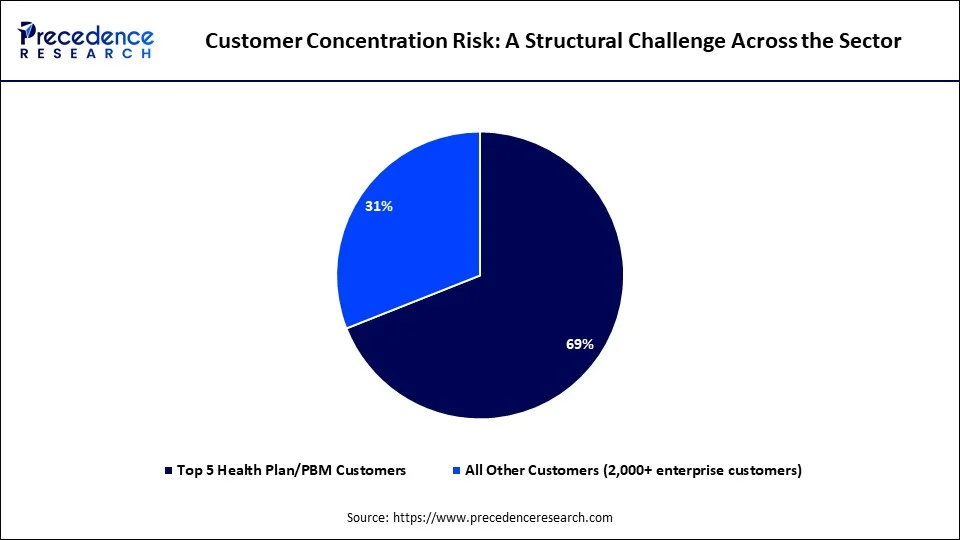
This chart shows the share of Omada Health's 2024 revenue derived from its top five health plan and PBM customers, based on the firm's own IPO registration statement.
Omada Health’s top five customer concentration reached 69% in 2024 because its business model depends heavily on a small number of massive health plans along with pharmacy benefit managers (PBMs) that bundle and then resell its chronic-care services to huge blocks of employers and members.
Key Insight: Even the employer-channel B2B2C model that has proven more resilient than the prescription model carries its own structural risk has a 69% revenue concentration in just five customers which means Omada's near-term financial health depends heavily on renewal decisions made by a handful of large health plan along with PBM executives, a risk profile the firm itself explicitly flagged in its own S-1 filing as a factor that could materially which affect results if even one or two key contracts were lost.
Source: Omada Health, Inc. - "S-1 Registration Statement," 2025.
Recent M&A and Consolidation in Digital Health
| Year | Company / Transaction | Details |
| 2020 | Teladoc Health / Livongo | Teladoc Health acquired Livongo for $18.5 billion |
| 2022 | Aptar Pharma / Voluntis | Aptar Pharma acquired Voluntis |
| 2022 | ResMed / Propeller Health | ResMed acquired Propeller Health |
| 2023-2024 | Digital Therapeutics Companies | Multiple DTx companies, including Pear and Better Therapeutics, filed for bankruptcy |
| 2025 | Hinge Health & Omada Health | Both companies completed successful IPOs |
This timeline traces major mergers, acquisitions, and consolidation events across digital health and digital therapeutics from 2020 to 2025.
- In 2020, Teladoc Health acquired Livongo for $18.5 billion to create a dominant, all-in-one "one-stop shop" for virtual and chronic healthcare.
- In 2022, Aptar Pharma acquired Voluntis to expand its digital therapeutics (DTx) capabilities and complement its portfolio of connected drug-delivery devices.
- In 2022, ResMed acquired Propeller Health to become the worldwide leader in digital health and patient management for chronic obstructive pulmonary disease (COPD) and asthma.
- In 2023-2024, Multiple DTx firms such as Pear Better Therapeutics filed for bankruptcy because they could not secure enough insurance coverage or hospital reimbursement to sustain high operating costs, leading to a Chapter 11 filing in April 2023.
- In 2025, Hinge Health and Omada Health both completed successful IPOs because both firms proved they could combine massive enterprise scale with sustainable unit economics and clear paths to profitability.
Key Insight: Teladoc's $18.5 billion Livongo acquisition in 2020 remains the largest single transaction in this timeline by a broad margin, and its subsequent well-documented write-downs, thus, Teladoc later recorded billions in goodwill impairment related to the deal offer a cautionary counterpoint even to M&A-based consolidation strategies in digital health, scale alone, achieved via acquisition, has not proven any more reliable a path to sustained value creation than the organic prescription-driven model that sank Pear Therapeutics.
Source: Multiple (see below) - "Company press releases and SEC filings on Teladoc/Livongo, Aptar/Voluntis, and ResMed/Propeller Health transactions," 2020-2022.
Quick-Reference Data Tables
The tables below present the same core figures from the Visual Intelligence section in plain, sortable Word-table format for quick reference and reuse.
Digital Therapeutics Companies at a Glance
| Company | Founded | Business Model | Status (2026) |
| Hinge Health | 2014 | Employer B2B2C (musculoskeletal) | Public (NYSE: HNGE) |
| Omada Health | 2012 | Employer B2B2C (chronic disease) | Public (Nasdaq: OMDA) |
| Akili Interactive | 2011 | Rx + OTC hybrid (ADHD) | Going private, 2025 |
| Pear Therapeutics | 2014 | Prescription DTx (substance use disorder) | Bankrupt, April 2023 |
| Proteus Digital Health | 2001 | Ingestible sensor + pharma partnership | Bankrupt, June 2020 |
Source: Hinge Health, Omada Health, and Akili Interactive company disclosures and SEC filings; Pear Therapeutics and Proteus Digital Health bankruptcy filings and industry reporting, 2020-2026.
The 2025 IPO Financial Snapshot
| Metric | Hinge Health | Omada Health |
| IPO date | May 21, 2025 | June 6, 2025 |
| Exchange / Ticker | NYSE: HNGE | Nasdaq: OMDA |
| IPO price | $32/share (high end of range) | $19/share (midpoint of range) |
| Amount raised | $437 million | $150 million |
| Day-1 valuation | >$3 billion market cap | ~$1.1 billion valuation |
| Recent revenue | $432M TTM (through Mar. 2025) | $170M (2024, +38% YoY) |
Source: Nelson Advisors and Fierce Healthcare reporting on Hinge Health and Omada Health IPO disclosures, 2025.
Recent Developments
Seven of the most consequential developments shaping the digital therapeutics market over the past several years, thus prioritized by recency and business impact:
Omada Health, Inc.-June 6, 2025
| Date | June 6, 2025 |
| Organization | Omada Health, Inc. |
| Development | Omada Health completed its IPO on the Nasdaq under ticker "OMDA," pricing at $19 per share and closing its first day of trading up 21% at $23 per share. |
| What Changed | The firm raised $150 million, targeting a valuation of nearly $1.1 billion, becoming the second major digital health IPO of 2025 after Hinge Health. |
| Why It Matters | It confirmed that Hinge Health's successful IPO two weeks earlier was not an isolated event, thus providing further evidence that public-market appetite for mature, high-growth digital health firms had genuinely reopened. |
| Business Significance | CEO Sean Duffy stated Omada does not plan to provide GLP-1 weight-loss medications directly, instead focusing on lifestyle-change guidance and coaching, a deliberate differentiation from pharma-centric weight-management competitors. |
Source: Yahoo Finance / Healthcare Dive, "Omada Health Goes Public at $23 Per Share," June 6, 2025
Hinge Health, Inc.- May 21-22, 2025
| Date | May 21-22, 2025 |
| Organization | Hinge Health, Inc. |
| Development | Hinge Health finished its IPO on the NYSE under ticker "HNGE," pricing at $32 per share (the high end of its range) and also opening at $39.25, a 23% jump. |
| What Changed | It shares closed up 17% from the IPO price on debut, giving the firm a market capitalization exceeding $3 billion and raising $437 million. |
| Why It Matters | It marked the first major digital health IPO of 2025 and the first significant test of public-market appetite for the sector since the SPAC-driven listings of 2020–2021, most of which subsequently struggled. |
| Business Significance | Hinge Health's first quarterly results as a public firm showed 55% year-over-year revenue growth, exceeding analyst expectations. |
Source: Nelson Advisors, "Hinge Health, Omada Health, HeartFlow: 3 Highly Successful HealthTech IPOs to Date in 2025," August 15, 2025
Akili Interactive- June 18, 2024
| Date | June 18, 2024 |
| Organization | Akili Interactive |
| Development | Akili declared FDA authorization of EndeavorOTC, the first FDA clearance of a digital treatment for adults with ADHD delivered via a video game. |
| What Changed | EndeavorOTC was reviewed and cleared via the FDA's 510(k) pathway, utilizing EndeavorRx as a predicate device, based on a clinical study of 221 adults in which 83% reported improved focus. |
| Why It Matters | It represented Akili's strategic pivot toward a direct-to-consumer, over-the-counter distribution model, and thus, moving away from reliance on the physician-prescription pathway that had proven commercially challenging for the prescription digital therapeutics industry-wide. |
| Business Significance | It came nearly six months after EndeavorRx's own label was expanded from ages 8-12 to ages 8-17 in December 2023, thus extending the addressable patient population for Akili's core franchise. |
Source: BusinessWire, "Akili Announces FDA Authorization of EndeavorOTC," June 18, 2024
Pear Therapeutics, Inc.- April 7, 2023
| Date | April 7, 2023 |
| Organization | Pear Therapeutics, Inc. |
| Development | Pear Therapeutics has filed for Chapter 11 bankruptcy protection, following a March 2023 announcement that it was exploring strategic options after failing to build a sustainable business. |
| What Changed | The firm's stock had lost approximately 99.28% of its value since its December 2021 Nasdaq debut through a SPAC merger with Thimble Point Acquisition Corp. |
| Why It Matters | It became the most prominent digital therapeutics failure to date, and thus, directly following in the footsteps of Proteus Digital Health's 2020 bankruptcy and casting a long shadow over investor confidence in prescription-based DTx business models. |
| Business Significance | Pear had projected 2023 revenue of $27–37 million shortly before the bankruptcy filing, a target the firm never had the opportunity to test given the timing of its collapse. |
Source: STAT News, "Digital Health Pioneer Pear Therapeutics Files for Bankruptcy," April 7, 2023
Akili Interactive- December 2023
| Date | December 2023 |
| Organization | Akili Interactive |
| Development | The FDA expanded EndeavorRx's label from ages 8-12 to ages 8-17, which is generally based on a clinical study involving 162 adolescents. |
| What Changed | It broadened the addressable patient population for Akili's flagship prescription digital therapeutic ahead of the firm's subsequent 2024 pivot toward an OTC product. |
| Why It Matters | It demonstrated continued regulatory and clinical progress for EndeavorRx even as the firm's broader commercial and financial position remained challenged. |
| Business Significance | The label expansion built directly on the original clinical evidence base established for the 2020 De Novo clearance, reflecting the FDA's willingness to extend digital therapeutic indications incrementally as additional evidence accumulates. |
Source: PMC (Pediatric Applications of Digital Therapeutics), citing Akili Interactive clinical and regulatory disclosures
Teladoc Health, Inc.- 2020 (context)
| Date | 2020 (context) |
| Organization | Teladoc Health, Inc. |
| Development | Teladoc Health completed its $18.5 billion acquisition of Livongo Health, a chronic condition management firm, in one of the largest digital health transactions in history. |
| What Changed | It combined Teladoc's telehealth platform with Livongo's remote monitoring along with chronic disease management technology for diabetes and other conditions. |
| Why It Matters | It represented an alternative consolidation-based strategy to organic digital therapeutics development, though the deal was later associated with substantial goodwill impairment charges as integration challenges and even slower-than-expected synergies emerged. |
| Business Significance | It offers an important counterpoint to the prescription-versus-employer-channel business model comparison at the center of this report: even M&A-driven scale has not proven a reliably successful path to sustained digital health value creation. |
Source: Company press releases and SEC filings on the Teladoc/Livongo transaction
Digital health industry- October 2025
| Date | October 2025 |
| Organization | Digital health industry |
| Development | Industry conference HLTH 2025 in Las Vegas featured extensive discussion of the Hinge Health as well as Omada Health IPOs as bellwethers for the wider digital health public-market reopening. |
| What Changed | Analysts identified additional digital health firms (Sword Health, Quantum Health, Transcarent, Maven) as potential 2026 IPO candidates thus, following the successful 2025 debuts. |
| Why It Matters | It signals that the digital health investment and exit community views 2025's IPO successes as a genuine market inflection point rather than a temporary or isolated event. |
| Business Significance | It also reported that payments firm Zelis and metabolic health company Virta Health were separately preparing for potential future IPOs, thus suggesting broader momentum across adjacent digital health categories. |
Source: Fierce Healthcare, "HLTH25: Hinge Health and Omada Broke the Digital Health IPO Dry Spell," October 23, 2025
Key Companies & Organizations
Public Digital Therapeutics/Digital Health Success Stories (2025 IPOs)
- Hinge Health, Inc. San Francisco, CA, US; founded in 2014 ; musculoskeletal digital therapeutics; employer/health plan B2B2C model;
- Omada Health, Inc. San Francisco, CA, US; founded in 2012; chronic disease management such as diabetes, obesity, cardiovascular disease, and employer/health plan B2B2C model.
Prescription Digital Therapeutics (Struggled or Failed)
- Pear Therapeutics, Inc. was founded in 2014 in Boston, MA, US (bankrupt April 2023) for reSET/reSET-O for substance use disorder.
- Akili Interactive was founded in 2011 in Boston, MA, US (going private, 2025); EndeavorRx/EndeavorOTC for ADHD.
- Proteus Digital Health founded 2001, Redwood City, CA, US (bankrupt June 2020); ingestible sensor technology.
- Better Therapeutics, US (bankrupt 2024), for AspyreRx for type 2 diabetes and cardiometabolic conditions.
Other Notable Digital Therapeutics Companies
- Big Health U.S./UK private deals with Sleepio (insomnia) and Daylight (anxiety) programs. It is an employer/health plan channel.
- Click Therapeutics U.S. private deals with a prescription digital therapeutics pipeline across multiple conditions.
- Welldoc U.S. private generally deals with the BlueStar diabetes management platform.
- DarioHealth U.S. public deals with a chronic condition management platform.
- Kaia Health Germany/U.S. (private) deals with musculoskeletal and COPD digital therapeutics.
- Mahana Therapeutics U.S. (private deals with irritable bowel syndrome digital therapeutics.
Acquired Digital Health/DTx-Adjacent Companies
- Livongo was acquired by Teladoc Health for $18.5 billion in 2020.
- Voluntis was acquired by Aptar Pharma in 2022.
- Propeller Health was acquired by ResMed in 2022.
Regulatory & Standards Bodies
- U.S. Food and Drug Administration (FDA), Digital Health Center of Excellence
- Centers for Medicare & Medicaid Services (CMS) - CPT/HCPCS coding and reimbursement policy
- American Medical Association (AMA) - CPT Editorial Panel
Questions Answered in This Blog
- Who are the major competitors in the digital therapeutics market, and what business models do they use?
- Why did Pear Therapeutics fail despite having FDA-cleared products?
- What happened to Proteus Digital Health, and how does its collapse compare to Pear Therapeutics' later failure?
- How did Hinge Health's and Omada Health's 2025 IPOs signal a turning point for digital health?
- What is the difference between the employer-channel B2B2C business model and even the prescription digital therapeutic model?
- What FDA regulatory pathways do digital therapeutics companies use to bring products to market?
- What is EndeavorRx, and how did it become the first FDA-cleared video game therapeutic?
- How is Akili Interactive's business strategy evolving, and why is the firm going private?
- How are digital therapeutics reimbursed in the US healthcare system, and what CPT codes apply?
- What specific business model factors separated Pear Therapeutics' failure from Hinge Health's, along with Omada Health's success?
- What are the stages of the digital therapeutics value chain, and where do most firms fail?
- How significant is customer concentration risk for digital therapeutics firms, even successful ones?
- What major mergers and acquisitions have shaped the wider digital health and digital therapeutics landscape?
- How does Omada Health's revenue growth trajectory compare in the years leading up to its IPO?
- What financial metrics did Hinge Health disclose that distinguished its IPO from earlier digital health SPAC listings?
What Additional Questions Can Our Full Research Report Answer?
This blog draws on public disclosures. A commissioned research report can thus go further, combining proprietary market modeling, primary interviews, along with competitive benchmarking to answer questions such as:
- Which digital therapeutics firms are best positioned to follow Hinge Health and Omada Health toward a successful public listing in 2026 or beyond?
- How do user acquisition costs as well as sales cycle length compare between the employer-channel B2B2C model and the prescription-based model?
- What is the realistic timeline and also probability of Akili Interactive's going-private transaction leading to a successful turnaround versus continued decline?
- How exposed is each major digital therapeutics company's revenue to potential changes in employer healthcare advantage spending during an economic downturn?
- What is the total addressable market for digital therapeutics by therapeutic category such as musculoskeletal, mental health, chronic disease, substance use disorder, and which categories show the strongest employer-channel product-market fit?
- Which prescription digital therapeutics companies still operating are most likely to pivot toward an employer-channel model, and then what would that transition require operationally?
- What premium do employers, along with health plans, pay for digital therapeutics with FDA clearance versus unregulated wellness apps addressing similar conditions?
- How do net dollar retention combine with gross margin compare across the digital therapeutics sector, and what do those metrics reveal about long-term unit economics?
- Which large pharmaceutical or medtech firms are most likely acquirers for struggling or undervalued digital therapeutics firms, following the pattern of Aptar/Voluntis, Teladoc/Livongo, and ResMed/Propeller Health?
- What is the realistic scenario range for the Access to Prescription Digital Therapeutics Act passing, and thus, how would permanent reimbursement codes change the competitive landscape for prescription DTx companies?
- What integration and data-interoperability challenges do employers and health plans face when adopting multiple digital therapeutics from different vendors simultaneously?
- How do clinical evidence requirements and real-world outcomes data differ in rigor and even cost between digital therapeutics competing for employer contracts versus those pursuing insurance reimbursement?
- What is the realistic five-year competitive trajectory for musculoskeletal digital therapeutics specifically, given Hinge Health's current market position and potential new entrants?
- How might increased GLP-1 medication adoption for obesity and diabetes affect the need for digital therapeutics companies such as Omada Health that offer complementary, non-pharmacological chronic disease management?
- What partnership or channel structures between digital therapeutics firms and pharmacy benefit managers are emerging as alternatives to direct employer contracting?
- How do international regulatory and reimbursement pathways for digital therapeutics such as the EU, UK, and Germany's DiGA framework compare to the US FDA/CPT model, and which firms are best positioned to expand internationally?
- How does venture capital investment activity in digital therapeutics compare before and after the 2023 wave of company bankruptcies, and what does that reveal about investor risk appetite?
- Which digital therapeutics firms show the strongest evidence of clinical outcomes translating into measurable healthcare cost savings for their enterprise customers?
- How might further digital health industry consolidation, given expected 2026 IPO candidates such as Sword Health, Quantum Health, and Transcarent, reshape competitive dynamics across therapeutic categories?
- What technology and AI integration strategies, like Omada's OmadaSpark, are digital therapeutics companies pursuing to differentiate from both pharmaceutical treatments and unregulated consumer health apps?
References
All sources cited throughout this report, in order of first appearance:
| Source / Organization | Title | Date | URL | Supports |
| STAT News | Digital Health Pioneer Pear Therapeutics Files for Bankruptcy | April 7, 2023 | https://www.statnews.com/2023/04/07/pear-therapeutics-bankruptcy-stock-sale/ | Pear Therapeutics bankruptcy filing details, stock decline, SPAC history |
| Axios | After Blazing a Trail in Digital Therapeutics, Pear Goes Bankrupt | April 10, 2023 | https://www.axios.com/pro/health-tech-deals/2023/04/10/after-blazing-a-trail-in-digital-therapeutics-pear-goes-bankrupt | Context on Pear's bankruptcy and broader DTx market impact |
| LinkedIn (industry analysis) | Pear Therapeutics' Bankruptcy: Rethinking the Future of Digital Therapeutics | July 5, 2023 | https://www.linkedin.com/pulse/pear-therapeutics-bankruptcy-rethinking | Pear prescription/fill statistics, 2023 revenue guidance |
| Healthcare.Digital | What's Next for Digital Therapeutics After It All Went PEAR Shaped? | May 17, 2023 | https://www.healthcare.digital/single-post/what-s-next-for-digital-therapeutics-after-it-all-went-pear-shaped | Proteus Digital Health funding history and bankruptcy detail |
| Pear Therapeutics, Inc. | SEC Form 424B3 and Form 8-K filings | 2023 | https://www.sec.gov/Archives/edgar/data/1835567/000162828023000011/pear424b3.htm | Official SEC confirmation of Pear Therapeutics corporate status |
| Fierce Healthcare | HLTH25: Hinge Health and Omada Broke the Digital Health IPO Dry Spell | October 23, 2025 | https://www.fiercehealthcare.com/digital-health/hlth25-hinge-health-and-omada-broke-digital-health-ipo-dry-spell-ceos-share-their | Hinge Health and Omada Health revenue, growth rates, business model detail |
| Healthcare Dive | Omada Goes Public in Second Recent Digital Health IPO | June 9, 2025 | https://www.healthcaredive.com/news/omada-health-goes-public-ipo/750115/ | Omada Health IPO pricing and proceeds raised |
| Yahoo Finance | Omada Health Goes Public at $23 Per Share | June 6, 2025 | https://finance.yahoo.com/news/omada-health-goes-public-at-23-per-share-marking-second-major-digital-health-ipo-in-2025-161353840.html | Omada Health IPO debut performance, net losses 2023-2024 |
| MedCity News | Omada & Hinge's IPO Debuts Signal Success for Digital Health Market | June 12, 2025 | https://medcitynews.com/2025/06/omada-hinge-ipo-success/ | Hinge Health and Omada Health market capitalization and IPO proceeds |
| Nelson Advisors | Hinge Health, Omada Health, HeartFlow: 3 Highly Successful HealthTech IPOs to Date in 2025 | August 15, 2025 | https://nelsonadvisors.co.uk/blog/hinge-health--omada-health--heartflow--3-highly-successful-healhtech-ipo-s-to-date-in-2025 | Hinge Health IPO pricing, debut performance, quarterly results |
| Healthcare.Digital | Omada Health v Hinge Health v Doctolib Financials and IPO Prospects | May 15, 2025 | https://www.healthcare.digital/single-post/omada-health-v-hinge-health-health-v-doctolib-financials-and-ipo-prospects | Omada Health customer concentration risk, revenue, member statistics |
| Galen Growth | Digital Health Exits: Navigating 2025's Shifting Tides Towards Maturity | August 21, 2025 | https://www.galengrowth.com/digital-health-exits-navigating-2025s-shifting-tides-towards-maturity/ | Omada Health Q1 2025 revenue and member/customer statistics |
| PMC (PubMed Central) | Pediatric Applications of Digital Therapeutics: Clinical Evidence and Implementation Landscape | 2025 | https://pmc.ncbi.nlm.nih.gov/articles/PMC12495783/ | EndeavorRx regulatory history and label expansion detail |
| MobiHealthNews | EndeavorRx, Akili's Video Game Therapeutic, Receives FDA De Novo Clearance | June 15, 2020 | https://www.mobihealthnews.com/news/endeavorrx-akilis-video-game-therapeutic-receives-fda-de-novo-clearance | EndeavorRx original FDA clearance detail and regulatory history |
| US FDA | De Novo Classification Request for EndeavorRx (DEN200026) | 2020 | https://www.accessdata.fda.gov/cdrh_docs/pdf20/DEN200026.pdf | Official FDA De Novo clearance letter and indication for use |
| BusinessWire | Akili Announces FDA Authorization of EndeavorOTC | June 18, 2024 | https://www.businesswire.com/news/home/20240618578815/en/Akili-Announces-FDA-Authorization-of-EndeavorOTC-the-First-FDA-Clearance-of-a-Digital-Treatment-for-Adults-with-ADHD-Through-a-Video-Game | EndeavorOTC 510(k) clearance, clinical trial results, going-private context |
| Nasdaq (SEC 8-K filing) | Akili Interactive, a Leader in Digital Medicine, to Become Publicly Traded Through Combination with Social Capital Suvretta Holdings Corp. I | 2022 | https://www.sec.gov/Archives/edgar/data/1850266/000119312522017656/d289187dex991.htm | Akili SPAC merger valuation and proceeds detail |
| Odelle Technology | Unlocking Reimbursement for Digital Therapeutics: The Comprehensive Guide to US Billing Codes, Origins and Current Challenges | December 8, 2025 | https://odelletechnology.com/unlocking-reimbursement-for-digital-therapeutics-the-comprehensive-guide-to-us-billing-codes-origins-and-current-challenges/ | CPT/HCPCS reimbursement codes for digital therapeutics |
About the Authors

Aditi Shivarkar
Aditi, Vice President at Precedence Research, brings over 15 years of expertise at the intersection of technology, innovation, and strategic market intelligence. A visionary leader, she excels in transforming complex data into actionable insights that empower businesses to thrive in dynamic markets. Her leadership combines analytical precision with forward-thinking strategy, driving measurable growth, competitive advantage, and lasting impact across industries.



Aman Singh
Aman Singh with over 13 years of progressive expertise at the intersection of technology, innovation, and strategic market intelligence, Aman Singh stands as a leading authority in global research and consulting. Renowned for his ability to decode complex technological transformations, he provides forward-looking insights that drive strategic decision-making. At Precedence Research, Aman leads a global team of analysts, fostering a culture of research excellence, analytical precision, and visionary thinking.

Piyush Pawar
Piyush Pawar brings over a decade of experience as Senior Manager, Sales & Business Growth, acting as the essential liaison between clients and our research authors. He translates sophisticated insights into practical strategies, ensuring client objectives are met with precision. Piyush’s expertise in market dynamics, relationship management, and strategic execution enables organizations to leverage intelligence effectively, achieving operational excellence, innovation, and sustained growth.