






 Request Consultation
In vehicle AI robots are transforming cars into intelligent, interactive spaces by enabling real time communication and personalization. These robotic assistants enhance safety, comfort, and user experience in next generation mobility systems.
Over a hundred years, the automobiles have undergone development mainly due to mechanical innovations, such as more powerful engines, safer construction, and better fuel efficiency. Over the last 20 years, software and electronics have been playing a larger role in the transformation of vehicles. Modern cars have already become high-tech computers with advanced driver assistance systems and digital dashboards, as well as connected infotainment and over-the-air updates.
A new frontier is now emerging at the intersection of robotics, AI, and human–machine interaction, including in-vehicle AI robots. These are much more than just a traditional voice helper or dashboard system. They are smart robotic friends built into the car interiors, able to communicate with the occupants by talking, making gestures, and being aware of the surroundings.
Automotive manufacturers and robotics developers have recently provided prototypes that depict the rate at which this idea is changing. Other next-generation vehicles have small robots, which are mounted either in the dashboard or the center console. They are able to literally turn to occupants, to detect emotional expressions, and to change the vehicles according to user preferences. Furthermore, it is possible that AI-powered robots will be the main interface between people and intelligent vehicles.
From Passive Interfaces to Interactive Robotic Companions
Traditional automotive interfaces were designed primarily for control. Physical buttons, mechanical switches, and simple displays allow drivers to control the vehicle functions, including lighting, navigation, and climate control. Although the touchscreen systems and voice assistants were unveiled. Interaction was relatively transactional; drivers gave commands, and systems acted.
AI robots in the car represent a radically new paradigm of interaction. These robotic systems are active members of the vehicle environment with the capability of initiating communication instead of being passive interfaces. They also assist and adjust to the behavior of the passengers. In case of long trips, the robot was able to trace the fatigue of a driver by analyzing the visual images and to suggest a rest or to change the cabin environment to be more alert.
It is possible due to the integration of various AI technologies, which include natural language processing, emotion recognition algorithms, contextual learning, and a robotic interface that physically fits in the car cabin. This leads to the interior of the vehicle being less machine-like and more of an interactive digital space.
Why Automakers are Exploring Robotic Interfaces
The creation of AI robots in vehicles is symptomatic of wider changes in the auto industry. The value of cars is slowly shifting as the amount of automation and connectivity is added to their functions, turning the value of cars into something beyond transportation.
Automakers have moved beyond engineering performance competition to digital experience, personalization, and passenger engagement competition. They develop a more user-friendly human-machine interface. Passengers can interact with a speech-recognizing and gesture-sensing context-aware robotic assistant rather than work with complicated touchscreen-based menus.
On the other hand, robotic companions have the ability to provide increased comfort and safety for passengers. AI systems may be used to pay attention to the environmental situation, recognize abnormal behavior, and act proactively against possible risks like driver distraction or fatigue. Intelligent robotic companions represent an effective method by which auto companies can redefine the in-car experience to gain a competitive advantage in the marketplace.
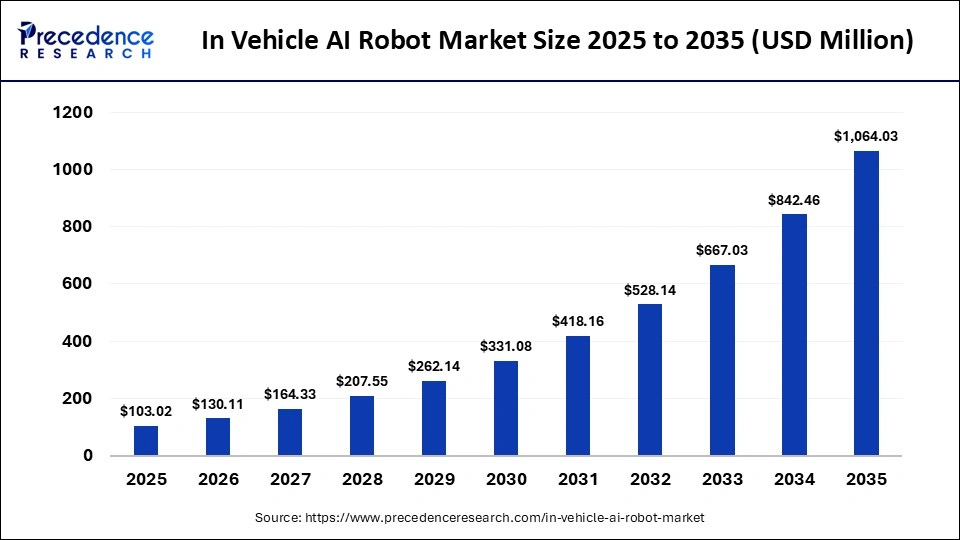
What is the In Vehicle AI Robot Market Size in 2026?
The global in vehicle AI robot market was valued at USD 103.02 million in 2025 and is projected to grow from USD 130.11 million in 2026 to approximately USD 1,064.03 million by 2035, registering a CAGR of 26.30% during the forecast period from 2026 to 2035. The market growth is driven by the increasing integration of artificial intelligence and robotics technologies in next-generation intelligent and autonomous vehicles.
How In-Vehicle AI Robots Work
Behind the engaging personalities and animated expressions of AI robots lies a complex technological architecture designed to process data from multiple sensors and interact seamlessly with passengers.
Core Components of In-Vehicle AI Robots
| Technology Layer | Function Inside the Vehicle |
| Computer Vision | Recognizes faces, gestures, and driver attention levels |
| Natural Language Processing | Enables conversational voice interaction |
| Emotion Recognition | Interprets facial expressions and vocal tone |
| Motion Control Systems | Allows robotic components to move or turn toward passengers |
| Contextual Learning Algorithms | Adapts responses based on user preferences and behavior |
Computer vision technology finds special application in automotive setups. The cameras inside the cabin are able to track the head movement, check the attention of the driver, and even detect gestures that are used to operate the functions of the vehicle. These visual indicators are perceived by AI algorithms and turned into operational instructions.
With the help of natural language processing, the passengers can conversationally talk to the robot. Modern AI models are able to process more complex questions, carry some conversational context, and sound more natural. Emerging capability include emotion recognition, which is the ability of AI systems to interpret facial expressions, speech patterns, and body language to determine the mood of the passengers.
A New Era of Cabin Intelligence
As vehicles evolve toward higher levels of automation, the cabin environment itself is becoming an increasingly important area of innovation. Once the driver no longer needs to concentrate fully on driving. The interior area could be used as a multipurpose area of productivity, entertainment, or leisure. The key driver in this change is in-vehicle AI robots, which coordinate the cabin experience.
During autonomous travel, a robotic assistant might organize the meetings and even arrange video conferences with colleagues. In the case of families touring the area, the robot could arrange entertainment for children or suggest some other destinations that are along the road. Such features imply that the car interior of the future might have the appearance of a moving home, and AI robots will become the intelligent design of such a home.
Collaboration between Robotics and Automotive Engineering
Making in-vehicle AI robots demands a strong partnership among several industries. They are automotive engineering, robotics, AI, and consumer electronics. Car makers introduce the background in safety engineering, automotive architecture, and legal standards.
Various car manufacturers have collaborated with robotics startups to incorporate small robotic helpers into concept cars. These may also be in the form of expressive robotic heads, animated digital faces, or articulated arms that can point at dashboard displays or engage passengers. By combining these software capabilities with physical robotic interfaces, companies are creating hybrid systems that merge digital intelligence with physical presence.
Emerging Use Cases Beyond Passenger Interaction
Although passenger interaction is the most obvious use of in-vehicle AI robots. Researchers and engineers are considering a variety of other applications that go beyond mere companionship. AI robots that read facial expressions, eye movements, and head movements using high-resolution vision systems are able to predict the onset of fatigue or distraction. The system could provide alerts or prescribe remedial measures in case the system recognizes potentially harmful behavior.
Robotic cabin assistants can also be used in logistics and commercial transportation. They could provide the primary interface with passengers in shared car mobility services, directing riders on boarding the vehicle, route instructions, and payment services. These applications prove that the opportunities of in-vehicle AI robots lie far beyond the innovation component.
Designing Robots for Human Trust and Comfort
Developing in-vehicle AI robots and ensuring that the systems are comfortable to be used by passengers is one of the challenging tasks. Cabin robots do not have a separate physical space from humans, including industrial robots that work in factories. Hence, psychological and emotional considerations are especially crucial. The designers are hence closely considering aspects, including the appearance of the robots, movement, and the style of communication.
Soft robotics materials or specifically tuned motion control algorithms are frequently employed by engineers, so that it is possible to make robotic gestures look natural and harmless. AI models used in conversation are being trained to sustain a congenial, context-sensitive conversation that is not obtrusive. Furthermore, by combining thoughtful design with advanced AI capabilities, developers aim to create robotic companions that passengers view as helpful travel partners rather than unfamiliar machines.
Technical and Ethical Challenges
Despite rapid innovation, the development of in-vehicle AI robots faces several technical and ethical challenges that must be addressed before widespread adoption becomes possible. Cars work in a very dynamic environment where sensors can be exposed to variable levels of lighting, background sounds, and erratic behavior of passengers. Under such circumstances, AI systems should operate regularly to provide safe and effective interaction.
Cabin robots are based on cameras, microphones, and biometric recognition systems to analyze the behavior of passengers. It will be crucial to handle this sensitive information with responsibility and make sure it is not exposed to other unscrupulous individuals, to keep people trusting. These issues will have to be approached through the cooperation of the car manufacturers, laws, and the technology creators.
The Long-Term Vision: Autonomous Mobility and Robotic Companions
There is a possibility that as the automotive industry evolves to a new level of automating vehicles, the functions of in-vehicle AI robots can increase significantly. Future robots can be combined with more comprehensive mobility systems, arranging ride-hailing services, making service appointments, or talking with smart city systems.
Riders may interface with their car robot to design the whole travel experience, including how to get to their destination, which includes reserving meals on the way to their destination. These opportunities offer the idea that AI in-vehicle robots might be a key component of the future mobility platform. It will close the divide between humans and smart transportation systems.
Conclusion: Redefining the Relationship between Humans and Vehicles
The development of in-vehicle AI robots represents one of the most intriguing intersections of robotics, AI, and automotive engineering. The necessity of user-friendly and interactive human-machine interfaces is getting more urgent as vehicles are turning into smart digital spaces. There are still technical and ethical issues to address, and the continued partnership between auto manufacturers and robotic developers. AI creators are rapidly increasing the pace of innovation in the area.
Ongoing collaboration between automakers, robotics companies, and AI developers is accelerating innovation in this field. In-vehicle AI robots dominate the future of mobility in this new world, overcoming it in the process of transforming the automobile.
Expert Advise
Our experts suggest that in vehicle AI robots are in high demand globally, driven by the increasing need for autonomous vehicles, the need for user-friendly automotive functions, and technological advancements. Ongoing efforts are made to unlock the full potential of in-vehicle AI robots by considering real-world functionality, safety, and user trust. Developers prefer context-aware AI systems that can interpret driver behavior, environmental conditions, and passenger needs. Thus, the future of in-vehicle AI robots is promising, driven by the integration with smart city infrastructure and IoT devices.
About the Authors

Aditi Shivarkar
Aditi, Vice President at Precedence Research, brings over 15 years of expertise at the intersection of technology, innovation, and strategic market intelligence. A visionary leader, she excels in transforming complex data into actionable insights that empower businesses to thrive in dynamic markets. Her leadership combines analytical precision with forward-thinking strategy, driving measurable growth, competitive advantage, and lasting impact across industries.



Aman Singh
Aman Singh with over 13 years of progressive expertise at the intersection of technology, innovation, and strategic market intelligence, Aman Singh stands as a leading authority in global research and consulting. Renowned for his ability to decode complex technological transformations, he provides forward-looking insights that drive strategic decision-making. At Precedence Research, Aman leads a global team of analysts, fostering a culture of research excellence, analytical precision, and visionary thinking.

Piyush Pawar
Piyush Pawar brings over a decade of experience as Senior Manager, Sales & Business Growth, acting as the essential liaison between clients and our research authors. He translates sophisticated insights into practical strategies, ensuring client objectives are met with precision. Piyush’s expertise in market dynamics, relationship management, and strategic execution enables organizations to leverage intelligence effectively, achieving operational excellence, innovation, and sustained growth.