



In Vehicle AI Robot Market Trends, Companies, Revenue / Sales Performance, Subscriber Growth, Pricing Strategies, Cloud Adoption, Infrastructure Expansion, Competitive Landscape, and Industry Outlook
In Vehicle AI Robot Market (By Robot Type: Driver Assistance AI Robot, Passenger Companion AI Robot, Service and Mobility Support: An AI Robot, Safety Monitoring AI Robot, Autonomous Taxi Cabin AI Robot; By Component: Hardware, Software, Services; By AI Capability: Voice Interaction and Conversational AI, Computer Vision and Gesture Recognition, Emotional and Behavioral AI, Autonomous Decision Assistance AI, Navigation and Route Optimization AI; By Application: Driver Monitoring, Passenger Infotainment Assistance, Safety and Emergency Assistance, Vehicle Control and Automation Support, Mobility Assistance for Elderly or Disabled Users; By End Use: Private Vehicle Owners, Ride-Hailing Fleets, Shared Autonomous Mobility Services, Logistics and Commercial Fleet Operators) - Global Industry Analysis, Size, Trends, Leading Companies, Regional Outlook, and Forecast 2026 to 2035
Source: https://www.precedenceresearch.com/in-vehicle-ai-robot-market
 Get a Sample
 Table Of Content


What is the In Vehicle AI Robot Market Size in 2026?
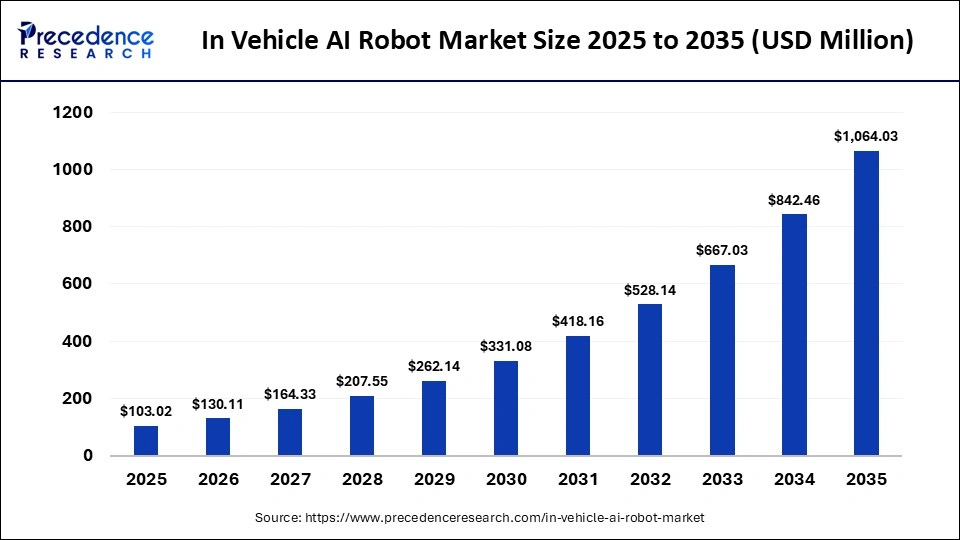
The global in vehicle AI robot market size was calculated at USD 103.02 million in 2025 and is predicted to increase from USD 130.11 million in 2026 to approximately USD 1,064.03 million by 2035, expanding at a CAGR of 26.30% from 2026 to 2035. The market growth is attributed to the increasing integration of artificial intelligence and robotics technologies in next-generation intelligent and autonomous vehicles.
Key Takeaways
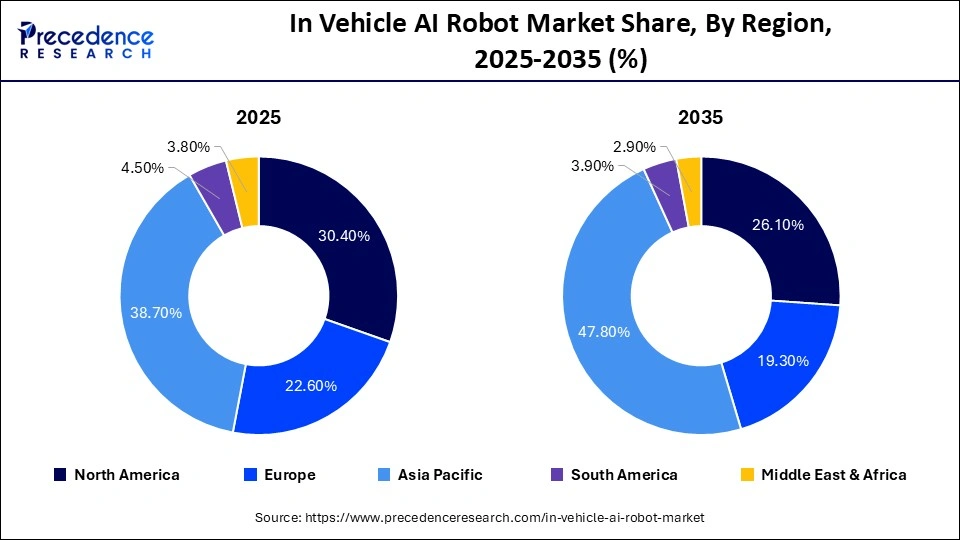
- Asia-Pacific dominated the market with 38.7% of the market share in 2025.
- North America is expected to grow at the fastest CAGR between 2026 and 2035.
- By robot type, the passenger companion AI robot segment contributed the highest in vehicle AI robot market share of 34.7% in 2025.
- By robot type, the autonomous taxi cabin AI robot segment is expected to grow at a strong CAGR of 28.8% between 2026 and 2035.
- By component, the hardware segment held a major market share of 46.8% in 2025.
- By component, the software segment is expected to expand at the fastest CAGR of 24.6% from 2026 to 2035.
- By AI capability, the voice interaction and conversational AI segment captured the highest market share of 33.4% in 2025.
- By AI capability, the emotional and behavioral AI segment is poised to grow at a healthy CAGR of 28.4% between 2026 and 2035.
- By application, the passenger infotainment assistance segment generated the biggest market share of 31.8% in 2025.
- By application, the mobility assistance for elderly or disabled users segment is expected to expand at the fastest CAGR of 29.1% between 2026 and 2035.
- By end use, the private vehicle owners segment accounted for the largest market share of 46.7% in 2025.
- By end use, the shared autonomous mobility services segment is projected to grow at a solid CAGR of 26.9% between 2026 and 2035.
Which Factors Drive the In Vehicle AI Robot Market?
The growing need for safer and more intelligent transportation systems is a major driver accelerating the market. In-vehicle AI robots are sophisticated AI systems installed in vehicles. These types of systems are made up of sensors, robotics, computer vision, and high-performance computing platforms. They perform a wide range of activities, including self-driving, vehicle surveillance, voice activation, and real-time decision-making.
The National Highway Traffic Safety Administration suggests that human error is the cause of nearly 94% of serious road accidents. This shows how AI-based automation can help to eliminate accidents to a large extent. Furthermore, the global push toward safer, automated transportation systems therefore remains the strongest driver shaping the global in-vehicle AI robot market in the coming years.
In Vehicle AI Robot Market Growth Factors
- Rising Deployment of Autonomous Vehicle Testing Programs: Expanding autonomous vehicle trials worldwide are driving the integration of advanced in-vehicle AI robotics technologies.
- Rising Consumer Demand for Advanced In-Vehicle Digital Experiences: Increasing expectations for voice assistants, intelligent cockpit systems, and personalized vehicle automation are boosting the integration of AI robotics inside vehicles.
Digital Intelligence on Wheels: The Acceleration of AI-Driven Automotive Robotics
- In 2024, approximately 68.6% of all vehicles sold globally incorporated automated driving or AI-assisted technologies at SAE Level 1 or higher, reflecting the rapid deployment of AI-driven in-vehicle automation features across passenger vehicles and mobility platforms.
- China leads globally in autonomous vehicle pilot deployments, with authorities issuing over 16,000 testing licenses and opening more than 32,000 km of public roads for autonomous vehicle trials by 2024, while more than 50 cities have introduced regulatory frameworks supporting robotaxi and AI mobility testing programs.
- AI semiconductor platforms are becoming core components of intelligent vehicle robotics systems, with Mobileye shipping more than 200 million EyeQ system-on-chip processors globally by 2024, supporting AI-driven perception, driver assistance, and autonomous vehicle capabilities across hundreds of vehicle models.
- Global innovation in intelligent mobility technologies continues accelerating, with more than 1.1 million inventions related to future transportation technologies, including autonomous driving, AI mobility systems, and connected vehicles, published in patent filings worldwide from 2000 to 2023, highlighting the scale of research and intellectual property development in next-generation transportation systems.
In Vehicle AI Robot Market Trends
- Robotaxi Commercialization Expanding Autonomous Mobility Services: Automobile manufacturers and technology firms are also introducing pilot programs of driverless ride-hailing and increased autonomous mobility fleets in major cities. Such advancements are speeding up the process of real-world implementation of in-vehicle AI robotic platforms, making the market of intelligent vehicle automation platforms robust.
- Strategic AI Mobility Ecosystems Reshaping Automotive Innovation: A growing movement of automotive companies, technology companies, and mobility platforms into strategic alliances to build integrated ecosystems of AI mobility. These ecosystems expand globally, further creating new opportunities for the deployment of in-vehicle AI robotic systems across consumer mobility and autonomous transportation services.
Market Scope
| Report Coverage | Details |
| Market Size in 2025 | USD 103.02 Million |
| Market Size in 2026 | USD 130.11 Million |
| Market Size by 2035 | USD 1,064.03 Million |
| Market Growth Rate from 2026 to 2035 | CAGR of 26.30% |
| Dominating Region | Asia Pacific |
| Fastest Growing Region | North America |
| Base Year | 2025 |
| Forecast Period | 2026 to 2035 |
| Segments Covered | Robot Type, Component, AI Capability, Application,End Use, and Region |
| Regions Covered | North America, Europe, Asia-Pacific, Latin America, and Middle East & Africa |
In Vehicle AI Robot Market Dynamics
Driver
Rising Safety Needs
Growing demand for intelligent driver assistance systems is anticipated to strengthen the integration of AI-powered robotics inside modern vehicles. The growing level of safety awareness and regulatory requirements has also contributed to the level of adoption that is being witnessed in global markets. This trend is hence bound to increase the use of in-vehicle AI robotic technologies.
Restraint
High Development and Integration Costs
High development and integration costs are expected to slow the widespread adoption of in-vehicle AI robotics technologies across cost-sensitive automotive segments. Carmakers are under mounting pressure to reconcile innovation and affordability, particularly in new markets. These pricing advantages are constraining high rates of scaling in the mid-range and entry-level categories. The high financial needs are thus expected to hinder general market penetration.
Opportunity
Surging Investments in Automotive AI Research
Surging investments in automotive AI research are projected to create immense opportunities for the market in the coming years. Automotive EMS and technology firms are dedicating substantial resources to AI chips, perception, and self-driving software. Continuous improvements in machine learning models and computing platforms are allowing vehicles to become intelligent robots. Large-scale pilot deployments and commercialization strategies are also being supported by these investments.
Segmental Insights
Robot Type Insights
In Vehicle AI Robot Market Share, By Robot Type, 2025-2035 (%)
| Robot Type | 2025 | 2035 |
| Passenger Companion AI Robot | 34.70% | 30.20% |
| Driver Assistance AI Robot | 28.60% | 25.40% |
| Service And Mobility Support An AI Robot | 16.40% | 17.60% |
| Safety Monitoring AI Robot | 12.70% | 11.30% |
| Autonomous Taxi Cabin AI Robot | 7.60% | 15.50% |
Which Robot Type Segment Dominated the In Vehicle AI Robot Market?
The passenger companion AI robot segment dominated the global market in 2025, accounting for an estimated 34.7% market share, due to the rising integration of human-centric AI systems inside modern vehicle cabins. These systems increase infotainment, navigation, and real-time support, which enhances the overall passenger interaction. Furthermore, the rapid consumer shift toward intelligent and immersive in-vehicle experiences is further boosting the segment growth.
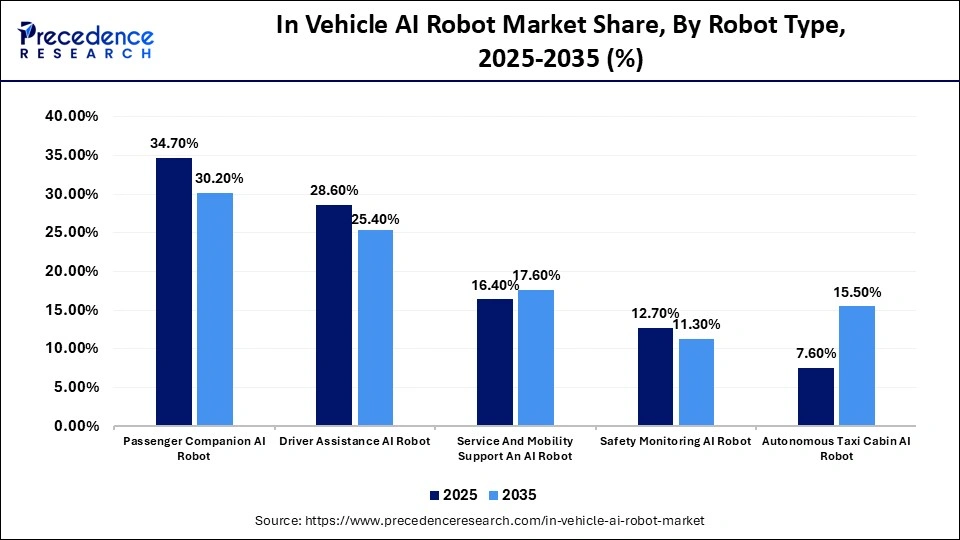
The autonomous taxi cabin AI robot segment is expected to grow at the fastest CAGR of 28.8% in the coming years, owing to the increasing implementation of robotaxi services in urban mobility ecosystems. In 2025, Alphabet subsidiary Waymo expanded fully driverless robotaxi operations across multiple U.S. cities, completing millions of autonomous rides annually. This segment is also expected to continue to grow at a faster rate as technology companies and automobile OEMs invest in driverless transportation networks.
Component Insights
In Vehicle AI Robot Market Share, By Component, 2025-2035 (%)
| Component | 2025 | 2035 |
| Hardware | 46.80% | 34.70% |
| Software | 37.60% | 49.30% |
| Services | 15.60% | 16.00% |
What Made the Hardware Segment Dominate the In Vehicle AI Robot Market?
The hardware segment held the largest revenue share of 46.8% in the market in 2025, due to the increasing reliance on high-performance computing units, advanced sensors, and embedded electronics within intelligent vehicle systems. Additionally, the segment continues to lead owing to continuous advancements in semiconductor technologies and sensor fusion systems.
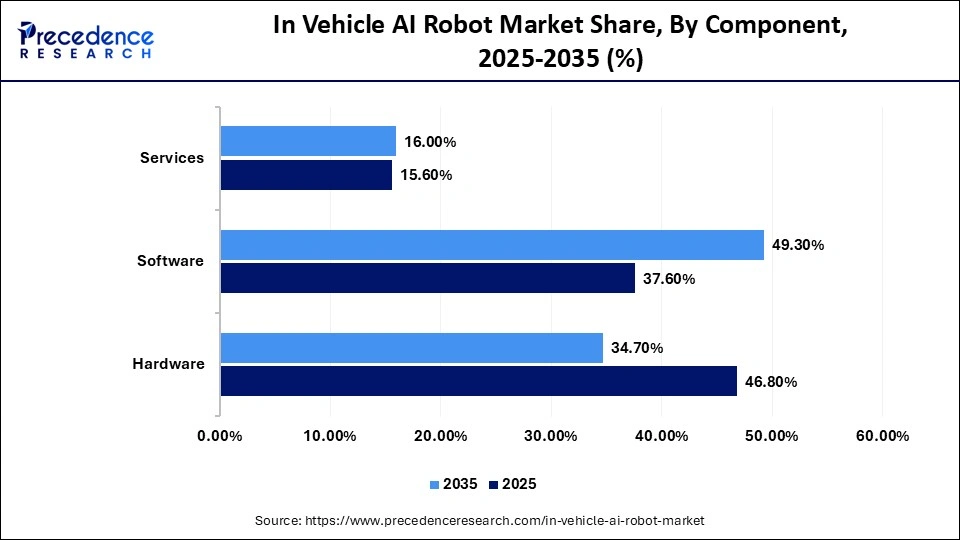
The software segment is expected to show the fastest growth with a CAGR of 24.60% over the forecast period, owing to the increasing trend toward software-defined vehicle designs and AI-powered automation systems. The growing attention to personalization and online services is potentiating the need to have smart software ecosystems within cars. This segment is also expected to continue growing faster as automotive OEMs and AI software innovation technology companies rely on each other.
AI Capability Insights
Why Did the Voice Interaction and Conversational AI Segment Dominate the Market?
The voice interaction and conversational AI segment contributed the biggest revenue share of 33.4% in the in vehicle AI robot market in 2025, due to the rapid integration of natural language interfaces within vehicle ecosystems. These systems increase the level of road safety by minimizing the level of interaction involving manual and cognitive distraction. The increase in consumer preference towards intuitive and hands-free interaction is strengthening the adoption of these technologies.
In Vehicle AI Robot Market Share, By AI Capability, 2025-2035 (%)
| AI Capability | 2025 | 2035 |
| Voice Interaction and Conversational AI | 33.40% | 26.20% |
| Computer Vision and Gesture Recognition | 21.70% | 20.40% |
| Emotional and Behavioral AI | 13.60% | 22.70% |
| Autonomous Decision Assistance AI | 17.60% | 18.60% |
| Navigation And Route Optimization AI | 13.70% | 12.10% |
The emotional and behavioral AI segment is expected to gain the highest market share with a CAGR of 28.4% between 2026 and 2035, owing to the increasing focus on human-centric intelligence and adaptive vehicle environments. Affectiva and Smart Eye are among the companies that are developing automotive emotion recognition features. The growing attention to safety, comfort, and human-machine interaction is thus expected to become a driver of the rapid introduction of emotional and behavioral AI in the domain of vehicle robotics.
Application Insights
Which Application Segment Led the In Vehicle AI Robot Market?
The passenger infotainment assistance segment led the market with a share of 31.8% in 2025, due to the fast modernization of cars to digitally interconnected entertainment spaces. Automakers are integrating AI-based infotainment systems, which provide customers with personalized media, navigation, and real-time content services. These platforms combine streaming, gaming, and voice-controllable applications to increase passenger engagement in a travelling experience. The segment growth is attributed to the increased consumer demand for the immersive and connected in-vehicle digital experience.
In Vehicle AI Robot Market Share, By Application, 2025-2035 (%)
| Application | 2025 | 2035 |
| Passenger Infotainment Assistance | 31.80% | 27.10% |
| Driver Monitoring | 24.70% | 20.80% |
| Safety And Emergency Assistance | 18.30% | 17.60% |
| Vehicle Control and Automation Support | 16.60% | 18.30% |
| Mobility Assistance for Elderly or Disabled Users | 8.60% | 16.20% |
The mobility assistance for elderly or disabled users segment is expected to witness the fastest growth in the market with a CAGR of 29.1% over the forecast period, as attention towards accessibility and non-discriminatory transportation solutions is increasing. Growing interest in safe, independent, and available transportation is thus fuelling the fast adoption of this segment.
End Use Insights
How the Private Vehicle Owners Segment Dominated the In Vehicle AI Robot Market?
The private vehicle owners segment accounted for the highest revenue share of 46.7% in the market in 2025, due to the rapid integration of AI-driven features into personal mobility platforms. Companies are incorporating smart assistants and customized cockpit technologies in their vehicles to transform normal driving experiences. These systems enhance comfort, convenience, and safety by updating data in real-time and adapting to the situation. The demand for connected and smart vehicles by consumers is increasing, which boosts the implementation of these technologies.
In Vehicle AI Robot Market Share, By End Use, 2025-2035 (%)
| End Use | 2025 | 2035 |
| Private Vehicle Owners | 46.70% | 38.60% |
| Ride-Hailing Fleets | 21.40% | 22.80% |
| Shared Autonomous Mobility Services | 18.30% | 26.70% |
| Logistics And Commercial Fleet Operators | 13.60% | 11.90% |
The shared autonomous mobility services segment is expected to expand rapidly in the market with a CAGR of 26.9% in the coming years, owing to the rapid evolution of urban transportation and on-demand mobility platforms. General Motors with Cruise and Baidu with Apollo Go are among the companies that are expanding autonomous mobility services in large cities. The segment is expected to grow with the growing need for economical and elastic transportation opportunities.
Regional Insights
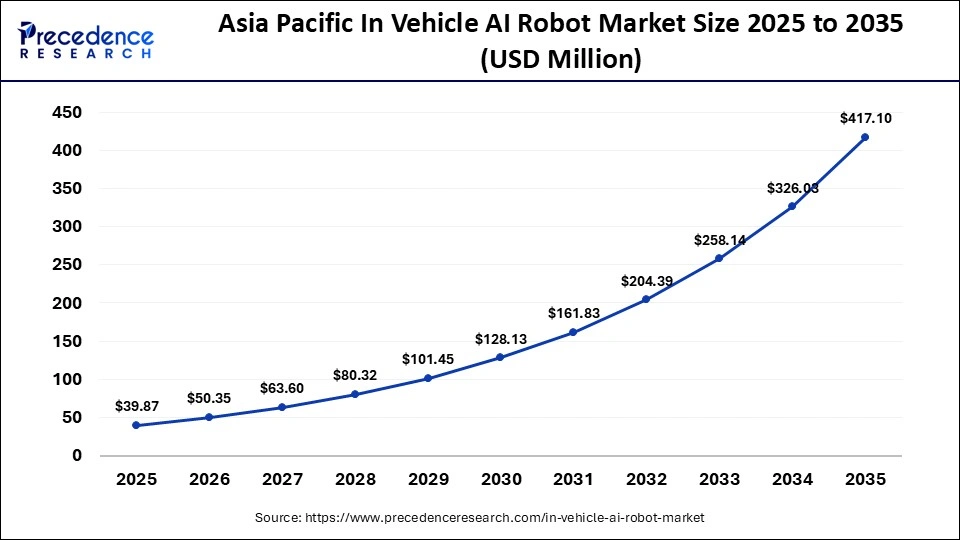
Asia Pacific In Vehicle AI Robot Market Size and Growth 2026 to 2035
The Asia Pacific in vehicle AI robot market size is expected to be worth USD 417.10 billion by 2035, increasing from USD 39.87 billion by 2025, growing at a CAGR of 26.46% from 2026 to 2035.
Why Did Asia-Pacific Emerge as the Dominant Force in the In Vehicle AI Robot Market?
Asia-Pacific held a major market share of 38.7% in 2025, due to the high density of developed automotive production systems and the use of intelligent mobility tools. Countries, including China, Japan, and South Korea, are putting a lot of funds into autonomous driving, AI integration, and smart car platforms.
China Society of Automotive Engineers forecasts that close to 70% of new car models in China are expected to install advanced assisted-driving systems by 2025. Huawei and Samsung Electronics are among the companies that are speeding up the use of AI chips and edge computing in cars. Furthermore, the continuous expansion of pilot cities and infrastructure is reinforcing regional growth in the market.
China: Powerhousing In-Vehicle AI Robotics Growth in Asia-Pacific
China leads the market, supported by aggressive national strategies and the rapid commercialization of intelligent vehicle technologies. Policies spearheaded by the Ministry of Industry and Information Technology of China are a priority for the government in terms of autonomous driving and the integration of AI. The ongoing growth of smart city projects and connected vehicle systems is therefore expected to sustain China's leadership in intelligent vehicle robotics.
How is North America Growing in the In Vehicle AI Robot Market?
North America is expected to host the fastest-growing market in the coming years, owing to the strong technological innovation and early adoption of autonomous vehicle technologies. The availability of major technology firms and OEMs in the automotive industry is increasing the pace of development of AI-based vehicle systems.
By 2025, Waymo only had to make more than 14 million autonomous rides in one year, and its operations made over 1 million rides per month in major cities. The area is experiencing massive momentum due to the intensive growth of autonomous mobility ecosystems and AI innovation centers.
U.S. Leading Innovation in In-Vehicle AI Robotics Across North America
The U.S. is leading the charge in North America, due to its well-developed technology ecosystem and the early shift towards autonomous mobility solutions. Tesla, Alphabet, and General Motors are among the major businesses that are increasing efforts in the development of AI-driven vehicle robotics platforms. The growth of related infrastructure and pilot programs on a large scale is thus expected to promote the long-term growth of AI-assisted vehicle robotics in the region.
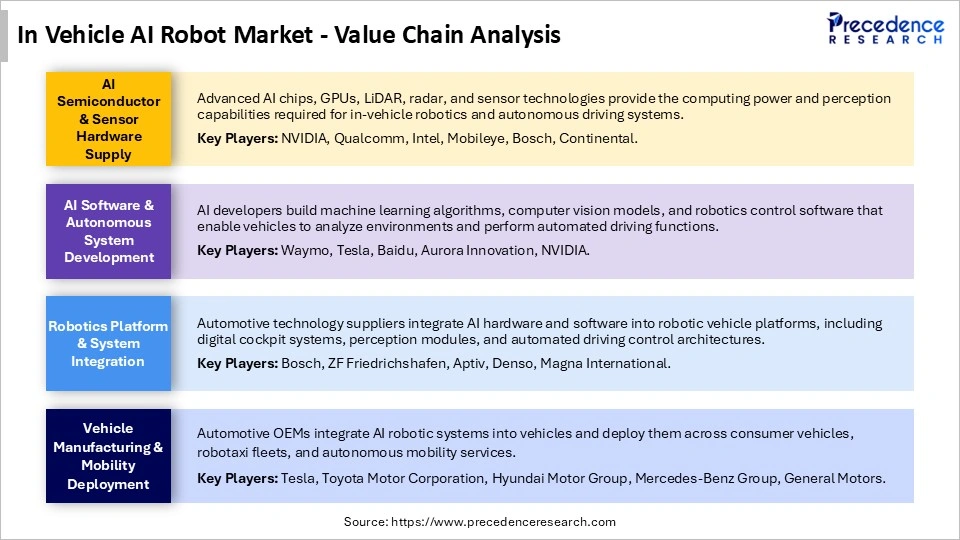
In Vehicle AI Robot Market Value Chain Analysis
In Vehicle AI Robot Market Companies
- Tesla
- Toyota Motor Corporation
- Hyundai Motor Company
- Honda Motor Company
- BYD Company
- Baidu
- NIO
- XPeng
- NVIDIA
- Qualcomm
- Bosch
- Continental AG
- Denso Corporation
- LG Electronics
- Samsung Electronics
Recent Developments
- In March 2026, Hyundai Motor Company and Kia Corporation expanded their partnership with NVIDIA to accelerate autonomous driving innovation. The collaboration integrated SDV capabilities with advanced AI platforms to strengthen next-generation vehicle intelligence. The initiative is expected to support the large-scale deployment of autonomous mobility ecosystems globally. (Source: https://www.hyundai.com)
- In March 2026, NVIDIA reported rapid adoption of its DRIVE Hyperion platform by automakers including BYD, Geely, Isuzu, and Nissan. The standardized architecture integrates compute, sensors, and safety systems to accelerate validation and deployment cycles. This expansion reflects increasing momentum toward scalable and safe autonomous vehicle development. (Source: https://nvidianews.nvidia.com)
Segments Covered in the Report
By Robot Type
- Driver Assistance AI Robot
- Passenger Companion AI Robot
- Service and Mobility Support: An AI Robot
- Safety Monitoring AI Robot
- Autonomous Taxi Cabin AI Robot
By Component
- Hardware
- Software
- Services
By AI Capability
- Voice Interaction and Conversational AI
- Computer Vision and Gesture Recognition
- Emotional and Behavioral AI
- Autonomous Decision Assistance AI
- Navigation and Route Optimization AI
By Application
- Driver Monitoring
- Passenger Infotainment Assistance
- Safety and Emergency Assistance
- Vehicle Control and Automation Support
- Mobility Assistance for Elderly or Disabled Users
By End Use
- Private Vehicle Owners
- Ride-Hailing Fleets
- Shared Autonomous Mobility Services
- Logistics and Commercial Fleet Operators
By Region
- North America
- Latin America
- Europe
- Asia-pacific
- Middle and East Africa
For inquiries regarding discounts, bulk purchases, or customization requests, please contact us at sales@precedenceresearch.com
Frequently Asked Questions





Ask For Sample
No cookie-cutter, only authentic analysis – take the 1st step to become a Precedence Research client
 Get a Sample




 sales@precedenceresearch.com
 Schedule a Meeting
