






 Request Consultation
Medical equipment cooling solutions are essential for preventing overheating in advanced healthcare devices. They ensure precision, reliability, and longer lifespan while supporting energy efficiency and patient safety.
What Is Medical Equipment Cooling?
Medical equipment cooling refers to specialized systems designed to regulate temperature, humidity, and airflow in advanced medical devices such as MRI machines, CT scanners, X-ray systems, and other high-performance diagnostic equipment. These systems utilize a range of technologies, including liquid cooling, air cooling, dehumidification, humidification, and refrigeration cycles, to manage the high heat loads generated during operation. By effectively controlling thermal conditions, these cooling solutions help reduce thermal stress, ensuring greater precision, extended equipment lifespan, and improved energy efficiency. Reliable cooling is essential for maintaining the continuous operation of medical devices, enabling healthcare providers to deliver accurate and timely diagnosis and treatment for patients.
Which Medical Equipment Cooling Technologies are in High Demand?
- Liquid Cooling Systems: Liquid cooling systems use water or dielectric fluids to efficiently dissipate heat in medical electronics. These systems provide precise temperature control and maintain consistent performance even under intensive workloads. Widely used in MRI, CT scanners, and other high-power medical equipment, liquid cooling helps extend component lifespan, enhance reliability, and ensure effective thermal management of critical diagnostic and treatment systems.
- Air Cooling: Air cooling systems involve the use of fans, blowers, and heat sinks to cool medical devices. These systems are suitable for mid-range diagnostic tools in which liquid cooling is not required. They help to cool down components quickly by supporting airflow among components, promote reliability and performance, and are a simpler, much less expensive thermal management solution to moderate-power electronics.
How Medical Equipment Cooling Solutions Address the Challenge of Overheating in Medical Devices?
Medical equipment cooling solutions address overheating by maintaining optimal operating temperatures, which ensures the reliability, accuracy, and longevity of medical devices. Advanced systems, including AI-driven predictive thermal regulation and energy-efficient cooling technologies, dynamically adjust to workloads, preventing thermal stress in high-power devices like MRI, CT scanners, and laser surgical tools. Sustainable coolants, compact heat exchangers, and phase change materials further enhance performance while minimizing energy consumption and environmental impact. Together, these innovations safeguard patient safety, improve device precision, and reduce operational costs across healthcare settings.
What is the Medical Equipment Cooling Market Size in 2026?
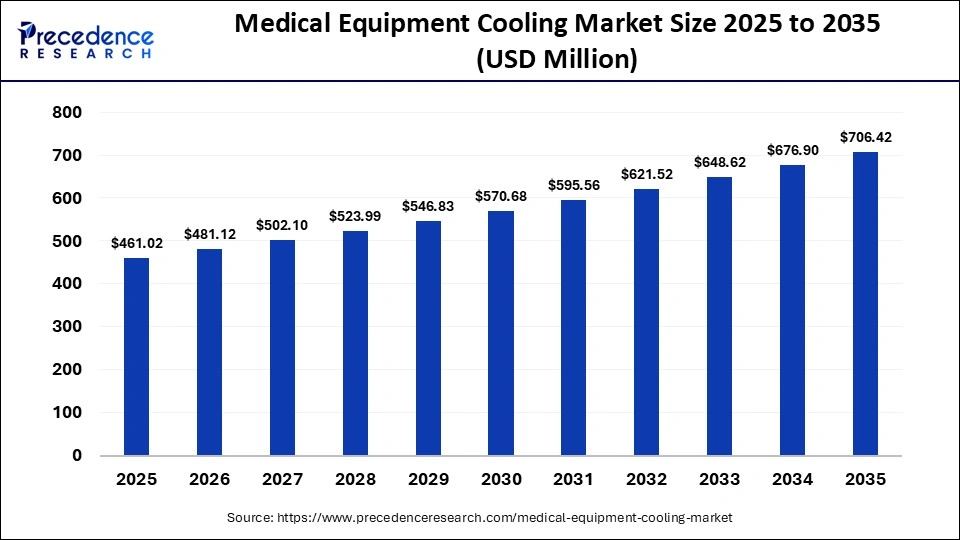
The global medical equipment cooling market was valued at USD 461.02 million in 2025 and is projected to grow from USD 481.12 million in 2026 to approximately USD 706.42 million by 2035, registering a CAGR of 4.36% during the forecast period from 2026 to 2035. The market growth is driven by the increasing use of advanced medical devices and the growing need for precise temperature control.
Get a Free Sample Report with Key Market Trends: https://www.precedenceresearch.com/sample/8205
Where Medical Equipment Cooling Solutions Are Used: Key Applications
- Diagnostic Imaging Machines: Advanced imaging systems such as MRI, CT, PET, and X-ray machines require precise cooling to maintain optimal operating temperatures. Effective thermal management ensures high image quality, prolonged component life, and consistent performance, especially as demand for high-resolution diagnostics continues to grow.
- Laboratory & Life Sciences: Cooling systems play a critical role in equipment like centrifuges, DNA sequencers, PCR machines, and blood analyzers. Maintaining thermal stability helps preserve sample integrity, improve test accuracy, and prevent overheating, ensuring reliability in clinical testing and research applications.
- Therapeutic, Surgical Equipment: Devices used in laser surgery, radiation therapy, and high-frequency ablation generate significant heat during operation. Efficient cooling ensures safe operation, optimal performance, and extended equipment lifespan, making compact and reliable cooling solutions essential in modern operating rooms.
- Wearable Devices and Patient Monitoring.: Cooling is increasingly important in advanced patient monitoring systems and wearable medical devices, such as glucose monitors and diagnostic wearables. The rise of portable healthcare solutions is driving demand for lightweight, efficient cooling technologies suitable for in-home and mobile use.
- Hospital Infrastructure: Cooling systems are integral to ICUs, robotic surgery suites, and hospital data centers, supporting both equipment reliability and patient safety. As healthcare infrastructure expands, there is growing investment in energy-efficient and high-performance thermal management systems across medical facilities.
Factors Boosting the Adoption of Medical Equipment Cooling Solutions
- Rising Device Usage: The necessity to have improved diagnostic and therapeutic equipment raises the requirement for constant cooling. Effective thermal management leads to a longer lifespan of the devices, uniform performance, and safety of the patients, and therefore, high-efficiency cooling is essential in hospitals, clinics, and labs worldwide.
- Miniaturization & Integration: Smaller and compact medical devices need small and efficient cooling systems to deal with heat. Embedding thermal management solutions into small areas maintains functionality and helps miniaturized electronics, portable diagnostics, wearable monitors, and the use of the technology in home healthcare.
- Regulatory & Safety Standards: Strict medical regulations and safety standards mandate precise thermal control to ensure device reliability. High-quality cooling systems are critical to prevent overheating, avoid malfunctions, and meet certification requirements, making compliance a key factor in adoption.
- Shift to Sustainable Healthcare: Energy-efficient cooling solutions help reduce operational costs and environmental impact. The use of low-power systems and eco-friendly coolants supports healthcare facilities in lowering their carbon footprint, aligning with the global shift toward sustainable healthcare infrastructure.
Barriers to Adoption: Why Medical Equipment Cooling Solutions Lag Behind
- Design Complexity: Advanced cooling technologies integrated into medical electronics can increase system complexity and design challenges. Techniques such as liquid cooling and phase-change systems require precise engineering, which can slow adoption, especially in compact or multifunctional devices.
- High Initial Costs: Sophisticated cooling methods, such as liquid cooling or phase change, are more expensive than traditional air cooling. The high upfront costs of components, installation, and maintenance can discourage adoption, particularly in cost-sensitive healthcare markets.
- Regulatory Barriers: Cooling systems must meet stringent regulatory and certification requirements, including safety, performance, and reliability standards. These rigorous testing processes can extend development timelines and delay the deployment of advanced cooling technologies in medical equipment.
The Road Ahead
- AI & Predictive Thermal Regulation: Smart systems predict the amount of heat needed by leveraging AI and actively control the cooling. To optimize performance, enhance temperature regulation, and lower operation costs, AI-driven cooling solutions are in high demand.
- Sustainable Cooling Technologies: The use of environmentally friendly coolants and low-energy thermal solutions is also increasing. The development of sustainable heat exchangers, phase change materials, and fluids helps to reduce the energy usage and emissions without the loss of performance of the devices.
- Integration with Telehealth Devices: With the growing popularity of remote healthcare and home diagnostics, wearable and portable devices need a small and compact cooling solution. Small, high-performance cooling systems are required in home healthcare due to the need to guarantee reliability of the device, patient safety, and the precision of the data.
Prominent Manufacturers and Suppliers of Medical Equipment Cooling Solutions
| Companies | Offerings |
| TE Connectivity | A multinational industrial technology corporation providing design and manufacturing of connectivity and sensor products required in the medical equipment cooling systems. Their products consist of thermal sensors, cooling connectors, heat dissipating housings, and fluid cooling interconnect components, which are applied in MRI, CT, and laboratory diagnostic machines. |
| Molex | A global sales leader in electronic connectivity, to supply connectors, cables, thermal management, and embedded cooling interface systems to med devices to assist in dealing with heat in complex electronic diagnostic equipment. |
| Sumitomo Electric Industries, Ltd. | Offers high-tech thermal management of medical equipment, such as cooling cable harnesses, optoelectronic cooling assemblies, and heat transfer substrates that are installed in diagnostic and monitoring devices. |
| Nexlogic Technologies | Offers integrated circuit-level cooling design and manufacturing assistance to medical device manufacturers, such as thermal pathway design and controlled heat dissipation design. |
Pioneering the Future of Medical Equipment Cooling
Medical equipment cooling solutions are in high demand, driven by the increasing need for advanced diagnostic and therapeutic equipment, rapid technological advancements, and stringent regulatory standards focused on safety and performance. Effective thermal management is critical to ensuring the reliability, longevity, and precision of high-power medical devices such as MRI and CT scanners, laser-based surgical systems, and portable patient monitoring equipment.
The integration of AI-driven predictive thermal regulation enables dynamic cooling that adapts to real-time workloads, improving energy efficiency and system performance. At the same time, the adoption of environmentally sustainable and energy-efficient cooling technologies helps reduce operational costs and minimize carbon footprints. Together, these innovations are accelerating the deployment of advanced cooling solutions across diagnostics, therapeutics, laboratories, and hospital infrastructure worldwide, supporting the long-term, sustainable growth of healthcare technologies.
Expert Opinion
According to our industry experts, medical equipment cooling has evolved from a niche technical requirement to a critical factor driving both operational efficiency and competitive advantage in healthcare technology. High-power diagnostic and therapeutic devices such as MRI scanners, CT machines, laser surgical systems, and portable monitoring devices generate significant heat, which, if unmanaged, can compromise performance, accuracy, and lifespan. Advanced cooling solutions, including AI-driven predictive thermal regulation, phase change materials, and compact heat exchangers, enable healthcare providers and device manufacturers to maintain optimal temperatures while minimizing energy consumption and operational costs.
For businesses, investing in efficient and sustainable cooling technologies not only reduces downtime and maintenance expenses but also supports regulatory compliance and patient safety standards, which are increasingly stringent. Furthermore, the rise of telehealth and home-based diagnostics creates demand for compact, high-performance cooling solutions in wearable and portable devices. Companies that integrate eco-friendly, energy-efficient thermal management systems can differentiate their products, appeal to environmentally conscious clients, and align with long-term sustainability goals. In a highly competitive medical technology sector, effective cooling solutions therefore represent both a technical necessity and a strategic business opportunity to enhance device reliability and cost-effectiveness.
About the Authors

Aditi Shivarkar
Aditi, Vice President at Precedence Research, brings over 15 years of expertise at the intersection of technology, innovation, and strategic market intelligence. A visionary leader, she excels in transforming complex data into actionable insights that empower businesses to thrive in dynamic markets. Her leadership combines analytical precision with forward-thinking strategy, driving measurable growth, competitive advantage, and lasting impact across industries.



Aman Singh
Aman Singh with over 13 years of progressive expertise at the intersection of technology, innovation, and strategic market intelligence, Aman Singh stands as a leading authority in global research and consulting. Renowned for his ability to decode complex technological transformations, he provides forward-looking insights that drive strategic decision-making. At Precedence Research, Aman leads a global team of analysts, fostering a culture of research excellence, analytical precision, and visionary thinking.

Piyush Pawar
Piyush Pawar brings over a decade of experience as Senior Manager, Sales & Business Growth, acting as the essential liaison between clients and our research authors. He translates sophisticated insights into practical strategies, ensuring client objectives are met with precision. Piyush’s expertise in market dynamics, relationship management, and strategic execution enables organizations to leverage intelligence effectively, achieving operational excellence, innovation, and sustained growth.