






 Request Consultation
A Data-Driven Look at NVIDIA's Scale, Regulatory Scrutiny, and Competitive Position
Introduction
Nvidia transitioned from a gaming card maker into an artificial intelligence infrastructure titan, capturing a significant share of the AI chip market. Disclosures from Nvidia SEC Filings, regulatory probes, and firm statements reveal an unprecedented consolidation of the AI hardware and software ecosystem. Moreover, data center and AI chip sales surged to comprise Nvidia's total revenue, a complete inversion of its historical reliance on consumer gaming. Thus, antitrust regulators in the U.S. (Department of Justice) as well as Europe have scrutinized Nvidia over whether it ties its dominant CUDA programming software and networking equipment, like InfiniBand or Mellanox hardware, to GPU allocations.
What emerges is a firm whose Data Center revenue grew nearly 13-fold in three years, whose market capitalization crossed two separate trillion-dollar thresholds in a single year, and even whose supremacy has drawn simultaneous antitrust scrutiny from regulators in the United States, the European Union, France, China, and the United Kingdom, a combination of commercial success and regulatory attention with few parallels in the history of the semiconductor industry.
Key Takeaways
- NVIDIA's Data Center revenue surged from approximately $15.0 billion in fiscal 2023 to $193.7 billion in fiscal 2026, thus marking a monumental shift driven by global need for generative AI infrastructure and accelerated computing platforms.
- NVIDIA made corporate history by hitting a $4 trillion market cap in July 2025, and a $5 trillion market cap in October 2025, accomplishing both unprecedented valuation records in under four months due to booming global need for artificial intelligence hardware.
- NVIDIA's Data Center segment now drives roughly 90% of total revenue, a massive jump from 56% in fiscal 2023. This change shows how NVIDIA shifted from a gaming chip maker into a leading artificial intelligence infrastructure company.
- The Bureau of Industry and Security (BIS) shifted its absolute "presumption of denial" policy in January 2026. Thus, it moved select high-end chips, such as
- Nvidia's H200 and AMD's MI325X, into a case-by-case review framework, paired with a 25% Section 232 tariff on imports passing through the US.
- France's Autorité de la concurrence disclosed that its long-running antitrust probe into Nvidia is nearing its conclusion, putting the regulator in a position to potentially issue formal charges regarding anti-competitive practices in the AI and graphics chip sectors.
- In its fiscal 2026 filings with the U.S. Securities and Exchange Commission, NVIDIA confirmed that strict export controls and regulatory friction left it "effectively foreclosed" from competing in China's data center compute market. The company noted that this exclusion assists domestic and global competitors in expanding their own tech ecosystems.
- China's State Administration for Market Regulation declared in September 2025 that a preliminary probe found Nvidia breached antitrust commitments tied to its 2020 purchase of Mellanox Technologies. Beijing started the formal compliance review in December 2024 and stated it will pursue further investigations to determine potential penalties.
- NVIDIA's Gaming segment reached $11.4 billion in fiscal 2025, but total firm revenue surged to $130.5 billion, driven by a massive $115.2 billion Data Center business. This puts Gaming at roughly 8.7% of annual revenue, while Data Center dominates at over 88%.
- AMD's 2025 Data Center revenue hit $16.6 billion, while NVIDIA reported $115.2 billion for its fiscal 2025 Data Center segment. This stark difference highlights a massive scale gap. AMD lumps EPYC CPUs and Instinct GPUs together, thus making direct AI chip comparisons difficult, but NVIDIA still leads the market by a broad margin.
Visual Intelligence: 15 Data Stories Shaping NVIDIA's GPU Market Position
NVIDIA's Data Center Revenue Rocket: From $15B to $194B in Three Fiscal Years
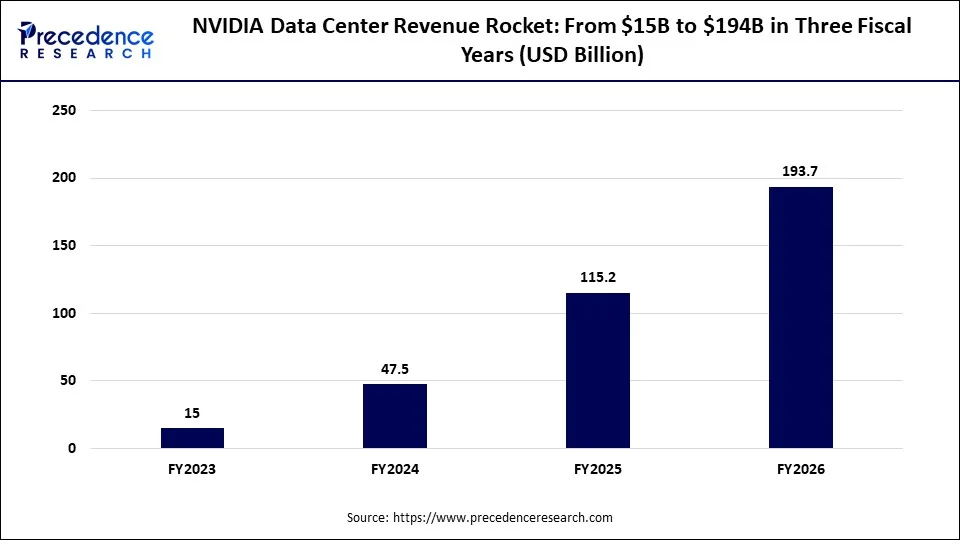
NVIDIA’s Data Center segment revenue increased from $15.0 billion in fiscal 2023 to $47.5 billion in fiscal 2024, jumped to $115.1 billion in fiscal 2025, and then reached a record $193.7 billion in full-year fiscal 2026, driven by an unprecedented global need for artificial intelligence infrastructure. Major cloud service providers, enterprise model builders, and sovereign AI initiatives expanded spending aggressively. Networking revenue grew past $31 billion in fiscal 2026, reflecting an integrated change toward complete AI factory architecture rather than individual GPUs alone.
Key Insight: Nvidia is transforming from a traditional gaming GPU maker into an accelerated computing and AI infrastructure titan. Its data center division expanded nearly 13-fold over three fiscal years, driven by massive global need for AI chips such as the H100 and newer architectures.
Source: NVIDIA Corporation - "SEC Forms 8-K and 10-K, Q4 FY2024 and Fiscal 2025 earnings releases; quarterly 10-Q filings, fiscal 2026," 2023–2026.
From Gaming Company to AI Infrastructure Giant: NVIDIA's Segment Mix Transformation
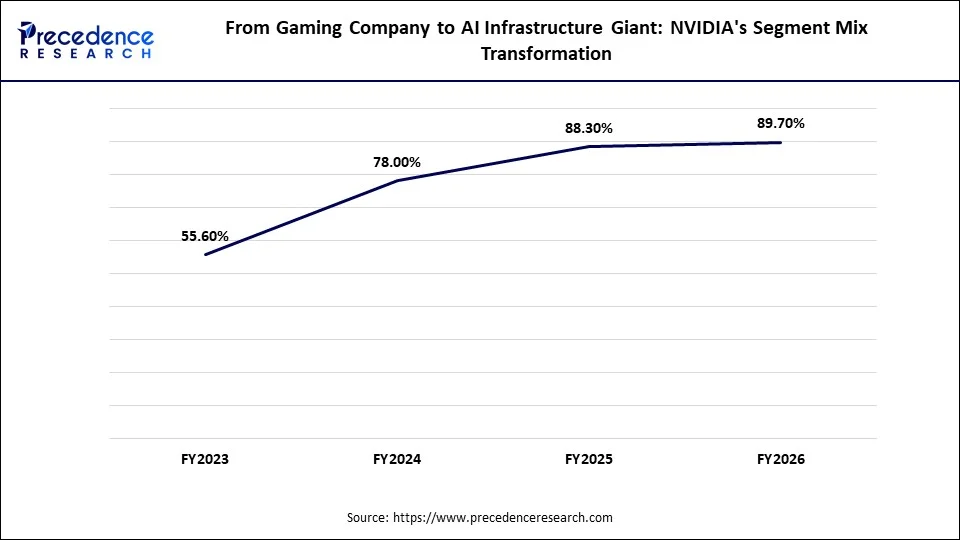
Between fiscal years 2023 and 2026, NVIDIA underwent an unprecedented structural transformation, with its Data Center segment revenue share thus expanding from 55.6% to 89.7% of total corporate revenue. It is driven by the explosive need for generative AI hardware; this shift officially cemented the firm's transition from a video game graphics vendor into a foundational AI infrastructure monopoly. High demand for Hopper-architecture GPUs (A100/H100) dominated enterprise purchases. Moreover, investors now trade NVIDIA strictly as an index of global AI compute need rather than traditional PC hardware markets.
Key Insight: The climb from 56% to nearly 90% in three years means data center has gone from "NVIDIA's biggest segment" to effectively "NVIDIA's business," with Gaming, Professional Visualization, and even Automotive now functioning more such as legacy product lines than growth drivers.
Source: NVIDIA Corporation - "SEC Form 8-K earnings releases, fiscal years 2023-2026 (figures calculated from disclosed segment revenue)," 2023-2026.
AMD's Data Center Segment Is Growing Fast - But Still Dwarfed by NVIDIA's Scale
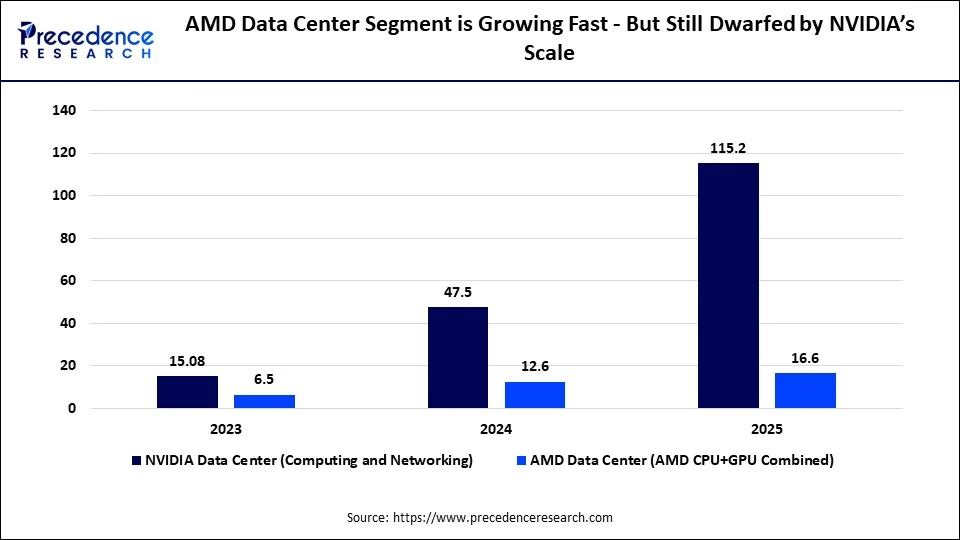
NVIDIA's Data Center revenue massively outpaced AMD's across 2023-2025, driven by official NVIDIA SEC Filings and AMD SEC Filings. Moreover, NVIDIA scaled from roughly $15 billion up to over $100 billion per year, driven by AI GPUs, whereas AMD's combined CPU and GPU Data Center segment grew from nearly $6.5 billion to $16.6 billion.
Key Insight: AMD's Data Center segment approximately doubled in 2024 alone, and its 2025 revenue of $16.6 billion represents genuine, accelerating expansion - but it is still less than one-seventh the size of NVIDIA's comparable segment, illustrating just how large the scale gap between the two remains even as AMD closes it in percentage terms.
Source: NVIDIA Corporation; Advanced Micro Devices, Inc. - "SEC filings and official earnings releases," 2023-2025.
NVIDIA's Stock Market Ascent: Four Trillion-Dollar Milestones in 28 Months
| Date | Milestone |
| Jun-23 | NVIDIA first reached $1 trillion market cap |
| Feb-24 | Surpassed $2 trillion market cap |
| Jun-24 | Surpassed $3 trillion market cap |
| Jul 9, 2025 | First company ever to reach $4 trillion market cap |
| Oct 29, 2025 | First company ever to reach $5 trillion market cap |
NVIDIA made corporate history on October 29, 2025, by becoming the first firm ever to cross a $5 trillion market capitalization. Driven by an insatiable global need for artificial intelligence hardware and data center infrastructure, the chipmaker achieved this historic ascent from its initial $1 trillion milestone in just over two years.
Key Insight: The accelerating pace of tech and market valuations reflects an unprecedented capital expenditure super-cycle, where hyperscalers and chipmakers such as Nvidia have compressed multi-year financial and capability milestones into months due to insatiable generative AI demand.
Source: Multiple (see below) - "Nasdaq-reported trading data via CNBC, NBC News, Morningstar, and Bloomberg," 2023–2025.
Six Years of Escalating U.S. Export Controls on Advanced GPUs to China
| Date | Regulatory Development |
| Oct-22 | BIS issued initial rules restricting advanced computing chips to China |
| Oct-23 | Expanded rules broadened Foreign Direct Product Rule to 43 more countries |
| Dec-24 | BIS strengthened controls on chip manufacturing equipment |
| Jan-25 | “AI Diffusion Rule” established country-based licensing framework |
| Jan-26 | Section 232 investigation proposed 25% tariff on selected semiconductors |
The U.S. export control timeline tracking advanced GPU and AI chip restrictions targeting China spans from the landmark October 2022 restrictions to the evolving policy shifts, volume caps, and even Section 232 tariff actions implemented by January 2026. The Bureau of Industry and Security (BIS) rolled out sweeping performance-based rules targeting advanced computing chips and even semiconductor manufacturing equipment. Performance Ceilings introduced thresholds restricting chips based on Total Processing Performance (TPP) and communication bandwidth to curb China's military supercomputing capabilities.
In 2023, BIS issued revised regulations refining performance density parameters to prevent workaround chips, like early down-specced Nvidia A100/H100 variants.
In 2024-2025, foreign-produced rules tightened constraints on foreign-produced items utilizing U.S. software or tools, thus introducing strict single-chip de minimis and node-agnostic tool definitions. In January 2025, the Biden administration proposed a global tiered licensing architecture dividing countries by access levels, and placing China firmly under a presumption of denial.
In January 2026, Quotas & Tariffs imposed a 25% Section 232 tariff on qualifying advanced computing chips, a 50% volume cap relative to domestic U.S. shipments, independent U.S. lab testing, alongside stringent know-your-customer (KYC) constraints.
Key Insight: U.S. export controls on semiconductor chips have triggered an unstable cycle. New trade rules contribute to chip redesigns to bypass limits. Governments then respond with stricter rules. Thus, this pattern has repeated at least five times in six years. Both sides remain locked in an escalating technology race.
Source: US Department of Commerce, Bureau of Industry and Security (BIS) - "Press releases and interim final rules," 2022-2026.
NVIDIA's Own Words: "Effectively Foreclosed" From China's Data Center Market
According to its fiscal year 2026 SEC filing, NVIDIA indicates it is effectively excluded from the Chinese data center market, thus allowing local competitors to dominate via established ecosystems and robust hardware options. Export restrictions on performance and memory parameters render compliant chip design unviable, allowing Chinese alternatives to capture significant market share.
Key Insight: Nvidia disclosed in regulatory filings that U.S. export controls have blocked it from selling high-end AI chips to China, a massive market. Nvidia warns this exclusion assists Chinese rivals in building local tech ecosystems, which may threaten Nvidia's global market power in the future.
Source: NVIDIA Corporation - "SEC Form 10-K, fiscal year ended January 25, 2026," 2026.
France Opens the First Formal Antitrust Case Against a GPU Maker's Dominant Position
| Date | Development |
| Sep-23 | French competition authority raided NVIDIA's French offices |
| Jun-24 | Authority published opinion flagging NVIDIA's dominant position in GPUs |
| Jul 15, 2024 | Authority confirmed formal antitrust investigation was underway |
| 2024–2025 | Investigation expanded to concerns including CUDA lock-in and investments |
| Jul-26 | Rapporteur reported investigation was continuing; no ruling or data set available |
France's Autorité de la concurrence declared on July 9, 2026, that its long-running antitrust investigation into Nvidia is nearing completion. The probe focuses on dominant market positions in AI hardware, the proprietary CUDA software lock-in, and cloud-provider investments. General rapporteur Umberto Berkani publicly declares that the investigative phase is approaching its end, moving the regulator closer to deciding whether to issue a formal statement of objections or close the file.
Key Insight: France's antitrust investigation into Nvidia targets hardware dominance and software lock-in through the CUDA platform. If upheld by the Autorité de la concurrence, it will establish a groundbreaking global precedent for policing artificial intelligence infrastructure and tech ecosystems.
Source: Autorite de la concurrence (French Competition Authority) - "Official press releases and opinions," 2023-2026.
From Mellanox Approval to Antitrust Violation: China's Case Against NVIDIA
| Date | Development |
| Mar-19 | NVIDIA announced $6.9B deal to acquire Mellanox Technologies |
| Apr-20 | SAMR conditionally approved deal with no-bundling and supply-term conditions for 6 years |
| Dec 9, 2024 | SAMR opened investigation into NVIDIA's compliance with 2020 conditions |
| Sep 12, 2025 | SAMR found NVIDIA violated antitrust law and proceeded with further investigation |
Following the April 2020 conditional approval of NVIDIA's acquisition of Mellanox, China's SAMR initiated a probe in December 2024 and declared a preliminary finding in September 2025 that NVIDIA violated non-discriminatory access commitments. The investigation focuses on alleged discriminatory practices along with product bundling, which could lead to significant fines.
Key Insight: In 2020, China's State Administration for Market Regulation approved NVIDIA's acquisition of Mellanox under strict conditions, like fair supply, no bundling, and no discrimination. While these terms mirrored standard antitrust remedies used worldwide to manage vertical integration, subsequent enforcement actions in 2025 reflect rising geopolitical and then trade tensions rather than pure long-term market foresight.
Source: China State Administration for Market Regulation (SAMR) - "Official investigation announcements, reported via Reuters and CNBC," 2019–2025.
Mapping the Global Regulatory Scrutiny of NVIDIA
| Region / Country | Regulatory Authority |
| UNITED STATES | Dept. of Justice investigating potential antitrust concerns; FTC has separate oversight authority following the blocked 2022 Arm acquisition attempt |
| FRANCE | Autorité de la concurrence formal investigation since Jul. 2024; focused on GPU market dominance and CUDA software lock-in; possible fine up to 10% of revenue |
| EUROPEAN UNION | European Commission examining competition in cloud computing and AI infrastructure markets, including NVIDIA's investments in AI cloud providers such as CoreWeave |
| CHINA | SAMR found preliminary antitrust violation (Sep. 2025) tied to 2020 Mellanox merger conditions; deeper investigation ongoing; fines of 1–10% of annual sales possible |
| UNITED KINGDOM | UK competition authorities have also scrutinized NVIDIA's position in AI infrastructure markets |
Antitrust and competition inquiries into NVIDIA across the five major jurisdictions span active investigations into sales practices, software dominance (CUDA), and even historical merger commitments.
United States: Led by the Department of Justice (DOJ), investigators issued subpoenas following initial questionnaires. Scrutiny centers on whether NVIDIA penalizes non-exclusive buyers, makes switching suppliers difficult, and even anti-competitively bundles hardware with software or acquisitions such as RunAI.
The French competition authority declared that its prolonged probe, stemming from a 2023 raid over suspected supremacy in GPUs and cloud-AI, is wrapping up. Regulators are deciding whether to issue a formal statement of objections regarding CUDA dependence and even cloud investments.
The European Commission has polled industry competitors regarding data center definitions alongside hardware bundling. NVIDIA also challenged EU regulators at the General Court over a referral regarding the RunAI startup acquisition.
China’s State Administration for Market Regulation (SAMR) declared a preliminary finding that NVIDIA violated anti-monopoly laws by failing to adhere to fair-competition conditions tied to its 2020 acquisition of Mellanox Technologies.
United Kingdom- The Competition and Markets Authority (CMA) has gathered intelligence and information regarding NVIDIA's grip on the AI hardware and accelerated computing supply chain, though it sits behind the US and France in formal enforcement stages.
Key Insight: Antitrust regulators in the U.S., EU, France, and the UK have started active investigations into Nvidia over GPU market supremacy. Authorities are scrutinizing exclusive software ecosystems, AI chip supply allocations, and even potential anticompetitive acquisitions, signaling deep global concern over hardware market power rather than just software applications.
Source: Multiple government sources (see below) - "Autorité de la concurrence; China SAMR; NVIDIA SEC disclosures; news reporting on DOJ, FTC, EU and UK inquiries," 2023-2026.
NVIDIA's Two Reportable Segments: Compute & Networking vs. Graphics
| Segment | Products, Platforms & Revenue Share |
| COMPUTE & NETWORKING |
|
| GRAPHICS |
|
NVIDIA reports its financial results to the SEC in its Form 10-K Annual Report utilizing two primary operating segments: Compute & Networking and Graphics. While public product discussions usually focus on markets like Data Center or Gaming, financial reporting groups them into these two distinct buckets. NVIDIA AI Enterprise software packages and DGX Cloud computing services. End-to-end networking products, which include InfiniBand (Quantum) and Ethernet (Spectrum) switches and interconnects.
Key Insight: NVIDIA reports two primary business segments: Compute & Networking and Graphics. The Compute & Networking segment generates the vast majority of revenue through data center chips, artificial intelligence processors, and even networking equipment. The Graphics segment includes consumer GeForce GPUs and professional visualization products, making it the smaller of the two units.
Source: NVIDIA Corporation - "SEC Form 10-K, fiscal year ended January 26, 2025 (Note 16, Segment Information)," 2025.
The GPU Value Chain: Why NVIDIA's Dominance Runs Through a Single Taiwanese Foundry
| Stage | Description |
| Chip Design | NVIDIA architectures and GPU designs, including Hopper and Blackwell |
| Foundry Fabrication | TSMC manufactures advanced NVIDIA chips |
| Memory & Packaging | HBM memory integration and advanced CoWoS packaging |
| System Integration | OEMs and system providers integrate GPUs into servers |
| Deployment | Cloud providers and enterprises deploy GPUs in data centers |
| Key Dependency | NVIDIA relies heavily on TSMC for advanced-node GPU production and shares capacity with other major customers |
NVIDIA functions under a fabless model, designing advanced GPU architectures such as Blackwell and Rubin while outsourcing all physical wafer fabrication to the Taiwan Semiconductor Manufacturing Company (TSMC). Moreover, this creates a high-stakes bottleneck where a single external foundry controls the manufacturing output for global AI infrastructure.
Key Insight: NVIDIA depends heavily on TSMC for its advanced chip manufacturing and packaging in Taiwan. This creates major risks. A single disruption in Taiwan can hurt NVIDIA. Other large tech firms also compete for the same factory space.
Source: Synthesized from official sources - "NVIDIA Corporation and TSMC public disclosures on foundry relationships and capacity constraints," 2025–2026.
AI Compute Costs Fell 280-Fold in Under Two Years
| Date | Cost per Million Tokens at GPT-3.5 Accuracy |
| Nov-22 | $20.00 |
| Oct-24 | $0.07 |
Documented in the Stanford AI Index Report, the expense of running an AI model matching GPT-3.5-level accuracy plunged over 280-fold between November 2022 and October 2024, thus falling from $20.00 per million tokens down to just $0.07 per million tokens.
Key Insight: Falling compute costs cut two ways for NVIDIA: they expand the addressable market for AI applications built on its hardware, but they also raise pressure on NVIDIA and its customers to keep delivering hardware efficiency gains, since cheaper compute overall does not necessarily mean higher margins for any single supplier in the chain.
Source: Stanford Institute for Human-Centered Artificial Intelligence (HAI) - "Artificial Intelligence Index Report 2025," 2025.
NVIDIA's Gaming Business: Still Growing, Now a Rounding Error Next to AI
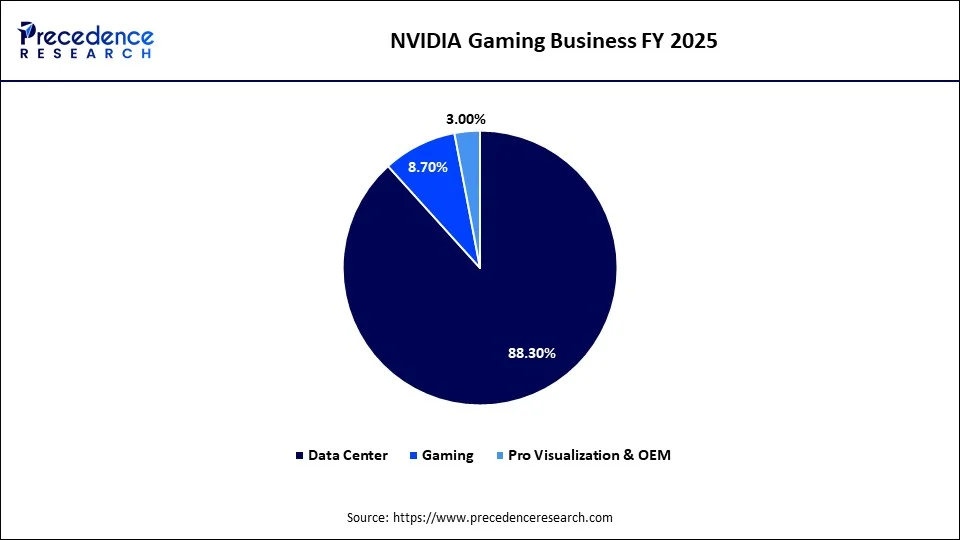
NVIDIA’s fiscal year 2025 total revenue reached a record $130.5 billion, dominated overwhelmingly by the Data Center segment at $115.2 billion (about 88.3%), while Gaming brought in $11.4 billion (8%), and even smaller segments accounted for the remaining balance.
Key Insight: Nvidia's gaming revenue grew nine percent in fiscal 2025. This growth means gaming is not a shrinking business. Moreover, its share of total revenue went down. The data center segment grew much faster. That massive expansion made every other part look smaller by comparison.
Source: NVIDIA Corporation - "SEC Form 8-K, Q4 and Fiscal 2025 Results," February 26, 2025.
GTC 2025: The Scale of NVIDIA's Developer and Partner Ecosystem
| Metric | Figure |
| In-person attendees in San Jose | 25,000 |
| Virtual attendees worldwide | 3,00,000 |
| Technical sessions | 1,000+ |
GTC developer conference in San Jose, California, drew a record-breaking 25,300 in-person attendees, up nearly 29% from 2024, alongside approximately 300,000 virtual participants. The five-day event featured roughly 400 exhibitors and over 1,000 sessions. This indicates that the CUDA software ecosystem and NVIDIA’s broader platform have penetrated among the communities of enterprises and researchers.
Key Insight: A single-company developer conference drawing 300,000 virtual attendees rivals the scale of many industry-wide technology conferences, illustrating how deeply the CUDA software ecosystem and NVIDIA's broader platform have penetrated both enterprise and research computing communities.
Source: NVIDIA Corporation - "GTC 2025 press materials," March 2025.
Three Chipmakers, Three Trajectories on AI Compute
| Category | NVIDIA | AMD | Intel |
| Flagship AI/GPU Product | Blackwell (GB200/GB300) GPU platform | Instinct MI300/MI350 series GPU accelerators | Arc discrete GPUs; Gaudi AI accelerators |
| Latest Fiscal-Year Revenue | $130.5B (FY2025); $215.9B (FY2026) | $25.8B (2024); $34.6B (2025) | Reports combined segments in 10-K |
| AI/Data Center Revenue | $115.2B (FY2025); $193.7B (FY2026) | $12.6B (2024); $16.6B (2025) | Data Center & AI segment reported separately |
| Foundry Model | Fabless + TSMC advanced nodes | Fabless + TSMC | Integrated device manufacturer (IDM) + Intel Foundry |
| China Exposure | Effectively closed from China data-center GPU market per 10-K | MI308 export-control inventory charge of ~$440M (2025) | Subject to same U.S. export-control framework |
NVIDIA dominates the AI hardware market with its H100, H200, and Blackwell architectures paired with the CUDA software stack, generating massive data center-led revenues. AMD positions its Instinct MI300 series as a main alternative, operating on a smaller revenue scale. Intel trails in dedicated AI accelerator revenue, aiming at Gaudi accelerators and Xeon-integrated features while transitioning its manufacturing strategy.
Key Insight: The three firms are pursuing structurally different strategies- NVIDIA and AMD are both fabless and dependent on TSMC, while Intel uniquely combines its own foundry operations with chip design, a difference that could matter significantly if geopolitical tensions further disrupt Taiwan-based manufacturing.
Source: NVIDIA Corp.; Advanced Micro Devices, Inc.; Intel Corp. - "SEC filings and official earnings releases," 2024–2026.
Recent Developments
NVIDIA Corporation - October 29, 2025
| Date | October 29, 2025 |
| Organization | NVIDIA Corporation |
| Development | NVIDIA became the first firm in history to reach a $5 trillion market capitalization. |
| What Changed | It shares rose 3.8% to a record $208.90 at market open, propelled by continued AI infrastructure need and new chip-supply partnership announcements with firms including Nokia, Samsung, and Hyundai Motor Group. |
| Why It Matters | It has been just under four months since NVIDIA became the first firm to reach $4 trillion, reflecting an unprecedented compression in the time between successive trillion-dollar milestones. |
| Business Significance | NVIDIA's valuation thus now exceeds Microsoft's and Apple's, both around $4 trillion at the time. |
Source: Barchart, Bloomberg reporting on NASDAQ: NVDA trading data, Oct. 29, 2025
China State Administration for Market Regulation (SAMR) - September 15, 2025
| Date | September 15, 2025 |
| Organization | China State Administration for Market Regulation (SAMR) |
| Development | SAMR declared that a preliminary investigation found NVIDIA violated China's Anti-Monopoly Law in connection with its 2020 acquisition of Mellanox Technologies. |
| What Changed | SAMR will now proceed with a deeper investigation to determine appropriate penalties, which under Chinese law can range from 1% to 10% of a firm's prior-year annual sales. |
| Why It Matters | It marks the first case in which a national regulator has formally found NVIDIA in violation of antitrust law, rather than merely investigating. |
| Business Significance | The announcement came the same day as unrelated US-China trade talks in Madrid, and then coincided with China launching two separate semiconductor trade probes targeting US chip policy. |
Source : China SAMR announcement, reported by CNBC and JURIST, Sept. 15, 2025
US Department of Commerce, Bureau of Industry and Security (BIS) - January 13, 2025
| Date | January 13, 2025 |
| Organization | US Department of Commerce, Bureau of Industry and Security (BIS) |
| Development | BIS declared the "AI Diffusion Rule," establishing a tiered, country-by-country licensing framework for advanced AI chip exports. |
| What Changed | It replaced blanket restrictions with a system categorizing countries by trust level, with different license requirements and then computing-power caps for each tier. |
| Why It Matters | It represented the most structurally significant change to US AI chip export policy since the original October 2022 controls, thus extending Washington's reach beyond China to dozens of additional countries. |
| Business Significance | The rule was later revised by the incoming Trump administration in 2025, illustrating how quickly US export control policy has continued to shift. |
Source : BIS press release and interim final rule, Jan. 13, 2025
Autorite de la concurrence (France) - July 2026 (ongoing)
| Date | July 2026 (ongoing) |
| Organization | Autorite de la concurrence (France) |
| Development | The French competition authority's rapporteur has stated that its antitrust investigation into NVIDIA is "nearing the end," without offering a ruling date. |
| What Changed | It has been nearly three years since the original September 2023 office raid; the case is approaching a decision point, with a potential fine of up to 10% of NVIDIA's global annual revenue if violations are confirmed. |
| Why It Matters | It would be the first concrete regulatory ruling anywhere in the world specifically addressing whether a GPU maker's market position constitutes an abuse of dominance. |
| Business Significance | It is shown that NVIDIA's fiscal 2025 revenue is $130.5 billion; a maximum fine under French law could theoretically approach $13 billion, but actual penalties (if any) are typically well below the statutory ceiling. |
Source : Autorite de la concurrence statements reported by Reuters, TheNextWeb, and PYMNTS, July 2026
NVIDIA Corporation - April 30, 2025
| Date | April 30, 2025 |
| Organization | NVIDIA Corporation |
| Development | NVIDIA reported first-quarter fiscal 2026 results, confirming continued Blackwell architecture ramp and disclosed a $4.5 billion charge related to H20 chip export restrictions. |
| What Changed | The firm recorded excess inventory and purchase-obligation charges tied to new export controls on its China-specific H20 chip, which had been programmed to comply with earlier restriction thresholds. |
| Why It Matters | It stated that the direct, quantifiable financial cost export control changes impose on NVIDIA, beyond the qualitative competitive concerns described elsewhere in its filings. |
| Business Significance | The firm generated approximately $60 million in H20 revenue under a subsequent licensing arrangement, a small fraction of what China sales previously represented. |
Source : NVIDIA Corporation, Form 10-Q, Q1 fiscal 2026
Advanced Micro Devices, Inc. - 2024-2025
| Date | 2024-2025 |
| Organization | Advanced Micro Devices, Inc. |
| Development | AMD's Data Center segment revenue grew 94% in 2024 to a record $12.6 billion, propelled by both AMD Instinct GPU accelerators and EPYC server processors. |
| What Changed | Combined AMD EPYC and Instinct data center product sales nearly doubled year-over-year, contributing nearly 50% of AMD's total annual revenue for the first time. |
| Why It Matters | It represents AMD's most concrete evidence yet of gaining share in AI accelerators, even though the absolute revenue gap with NVIDIA remains enormous. |
| Business Significance | AMD CEO Lisa Su stated the MI325X and also the upcoming MI350 series would "compete very well" with NVIDIA's H200 and Blackwell chips, respectively. |
Source : AMD 2024 Annual Report; AMD Q4 and full-year 2024 earnings release
White House - US Department of Commerce - January 14, 2026
| Date | January 14, 2026 |
| Organization | White House - US Department of Commerce |
| Development | The White House declared an immediate 25% tariff on a narrow group of semiconductor products meeting specific performance thresholds, following a Section 232 national security investigation. |
| What Changed | It has added a tariff-based trade tool to the existing export-license framework governing advanced chip sales, layering a new cost mechanism on top of prior BIS export restrictions. |
| Why It Matters | It signaled that US policy toward advanced semiconductor trade is expanding beyond export licensing into tariff policy, and adding a new and separate variable for companies such as NVIDIA to navigate. |
| Business Significance | It came alongside a BIS policy revision moving from a blanket presumption of denial to case-by-case review for certain advanced AI chips destined for China and Macau. |
Source : Morgan Lewis legal alert summarizing Section 232 action and BIS policy revision, Jan. 16, 2026
Key Companies & Organizations
Major Companies (GPU - AI Accelerator Makers)
- NVIDIA Corporation dominated AI accelerator and GPU maker, is considered the first firm to reach $5 trillion market capitalization.
- Advanced Micro Devices, Inc., maker of Instinct MI300 - MI350 series AI accelerators and Radeon gaming GPUs.
- Intel Corporation, maker of Arc discrete GPUs and Gaudi AI accelerators; and even operates its own semiconductor foundry.
Foundry & Manufacturing Partners
- Taiwan Semiconductor Manufacturing Company is the primary foundry partner for NVIDIA's and AMD's advanced-node GPU production.
Acquired - Integrated Companies
- Mellanox Technologies is the Israeli networking hardware firm acquired by NVIDIA in 2020 for $6.9 billion and is also central to China's antitrust case against NVIDIA.
Government & Regulatory Organizations
- US Department of Commerce, Bureau of Industry and Security (BIS)
- Autorite de la concurrence (French Competition Authority)
- European Commission
- US Department of Justice (DOJ)
- US Federal Trade Commission (FTC)
- China State Administration for Market Regulation (SAMR)
- UK competition authorities
Research & Academic Institutions
- Stanford Institute for Human-Centered Artificial Intelligence (HAI)
- Center for Security and Emerging Technology (CSET), Georgetown University
Questions Answered in This Blog
- What share of NVIDIA's total revenue now comes from Data Center versus Gaming, and how has that mix shifted?
- How does NVIDIA's Data Center revenue compare to AMD's, and why aren't the two figures perfectly comparable?
- How has NVIDIA's Data Center segment revenue grown over the past three fiscal years, and what does that reveal about the company's transformation?
- What market capitalization milestones has NVIDIA reached, and how quickly has it moved between them?
- What has NVIDIA itself disclosed about its competitive position in China's data center market?
- What is France's Autorité de la concurrence investigating regarding NVIDIA, and what penalties could result?
- What export control actions has the US government taken to restrict advanced GPU sales to China, and how have they evolved since 2022?
- What did China's SAMR find regarding NVIDIA's compliance with its 2020 Mellanox acquisition conditions?
- How are NVIDIA's two reportable business segments - Compute & Networking and Graphics - structured?
- Why does NVIDIA's market position depend so heavily on a single foundry partner, and what does that mean for supply chain risk?
- Which countries and regulatory bodies are currently scrutinizing NVIDIA's market position?
- How quickly have AI compute costs fallen, and what does that mean for NVIDIA's competitive position?
- How large is NVIDIA's developer and partner ecosystem, based on its own conference attendance figures?
- Is NVIDIA's Gaming business declining, and if not, why has its share of total revenue fallen so sharply?
- How do NVIDIA, AMD, and Intel compare on AI or GPU product strategy, revenue scale, and manufacturing model?
What Additional Questions Can Our Full Research Report Answer?
- What is the realistic timeline for AMD's Instinct accelerator line to reach cost-competitive parity with NVIDIA's Blackwell and even next-generation architectures on a performance-per-dollar basis?
- How would a confirmed antitrust finding against NVIDIA in France translate into required behavioral remedies, and how might those remedies affect CUDA licensing terms worldwide?
- Which combination of countries provides the strongest balance of AI chip demand growth, regulatory clarity, and even data-center construction capacity for infrastructure investment over the next five years?
- How exposed are major cloud service providers such as AWS, Microsoft Azure, and Google Cloud to NVIDIA-specific supply risk, and how quickly are their custom silicon programs such as Trainium, Maia, and TPU closing the capability gap?
- What is the realistic capacity NVIDIA could redirect from constrained markets, for example, China, to alternative markets under different export control scenarios through 2028?
- What is the total addressable market for AI accelerators by application segment (training vs. inference) through 2030, adjusted for the cost declines documented in the Stanford AI Index?
- What would be the estimated revenue and margin impact on NVIDIA of a permanent loss of the China data center market versus a partial restoration of access?
- Which enterprise and hyperscaler customers show the highest switching-cost sensitivity to a hypothetical CUDA-alternative software ecosystem, e.g., ROCm, oneAPI?
- How does TSMC's advanced-node capacity allocation across NVIDIA, AMD, Apple, and Qualcomm affect each firm's ability to fulfill order backlogs?
- How do procurement contracts between NVIDIA and its largest cloud service provider customers structure pricing, allocation priority, and exclusivity terms?
- How might a UK, EU, or US antitrust finding affect NVIDIA's ongoing and planned investments in AI cloud service providers like CoreWeave?
- What operational and financial risks does NVIDIA face from its dependency on a single foundry partner concentrated in a geopolitically sensitive region?
- What is the realistic five-year trajectory for China's domestic AI chip industry, such as Huawei and others, to substitute for foreclosed NVIDIA supply?
- What premium, if any, do enterprise customers pay for NVIDIA GPUs relative to comparable AMD or custom-silicon alternatives, adjusted for total cost of ownership including software and support?
- How sensitive is NVIDIA's stock valuation to changes in hyperscaler capital expenditure guidance, and what capex growth rate is implied by current market capitalization levels?
- How do NVIDIA's automotive AI platform partnerships compare in scale and revenue potential to its Data Center business, and what is the realistic timeline for automotive to become a meaningful revenue contributor?
- What licensing and compliance costs do multinational AI infrastructure companies face when navigating simultaneous antitrust and export control regimes across the US, EU, France, and China?
- What is the realistic scenario range for how the France Autorité de la concurrence case is resolved - settlement, behavioral remedy, or contested fine - based on precedent from comparable EU competition cases?
- How does NVIDIA's Professional Visualization segment growth rate compare to its Gaming segment, and which end markets are driving each?
- How would a further tightening or loosening of the AI Diffusion Rule framework affect NVIDIA's addressable market across the 40+ countries subject to tiered licensing?
- How do Intel's combined foundry-and-design model economics compare to NVIDIA's and AMD's fabless models under different geopolitical disruption scenarios?
- What partnership or investment structures, such as equity stakes in AI cloud providers, is NVIDIA using to secure demand, and how might regulators view these arrangements going forward?
- What is the customer concentration risk profile for NVIDIA, given that a small number of hyperscale and even system-integrator customers represent 10%+ of total revenue individually?
- What is the realistic capacity utilization and expansion timeline for TSMC's non-Taiwan fabrication facilities, for example, Arizona, and how would that affect NVIDIA's supply chain risk profile?
- What scenario-planning assumptions best forecast NVIDIA's revenue growth under a range of export control tightening versus loosening pathways through 2030?
- How does the H20 chip's post-restriction economics, including the $4.5 billion inventory charge and subsequent $60 million licensed revenue, illustrate the cost of designing products around shifting export thresholds?
- Which segments of the AI accelerator market, such as training clusters, inference at the edge, and embedded AI, show the greatest opportunity for new entrants to bypass NVIDIA's CUDA ecosystem advantage?
- What has been the historical pattern of antitrust settlement outcomes for dominant technology platform companies in the EU and France, and how might that inform expectations for NVIDIA's case?
- How do sovereign AI initiatives such as national government AI infrastructure programs factor into NVIDIA's country-by-country revenue and licensing exposure under the AI Diffusion framework?
References
All sources cited throughout this report, in order of first appearance:
| Source/Organization | Title | Date | URL | Supports |
| NVIDIA Corporation | Form 8-K, NVIDIA Announces Financial Results for Fourth Quarter and Fiscal 2025 | Feb. 26, 2025 | https://www.sec.gov/Archives/edgar/data/1045810/000104581025000021/q4fy25pr.htm | FY2025 total, Data Center, and Gaming revenue figures |
| NVIDIA Corporation | Form 8-K, Q4 FY2024 Earnings Release | Feb. 2024 | https://www.sec.gov/Archives/edgar/data/1045810/000104581024000028/q4fy24pr.htm | FY2024 Data Center revenue figure |
| NVIDIA Corporation | Form 10-K, fiscal year ended January 26, 2025 | 2025 | https://www.sec.gov/Archives/edgar/data/1045810/000104581025000023/nvda-20250126.htm | Segment definitions (Compute & Networking vs. Graphics); China revenue disclosure |
| NVIDIA Corporation | Form 10-K, fiscal year ended January 25, 2026 | 2026 | https://www.sec.gov/Archives/edgar/data/1045810/000104581026000021/nvda-20260125.htm | Effectively foreclosed" China market disclosure; H20 licensing revenue |
| NVIDIA Corporation | Form 10-Q, quarter ended April 27, 2025 | 2025 | https://www.sec.gov/Archives/edgar/data/1045810/000104581025000116/nvda-20250427.htm | H20 export-control inventory charge |
| NVIDIA Corporation | Form 10-Q, quarter ended October 26, 2025 | 2025 | https://www.sec.gov/Archives/edgar/data/1045810/000104581025000230/nvda-20251026.htm | FY2026 Data Center growth commentary |
| NVIDIA Corporation | GTC 2025 press materials | March 2025 | https://nvidianews.nvidia.com/news/nvidia-ceo-jensen-huang-and-industry-visionaries-to-unveil-whats-next-in-ai-at-gtc-2025 | GTC 2025 attendance figures |
| Bullfincher.io (secondary compilation of NVIDIA SEC filings) | NVIDIA Corporation Revenue Breakdown By Segment | Accessed 2026 | https://bullfincher.io/companies/nvidia-corporation/revenue-by-segment | FY2026 Data Center revenue figure (derived from quarterly 10-Q filings) |
| Advanced Micro Devices, Inc | AMD Reports Fourth Quarter and Full Year 2024 Financial Results | Feb. 4, 2025 | https://ir.amd.com/news-events/press-releases/detail/1236/amd-reports-fourth-quarter-and-full-year-2024-financial-results | AMD 2024 Data Center segment revenue |
| Advanced Micro Devices, Inc | Form 10-K (amd-20251227) | 2026 | https://www.sec.gov/Archives/edgar/data/2488/000000248826000021/amd-20251227.htm | AMD 2025 Data Center segment revenue; MI308 export-control charge |
| Advanced Micro Devices, Inc | 2024 Annual Report | 2025 | https://ir.amd.com/financial-information/sec-filings/content/0001193125-25-067185/0001193125-25-067185.pdf | AMD 2024 segment revenue breakdown and EPYC/Instinct combined contribution. |
| US Department of Commerce, Bureau of Industry and Security (BIS) | Commerce Strengthens Export Controls to Restrict China's Capability to Produce Advanced Semiconductors | Dec. 2024 | https://www.bis.gov/press-release/commerce-strengthens-export-controls-restrict-chinas-capability-produce-advanced-semiconductors-military | December 2024 export control action |
| Morgan Lewis | BIS Revises Export Review Policy for Advanced AI Chips Destined for China and Macau | Jan. 16, 2026 | https://www.morganlewis.com/pubs/2026/01/bis-revises-export-review-policy-for-advanced-ai-chips-destined-for-china-and-macau | January 2026 Section 232 tariff and BIS policy revision |
| Center for Security and Emerging Technology (CSET), Georgetown University | Explainer: The Commerce Department's October 2023 Export Control Update | 2023 | https://cset.georgetown.edu/article/bis-2023-update-explainer/ | October 2023 export control details |
| Autorité de la concurrence (French Competition Authority) | Generative Artificial Intelligence: Autorité Issues Its Opinion on Competitive Functioning | June 2024 | https://www.autoritedelaconcurrence.fr/en/press-release/generative-artificial-intelligence-autorite-issues-its-opinion-competitive | France's official opinion flagging NVIDIA's dominant position |
| TheNextWeb (reporting on Autorite de la concurrence statements) | France's Antitrust Probe Into Nvidia Is Nearing Its End, Regulator Says | July 2026 | https://thenextweb.com/news/france-nvidia-antitrust-probe-nearing-end | Status update on France's NVIDIA antitrust investigation |
| CNBC | China: Nvidia Violated Anti-Monopoly Law, Will Continue Investigation | Sept. 15, 2025 | https://www.cnbc.com/2025/09/15/china-nvidia-violated-anti-monopoly-law-will-continue-investigation.html | SAMR's September 2025 preliminary finding against NVIDIA |
| Data Center Dynamics | Chinese Regulator Says Nvidia's Mellanox Acquisition Violated Antitrust Law | 2025 | https://www.datacenterdynamics.com/en/news/chinese-regulator-says-nvidias-mellanox-acquisition-violated-antitrust-law-as-govt-opens-two-separate-chip-probes-ahead-of-china-us-trade-talks/ | Details of 2020 Mellanox approval conditions and 2024 SAMR investigation opening |
| CNBC | Nvidia Briefly Touched $4 Trillion Market Cap for First Time | July 9, 2025 | https://www.cnbc.com/2025/07/09/nvidia-4-trillion.html | NVIDIA's $4 trillion market cap milestone and prior $1T/$2T/$3T dates |
| Barchart / Bloomberg | Nvidia Becomes First 5 Trillion Company as AI Boom Pushes Shares to Record High | Oct. 29, 2025 | https://www.barchart.com/story/news/35778342/nvidia-becomes-first-5-trillion-company-as-ai-boom-pushes-shares-to-record-high | NVIDIA's $5 trillion market cap milestone |
| Stanford Institute for Human-Centered Artificial Intelligence (HAI) | Artificial Intelligence Index Report 2025 | 2025 | https://hai.stanford.edu/ai-index/2025-ai-index-report | AI compute cost decline data |
| Maginative | NVIDIA to Face Antitrust Charges in France | 2024 | https://www.maginative.com/article/nvidia-to-face-antitrust-charges-in-frances/ | Overview of DOJ, FTC, EU, and UK regulatory scrutiny of NVIDIA |
About the Authors

Aditi Shivarkar
Aditi, Vice President at Precedence Research, brings over 15 years of expertise at the intersection of technology, innovation, and strategic market intelligence. A visionary leader, she excels in transforming complex data into actionable insights that empower businesses to thrive in dynamic markets. Her leadership combines analytical precision with forward-thinking strategy, driving measurable growth, competitive advantage, and lasting impact across industries.



Aman Singh
Aman Singh with over 13 years of progressive expertise at the intersection of technology, innovation, and strategic market intelligence, Aman Singh stands as a leading authority in global research and consulting. Renowned for his ability to decode complex technological transformations, he provides forward-looking insights that drive strategic decision-making. At Precedence Research, Aman leads a global team of analysts, fostering a culture of research excellence, analytical precision, and visionary thinking.

Piyush Pawar
Piyush Pawar brings over a decade of experience as Senior Manager, Sales & Business Growth, acting as the essential liaison between clients and our research authors. He translates sophisticated insights into practical strategies, ensuring client objectives are met with precision. Piyush’s expertise in market dynamics, relationship management, and strategic execution enables organizations to leverage intelligence effectively, achieving operational excellence, innovation, and sustained growth.