






 Request Consultation
Introduction
The Software-as-a-Service (SaaS) industry is in the middle of two overlapping revolutions at once: a continued, decade-long migration of enterprise software from on-premises licenses to cloud subscriptions, and another newer race to embed autonomous AI agents into every major platform. Further, Microsoft's Cloud business alone can generate $168.9 billion a year, more than four times the revenue of Salesforce, the largest pure-play SaaS firm, while legacy enterprise vendors Oracle and SAP are posting faster cloud growth rates than several firms that were "born in the cloud."
Key Takeaways
- Microsoft is the largest firm competing in the SaaS or cloud space by both total revenue of $281.7 billion in FY2025, and cloud-specific revenue of Microsoft Cloud reached $168.9 billion, up 23% year-over-year, a scale no other firm in this report approaches.
- Oracle's cloud business is considered the fastest-growing among major platforms, with total cloud revenue (IaaS + SaaS) up 39% to $34.0 billion in fiscal 2026, driving record total company revenue of $67.4 billion and even a Remaining Performance Obligations backlog that rose 438% to $523 billion on the strength of AI infrastructure contracts.
- Salesforce remains the world's largest pure-play SaaS firm, with subscription and support revenue of nearly $35.7 billion (FY2025, ~94% of total revenue) and $12.4 billion in free cash flow more free cash flow than Adobe, ServiceNow, and even Workday combined.
- SAP's cloud transition has reached a tipping point, which is cloud revenue growing 23% to €21.02 billion in fiscal 2025, with Cloud ERP Suite revenue alone thus reaching €18.12 billion (+28%), while the company's Total Cloud Backlog hit a record €77.3 billion.
- Adobe closed fiscal 2025 with record revenue of $23.77 billion (+11%) and also total Annualized Recurring Revenue of $25.20 billion, with AI-driven Firefly having generated more than 9 billion images across Creative Cloud applications.
- ServiceNow grew total quarterly revenue every quarter in 2025, closing Q4 at $3.568 billion (+20.5% YoY), while its Remaining Performance Obligations reached $28.2 billion (+26.5% YoY), alongside "Now Assist" AI net-new annual contract value more than doubled year-over-year.
- Workday now serves more than 50% of the Fortune 500, with fiscal 2025 total revenue of $8.446 billion (+16.4%) and then subscription revenue of $7.718 billion (+16.9%).
- AI agents and copilots have become the central competitive battleground for every major platform in 2024–2026: Salesforce's Agentforce, Adobe's Firefly, ServiceNow's Now Assist, Oracle's AI Studio, and even SAP's Business AI were each highlighted as primary growth drivers in their respective firms' most recent earnings releases.
- Salesforce remains the largest pure-play SaaS firm by market capitalization at $161.4 billion, 2.8 times larger than the second-largest, ServiceNow ($57.9 billion). Remaining Performance Obligations (RPO), along with cloud backlog contracted future revenue not yet recognized have become the metric every major platform contributes with in earnings releases, reflecting a wider industry shift toward large, multi-year AI infrastructure and platform commitments.
The 15 Biggest SaaS Companies: Revenue, Cloud Growth, AI, and Market Trends in 2026
The Largest SaaS-Leading Companies by Total Revenue
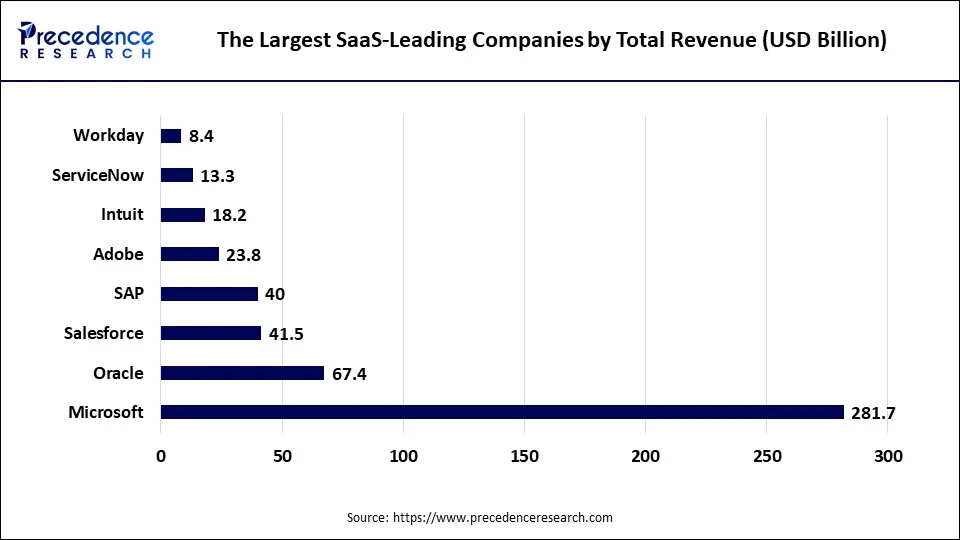
Most commonly identified as leading the SaaS market by their most recently reported full-year total company revenue, based on each company's own SEC filings and earnings releases.
- Microsoft's figure of $281.7 billion represents the company's total audited revenue for fiscal year 2025. This is because of high growth in cloud and AI services, with Azure alone generating over $75 billion in annual cloud revenue.
- Oracle's figure of $67.4 billion represents the company's record total revenue for the fiscal year. The explosive expansion was heavily fueled by Oracle Cloud Infrastructure (OCI) rentals for AI training and workloads, which helped drive a massive remaining performance obligations (RPO) backlog of $638 billion.
- Salesforce reached $41.5 billion in total revenue for fiscal year 2026 because of steady enterprise subscription growth along with a rapid surge in new AI-driven product adoption.
- SAP's annual revenue recently crossed the $40 billion milestone, reaching nearly $41.6 billion for fiscal 2025 and tracking near $43-44 billion over the trailing 12 months.
Key Insight: Microsoft's total revenue is approximately 4.2 times larger than second-place Oracle's, but this comparison is somewhat misleading, since Microsoft's total includes large non-SaaS businesses such as Windows OEM licensing, Surface hardware, LinkedIn, and Xbox, which Salesforce and Workday, as far more SaaS-concentrated firms, do not have.
Source: Multiple (see below) "Company FY2025/FY2026 earnings releases and SEC/regulatory filings," 2025-2026.
A Fairer Comparison: Cloud/SaaS-Specific Revenue Only
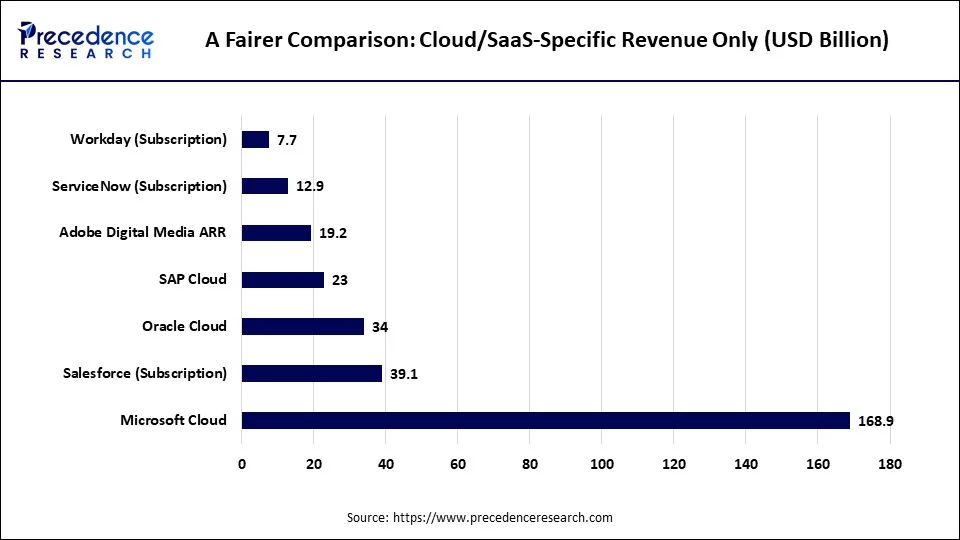
This chart isolates each company's cloud or SaaS-specific revenue, offering a more apples-to-apples comparison of actual SaaS market presence.
Microsoft's total cloud revenue reached $168.9 billion, thus serving as a massive enterprise foundation that spans infrastructure such as Azure, platform services, and SaaS applications such as Microsoft 365 and Dynamics 365.
Salesforce subscription and support revenue reached $39.4 billion for fiscal 2026. Meanwhile, Agentforce and Data Cloud products crossed $1.4 billion in combined annual recurring revenue (ARR) during the fiscal year.
Oracle's $34 billion cloud figure thus represents its total combined cloud services revenue for infrastructure and SaaS combined rather than pure SaaS revenue alone.
Key Insight: Even on this narrower, fairer basis, Microsoft's Cloud revenue of $168.9 billion still dwarfs every dedicated SaaS competitor, more than four times larger than Salesforce's subscription revenue, the largest of the pure-play firms, confirming that Microsoft's SaaS or cloud scale advantage is real and not merely an artifact of counting unrelated hardware businesses.
Source: Multiple (see below) "Company FY2025/FY2026 earnings releases (cloud/subscription/ARR figures as specifically disclosed by each company)," 2025-2026.
Microsoft Cloud Revenue Grew 23% to Nearly $169 Billion in FY2025
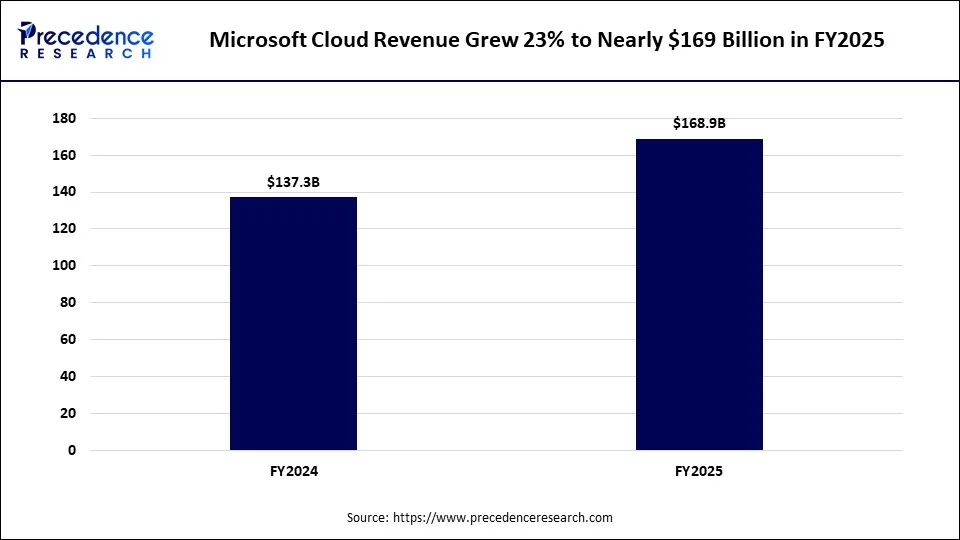
This chart shows Microsoft Cloud revenue growth for fiscal year 2025, with the prior-year figure derived from the company's disclosed 23% growth rate.
Microsoft Cloud generated nearly $135 billion to $137.3 billion in revenue for fiscal year 2024 because of surging enterprise need for artificial intelligence services and core cloud infrastructure.
Microsoft Cloud reached $168.9 billion in fiscal year 2025, a 23% increase year-over-year because of massive enterprise requirements for AI integration and a permanent shift to subscription-based services.
Key Insight: Azure alone surpassed $75 billion in annual revenue for the first time in FY2025, thus growing 34% faster than Microsoft Cloud's overall 23% growth rate, which indicates that Azure's infrastructure business is now growing faster than Microsoft's more mature productivity-cloud businesses.
Source: Microsoft Corporation, "Form 10-K, fiscal year 2025," 2025.
Salesforce's FY2025 Financial Profile: The Pure-Play SaaS Benchmark
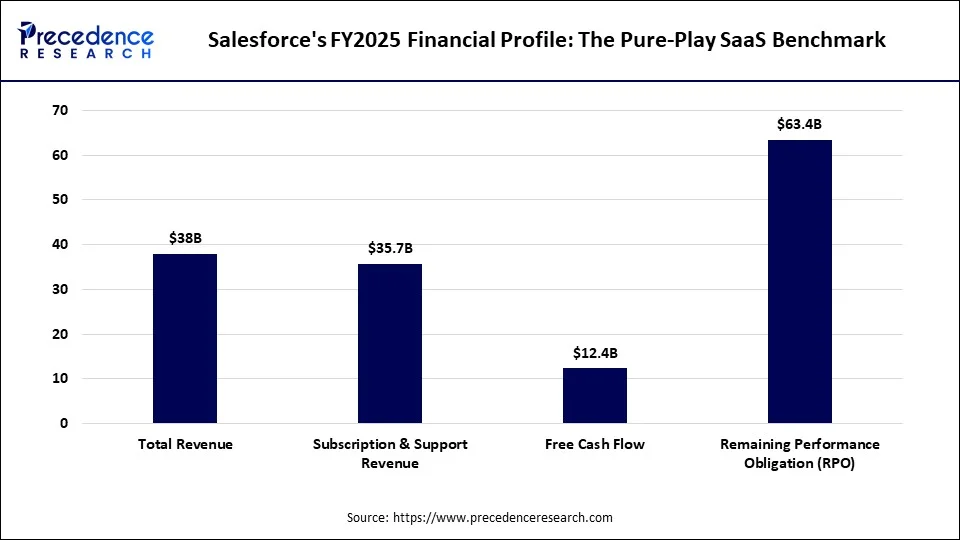
This chart summarizes Salesforce's key FY2025 financial metrics: total revenue, subscription and support revenue, free cash flow, and Remaining Performance Obligations.
Salesforce reached an annual revenue of approximately $38 billion for fiscal year 2025 due to its dominant market position in customer relationship management (CRM), along with successful multi-product expansion.
- Subscription and Support Revenue- $35.7B
- Free Cash Flow- $12.4B
- Remaining Performance Obligations- $63.4B
Key Insight: A $63.4 billion RPO balance against nearly $38 billion in annual revenue means Salesforce already has more than 1.6 years of revenue contractually booked but not yet recognized, among the strongest visibility into future revenue of any firm in this report.
Source: Salesforce, Inc. "FY2025 earnings release and company financial disclosures," 2025.
Oracle's Cloud Business Accelerated Sharply in FY2026
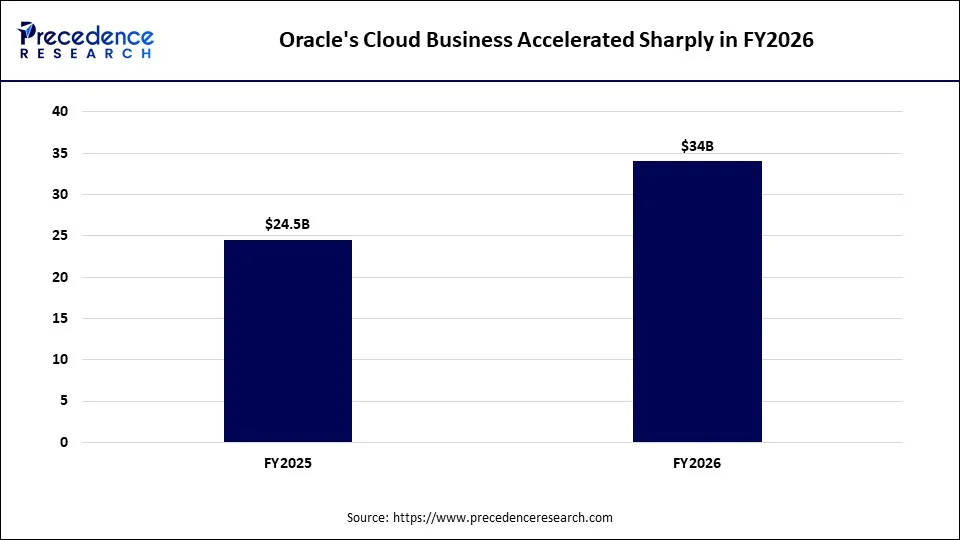
This chart shows Oracle's total cloud revenue for fiscal year 2026, with the prior-year figure derived from the company's disclosed 39% growth rate.
Oracle achieved $24.5 billion in cloud revenue for fiscal year 2025 because of massive global need for its artificial intelligence infrastructure and enterprise cloud applications.
Oracle's total cloud revenue reached $34 billion in fiscal year 2026 due to massive global need for artificial intelligence training and even cloud infrastructure.
Key Insight: Oracle's own CEO explicitly guided that fiscal 2026's cloud growth rate which is >40% expected, 39% delivered, would be "dramatically higher" than fiscal 2025's 24% and the firm delivered on that promise, driven overwhelmingly by Cloud Infrastructure (IaaS) revenue, which grew 55-68% in individual quarters as Oracle positioned itself as a major AI infrastructure manufacturer alongside its traditional database and applications business.
Source: Oracle Corporation "Fiscal 2026 Fourth Quarter and Full-Year earnings release," 2026.
SAP's Cloud Transition: Cloud Revenue Now Over Half of Software Revenue
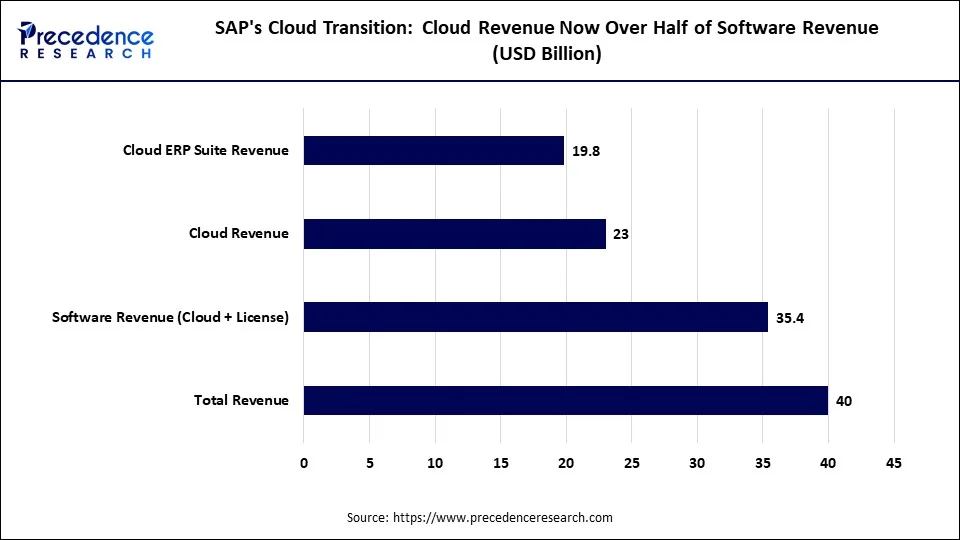
This chart breaks down SAP's fiscal 2025 revenue into total revenue, software revenue, cloud revenue specifically, and Cloud ERP Suite revenue, the firm's core growth engine.
- SAP's fiscal 2025 total revenue landed near the $40 billion threshold because of strong multi-digit acceleration in its cloud business.
- SAP reported total "cloud and software" revenue of nearly $35.4 billion, depending on the exchange rate for fiscal year 2025.
- SAP reported full-year 2025 cloud revenue of $23 billion, depending on the exchange rate, driven by strong enterprise need for its cloud ERP suite and business AI integration.
Key Insight: Cloud ERP Suite revenue grew 28% while overall license revenue continued to decline. SAP's own reporting confirms fewer customers are pursuing large on-premises "core rebuilds" and even more are adopting standard cloud offerings, a structural shift the firm has been engineering for nearly a decade via its "RISE with SAP" migration program.
Source: SAP SE "Q4 and Fiscal Year 2025 Results," January 29, 2026.
Adobe's FY2025: Record Revenue Driven by AI-Enabled Creative Tools
This chart shows Adobe's fiscal 2025 total revenue, total Annualized Recurring Revenue, Digital Media segment ARR, and Digital Experience segment revenue.
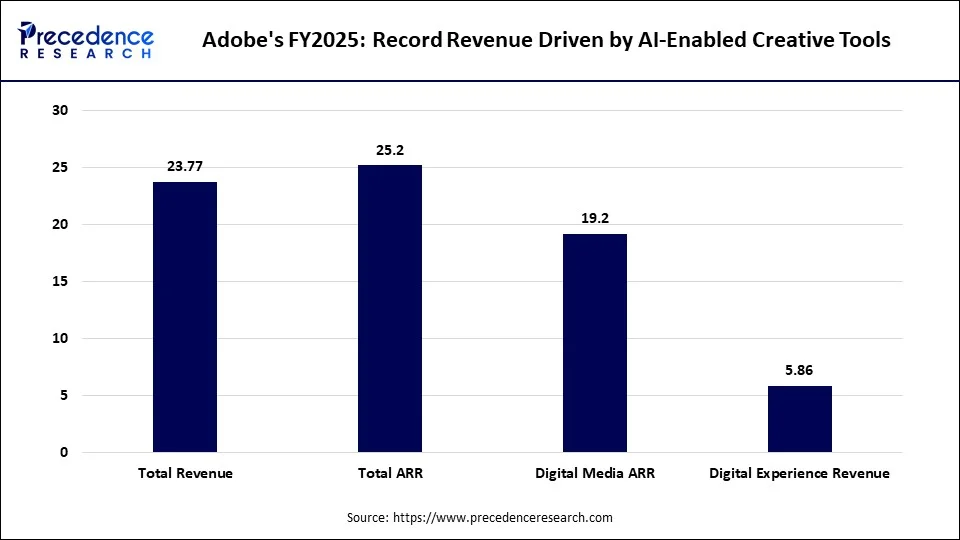
- Adobe reached a record fiscal 2025 total revenue of $23.77 billion, driven by strong demand for its creative software and the rapid adoption of its artificial intelligence tools.
- Adobe achieved a Total Annualized Recurring Revenue (ARR) of $25.20 billion at the end of fiscal year 2025, thus representing an 11.5% year-over-year growth driven by steady enterprise demand and even ongoing core software subscriptions.
- Adobe reached $19.2 billion in Digital Media Annual Recurring Revenue (ARR) at the end of fiscal 2025 due to strong subscription growth, enterprise demand, along with rapid adoption of its AI features.
- Adobe's fiscal 2025 Digital Experience segment generated $5.86 billion because of strong enterprise demand for data analytics, marketing workflows, along with content supply chain solutions.
Key Insight: Digital Media ARR of $19.20 billion represents approximately 76% of Adobe's total ARR, thus confirming that Creative Cloud and Document Cloud, not the Digital Experience marketing-software business, remain the firm's dominant growth engine, even as Adobe increasingly markets itself around AI-native features such as Firefly and the Acrobat AI Assistant.
Source: Adobe Inc. "Form 8-K, Q4/Full-Year FY2025 earnings release," December 2025.
ServiceNow Grew Quarterly Revenue Every Quarter in 2025
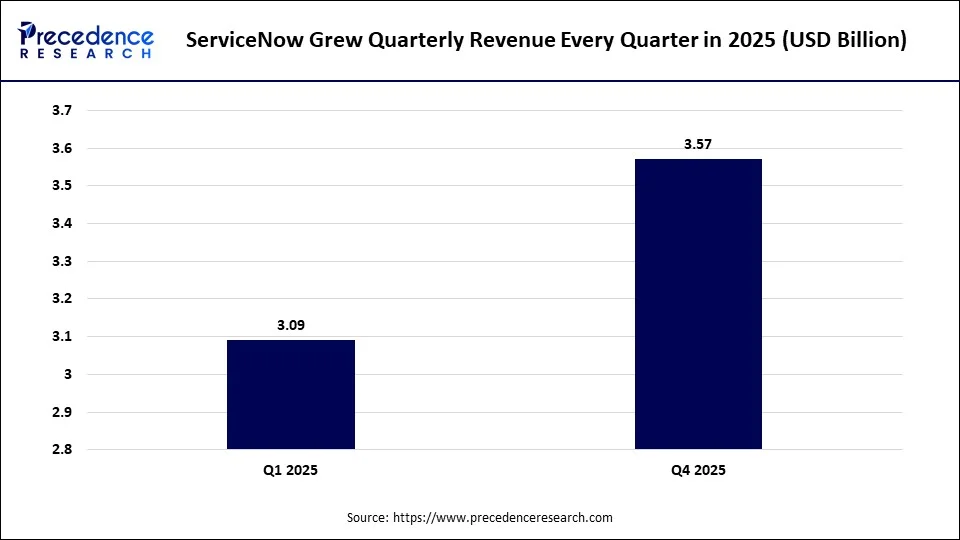
ServiceNow reported a total revenue of $3.09 billion for the first quarter of 2025, beating analyst estimates. This was driven by strong adoption of AI workflows combined with subscription expansions.
ServiceNow reported a total Q4 2025 revenue of $3.57 billion, thus representing a 20.7% increase year-over-year.
Key Insight: ServiceNow had crossed 500 customers with more than $5 million in annual contract value during Q1 2025. A customer-concentration milestone that, combined with 26.5% RPO growth by year-end, signals the firm is successfully moving upmarket into larger, stickier enterprise contracts rather than relying purely on new-logo acquisition for growth.
Source: ServiceNow, Inc. "Q1 2025 and Q4/Full-Year 2025 earnings releases," 2025-2026.
Workday Serves More Than Half of the Fortune 500
| Metric | Value |
| Fortune 500 Companies Using Workday | 50%+ |
| Remaining Fortune 500 Companies | Less than 50% |
This chart highlights Workday's customer penetration among Fortune 500 companies, alongside its FY2025 total revenue.
Workday plans to reach 50 firms in the Fortune Global 500 by scaling domestic manufacturing, integrating deeply into global supply chains, along with building international business scale. Moreover, it is growing global competitors across multiple sectors, including technology, banking, pharmaceuticals, and consulting.
Key Insight: Workday's growth is now increasingly coming from expanding within its existing enterprise base, adding new products and modules to existing Fortune 500 users rather than from net-new large-enterprise logo wins, since more than half of the addressable Fortune 500 market is already a Workday customer.
Source: Workday, Inc. "Form 8-K, Fiscal 2025 Fourth Quarter and Full-Year earnings release," February 25, 2025.
Salesforce Remains the Largest Pure-Play SaaS Company by Market Value
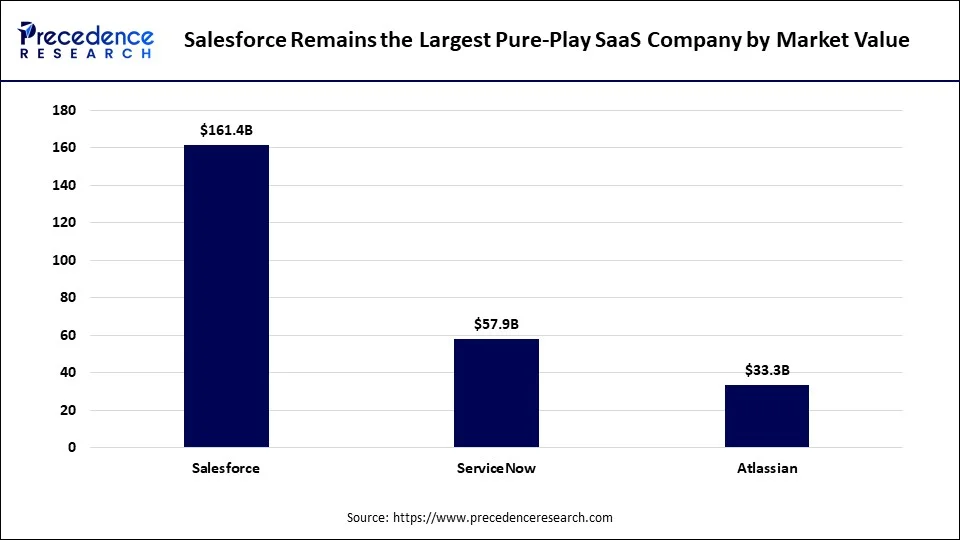
This chart compares the market capitalization of three leading US-listed pure-play SaaS companies.
Salesforce's market capitalization sits around $161.4B as its stock price has pulled back remarkably from its late 2024 peak. Investors have rotated away from traditional software-as-a-service (SaaS) firms amid broader concerns about how generative AI combined with agentic AI will disrupt legacy subscription business models.
ServiceNow: $57.9B, because markets are heavily scrutinizing whether software platforms can now successfully convert artificial intelligence pilots into recurring, high-margin production revenue.
Atlassian: $33.3B, with valuation and market capitalization fluctuating based on quarterly earnings, cloud transitions, and even shifting tech sector sentiment.
Key Insight: Salesforce's market cap lead over ServiceNow is larger than the revenue gap between the two firms would suggest. Salesforce's revenue is roughly 2.9x ServiceNow's, indicating investors are valuing the two firms at widely similar revenue multiples despite ServiceNow's currently faster growth rate, a valuation gap that could compress if ServiceNow's growth advantage persists.
Source: Mike Sonders, "The 50 Biggest SaaS Companies in the U.S." (updated weekly market-cap tracker), 2025-2026.
Contracted Future Revenue: Oracle's Backlog Dwarfs Even Its Larger SaaS Peers
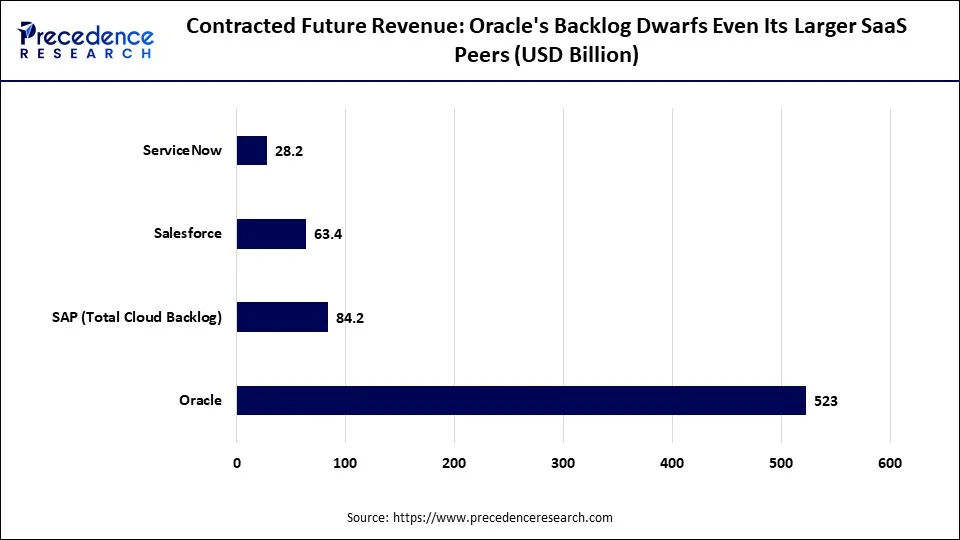
This chart compares Remaining Performance Obligations (RPO), or total cloud backlog contracted future revenue not yet recognized across four major platforms.
Oracle reported $523 billion in remaining performance obligations (RPO), thus representing legally binding, contracted future revenue, during the second quarter of its fiscal year 2026.
SAP reported a current cloud backlog of $84.2B, representing contracted cloud revenue scheduled to be recognized over the coming 12 months.
Salesforce reported a Remaining Performance Obligation (RPO), representing contracted future revenue, of $63.4 billion at the close of fiscal year 2025.
ServiceNow has $28.2 billion in contracted future revenue, which is called remaining performance obligations (RPO). This total grew by about 26% compared to the previous year.
Key Insight: Oracle's $523 billion RPO is larger than the combined annual revenue of every other company profiled in this report, driven overwhelmingly by multi-year AI infrastructure contracts rather than traditional SaaS application subscriptions, meaning this backlog figure reflects Oracle's emerging position as a cloud infrastructure provider as much as its position as an applications or database company.
Source: Multiple (see below) "Oracle, SAP, Salesforce, and ServiceNow FY2025/FY2026 earnings releases," 2025-2026.
Mapping the SaaS Business Model and Revenue Engine
| Stage | Description |
| Platform Development | Multi-tenant cloud architecture, core feature engineering |
| AI/Agent Layer | Embedded copilots, agents, and generative AI features |
| Go-to-Market | Direct sales, partner/reseller channels, PLG |
| Customer Success | Onboarding, support, renewal and expansion (net retention) |
| Recurring Revenue | Subscription + consumption billing |
This process diagram traces the five-stage SaaS business model, from platform development to recurring revenue realization, and highlights RPO or backlog as the sector's key forward-looking metric.
The five-stage SaaS business model moves a company from initial product creation to predictable, recurring income, using Remaining Performance Obligation (RPO) as a key indicator of future growth.
The Five-Stage SaaS Model
- Platform Development: It creates the initial software solution to solve a specific user problem and designs a secure, cloud-based system that can grow over time.
- AI/Agent Layer: It gives the software to a small group of beta testers or early adopters and fixes bugs and improves the software based on direct user feedback.
- Go-to-Market and Scale: It encourages the product to reach a wider audience to attract new buyers and hire specialized staff for customer support, sales, and engineering.
- Customer Success: It stops users from canceling their subscriptions and provides higher-tier plans or extra features to current users.
- Recurring Revenue: It collects steady monthly or annual subscription fees and enjoys high profit margins as operational costs grow slower than revenue.
Key Insight: The insertion of a dedicated "AI/Agent Layer" as a distinct stage, separate from core platform development, reflects how fundamentally SaaS firm organizational structures have shifted since 2023; every major platform profiled in this report now treats AI agent capability as a standalone product investment area with its own metrics.
Source: Synthesized from official sources: "Microsoft, Salesforce, Oracle, SAP, Adobe, ServiceNow, and Workday earnings disclosures and reporting structures," 2025–2026.
Leading SaaS Platforms: Side-by-Side Comparison
| Company | Core Category | Latest FY Revenue | Cloud/SaaS Revenue | YoY Growth (Cloud/SaaS) |
| Microsoft | Productivity, Cloud Infrastructure, AI | $281.7B (FY2025) | $168.9B (Cloud) | 23% |
| Salesforce | CRM | ~$38.0B (FY2025) | $35.7B (Subscription) | 10% |
| Oracle | Database, ERP, Cloud Infrastructure | $67.4B (FY2026) | $34.0B (Cloud) | 39% |
| SAP | ERP | ~$40.0B (FY2025) | ~$23.0B (Cloud) | 23% |
| Adobe | Creative & Marketing Software | $23.77B (FY2025) | $25.20B (Total ARR) | 11.50% |
| ServiceNow | IT Workflow Automation | ~$13.3B (FY2025) | ~$12.9B (Subscription) | ~+20% |
| Workday | HCM & Financial Management | $8.45B (FY2025) | $7.72B (Subscription) | 16.90% |
This styled comparison table profiles leading companies on core category, latest full-year revenue, cloud- or SaaS-specific revenue, and year-over-year growth, based on each firm's own earnings disclosures.
- Microsoft Corporation generated $281.7 billion in revenue during Fiscal Year 2025, while its total annual revenue for Fiscal Year 2026 grew to $331.8 billion.
- Salesforce reported record annual revenue of $38 billion for Fiscal Year 2026.
Key Insight: Oracle's 39% cloud growth rate stands out as the fastest among the diversified or legacy players in this table, while Salesforce's 10% subscription growth is the slowest a reversal of these two firms' historical growth-rate rankings from a decade ago.
Source: Multiple (see below): "Microsoft, Salesforce, Oracle, SAP, Adobe, ServiceNow, and Workday FY2025/FY2026 earnings releases and SEC/regulatory filings," 2025-2026.
AI Agents Have Become the Central Battleground Across Every Major SaaS Platform
| Year | Company & AI Agent Development |
| 2024 | Salesforce - Launches Agentforce for autonomous AI agents |
| 2025 | ServiceNow - “Now Assist” net-new ACV more than doubles YoY |
| 2025 | Adobe - Firefly generates 9B+ AI images across apps |
| Oct. 2025 | Oracle - Launches AI Studio to deploy agents on OCI |
| 2026 | SAP - Business AI in two-thirds of Q4 cloud order entry |
This timeline traces major AI agent and generative-AI product announcements across five leading SaaS platforms from 2024 through 2026.
- Salesforce started Agentforce in 2024 as a native platform for building autonomous AI agents that reason, make decisions, and execute multi-step tasks across business workflows.
- ServiceNow's generative AI suite, Now Assist, thus, crossed $600 million in total annual contract value (ACV) by the end of 2025, with net new ACV more than doubling year-over-year.
- Adobe's Firefly crossed a major milestone by generating more than 9 billion AI images across numerous creative applications.
- SAP Business AI was included in two-thirds of SAP's Q4 2025 cloud order entries in January 2026.
Key Insight: Every firm in this timeline frames its AI capability utilizing the language of autonomous "agents" rather than passive "copilots" or "assistants" a deliberate industry-wide vocabulary change signaling that vendors are now competing on AI systems that can independently execute multi-step tasks.
Source: Multiple (see below) "Salesforce, ServiceNow, Adobe, Oracle, and SAP official earnings releases and product announcements," 2024-2026.
Oracle's Cloud Business Is Growing Nearly 4x Faster Than Salesforce's Core Subscription Revenue
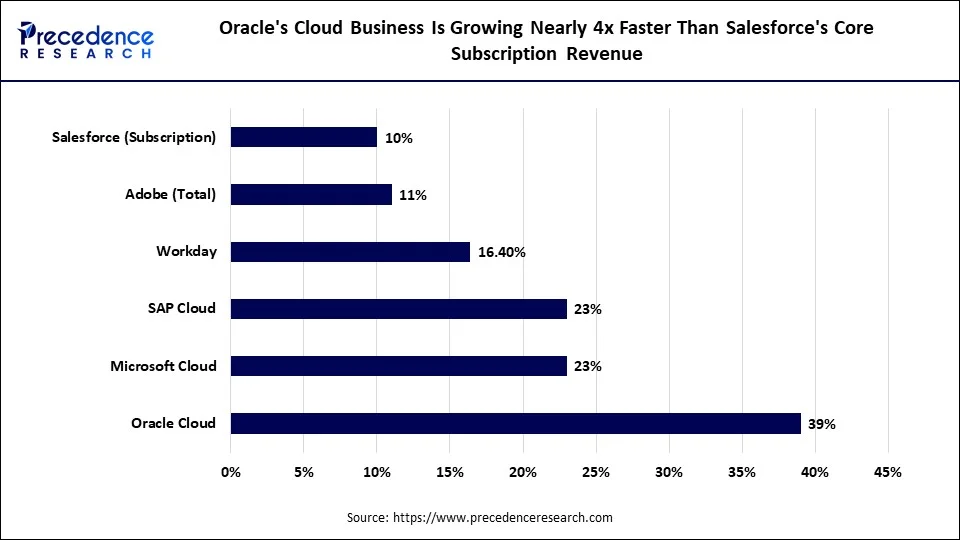
This chart ranks six major firms' most recently disclosed year-over-year growth rates for their cloud- or SaaS-specific revenue.
- Oracle's overall cloud revenue grew 39% to $34.0 billion for fiscal year 2026 because of massive enterprise need for artificial intelligence workloads, along with rapid customer migration from on-premises systems to cloud infrastructure.
- Microsoft Cloud revenue grew by nearly 23% due to massive enterprise adoption of artificial intelligence as well as cloud infrastructure.
- SAP's cloud revenue growth, hovering around 23%, is driven by its strategic change from traditional on-premises software licenses to predictable, subscription-based cloud ERP models.
- Workday achieved a 16.4% total revenue growth rate during its fiscal year 2025 due to strong enterprise adoption of its cloud-based financial and human resources platforms.
- Adobe's cloud and SaaS revenue grew approximately 11% year-over-year due to expanding subscriber bases across its core clouds and the successful integration of artificial intelligence features.
- Salesforce Revenue Cloud can increase a company's revenue by roughly 10% because it automates and connects the entire quote-to-cash process.
Key Insight: The two firms most associated with legacy, pre-cloud enterprise software such as Oracle and SAP now post faster cloud growth rates than two of the firms most associated with being "born in the cloud" such as Salesforce and Adobe, evidence that the SaaS market's growth leadership has changed toward companies successfully migrating large, entrenched on-premise customer bases to the cloud, rather than toward the original cloud-native disruptors.
Source: Multiple (see below) "Company FY2025/FY2026 earnings releases (Oracle, Microsoft, SAP, Workday, Adobe, Salesforce)," 2025-2026.
Quick-Reference Data Tables
The tables below present the same core figures from the Visual Intelligence section in plain, sortable Word-table format for quick reference and reuse.
Leading SaaS Platforms at a Glance
| Company | Latest FY Total Revenue | Cloud/SaaS Revenue | YoY Growth |
| Microsoft | $281.70B (FY2025) | $168.90B (Cloud) | +23% |
| Oracle | $67.40B (FY2026) | $34.00B (Cloud) | +39% |
| Salesforce | ~$38.00B (FY2025) | $35.70B (Subscription) | +10% |
| SAP | ~$40.00B (FY2025) | ~$23.00B (Cloud) | +23% |
| Adobe | $23.77B (FY2025) | $25.20B (Total ARR) | +11.5% |
| ServiceNow | ~$13.30B (FY2025) | ~$12.90B (Subscription) | ~+20% |
| Workday | $8.45B (FY2025) | $7.72B (Subscription) | +16.9% |
Source: Microsoft, Oracle, Salesforce, SAP, Adobe, ServiceNow, and Workday FY2025/FY2026 earnings releases and SEC/regulatory filings; fiscal years are not calendar-aligned across companies.
Remaining Performance Obligations (RPO)/Backlog Comparison
| Company | RPO / Backlog | YoY Change | Period |
| Oracle | $523.0 billion | +438% | Q2 FY2026 |
| SAP (Total Cloud Backlog) | ~$84.2 billion (€77.3B) | +30% (constant currency) | FY2025 |
| Salesforce | $63.4 billion | Not separately disclosed in cited source | FY2025 |
| ServiceNow | $28.2 billion | +26.5% | Q4 2025 |
Source: Oracle Q2 FY2026 earnings release; SAP FY2025 results; Salesforce FY2025 earnings disclosures; ServiceNow Q4 2025 earnings release.
Recent Developments
Seven of the most consequential developments shaping the leading SaaS platforms over the past 18 months, prioritized by recency and business impact:
Oracle Corporation June 10, 2026
| Date | June 10, 2026 |
| Organization | Oracle Corporation |
| Development | Oracle declared record fiscal 2026 full-year results, with total revenue up 17% to $67.4 billion and cloud revenue up 39% to $34.0 billion. |
| What Changed | GAAP net income available to common shareholders reached $17.0 billion, up 36% year-over-year, while non-GAAP operating income rose to a record $28.9 billion. |
| Why It Matters | It confirms Oracle's multi-year cloud transformation has reached an inflection point where cloud revenue growth is now materially accelerating rather than merely sustaining prior-year rates. |
| Business Significance | It followed a Q1 FY2026 disclosure of Remaining Performance Obligations up 359% to $455 billion, which itself grew further to $523 billion by Q2 among the fastest RPO growth rates ever disclosed by a major enterprise software company. |
Source: Oracle Corporation, "Oracle Announces Record Q4 and FY 2026 Results," June 10, 2026
SAP SE January 29, 2026
| Date | January 29, 2026 |
| Organization | SAP SE |
| Development | SAP declared fourth-quarter and fiscal year 2025 results, reporting a record Total Cloud Backlog of €77.3 billion, up 30% at constant currencies. |
| What Changed | Two-thirds of Q4 cloud order entry involved a Business AI component, and Joule (SAP's AI assistant) adoption rose ninefold during the year. |
| Why It Matters | Despite meeting full-year revenue and profit targets, SAP's share price fell sharply on results day in some markets, the largest single-day drop since 2020, as investors focused on decelerating current-quarter cloud bookings rather than the strong backlog. |
| Business Significance | SAP's 2026 cloud revenue outlook of €25.8–26.2 billion states continued growth of 23–25%, a deceleration from 2025's 26% constant-currency rate that appears to have driven the negative market reaction. |
Source: SAP News Center, "SAP Announces Q4 and FY 2025 Results," January 29, 2026
Adobe Inc. December 2025
| Date | December 2025 |
| Organization | Adobe Inc. |
| Development | Adobe recorded record fourth-quarter and fiscal year 2025 revenue of $23.77 billion, up 11% year-over-year, with total Annualized Recurring Revenue reaching $25.20 billion. |
| What Changed | The firm also announced changes to its reporting and guidance structure effective fiscal 2026, thus signaling a shift in how it will present segment performance going forward. |
| Why It Matters | Adobe's continued double-digit growth despite intensifying competition from AI-native creative tools suggests the firm's integration of generative AI (Firefly) into its existing subscription base has so far successfully defended its incumbent position. |
| Business Significance | Adobe repurchased nearly 30.8 million shares over the fiscal year, signaling continued confidence in the durability of its subscription revenue base. |
Source: TradingView News, "Adobe Reports Record Q4 and FY2025 Revenue," December 10, 2025
ServiceNow, Inc. February 2026 (reported)
| Date | February 2026 (reported) |
| Organization | ServiceNow, Inc. |
| Development | ServiceNow reported fourth-quarter and full-year 2025 results, with the Board of Directors authorizing an additional $5 billion for its share repurchase program. |
| What Changed | ServiceNow declared plans for an imminent $2 billion accelerated share repurchase, its most aggressive capital-return action to date. |
| Why It Matters | The scale of the buyback authorization signals management's confidence that ServiceNow's stock is undervalued relative to its RPO growth trajectory (+26.5% YoY) and Now Assist AI product momentum. |
| Business Significance | Now Assist net-new Annual Contract Value more than doubled year-over-year in Q4 2025, thus making it one of the fastest-scaling AI product lines among the firms profiled in this report. |
Source: ServiceNow Newsroom, "ServiceNow Reports Fourth Quarter and Full-Year 2025 Financial Results," 2026
Workday, Inc. May 22, 2025
| Date | May 22, 2025 |
| Organization | Workday, Inc. |
| Development | Workday reported fiscal 2026 first-quarter results, with total revenues of $2.240 billion, up 12.6% year-over-year, alongside a 166 million restructuring charge. |
| What Changed | Non-GAAP operating income nonetheless rose to $677 million (30.2% of revenue), up from $515 million (25.9% of revenue) in the prior-year quarter, despite the restructuring impact. |
| Why It Matters | It showed Workday actively trading near-term reported profitability for what management frames as a more efficient long-term cost structure, thus, a pattern also visible at Rockwell Automation and other enterprise software firms restructuring around AI-era product priorities. |
| Business Significance | Workday has rebranded itself as "the AI platform for managing people, money, and agents," and formally added "agents" to its core value proposition alongside its traditional HCM and financial management positioning. |
Source: Workday, Inc., Form 8-K, Fiscal 2026 First Quarter Financial Results, May 22, 2025
Oracle Corporation October 2025
| Date | October 2025 |
| Organization | Oracle Corporation |
| Development | Oracle started AI Studio, a platform for deploying AI agents on Oracle Cloud Infrastructure (OCI), and expanded its Microsoft Azure interoperability partnership. |
| What Changed | Oracle Cloud also added Nvidia AI Enterprise software along with Nvidia's Blackwell GB200 NVL72 systems to its infrastructure offering during the same period. |
| Why It Matters | It positions Oracle simultaneously as an AI infrastructure supplier (competing with AWS, Azure, and even Google Cloud) and as an enterprise applications firm (competing with SAP and Workday) a dual identity few other firms in this report share. |
| Business Significance | Oracle's continued Azure partnership, despite Microsoft being a direct competitor in cloud infrastructure. It illustrated the "co-opetition" dynamics increasingly common among the largest cloud platforms. |
Source: Constellation Research, "Oracle Cloud's Annual Revenue Run Rate Exiting Q4 Nears $27 Billion," 2025
Salesforce, Inc. 2025 (ongoing)
| Date | 2025 (ongoing) |
| Organization | Salesforce, Inc. |
| Development | Salesforce continued scaling Agentforce, its autonomous AI agent platform started in 2024, as a central pillar of its product strategy. |
| What Changed | Agentforce is positioned to enable AI agents to autonomously handle customer service, sales, and other workflows without constant human supervision, thus extending beyond Salesforce's traditional Einstein AI assistant features. |
| Why It Matters | It represents Salesforce's strategic bet that the next phase of CRM competition will be won on agentic AI capability rather than core database or workflow features, where the market is already highly mature and consolidated. |
| Business Significance | Salesforce's FY2025 subscription and support revenue growth of 10%, its slowest in years, has increased pressure on Agentforce to become a meaningful new growth contributor rather than purely a retention tool for the existing customer base. |
Source: Pixeto, "Top SaaS Companies: Biggest B2B SaaS Leaders," 2026
Key Companies and Organizations
Diversified Cloud & Platform Leaders
- Microsoft Cloud achieved $168.9 billion in revenue for fiscal year 2025, driven by strong enterprise need across its core software and infrastructure platforms.
- Oracle Corporation's cloud business features some of the fastest-growing revenue among major enterprise technology platforms, driven heavily by the need for artificial intelligence workloads and database migrations.
- SAP SE is the largest enterprise resource planning (ERP) software firm in the world. It helps businesses manage operations such as finance, HR, and supply chains using cloud technology.
Pure-Play SaaS Leaders
- Salesforce is the world's largest cloud-based software firm focused on customer management and enterprise technology.
- ServiceNow drives strong enterprise growth by combining core IT workflow automation with the rapid acceptance of its Now Assist generative artificial intelligence platform.
- Workday, Inc. offers cloud-based enterprise software for human capital management (HCM) along with financial management, and it now serves over 65% of the Fortune 500.
- Adobe Inc. organizes its major software and services into four core pillars that serve creators, businesses, and even everyday users.
- Intuit Inc. is a major technology firm that provides financial software for small businesses and individuals.
Other Notable SaaS Platforms
- ADP, Inc. (Automatic Data Processing) is a leading global manufacturer of cloud-based human capital management (HCM) as well as payroll software-as-a-service (SaaS).
- Atlassian makes collaboration and project management software such as Jira for tracking tasks and Confluence for team documentation.
- Shopify is a cloud-driven software-as-a-service (SaaS) e-commerce platform that enables businesses to build, run, and scale their stores online and in person.
- Snowflake is a cloud-native data platform that lets organizations store, process, and even share large volumes of data across multiple cloud providers.
- HubSpot is a cloud-based customer platform that unifies marketing, sales, and customer service tools into a single, AI-powered Smart CRM.
- Datadog is a cloud-scale Software-as-a-Service (SaaS) platform that unifies infrastructure monitoring, log management, application performance monitoring (APM), and security into a single interface.
Research & Reference Sources
- The primary source for all firm financial filings required by the U.S. Securities and Exchange Commission (SEC) is the EDGAR System (Electronic Data Gathering, Analysis, and Retrieval).
Questions Answered in This Blog
- Which firm leads the SaaS market by total revenue, and which leads by cloud or SaaS-specific revenue?
- What is Salesforce's financial profile as the largest pure-play SaaS firm, and how much free cash flow does it generate?
- How much did Microsoft Cloud revenue grow in fiscal 2025, and what is driving that growth?
- Why did Oracle's cloud revenue growth accelerate so sharply in fiscal 2026?
- What role is AI playing in Adobe's record fiscal 2025 revenue?
- How is SAP's transition from on-premises software to cloud subscriptions progressing?
- What share of the Fortune 500 does Workday serve, and how is that shaping its growth strategy?
- How consistently did ServiceNow grow revenue throughout 2025, and what does its backlog indicate about future growth?
- Which firm is the largest pure-play SaaS business by market capitalization?
- What are the core stages of the SaaS business model, and where does AI now fit into that model?
- How do the seven leading SaaS platforms compare on revenue, cloud growth, and even core category?
- What is Remaining Performance Obligations (RPO), and why has it become such an important metric for SaaS investors?
- Which AI agent products have the leading SaaS firms launched, and when?
- What recent developments have reshaped the competitive dynamics among leading SaaS platforms?
- Why is Oracle's cloud growth rate now faster than Salesforce's subscription growth rate?
What Additional Questions Can Our Full Research Report Answer?
This blog draws on public, government, and institutional data. A commissioned research report can thus go further by combining proprietary market modeling, primary interviews, and even competitive benchmarking to answer questions such as:
- Which SaaS firms are best positioned to convert AI agent product investment such as Agentforce, Now Assist, Business AI, into durable new revenue streams rather than retention-only features?
- How does customer concentration risk (percentage of revenue from largest users) compare across the leading SaaS platforms profiled in this report?
- What is the realistic timeline for Oracle's cloud infrastructure business to become a meaningful competitor to Azure, AWS, and Google Cloud at scale, given its current RPO trajectory?
- What premium do enterprise customers pay for AI-agent-enabled SaaS tiers relative to traditional subscription tiers, and then how is that affecting overall platform pricing power?
- How exposed is each major SaaS firm's growth to enterprise IT budget cycles versus secular AI-driven spending increases?
- Which mid-sized SaaS companies such as Atlassian, HubSpot, Snowflake, and Datadog are most likely acquisition targets for the largest diversified platforms over the next three years?
- How does net revenue retention compare across the leading platforms, and what does that reveal about upsell versus new-logo growth dependency?
- What is the realistic five-year market-share trajectory for SAP versus Oracle in cloud ERP, given their current growth-rate divergence?
- What integration and switching-cost barriers are AI agent features creating for customers considering a change of core SaaS platform vendor?
- What is the total addressable market for AI agent-specific SaaS spending, which is disaggregated from traditional per-seat subscription spending?
- How might increased regulatory scrutiny of AI data usage along with training practices affect the competitive positioning of platforms with the largest proprietary enterprise data sets such as Salesforce, Microsoft, SAP?
- How do customer acquisition costs and payback periods compare across the leading platforms' go-to-market motions (direct enterprise sales vs. product-led growth)?
- Which cloud infrastructure dependencies such as AWS, Azure, Google Cloud, Oracle Cloud create the greatest single-vendor concentration risk for SaaS firms that build on top of hyperscaler infrastructure?
- How is the change toward consumption-based (rather than per-seat subscription) pricing models affecting revenue predictability and RPO reporting across the industry?
- What geographic expansion strategy should mid-sized SaaS vendors pursue given current growth-rate patterns, thus showing outsized strength in APJ and EMEA cloud revenue for SAP- and Siemens-adjacent platforms?
- What is the realistic scenario range for further consolidation among the pure-play SaaS leaders such as Salesforce, Workday, ServiceNow, Adobe over the next five years?
- Which firms face the greatest platform migration risk as customers increasingly adopt multi-cloud and then best-of-breed AI agent strategies rather than single-vendor lock-in?
- How do free cash flow margins and capital allocation priorities (buybacks vs. R&D vs. M&A) differ across the leading platforms, and what does that reveal about each company's growth-stage maturity?
- How might a slowdown in enterprise AI infrastructure capital expenditure affect Oracle's and Microsoft's current RPO-based growth narratives specifically?
- What competitive threats do vertical-specific AI-native SaaS startups pose to the horizontal platforms profiled in this report over a five-to-ten-year horizon?
References
| Source / Organization | Title | Date | URL | Supports |
| Microsoft Corporation | Form 10-K, fiscal year 2025 | 2025 | https://www.sec.gov/Archives/edgar/data/789019/000095017025100235/msft-20250630.htm | Microsoft Cloud revenue, total company revenue, Azure growth |
| Microsoft Corporation | Microsoft Cloud and AI Strength Fuels Fourth Quarter Results | July 30, 2025 | https://news.microsoft.com/source/2025/07/30/microsoft-cloud-and-ai-strength-fuels-fourth-quarter-results/ | FY2025 Q4 results, Azure surpassing $75 billion |
| Microsoft Corporation | 2025 Annual Report | 2025 | https://www.microsoft.com/investor/reports/ar25/index.html | FY2025 total revenue: $281.7B, operating income, segment structure |
| Beancount.io | Microsoft FY2025 Earnings: The $101B Profit Machine | March 23, 2026 | https://beancount.io/blog/2026/03/23/microsoft-fy2025-earnings-analysis | FY2025 net income of $101.8 billion, capital expenditure details |
| Salesforce, Inc. | Wikipedia infobox (citing company financial disclosures) | 2026 | https://en.wikipedia.org/wiki/Salesforce | FY2026 revenue, net income, employee count |
| TechnologyChecker.io | Trends, Insights and Salesforce Market Share 2026 | March 26, 2026 | https://technologychecker.io/blog/salesforce-statistics-trends-insights-and-salesforce-market-share | FY2025 subscription revenue, free cash flow, RPO |
| Oracle Corporation | Oracle Announces Fiscal 2025 Fourth Quarter and Fiscal Full Year Financial Results | June 11, 2025 | https://investor.oracle.com/investor-news/news-details/2025/Oracle-Announces-Fiscal-2025-Fourth-Quarter-and-Fiscal-Full-Year-Financial-Results/default.aspx | FY2025 total revenue, cloud services and license support revenue |
| Oracle Corporation | Oracle Announces Fiscal Year 2026 Second Quarter Financial Results | December 10, 2025 | https://www.sec.gov/Archives/edgar/data/1341439/000119312525314207/orcl-ex99_1.htm | Q2 FY2026 RPO of $523 billion, cloud revenue growth |
| Oracle Corporation | Oracle Announces Record Q4 and FY 2026 Results | June 10, 2026 | https://investor.oracle.com/investor-news/news-details/2026/Oracle-Announces-Record-Q4-and-FY-2026-Results-Driven-by-Cloud-Infrastructure--Cloud-Applications/default.aspx | FY2026 record total revenue $67.4B, cloud revenue $34.0B |
| Constellation Research | Oracle Cloud's Annual Revenue Run Rate Exiting Q4 Nears $27 Billion | 2025 | https://www.constellationr.com/blog-news/insights/oracle-cloud-s-annual-revenue-run-rate-exiting-q4-nears-27-billion | Oracle FY2025 cloud growth guidance context, AI Studio launch |
| SAP SE | SAP Announces Q4 and FY 2025 Results | January 29, 2026 | https://news.sap.com/2026/01/sap-announces-q4-and-fy-2025-results/ | FY2025 total revenue, cloud revenue, Total Cloud Backlog |
| SAP SE | 2025 SAP Integrated Report | 2026 | https://www.sap.com/docs/download/investors/2025/sap-2025-integrated-report.pdf | FY2025 financial details, Total Cloud Backlog growth |
| IgniteSAP | SAP Financial Performance FY2025 & Q4 | February 3, 2026 | https://ignitesap.com/sap-financial-performance-fy2025-q4/ | SAP FY2025 software, cloud, and Cloud ERP Suite revenue breakdown |
| ERP Today | SAP Q4 2025 Earnings Analysis: Record Profits vs. Cloud Growth Concerns | January 29, 2026 | https://erp.today/sap-q4-2025-earnings-cloud-growth-analysis/ | SAP Q4 2025 results, market reaction, Business AI adoption |
| Adobe Inc. | Form 8-K, Q3 Fiscal Year 2025 Financial Highlights | 2025 | https://www.sec.gov/Archives/edgar/data/796343/000079634325000102/adbeex991q325.htm | Adobe Q3 FY2025 segment revenue, ARR detail |
| TradingView News | Adobe Reports Record Q4 and FY2025 Revenue | December 10, 2025 | https://www.tradingview.com/news/tradingview:7ce311e3938a2:0-adobe-reports-record-q4-and-fy2025-revenue/ | Adobe FY2025 total revenue, Digital Media segment details |
| AnalystLens | ADBE 10-K FY2025 Annual Report: Revenue, Net Income, EPS | February 20, 2026 | https://www.analystlens.com/stocks/adbe/10k/fy2025 | Adobe FY2025 total ARR, Digital Media ARR, Digital Experience revenue |
| ServiceNow, Inc. | ServiceNow Reports First Quarter 2025 Financial Results | April 23, 2025 | https://www.sec.gov/Archives/edgar/data/1373715/000137371525000124/erq1fy25.htm | Q1 2025 subscription and total revenue, RPO |
| ServiceNow Newsroom | ServiceNow Reports Fourth Quarter and Full-Year 2025 Financial Results | 2026 | https://newsroom.servicenow.com/press-releases/details/2026/ServiceNow-Reports-Fourth-Quarter-and-Full-Year-2025-Financial-Results-Board-of-Directors-Authorizes-Additional-5B-for-Share-Repurchase-Program/default.aspx | Q4 2025 revenue, RPO, Now Assist AI growth, share repurchase |
| Workday, Inc. | Workday Announces Fiscal 2025 Fourth Quarter and Full Year Financial Results | February 25, 2025 | https://www.sec.gov/Archives/edgar/data/1327811/000132781125000040/wday-1312025x991.htm | FY2025 total and subscription revenue |
| Workday, Inc. | Workday Announces Fiscal 2026 First Quarter Financial Results | May 22, 2025 | https://www.sec.gov/Archives/edgar/data/1327811/000132781125000105/wday-04302025x991.htm | Q1 FY2026 revenue and restructuring details |
| Exploding Topics | Top 50 SaaS Companies (2025) | July 7, 2025 | https://explodingtopics.com/blog/top-saas-companies | Workday Fortune 500 customer penetration statistic |
| Mike Sonders | The 50 Biggest SaaS Companies in the U.S. (Updated Weekly) | 2025–2026 | https://www.mikesonders.com/largest-saas-companies/ | Salesforce, ServiceNow, and Atlassian market capitalization |
| Flippa | Top SaaS Companies in the USA (2026 Guide) | December 2, 2025 | https://flippa.com/blog/top-saas-companies/ | Cross-company context on Salesforce and ServiceNow product positioning |
| Pixeto | Top SaaS Companies: Biggest B2B SaaS Leaders | May 8, 2026 | https://www.pixeto.co/blog/top-saas-companies | Salesforce Agentforce context, cross-company revenue figures |
About the Authors

Aditi Shivarkar
Aditi, Vice President at Precedence Research, brings over 15 years of expertise at the intersection of technology, innovation, and strategic market intelligence. A visionary leader, she excels in transforming complex data into actionable insights that empower businesses to thrive in dynamic markets. Her leadership combines analytical precision with forward-thinking strategy, driving measurable growth, competitive advantage, and lasting impact across industries.



Aman Singh
Aman Singh with over 13 years of progressive expertise at the intersection of technology, innovation, and strategic market intelligence, Aman Singh stands as a leading authority in global research and consulting. Renowned for his ability to decode complex technological transformations, he provides forward-looking insights that drive strategic decision-making. At Precedence Research, Aman leads a global team of analysts, fostering a culture of research excellence, analytical precision, and visionary thinking.

Piyush Pawar
Piyush Pawar brings over a decade of experience as Senior Manager, Sales & Business Growth, acting as the essential liaison between clients and our research authors. He translates sophisticated insights into practical strategies, ensuring client objectives are met with precision. Piyush’s expertise in market dynamics, relationship management, and strategic execution enables organizations to leverage intelligence effectively, achieving operational excellence, innovation, and sustained growth.