






 Request Consultation
Safety light curtains act as invisible shields on factory floors, instantly stopping machines when hazards are detected. This blog explains their working, real-world impact, and how they enhance worker safety in modern automated environments.
Today, there is a significant rise in startups across various sectors, as individuals aspire to become entrepreneurs. This trend spans numerous industries, including construction, manufacturing, AI, healthcare, food and beverages, drug discovery, and cosmetics. Despite the diversity across these fields, a fundamental aspect remains consistent: safety, which is often overlooked in discussions. While industries like food and healthcare prioritize hygiene and quality, respectively, the overarching concern for manufacturing environments is safety. This brings us to the focus of the discussion: a safety gadget known as the “safety light curtain”. Although it may seem peculiar for a device made of light to ensure safety, it plays a crucial role in protecting individuals working near machinery.
What is the Safety Light Curtain Market Size in 2026?
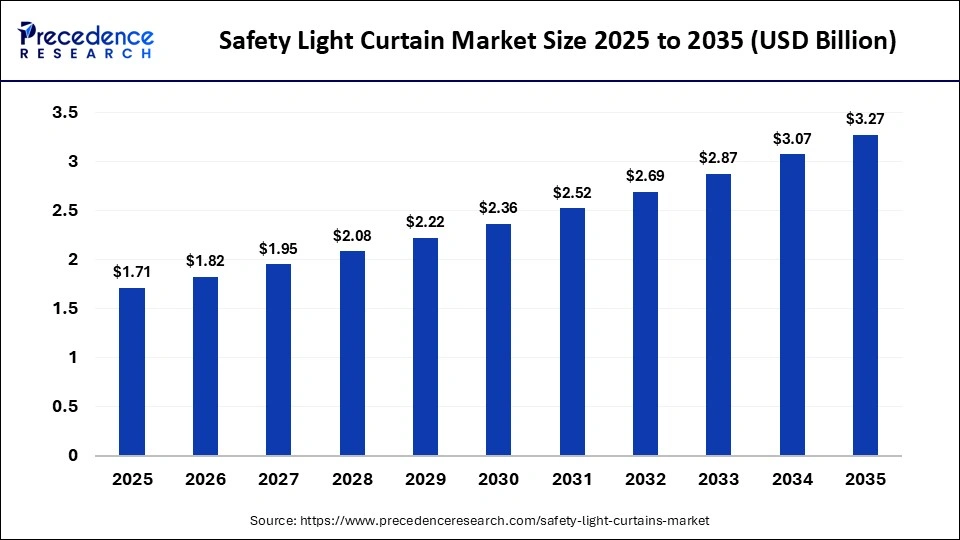
The global safety light curtain market size accounted for USD 1.71 billion in 2025 and is predicted to increase from USD 1.82 billion in 2026 to approximately USD 3.27 billion by 2035, expanding at a CAGR of 6.70% from 2026 to 2035
Key Takeaways
- Safety configuration: Machine guarding and perimeter guarding. Type 2 for lower-risk applications and Type 4 for higher-risk environments.
- Applications: Automated manufacturing, robotics, and material handling environments, with a focus on workplace injury risk reduction.
- Growth trends: North America shows dominant adoption, driven by strong industrial safety regulations and a strong presence of U.S. companies, including Rockwell Automation and Banner Engineering. Asia-Pacific is the fastest-growing market, supported by automation expansion in China and India, along with technology leadership from Japanese firms such as Keyence and Omron.
Where It All Began?
The evolution of light curtains dates to the mid-20th century, when industries began searching for smarter ways to protect workers around hazardous machinery. In the early days, these systems were simple product-detection setups, using incandescent lamps aligned with corresponding light detectors.
A breakthrough came in 1951, when Erwin Sick introduced the first wooden prototype of a light curtain at the German Inventor and New Development Trade Fair in Munich, Germany. By the 1980s and 1990s, rapid advancements in electronics and sensor technology gave these systems a serious upgrade, transforming them into more sophisticated and reliable safety solutions.
As the new millennium arrived and automation started taking over factory floors, safety light curtains also evolved, adding advanced diagnostics and connectivity features that allowed seamless integration with automated production lines. Today, they stand at the forefront of industrial safety, combining robust protection with IoT connectivity and AI-driven predictive maintenance. Over the last 25 years, what once started as a niche machine-safety solution has grown into a widely used technology across diverse industrial environments.
Multi-Layer Protection Architecture of Safety Light Curtains
When it comes to safety light curtains, the concept quietly branches into two protective approaches.
First comes the machine guard.
Think of it as a focused shield. Instead of covering the entire machine area, machine-guard light curtains protect the most hazardous zone, the exact spot where the risk of injury is highest. Their job is simple: guard the danger point.
Then there is the perimeter guard.
This one works a step earlier. Rather than protecting a specific machine part, perimeter-guard light curtains secure the entire access area around the machine, preventing anyone from even reaching the hazardous zone in the first place.
So while one protects the danger point, the other protects the path leading to it.
Now comes another layer of safety classification: Type 2 and Type 4. These two types represent different levels of protection depending on how risky the environment is.
Type 2 light curtains are designed for lower-risk applications. These systems typically protect against minor injuries, situations where the worst outcome might only require first-aid treatment. They generally offer hand and body protection and are more cost-effective.
Type 4 light curtains are where safety becomes far more sensitive. These systems are built for high-risk environments, where the possibility of severe injury exists. Their detection capability is extremely precise, so precise that even a finger passing through the beams can immediately stop the machine. These curtains act as a critical safeguard where accidents could otherwise lead to serious harm or hospitalization.
In simple terms, safety light curtains create a layer of protection. Where they are placed defines what they guard, and their type defines how sensitive that protection becomes.
Safety Light Curtain: Where Safety Meets Real Impact
Imagine an invisible line of defense on the factory floor. Instead of metal guards or physical barriers, this system creates an invisible wall of infrared light between workers and hazardous machinery. The moment something interrupts those beams, a tool, a hand, or even loose clothing, the response is immediate. The machine stops, and a potential accident is avoided.
And the results are not just theoretical. Many companies that have introduced safety light curtains report injury reductions of up to 70%. When workers know a smart safety layer is constantly watching over the workspace, their confidence naturally rises. A confident workforce focuses better, works faster, and productivity improves.On the factory floor, their role is crucial around moving parts, pinch points, and crush hazards, especially in situations where a machine could unexpectedly start during maintenance. In operations such as press machines, robotic cells, and assembly lines, these light-based barriers quietly stand between people and high-speed equipment.
But their usefulness doesn’t stop there. In material-handling environments such as conveyor systems and automated warehouses, light curtains help detect the presence of objects or personnel entering restricted zones. Packaging and sorting lines rely on them to verify whether products are present or missing as they move through the process.
Certain environments demand even tighter control. Clean rooms, laboratories, and hazardous zones use these systems to maintain controlled access. Around collaborative robots (cobots), they form protective zones that allow humans and robots to work side by side safely.
In some cases, these light barriers even act as virtual safety boundaries around workstations, helping maintain ergonomic movement and a well-defined, controlled workspace. Beyond traditional industry, the same technology appears in security systems to detect unauthorized entry, and even in interactive installations and gaming environments, where motion detection becomes part of the experience.
Mapping the Global Landscape of Safety Light Curtains
Around the world, innovation in safety and sensing technology is gaining strong momentum. Leading industrial technology companies, especially in North America, such as Rockwell Automation, Banner Engineering, Panasonic, Schindler, and Datalogic, are continuously advancing sensing technologies, automation systems, and industrial safety solutions. The U.S. market is supported by stringent regulations, high level of industrial automation, and large manufacturing and automotive sector.Europe remains a strong center for engineering and automation expertise. Germany, long known for its leadership in industrial technology and smart manufacturing, continues to contribute significantly to the development of advanced sensing systems and safety infrastructure. Meanwhile, the British Standards Institution has released a revised version of BS 8524, a long-awaited update to the UK’s definitive series for active fire curtain barriers, reflecting the ongoing evolution of safety standards and protective technologies.
Across the Asia-Pacific region, countries such as China and India are rapidly expanding their automation capabilities under Industry 4.0 initiatives supported by government policies and growing industrial infrastructure. At the same time, a digital-first distribution landscape is making advanced safety technologies more accessible to industries worldwide, accelerating adoption across manufacturing, logistics, and smart factory environments.
Future Outlook of Safety Light Curtains
So, what’s next for safety light curtains? Future safety light curtains are evolving to be smarter and more connected, enabling remote monitoring through mobile apps. These systems will not only trigger alarms when issues arise but also provide detailed explanations of problems, such as sensor dust or misalignments. Additionally, they will be designed for greater durability in challenging factory environments, able to alert operators about performance issues caused by oil, water, or dust. The overarching aim is to develop safety systems that are proactive and insightful.
In simple words, the goal is clear: safety systems that don’t just react but think ahead.
Conclusion
Safety light curtains have become an essential component of the modern industrial ecosystem, offering reliable protection without interrupting productivity. As industries adopt automation and smart manufacturing technologies, the need for advanced machine safeguarding solutions increases rapidly. Safety light curtains have undergone a revolution over the past decades, enhancing protection efficiency and disrupting various industrial sectors. By combining precision sensing with rapid response capabilities, safety light curtains help organizations maintain regulatory compliance, reduce workplace injuries, and create safer production environments.
Expert Advise
According to Precedence Research, the trend for safety light curtains is increasing with the rapid adoption of advanced technologies and automation in industries. Several sectors, such as automotive, manufacturing, packaging, electronics, and logistics, have adopted safety light curtains. In addition, other industries are increasingly adopting safety light curtains to ensure safety without reducing efficiency. Our experts suggest that investing in these intelligent safety systems is not just about meeting standards; it is about building a culture of safety while supporting efficient and uninterrupted operations.
About the Authors

Aditi Shivarkar
Aditi, Vice President at Precedence Research, brings over 15 years of expertise at the intersection of technology, innovation, and strategic market intelligence. A visionary leader, she excels in transforming complex data into actionable insights that empower businesses to thrive in dynamic markets. Her leadership combines analytical precision with forward-thinking strategy, driving measurable growth, competitive advantage, and lasting impact across industries.



Aman Singh
Aman Singh with over 13 years of progressive expertise at the intersection of technology, innovation, and strategic market intelligence, Aman Singh stands as a leading authority in global research and consulting. Renowned for his ability to decode complex technological transformations, he provides forward-looking insights that drive strategic decision-making. At Precedence Research, Aman leads a global team of analysts, fostering a culture of research excellence, analytical precision, and visionary thinking.

Piyush Pawar
Piyush Pawar brings over a decade of experience as Senior Manager, Sales & Business Growth, acting as the essential liaison between clients and our research authors. He translates sophisticated insights into practical strategies, ensuring client objectives are met with precision. Piyush’s expertise in market dynamics, relationship management, and strategic execution enables organizations to leverage intelligence effectively, achieving operational excellence, innovation, and sustained growth.