






 Request Consultation
Surface roughness measurement plays a crucial role in determining product performance, durability, and reliability. This blog explores key parameters, measurement methods, and real-world applications across industries. Discover how precision surface analysis drives modern manufacturing and innovation.
It seems like you can see a surface at first glance that is perfect, but on scrutiny, there is a tangled landscape of nuances and minutiae. The measuring of roughness here goes beyond a test; it is a carefully applied act of interpretation.
Every surface tells a subtle story that is not transparent; it’s not flashy on display, but it has a subtle effect on usefulness, durability, and resilience. When you skim smooth steel and engineered implants with your fingers or push glass in a smartphone screen to hold what you see, you only get a tiny slice of reality. Underneath that physical experience is a complex topography of microscopic highs and lows. This is when roughness measurement begins, not as a mere tool but as a way to extract information that one wouldn’t otherwise see with the naked eye.
Surface roughness is usually dismissed as a matter of beauty, but it is an important aspect from which the properties of performance, such as durability, stability, and long-term reliability in industries as diverse as aerospace engineering, pharmaceutical manufacturing, and others, are determined. Even minute irregularities can drastically shift the level of friction, weaken the sealing capability, or hasten wear in subtly and financially burdensome ways.
What Exactly is Surface Roughness?
As surface roughness is the simplest way to define it, it is the minute deviations from a surface of a material that deviates from an even plane. These irregular changes are not defects in the classic sense; rather, they are just the typical byproducts of machining, polishing, coating, and exposure to environmental conditions.
No surface can be fully devoid of texture. These microscopic undulations due to mechanical forces, thermal stresses, and inherent material properties can occur even in materials that have been very highly refined. This means you focus less on whether these exist and more on how significant they are, their distribution, and their effect.
To understand roughness in such a bigger sense, it is useful to take into account the wider parameters of surface texture, including:
- Form - the overall shape or geometry
- Waviness - medium-scale deviations
- Roughness - fine and high-frequency irregularities
Concerning these elements, roughness is one of the most sensitive factors for manufacturing practices; it is crucial in functional interactions.
What is the Surface Roughness Measurement Market Size in 2026?
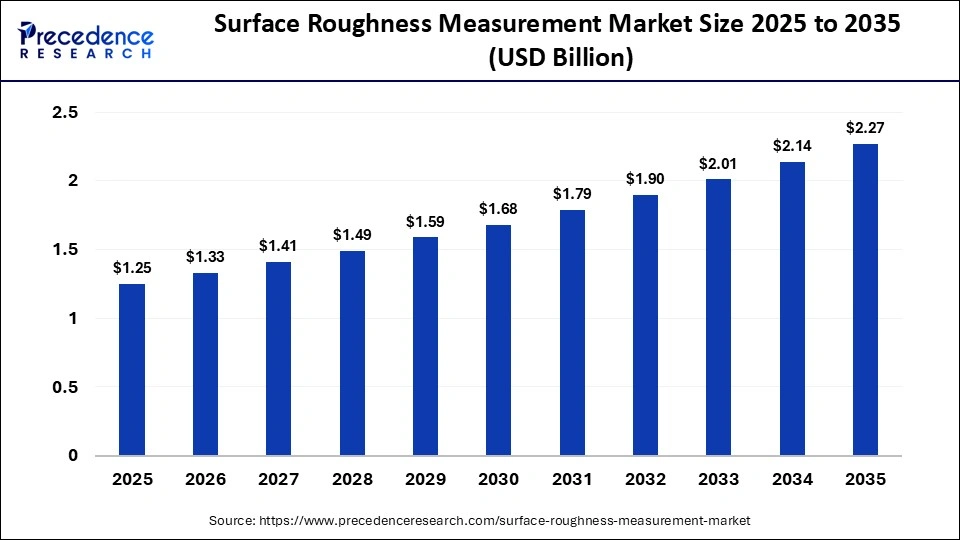
The global surface roughness measurement market was valued at USD 1.25 billion in 2025 and is projected to grow from USD 1.33 billion in 2026 to approximately USD 2.27 billion by 2035, registering a CAGR of 6.13% during the forecast period from 2026 to 2035. The growth is driven by increasing adoption of non-contact measurement technologies, advancements in semiconductor manufacturing, stricter international quality standards, and rising use of surface metrology systems in automated production environments.
Get a Free Sample Report with Key Market Trends: https://www.precedenceresearch.com/sample/8232
Why Surface Roughness Measurement Matters More Than It Appears
So, this is why roughness measurement is more important than ever. Surfaces are seldom inert; they come into interaction with fluids, other hard materials, heat, and sometimes even microbes. The quality of these interactions is greatly affected by roughness. Higher surface roughness will increase friction and result in faster wear and more energy dissipation. Besides, it may serve as a conduit for contaminant movement, and so the lubrication can be less effective, resulting in deteriorating sealing performance.
Conversely, excessively smooth surfaces can struggle for adhesion or coating retention. This is particularly important in drugs and biomedicine. Surface roughness directly influences drug delivery techniques, implant integration protocols, and sterility regulation. It affects fatigue resistance and contact dynamics in mechanical systems. This is why surface roughness is not only a measurement but also an essential piece of the overall performance.
Surface Roughness: Key Parameters
While there are many metrics available in the field, multiple methods have been developed as common denominators in the field, including standard references:
- Ra (Average Roughness): Ra is the mean distance from an established mean line, or the average, between a surface profile and a mean line. Although it is widely popular since it is simple, it tends to neglect peaks of maximum height or maximum valley.
- Rz (Maximum Height): The maximum range distance between the top peak and the minimum height of the bottom valley, Rz, is the distance from top to bottom in terms of the measuring length of the sampling point.
- Areal Parameters: Modern assessments often go beyond linear profiles to probe entire surface areas for increased understanding of surface behavior.
- Methods of Surface Roughness Measurement
The means of measurement of surface roughness show advancements in technology and attributes of the studied surfaces. In general, these measurement methods are classified into two types
Contact Methods (Stylus Profilometry)
In the traditional process, a fine stylus is transmitted over the surface to produce vertical displacements, which give a profile of that surface.
Advantages:
- High precision
- Well-estimated standards
- Economical
Disadvantages:
- Potential risk of damaging softer material
- Slower operation speed
- Limited to linear measurement
Non-Contact Methods (Optical and Advanced Techniques)
Modern industrial environments favor non-contact techniques using light, lasers, or interferometric applications to investigate surfaces without direct contact. Other common methodologies include the following.
Common approaches include:
- Optical profilometry
- Laser triangulation
- Interferometry
- Microscopy-based methods
Microscopy-based techniques allow for faster data collection and do not need physical contact with the surface, so they can be considered for sensitive or high-precision use. However, they often require larger expenses and an increased complexity relative to contact methods.
Choosing a Measure and Methodology
The selection of a roughness measurement method is more based on specific factors than on the self. Important parameters are the type of material used, the degree of precision required, and its application.
- Rigid and resilient surfaces will mostly fit well with the use of stylus-based methodologies.
- Delicate or soft materials would require non-contact methods to avoid damage.
- Intricate shapes are best evaluated with optical scanners.
- Automation of the measurement system helps in high-volume production.
Finally, in this regard, there is no single way to solve the problem, but finding the appropriate balance between the implementation method and technical requirements is key to success.
Interpreting Measurements
Data collection is the first step that requires the interpretation of the data to truly understand it. For instance, one value of Ra may indicate a polished surface, but miss out on sharp peaks that might manifest as wear and tear.
But even at a higher roughness, it may remain effective when lubrication is adequately maintained. This is why engineers often couple multiple parameters with visual assessments. Surface roughness goes beyond numbers to a pattern demanding contextual understanding.
Applications Across Industries
- Manufacturing and Engineering: Surface roughness in manufacturing determines how the components will fit together and last a long time based on the surface roughness assessment. It affects tolerance levels, wear characteristics, resistance to fatigue, and influences whether a part performs reliably or fails prematurely, long after the precision environment of production is taken out of the context.
- Automotive and Aerospace: In the automotive and aerospace industries, surface roughness significantly affects performance in subtle ways. It influences airflow across components, friction within moving parts, and the overall durability of elements that are subjected to stressors such as heat and continuous mechanical action.
- Electronics and Optics: Even small deviations in surface roughness can undermine the functionality of electronics and optical system components at fine spatial scales. Such differences can scatter light or impair signal transmission while reducing efficiency; for this reason, control over the surfaces is more about maintaining micro-level precision rather than merely achieving aesthetic finishes.
- Biomedical and Pharmaceutical: Surface roughness is essential in the biological and pharmaceutical domains, as it defines the relationship between materials in the context of biomedical systems. It can influence cell adhesion patterns, drug delivery mechanisms, and sterility considerations, even small differences that exert an important influence beyond the material properties.
Emerging Trends in Surface Roughness Measurement
- 3D Surface Metrology: The discussion concerning surface roughness is transitioning from line scans to whole surface measurements, thereby allowing the detection and analysis of entire regions. That change allows people to be informed, in other words, about not just differences but the relationship between peaks and valleys, where performance effects can be revealed that one trace could never explain.
- Integration with Automation: From being a mere step in a manufacturing process, measurements of roughness are directly relevant to the process itself. Surfaces are monitored as machines move, and insights may be given in real time that allow minor adjustments while materials undergo shaping.
- AI and Data Analytics: The impact of roughness measurement means that the outcome from raw material is moving from mere reports and backups to dynamic archives of information. AI is now capable of identifying patterns between batches and timeframes, interpreting feels much more organic and not mechanical. That is to say, the actual data itself can acquire its own mode of narration.
- Nano-Scale Measurement Techniques: As industries progress towards microscopic dimensions, there is a growing demand for accurate roughness measurements in which even atomic-level variations have grave consequences. Parts once thought trivial are now vital, especially in industries where surface properties at tiny scales dictate total effectiveness.
Surface Roughness Measurement in the Age of Precision
We are moving into a time in which surfaces are engineered, not just shaped but designed at microscopic scales. Surface roughness has gone from an incidental trait to an adaptive asset that can be manipulated, optimized, occasionally even used as a strategic asset. It plays a crucial role in the biological engineering of how tissues integrate with implants. Such a shift from pure measurement to active manipulation is a paradigm shift in our understanding of surfaces.
Practical Considerations for Implementation
Some important principles that organizations should take into account in their efforts to improve their practices of measuring roughness include:
- Define what functions need to be fulfilled before choosing parameters
- Choose specific measurement procedures to suit individual substances and uses
- Standardize for consistency in measures
- Make good use of data without making things unnecessarily complex
The Future of Surface Roughness Measurement
It is anticipated that the development of roughness measurement is also dependent on the implementation of different technologies, fields, and dimensions. Optical equipment will likely become more widely available, AI-based analysis will potentially become simpler, and measurement processes will evolve as a part of the manufacturing process.
But the most telling change might take place at a conceptual level. Instead of being considered an afterthought or as yet another quality review in manufacturing, roughness will be incorporated into the design strategy at the beginning stages of the development process.
Expert Advise
Our research concludes that surface roughness measurement is no longer a quality control parameter; it is a critical determinant of product performance, durability, and compliance. Industrial sectors, such as automotive, aerospace, semiconductors, and medical devices, need precise measurement of surfaces, and even minute changes in surfaces can impact friction, wear resistance, and functionality. The future of surface roughness measurement is driven by the increasing adoption of automation, 3D nanoscale metrology, and the use of other digital tools. The shifting trend towards precision manufacturing is encouraging investors to invest heavily in measurement methods for surface roughness.
About the Authors

Aditi Shivarkar
Aditi, Vice President at Precedence Research, brings over 15 years of expertise at the intersection of technology, innovation, and strategic market intelligence. A visionary leader, she excels in transforming complex data into actionable insights that empower businesses to thrive in dynamic markets. Her leadership combines analytical precision with forward-thinking strategy, driving measurable growth, competitive advantage, and lasting impact across industries.



Aman Singh
Aman Singh with over 13 years of progressive expertise at the intersection of technology, innovation, and strategic market intelligence, Aman Singh stands as a leading authority in global research and consulting. Renowned for his ability to decode complex technological transformations, he provides forward-looking insights that drive strategic decision-making. At Precedence Research, Aman leads a global team of analysts, fostering a culture of research excellence, analytical precision, and visionary thinking.

Piyush Pawar
Piyush Pawar brings over a decade of experience as Senior Manager, Sales & Business Growth, acting as the essential liaison between clients and our research authors. He translates sophisticated insights into practical strategies, ensuring client objectives are met with precision. Piyush’s expertise in market dynamics, relationship management, and strategic execution enables organizations to leverage intelligence effectively, achieving operational excellence, innovation, and sustained growth.