






 Request Consultation
Surgical microscopy cameras are transforming modern surgery with enhanced visualization and precision. This blog highlights their role in minimally invasive procedures, digital operating rooms, and medical training. It also covers advancements like AI and 3D imaging shaping the future of surgical care.
The surgical microscopy camera is one of the key technologies propelling the significant change in modern surgery. Today's operating rooms differ greatly from those of ten years ago. Surgeons now employ high-resolution cameras, digital visualization tools, 3D imaging, and even artificial intelligence in addition to conventional optical microscopes to carry out intricate procedures with increased accuracy and safety. Modern operating rooms are increasingly equipped with surgical microscopy cameras, which help surgeons see more clearly, operate more precisely, and treat patients better.
This blog explores how surgical microscopy cameras are transforming the way surgeries are performed, revolutionizing hospital procedures, and shaping the future of healthcare with precision imaging and enhanced patient outcomes.
What is the Surgical Microscopy Camera Market Size in 2026?
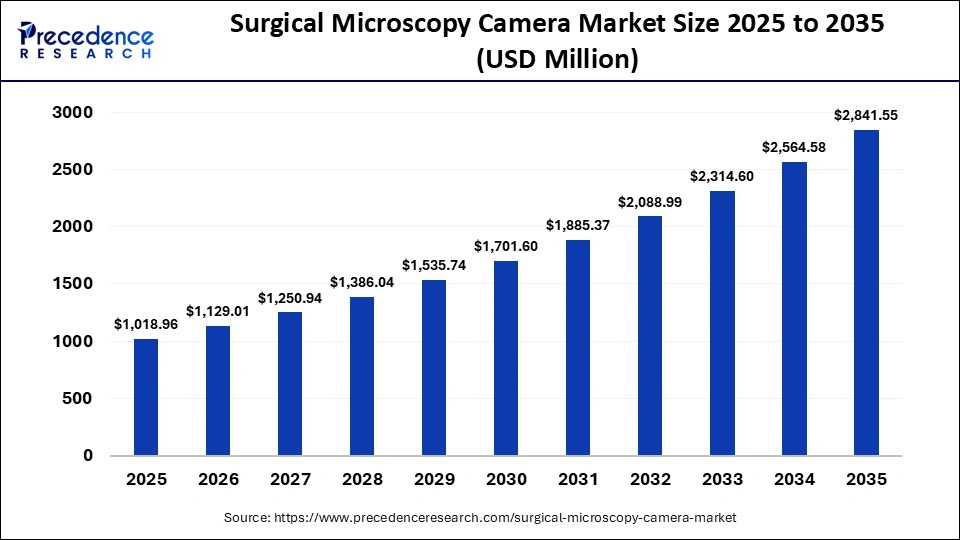
The global surgical microscopy camera market size was valued at USD 1,018.96 million in 2025 and is predicted to increase from USD 1,129.01 million in 2026 to approximately USD 2,841.55 million by 2035, expanding at a CAGR of 10.80% from 2026 to 2035. This market is growing due to an increasing number of minimally invasive surgeries and the rising demand for high-resolution imaging.
Get a Free Sample Report with Key Market Trends: https://www.precedenceresearch.com/sample/8242
What is a Surgical Microscopy Camera?
A surgical microscopy camera is a high-resolution camera attached to a surgical microscope that records and displays magnified images of the surgical site on monitors. These cameras allow surgeons to view tiny anatomical structures, such as blood vessels, nerves, and tissues, with exceptional detail. Previously, surgeons had to rely on looking through microscope eyepieces for extended periods, which was physically demanding and limited team collaboration. Today, surgical microscopy cameras project the surgical field onto large screens, enabling the entire surgical team to observe the procedure in real time and improving both accuracy and teamwork.
These cameras are widely used in:
- Neurosurgery
- Ophthalmology
- ENT surgery
- Spine surgery
- Dental microsurgery
- Plastic and reconstructive surgery
With surgeries becoming increasingly complex and minimally invasive, the demand for advanced surgical visualization systems is rising rapidly, driving innovation in high-resolution imaging technologies.
Tracing the Journey of Surgical Microscopy Cameras Through Time
Surgical visualization technology has come a long way over the years. While early systems relied on simple optical microscopes with basic cameras, modern surgical imaging now features Full HD, 4K, and even 3D imaging technologies. These advancements provide surgeons with unprecedented clarity, depth, and precision, transforming the way complex procedures are performed and improving patient outcomes.
Evolution of Surgical Microscopy Technology
| Generation | Technology | Features |
| First Generation | Optical Microscopes | Basic magnification, no recording |
| Second Generation | HD Cameras | Video recording and display |
| Third Generation | Full HD Cameras | Better resolution and image clarity |
| Fourth Generation | 4K Cameras | Ultra high-resolution imaging |
| Latest Generation | 3D & Digital Visualization | 3D imaging, AI integration, digital surgery |
How Surgical Microscopy Cameras Improve Surgical Precision?
Surgical microscopy cameras enhance precision in surgery by providing high-resolution, magnified images of the operative field, allowing surgeons to clearly see tiny anatomical structures such as blood vessels, nerves, and tissues. This detailed visualization reduces the risk of errors, supports delicate maneuvers, and enables more accurate surgical interventions. Additionally, projecting the surgical site onto monitors allows the entire surgical team to follow the procedure in real time, improving coordination, decision-making, and overall patient outcomes.
These cameras help surgeons:
- Identify tiny nerves and tissues
- Reduce surgical errors
- Perform minimally invasive procedures
- Improve hand-eye coordination
- Reduce surgery time
- Improve patient safety
For instance, in neurosurgery, where the brain and spinal cord are operated on, accuracy is crucial. Surgical microscopy cameras enable surgeons to see small structures with clarity and prevent damage to important areas.
Role of Surgical Microscopy Cameras in Minimally Invasive Surgery
Minimally invasive surgery is one of the most significant advancements in modern medicine, offering smaller incisions, less pain, shorter hospital stays, and faster recovery. These procedures rely heavily on advanced visualization rather than direct viewing, making surgical microscopy cameras essential.
In minimally invasive surgeries:
- Cameras provide magnified, high-resolution images.
- Surgeons operate efficiently using monitors instead of direct line-of-sight.
- Small, precise instruments are utilized.
- Tissue damage is minimized, protecting surrounding structures.
- Patients experience quicker recovery times.
Due to these benefits, hospitals are increasingly investing in advanced surgical visualization systems and microscopy cameras to improve outcomes and enhance surgical precision.
From Traditional to Digital: The Future of Operating Rooms
Surgical microscopy cameras have become a key component of digital surgery systems, which are increasingly standard in modern operating rooms. Many hospitals now utilize digital visualization platforms, projecting high-resolution images onto large 3D monitors instead of relying on traditional microscopes, improving precision, team collaboration, and overall surgical outcomes.
These systems allow:
- Surgeons to operate while looking at screens
- Surgical procedures to be recorded
- Remote consultation and telemedicine
- Training for medical students
- Better collaboration among surgical teams
Digital operating rooms improve workflow efficiency and allow hospitals to integrate imaging systems, patient data, and surgical recordings into one platform.
Smart Surgery: The Role of AI in Modern Microscopy Cameras
Future surgical microscopy cameras are expected to be profoundly enhanced by artificial intelligence. By analyzing surgical images in real time and providing guidance during procedures, AI can assist surgeons in making faster, more accurate decisions, improving precision, reducing errors, and enhancing patient outcomes.
In the future, AI may help with:
- Identifying tissues and nerves
- Highlighting critical structures
- Detecting bleeding areas
- Providing surgical navigation guidance
- Recording and analyzing surgical procedures
- Training surgeons using recorded data
AI-based surgical visualization systems will reduce surgical risks and improve outcomes.
Benefits for Hospitals and Surgeons
Surgical microscopy cameras benefit not only surgeons but also hospitals and patients, enhancing surgical precision, improving workflow efficiency, and contributing to better overall outcomes and patient safety.
Benefits for Surgeons
- Better visualization
- Improved posture (no need to investigate eyepieces)
- Reduced fatigue
- Higher surgical accuracy
- Ability to record surgeries
Benefits for Hospitals
- Advanced operating rooms
- Better training and education
- Ability to record and store surgeries
- Improved patient outcomes
- Increased hospital reputation
Benefits for Patients
- Safer surgeries
- Smaller incisions
- Faster recovery
- Less pain
- Shorter hospital stay
Exploring the Role of Surgical Microscopy Cameras in Different Surgeries
Surgical microscopy cameras are utilized in a variety of procedures that call for extreme magnification and precision. These cameras make it easier for surgeons to see minute anatomical details, which is crucial for delicate procedures. Surgical microscopy cameras are used by various medical specialties for various purposes, but the primary objective is always to increase surgical accuracy and visualization.
Surgical microscopy cameras are used in neurosurgery to perform operations on the brain and spinal cord, where even a minor error can result in major harm. These cameras aid in the precise execution of corneal, retinal, and cataract surgeries by ophthalmologists. Microscopy cameras are used by ENT surgeons to perform ear, nose, and throat surgeries, particularly those that involve the inner ear. These cameras aid dentists in performing more precise gum and root canal procedures in dental microsurgery. Surgical microscopy cameras are becoming indispensable tools in contemporary hospitals due to their many uses.
Role of Surgical Microscopy Cameras in Medical Training and Education
The use of surgical microscopy cameras in medical education and training is another significant benefit. It used to be challenging for students and assistant surgeons to watch the procedure because only the primary surgeon could see the surgical field through the microscope eyepiece. Surgical microscopy cameras, on the other hand, enable medical students and trainee surgeons to witness surgeries in real time by displaying the entire process on large monitors.
Microscopy cameras are now used by hospitals and medical schools to record surgeries, which are then used for instructional and training purposes. Students can learn more about anatomy, comprehend surgical techniques, and study actual surgical procedures. This raises the standard of medical education and aids in the development of future surgeons. Additionally, surgical documentation, case studies, and research can benefit from surgical video recording.
Comparison: Traditional Microscope Vs Digital Surgical Visualization System
| Feature | Traditional Surgical Microscope | Digital Visualization System |
| Viewing Method | Eyepiece | Monitor Screen |
| Surgeon Posture | Fixed posture | Comfortable posture |
| Image Quality | Optical | HD/4K/3D Digital |
| Recording | Limited | Easy Recording |
| Training | Limited viewing | Multiple viewers |
| Collaboration | Difficult | Easy team collaboration |
| Integration | Limited | Can integrate with digital systems |
| Future Technology | Limited | AI and AR integration is possible |
This comparison clearly shows that digital visualization systems and surgical microscope cameras are the future of operating rooms.
Why Demand for Surgical Microscopy Cameras Will Continue to Grow
In the coming years, the demand for surgical microscopy cameras is expected to increase significantly. This is mainly due to the rising number of surgeries, the growing popularity of minimally invasive procedures, advancements in imaging technology, and expanding healthcare infrastructure in developing countries. To improve patient care and surgical outcomes, hospitals are increasingly investing in advanced surgical equipment and digital operating rooms, making surgical microscopy cameras an essential tool for modern healthcare.
Expert Opinion
According to our industry experts, surgical microscopy cameras represent a strategic investment for hospitals and healthcare providers seeking to enhance operational efficiency, surgical precision, and patient outcomes. The increasing adoption of minimally invasive procedures and digital operating rooms is driving demand for high-resolution imaging systems that support better decision-making and reduce procedural risks. These cameras not only improve surgical accuracy but also facilitate team collaboration, training, and documentation, making them an essential component of modern surgical suites.
For medical device manufacturers, the growing need for advanced visualization systems creates opportunities to innovate with AI integration, 3D imaging, and compact designs tailored for specialty surgeries. Additionally, healthcare facilities can leverage surgical microscopy cameras to differentiate their services, attract high-value patients, and justify premium pricing for advanced procedures. As emerging markets expand their healthcare infrastructure, the demand for these cameras is expected to grow over the next decade.
Final Thoughts
By offering high-resolution visualization, enhancing surgical accuracy, and facilitating minimally invasive procedures, surgical microscopy cameras are revolutionizing contemporary surgery and operating rooms. Advanced surgical visualization systems and digital operating rooms are increasingly relying on these cameras. The integration of robotic surgery, 3D imaging, and artificial intelligence makes surgical microscopy cameras appear to have a bright future.
Surgical microscopy cameras will be essential to increasing patient care, lowering risks, and improving surgical results as hospitals continue to use digital surgical technologies. Surgical microscopy cameras will play a key role in the future of surgery, which will be more digital, precise, and technology-driven.
About the Authors

Aditi Shivarkar
Aditi, Vice President at Precedence Research, brings over 15 years of expertise at the intersection of technology, innovation, and strategic market intelligence. A visionary leader, she excels in transforming complex data into actionable insights that empower businesses to thrive in dynamic markets. Her leadership combines analytical precision with forward-thinking strategy, driving measurable growth, competitive advantage, and lasting impact across industries.



Aman Singh
Aman Singh with over 13 years of progressive expertise at the intersection of technology, innovation, and strategic market intelligence, Aman Singh stands as a leading authority in global research and consulting. Renowned for his ability to decode complex technological transformations, he provides forward-looking insights that drive strategic decision-making. At Precedence Research, Aman leads a global team of analysts, fostering a culture of research excellence, analytical precision, and visionary thinking.

Piyush Pawar
Piyush Pawar brings over a decade of experience as Senior Manager, Sales & Business Growth, acting as the essential liaison between clients and our research authors. He translates sophisticated insights into practical strategies, ensuring client objectives are met with precision. Piyush’s expertise in market dynamics, relationship management, and strategic execution enables organizations to leverage intelligence effectively, achieving operational excellence, innovation, and sustained growth.