






 Request Consultation
Introduction to the Global Application Development Software Market
The application development software market exists to offer organizations with the specialized tools, frameworks, and then environments necessary to turn complex business needs into functional digital products. Without this dedicated market, enterprises would face insurmountable technical debt, platform fragmentation, along with manual bottlenecks. Digital transformation, cloud-native development, DevOps adoption, AI-assisted coding, low-code or no-code platforms, and enterprise modernization drive market expansion by accelerating product delivery, cutting operational costs, and even bridging developer skill gaps. Together, these forces remove traditional engineering bottlenecks and enable organizations to scale applications instantly.
Leading application development software is dominated by hyperscalers, enterprise low-code pioneers, and DevSecOps leaders such as Microsoft, OutSystems, and GitLab. Their strategies center on AI-assisted coding, cloud-native scalability, and even bridging the gap for citizen developers. Microsoft Azure, along with Google Cloud, dominates by blending robust developer IDE environments directly with AI model deployment and infrastructure-as-a-service.
Understanding the Evolution of the Application Development Software Industry
Application development has evolved from rigid, linear engineering into AI-driven, cloud-native, and DevSecOps-driven environments. Organizations now depend on integrated developer platforms to speed up delivery, boost productivity, along with scale digital transformation. Automated CI or CD pipelines combined with AI-driven testing reduce build times and remove manual configuration bottlenecks. Automated security scans such as SAST, DAST, and container analysis, are shifted left into early development stages, enabling code to be validated and patched continuously rather than during delayed audits.
Enterprise Digital Transformation Fueling Software Development Demand
Organizations invest in application development platforms to break down rigid legacy silos, deploy cloud-native tools, alongside launch real-time digital services. They do this by adopting microservices, open APIs, and even automated workflows to cut maintenance costs and speed up user interactions.
Application Development Software Market Size and Forecast 2025 to 2035
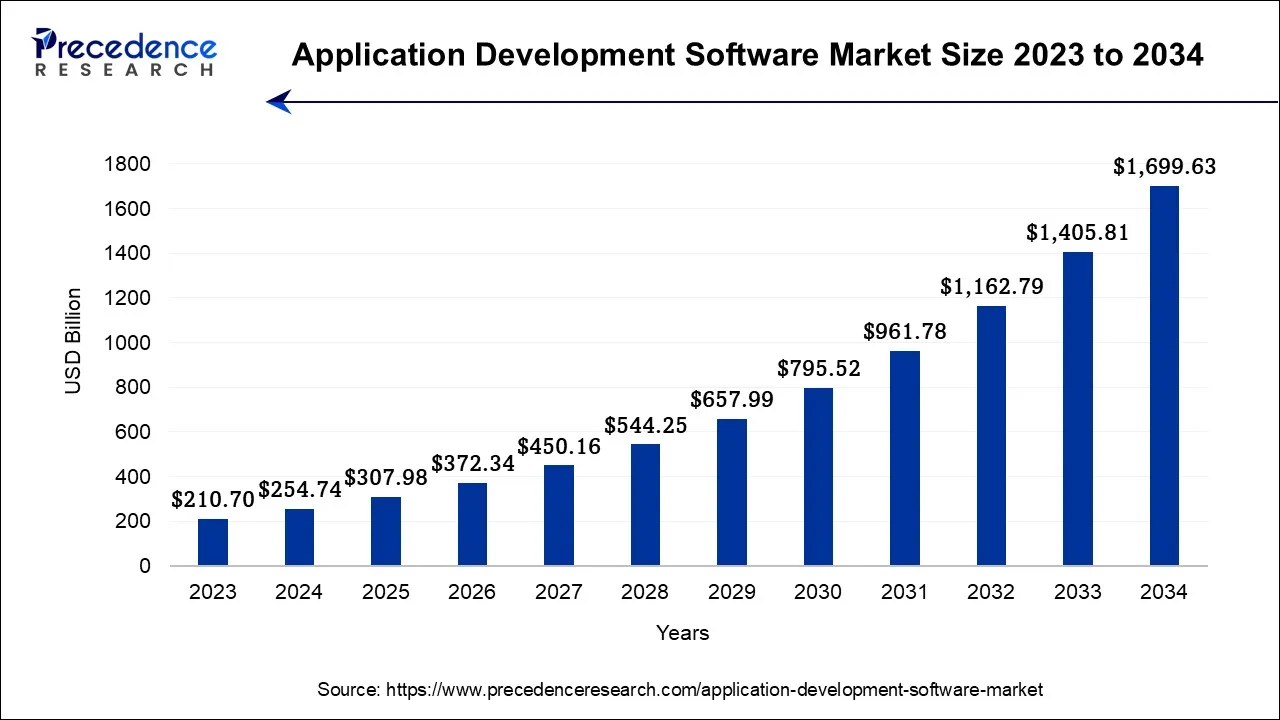
The global application development software market was valued at USD 307.98 billion in 2025 and is projected to grow from USD 372.34 billion in 2026 to USD 1,959.58 billion by 2035, registering a CAGR of 20.33% during the forecast period from 2026 to 2035. This growth is primarily driven by the accelerating pace of digital transformation across industries worldwide.
Get a Free Sample Report with Key Market Trends: https://www.precedenceresearch.com/sample/3280
Top Companies in the Application Development Software Market
Leading companies such as Microsoft, Oracle, and then IBM shape the global application development software industry by offering cloud platforms, AI-driven tools, and also enterprise ecosystems. They compete by delivering integrated development environments.
Microsoft
Microsoft has established a dominant, market-leading position in the software development industry by weaving its disparate platforms, low-code utilities, IDE environments, cloud frameworks, and DevOps engines into a cohesive, AI-accelerated ecosystem. It modernized into a high-performance, open-source, and also cross-platform framework specifically optimized for containerized cloud deployment.
Oracle Corporation
Oracle’s application development strategy is built on a highly integrated approach that bridges high-performance data architecture with flexible developer choices. Oracle allows an architecture where Oracle APEX, Java, Oracle Cloud Infrastructure (OCI), and even advanced database integration work seamlessly together to power enterprise application platforms.
IBM
IBM’s enterprise application development strategy centers on a unified hybrid cloud ecosystem powered by Red Hat OpenShift, integrated AI, along with advanced automation. By combining its infrastructure heritage with Red Hat's open-source innovations, IBM enables organizations to build, deploy, and also modernize applications seamlessly across any cloud environment.
Salesforce
Salesforce's ecosystem is a complete enterprise technology suite anchored by the core Salesforce Platform, the UI-accelerating Lightning Platform, along with MuleSoft integration tools. It unifies low-code app creation, AI-driven customization, and even automated workflows to connect siloed data across cloud environments.
SAP SE
SAP Business Technology Platform (BTP) serves as the unified, multi-cloud foundation for modern enterprise application development, integration, along with automation. It allows organizations to execute an agile, cloud-native application strategy by changing innovation and customization out of the core ERP, thereby allowing faster upgrades and lower maintenance costs.
ServiceNow
ServiceNow's App Engine is a core component of the ServiceNow AI Platform, enabling companies to build, scale, and even deploy enterprise-grade custom applications. It acts as a bridge between professional software engineers along with business-side "citizen developers". It consolidates artificial intelligence, low-code innovation, and deep integration frameworks onto a single, cross-departmental platform.
OutSystems
OutSystems maintains a dominant market leadership across high-performance low-code application development, AI-assisted development, enterprise modernization, cloud deployment, and digital transformation initiatives.
Mendix (Siemens)
Mendix is a comprehensive enterprise low-code platform, thus featuring integrated application lifecycle management, industrial digitalization support through Siemens, and cloud-native deployment. It also involves AI-assisted development tools and extensive integration capabilities.
Appian
Appian is a unified enterprise platform combining process automation, a low-code visual environment, along with intelligent business process management (iBPM). It connects people, robotic process automation (RPA), data fabric, and even private AI capabilities to build complex, secure end-to-end workflows.
Google Cloud
Google Cloud’s application development ecosystem offers a highly unified, secure, and production-ready toolkit programmed to build, manage, and scale intelligent, cloud-native applications. By weaving together infrastructure management, full-stack serverless capabilities, robust API lifecycles, and leading-edge artificial intelligence, the ecosystem addresses the entire spectrum of developer and enterprise needs.
Amazon Web Services (AWS)
AWS's software development ecosystem blends serverless computing, automation, along with AI integration to accelerate building applications. Core pillars involve AWS Amplify, AWS CodePipeline, and AWS Lambda, backed by generative AI assistant tools such as Amazon Q for developer productivity.
Atlassian
Atlassian offers an integrated enterprise development platform anchored by Jira for agile project management, Bitbucket for code management and CI or CD, and Confluence for collaborative documentation. These tools combine with Compass to form a complete DevOps ecosystem.
Competitive Landscape of the Application Development Software Market
The enterprise software and cloud market is heavily concentrated among three leading hyperscalers and application giants: Amazon Web Services (AWS), Microsoft Azure, along with Google Cloud, closely followed by application leaders such as Salesforce and Oracle. These companies compete across intelligence layers, infrastructure, and developer experience. Operate as application-to-infrastructure leaders; Oracle aims heavily on high-performance database cloud workloads, meanwhile Salesforce dominates customer relationship management (CRM) architectures.
Comparison Based on Product Portfolio
Companies categorize, select, and also evaluate modern technology providers based on these specific ecosystem layers because they directly control the speed, cost, along with risk of delivering digital software products. Industry analysts such as Gartner and Forrester group these capabilities together as modern software development is no longer isolated; it requires a tightly unified, end-to-end framework.
Comparison Based on Artificial Intelligence Capabilities
AI technologies are fundamentally changing software engineering by shifting the developer's role from manual syntax writing to high-level architectural design. Human engineers save time looking up external API documentation or libraries, enabling them to remain deeply immersed in active problem-solving. Machine learning models quickly draft edge cases, unit tests, along with integration flows that manual testers often miss.
Comparison Based on Enterprise Adoption
Customer adoption of modern digital solutions along with cloud solutions across diverse sectors is driven by cost reduction, operational scalability, along with security compliance. Different organizations accept these technologies to meet distinct operational goals. Integrate prebuilt capabilities and standardized data interfaces to rapidly deliver updates and even scale offerings.
Market Share and Industry Leadership Analysis
Mendix, Microsoft, and OutSystems lead the application development software market by combining robust enterprise reach, massive developer adoption, along with deep cloud ecosystems. They operate on tiered user or app subscription models tied closely to overarching enterprise Microsoft 365 and Azure licensing agreements, thus amplified by a massive global reseller network.
Leaders in Enterprise Application Development
Dominant tech companies command enterprise software development by merging Amazon Web Services, Microsoft Azure, and even Google Cloud with robust developer tools and deep business applications. This unified approach locks enterprises into single tech stacks. Managed Kubernetes, serverless execution models, along with integrated databases let developers spin up production environments instantly without hardware constraints.
Leaders in Low-Code and No-Code Development
Vendors of low-code platforms simplify application development, accelerate deployment, reduce costs, along with support citizen developers by utilizing visual drag-and-drop tools, pre-built components, and even automated cloud management. These features replace manual coding with a graphical interface, which makes building software faster and easier for everyone.
Leaders in Cloud-Native Development
Cloud providers enable modern software by providing managed platforms and automated services that remove the burden of managing physical hardware. They offer elastic resources, integrated security tools, and also orchestration systems so developers can build and run scalable applications efficiently. Providers supply API gateways, service meshes, along with managed databases to let independent services communicate reliably and scale separately. Services such as AWS Lambda or Google Cloud Functions completely abstract servers away, running code on-demand with pay-per-use billing.
Growth Strategies Adopted by Leading Market Players (2025–2030)
Leading application development software firms are strengthening their market positions by embedding generative and agentic AI coding assistants, obtaining specialized cloud-native tech, expanding across global regions such as Asia-Pacific, scaling cloud infrastructure investments, and nurturing active developer communities. Shifting core development tools to scalable cloud frameworks that reduce hardware costs and support remote workforces.
Artificial Intelligence Integration Across Development Platforms
Investing in these six core areas of AI-based software engineering fundamentally transforms the Software Development Life Cycle (SDLC) from a manual, error-prone craft into a highly automated, predictive, along with scalable pipeline. Organizations invest in these technologies to achieve three high-level business goals: exponentially faster time-to-market, drastic cost reductions by removing technical debt, and the elimination of human-introduced bugs.
Expansion Through Strategic Acquisitions
Acquisitions assist companies in bypassing slow internal development by instantly adding specialized technology, engineering talent, as well as market share. They strengthen portfolios by filling specific operational gaps along with scaling modern digital platforms.
Cloud Platform and Ecosystem Expansion
Investments in cloud-native application services, partner networks, developer platforms, marketplace ecosystems, and integrated software development environments drive speed, scale, and efficiency by enabling faster innovation, decreasing operational complexity, and expanding market reach.
Product Innovation Transforming Application Development
Continuous product innovation drives modern software engineering by accelerating release cycles, embedding intelligent automation, along with unifying cross-functional workflows. It optimizes engineering capability via automated pipelines, AI tools, and elastic cloud architectures. Standardized cloud environments along with infrastructure abstraction layers minimize manual boilerplate setup and repetitive overhead. DevSecOps practices embed static analysis, secret scanning, and even automated policy checks early into every stage of the development lifecycle.
AI-Powered Code Generation and Developer Assistants
AI tools accelerate software development by automating repetitive tasks, augmenting developer decision-making, along with continuously determining the codebase across the entire lifecycle. By functioning as collaborative co-pilots, these tools change the human role from manual line-by-line drafting to architectural design and system orchestration.
Low-Code and No-Code Platform Innovation
The technology innovations described are Low-Code along with No-Code Development Platforms (LCNCDPs). These platforms abstract and automate the complex, manual tasks of traditional software engineering. This enables both professional software engineers and non-technical "citizen developers" to build applications rapidly. Complex business logic, automated steps, along with API backend integrations are mapped out visually like a flowchart. Cloud-native infrastructure handles compiling, environment configurations, along with continuous hosting via streamlined "one-click" pipelines.
DevSecOps and Automated Software Delivery
Innovations across these specific domains are essential as they eliminate the "integration hell" of manual development, accelerate market delivery, along with block security vulnerabilities before software ever reaches production. By replacing slow, error-prone human checkpoints with automated pipelines, organizations can scale their engineering efforts, lower operational costs, along with maintain highly resilient software systems. Checks open-source dependencies (SCA) and flags hardcoded API tokens or secrets automatically. Catching threats early decreases remediation costs, as fixing active production breaches is highly disruptive and expensive.
Strategic Partnerships and Ecosystem Development
Software vendors build broad ecosystems to scale efficiently, drive co-innovation, along with reduce market friction. No single firm possesses the reach, infrastructure, or specialized expertise to dominate complex global markets independently. They bridge the gap between raw software along with enterprise deployment by navigating complex procurement, customizing architecture, and driving digital transformation; cultivate future talent pipelines, build foundational technical literacy around the platform, along with foster localized research partnerships.
Partnerships with Cloud Providers
Collaborations supporting these modern pillars exist to decrease operational complexity, accelerate product delivery, along with mitigate vendor lock-in. No single tech provider has a monopoly on best-in-class tools, thus making partnerships essential for a seamless enterprise experience. Joint frameworks and cross-cloud interconnects let applications run smoothly across different vendor ecosystems, such as Amazon Web Services, Google Cloud, and Microsoft Azure, to prevent single-provider outages.
Enterprise Technology Alliances
Partnerships with ERP, CRM, cybersecurity, database, along with enterprise software vendors are essential to eliminate data silos, secure sensitive operations, and even reduce development time. These alliances offer pre-built connectors and unified architectures that single vendors cannot build alone.
Developer Community and Open-Source Collaboration
Investments in developer programs, such as Developer Relations (DevRel) education, open-source, and APIs, are vital because developers drive modern tech purchasing decisions, reject traditional advertising, along with create bottom-up product adoption. These pillars build trust, scale product ecosystems, and even turn users into long-term advocates. Hackathons and open-source contributions yield external integrations, bug fixes, along with features that internal roadmaps cannot build alone. Clean APIs and good documentation enable engineers to evaluate and integrate tools successfully at any hour.
Industry Applications Driving Market Growth
Organizations invest in application development software to modernize operations, improve customer experiences, automate workflows, and even accelerate digital transformation via cloud-native platforms, low-code tools, and AI-driven automation.
Banking, Financial Services, and Insurance (BFSI)
Financial institutions build secure digital systems by utilizing microservices architectures, zero-trust cloud security, and real-time AI monitoring. They integrate these core methods across platforms to protect user data, process payments safely, and even meet strict laws. They analyze typing speed, mouse movements, along with device details in milliseconds to spot account takeovers, and use secure infrastructure on platforms such as Azure for Financial Services or AWS FinSpace with strict data residency limits.
Healthcare and Life Sciences
Healthcare applications supporting these systems exist to enhance patient outcomes, streamline clinical workflows, and also reduce administrative burdens. They achieve this through core pillars such as enhanced data sharing, remote access, and automated intelligence.
Retail and E-Commerce
Application development supports modern retail by building scalable digital storefronts, synchronizing real-time data across channels, along with processing secure transactions. It connects front-end user experiences with back-end inventory, payments, and even analytics.
Manufacturing and Industrial Automation
Industrial applications support smart factories by using interconnected tech such as IoT platforms, predictive maintenance, and even digital twins to turn raw data into real-time actions. Moreover, these systems work together to stop machine breakdowns before they happen, thus making supply chains run smoothly and giving clear insights into daily factory work.
Government and Public Sector
Digital government initiatives, citizen services, along with e-governance platforms are adopted to enhance efficiency, increase transparency, and reduce corruption. They modernize public administration by changing manual processes online, saving operational costs, and even making it easier for citizens to access state resources.
Challenges Facing the Application Development Software Industry
Software vendors face heavy pressure from compounding technical along with market disruptions, led by increasing cybersecurity threats, AI governance demands, and even legacy system modernization. Navigating these hurdles demands balancing rapid feature delivery with rigorous risk control. Stricter international data laws, like GDPR and DORA, need continuous real-time monitoring and strict data mapping. Embedding autonomous AI agents introduces unmapped code dependencies, data leakage risks, along with exposure to regulations like the EU AI Act.
Vendors invest in automation, AI, and even cloud innovation to overcome technical debt, integration complexity, and the skills gap by deploying agentic workflows, thus expanding cloud-native infrastructure and integrating AI-driven development tools. Enterprises migrate legacy systems to elastic, API-first cloud platforms such as Infosys Cobalt to remove architectural bottlenecks and scale AI applications safely.
Managing Security Across Modern Applications
Organizations combine these methodologies to prevent catastrophic data breaches, remove costly late-stage code fixes, and then establish unbroken trust in modern, rapid software deployment pipelines. Modern software development moves too fast for traditional, perimeter-only defenses. Legacy processes which check security right before a product launches create massive development bottlenecks, delaying releases and leaving vulnerable software.
Addressing Developer Productivity Challenges
Organizations enhance software delivery by combining these five modern engineering pillars to accelerate time-to-market, reduce human error, and scale operational efficiency across the entire Software Development Lifecycle (SDLC). By changing engineering hours from mechanical grunt work to high-value architecture, these capabilities thus establish a faster and more predictable release pipeline.
Future Outlook for the Application Development Software Market (2025–2030)
Application development is transitioning to an AI-first paradigm, propelled by autonomous agents, cloud-native orchestration, and then platform engineering. Software engineering is shifting from manual coding to goal-directed system design and validation, unlocking hyper-efficient enterprise delivery and also new commercial models for vendors. Containerized microservices and Kubernetes infrastructure scale agentic workloads along with dynamic AI microservices seamlessly. Internal Developer Platforms now provision infrastructure for both humans and even non-human actors such as AI agents, with distinct scoped permissions and audit trails.
Generative AI Will Transform Software Engineering
AI technologies are converging to fundamentally change the developer's role from code writers to system orchestrators. Instead of spending hours writing boilerplate code, debugging stack traces, along with configuring pipelines, developers now focus on architecture, strategic guardrails, and validation. Integrated development environments (IDEs) use context-aware language models to auto-complete logic, convert natural language prompts into working modules, and thus write code documentation instantly. Developers skip the repetitive "boilerplate" phase. They act as code reviewers, validating generated snippets for security and also intent rather than building everything from scratch.
Cloud-Native Platforms Will Dominate Enterprise Development
Containerization, Kubernetes, platform engineering, serverless computing, hybrid cloud, and multi-cloud architectures form the bedrock of modern enterprise software, thus decoupling application logic from underlying physical infrastructure. Together, they deliver standardized portability, automated resource elasticity, and even reduced developer cognitive load.
Conclusion: Innovation, AI, and Cloud Technologies Will Shape the Future of Application Development
Leading enterprise technology giants are driving global innovation by converging AI-assisted development, low-code simplicity, cloud-native infrastructure, and proactive DevSecOps to fuel modernization. Software engineering has now evolved from simple code-completion tools into autonomous, agentic AI ecosystems which understand contextual requirements and entire software repositories. Security is no longer a slow check at the end of the deployment cycle; instead, AI-based automation embeds compliance and vulnerability checking into every commit. Atlassian was recognized as an industry leader in the Gartner Magic Quadrant for DevSecOps Platforms, thus, prioritizing collaborative platform engineering over isolated code generation.
Investing in intelligent platforms, integrated ecosystems, along with continuous innovation drives the global application development software market by leveraging generative AI integration, thus expanding cloud-based aPaaS frameworks, and accelerating agile deployment. This shift optimizes productivity and even defines competitive leadership. High deployment costs for enterprise-grade tooling can limit smaller company adoption, and even connecting diverse APIs, IoT frameworks, along with microservices architectures streamlines workflows.
About the Authors

Aditi Shivarkar
Aditi, Vice President at Precedence Research, brings over 15 years of expertise at the intersection of technology, innovation, and strategic market intelligence. A visionary leader, she excels in transforming complex data into actionable insights that empower businesses to thrive in dynamic markets. Her leadership combines analytical precision with forward-thinking strategy, driving measurable growth, competitive advantage, and lasting impact across industries.



Aman Singh
Aman Singh with over 13 years of progressive expertise at the intersection of technology, innovation, and strategic market intelligence, Aman Singh stands as a leading authority in global research and consulting. Renowned for his ability to decode complex technological transformations, he provides forward-looking insights that drive strategic decision-making. At Precedence Research, Aman leads a global team of analysts, fostering a culture of research excellence, analytical precision, and visionary thinking.

Piyush Pawar
Piyush Pawar brings over a decade of experience as Senior Manager, Sales & Business Growth, acting as the essential liaison between clients and our research authors. He translates sophisticated insights into practical strategies, ensuring client objectives are met with precision. Piyush’s expertise in market dynamics, relationship management, and strategic execution enables organizations to leverage intelligence effectively, achieving operational excellence, innovation, and sustained growth.