






 Request Consultation
What Is Agentic AI?
Enterprises Are Experimenting Fast, but Scaling Slowly
AI use is nearly universal at the surface, but the funnel narrows sharply once agentic AI has to move from pilot to production.
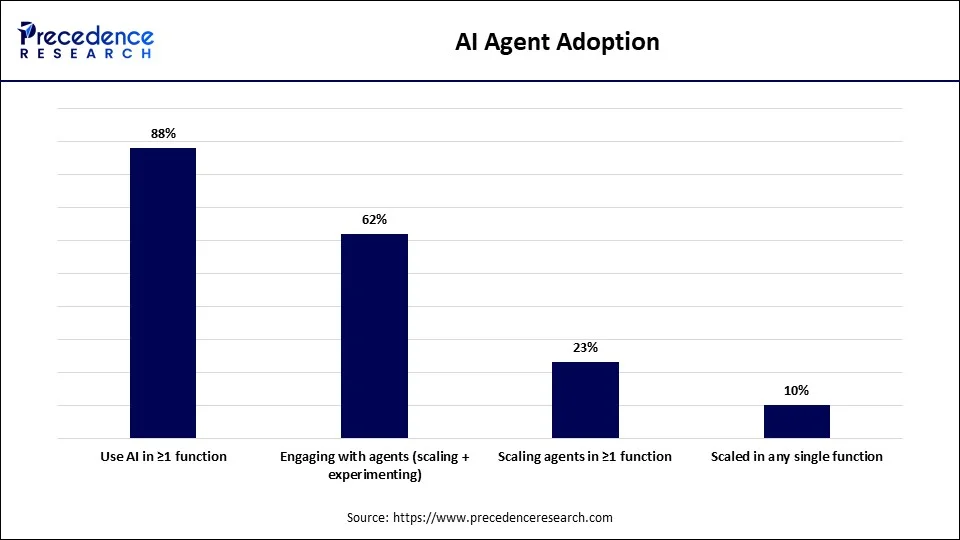
The data points reveal an "AI adoption paradox": while basic tool usage is nearly universal, true operational integration, along with advanced autonomous agents, remains stuck in early, localized phases. 88% of organizations regularly use AI in at least one business function (up from 78%). 62% of organizations are testing autonomous AI agents capable of handling multi-step workflows. Further, only 23% report actively scaling these agentic systems in at least one business function. Meanwhile, fewer than 10% of enterprises have now fully scaled AI agents in any single department or function.
Key insight: Most companies fail to scale agentic AI because a controlled pilot only tests a model's intelligence, while production demands fixing broken data foundations, complex legacy integrations, and an absence of organizational guardrails for autonomous decision-making.
Source: McKinsey, “The State of AI: Global Survey 2025,” QuantumBlack, November 2025
Nearly Half of Agentic AI Projects Won't Survive to 2027
Behind the hype cycle sits a sobering operational reality - escalating costs, unclear ROI, and weak risk controls are expected to kill a large share of current initiatives.
According to Gartner, over 40% of agentic AI projects face cancellation by 2027 because of exploding costs, vague business value, and weak risk controls. Over 60% of enterprise leaders scramble to implement autonomous frameworks, boosted by fear of missing out rather than solid architecture. Actual production deployment sits low at 17%, meaning the vast majority of initiatives are stuck in expensive proof-of-concept purgatory.
Key insight: Gartner attributes enterprise AI cancellations to an execution and verification gap rather than underlying model flaws. Firms treat AI as a plug-and-play tech upgrade instead of an operational overhaul, leading to uncontrolled expenses, unmanaged risks, and even unlinked P&L impact once systems scale past safe sandbox pilots.
Source: Gartner, Inc. press release, June 25, 2025; Gartner Hype Cycle for Agentic AI, 2026
Investment Confidence Is High, but Cautious
Most organizations are putting real money behind agentic AI, but the largest single group is hedging with conservative bets rather than going all-in.
This data comes from a January 2025 Gartner poll of 3,412 webinar attendees regarding organizational adoption and investment strategies surrounding agentic AI.
- 42% Conservative Investment: Organizations making minor, cautious, and tightly controlled financial commitments to agentic AI projects.
- 31% Wait-and-See or Unsure: Firms holding back to observe market maturity, vendor stability, and then proven use cases before committing funds.
- 19% Significant Investment: Early-mover enterprises deploying major capital along with actively scaling agentic AI capabilities.
- 8% No Investment: Companies with zero current financial allocation or interest in the space.
Key insight: They test small projects to see if they work before risking big money. Unclear returns on investment, messy data, along with a lack of internal skills, stop them from making a full financial commitment.
Source: Gartner poll of 3,412 webinar attendees, reported in Gartner press release, June 25, 2025
AI Infrastructure Now Absorbs Over Half of Global AI Spending
Before agents can act, someone has to build the compute they run on - and that build-out is where most of the world's AI dollars are going.
The total global spend on AI was $2.52T in 2026, representing an increase of 44% year-over-year. Of these, about $1.37 trillion (54%) was contributed to infrastructure, $588.6 billion (23%) was for services, and $452.5 billion (18%) was allotted to software. Thus, dominant capital expenditures in physical data centers, specialized chips, and power grids significantly exceed software and service revenues. This spending imbalance proves the tech sector remains focused on foundational capacity building rather than profitable application deployment.
Key insight: Infrastructure spending is higher because firms must first build the foundational hardware, data centers, and power grids before advanced software can run at scale. This heavy up-front investment is demanded to support future AI and cloud growth.
Source: Gartner Worldwide IT Spending Forecast, 2026
Agentic AI Funding More Than Doubled in a Single Year
Investors aren't just writing more checks- they're writing much bigger ones, signaling growing conviction in specific, workflow-critical agent applications.
Investors invested a total of $2.66 billion across 44 rounds from January 2026 to April 2026, resulting in an increase from $1.09 billion raised during January 2025 to April 2025. The average round size rose from $82 million in the first-half of 2025 to $155 million from Q4 2025 to Q1 2026. The venture capital landscape has bifurcated into a "K-shaped" market. Thus, overall funding volume falls to multi-year lows while massive sums concentrate in record-shattering mega-rounds for a tiny fraction of elite artificial intelligence companies. Round sizes swell even as general deal counts contract across the wider startup ecosystem.
Key insight: AI venture capital round sizes doubled and concentrated into fewer mega-deals because training frontier foundation models and even building data center infrastructure require billions in upfront compute. Furthermore, investors face a winner-take-all market, funneling massive checks to market leaders such as OpenAI and Anthropic while starving smaller startups.
Source: Unicorn Screener analysis of PitchBook/Crunchbase-sourced agentic AI deal data, May 2026
Salesforce's Agentforce: From Pilot to 2 Million Conversations
One of the largest CRM vendors' own deployment numbers offer a rare, verifiable look at what agentic AI does at real enterprise scale.
Salesforce’s Agentforce handled more than 2 million conversations since its launch in Q4 FY26. About 29,000 deals were closed with an autonomous resolution rate of 85%. Service cases resolved by AI are projected to rise from 30% in 2025 to 50% in 2027. Salesforce’s internal Agentforce deployment data thus reveals an 85% autonomous resolution rate for hundreds of thousands of customer support interactions, with hardly any human escalation required. This changes conversational AI from passive script-reading chatbots to active, end-to-end.
Key insight: Salesforce's Agentforce autonomously resolves routine interactions without human escalation because it uses dynamic reasoning rather than rigid scripts. It executes multi-step actions and then retrieves real-time context across enterprise data systems rather than just offering static FAQ links.
Source: Salesforce Q4 FY26 earnings release; Salesforce State of Service, 7th Edition, 2026
The Global Workforce Faces a Net Gain, Not a Net Loss - But the Transition Is Uneven
The headline number is positive, but it masks a harder reality: displaced and created roles rarely sit in the same industry, region, or skill bracket.
The World Economic Forum projects that 92 million jobs will be displaced and 170 million new roles will be created worldwide by 2030, yielding a net gain of 78 million jobs. This massive labor market shift is driven by artificial intelligence, green energy transitions, automation, and demographic changes.
Key insight: Global net job growth masks deep structural divides because new technology-driven roles need specialized technical skills that displaced workers usually lack, and job creation is concentrated in tech-heavy urban hubs or aging developed nations rather than developing regions with youth bulges.
Source: World Economic Forum, Future of Jobs Report 2025
Agentic AI ROI Remains the Exception, Not the Rule
Agentic AI slightly underperforms generative AI overall on measured ROI, even as most organizations report real friction adopting either technology.
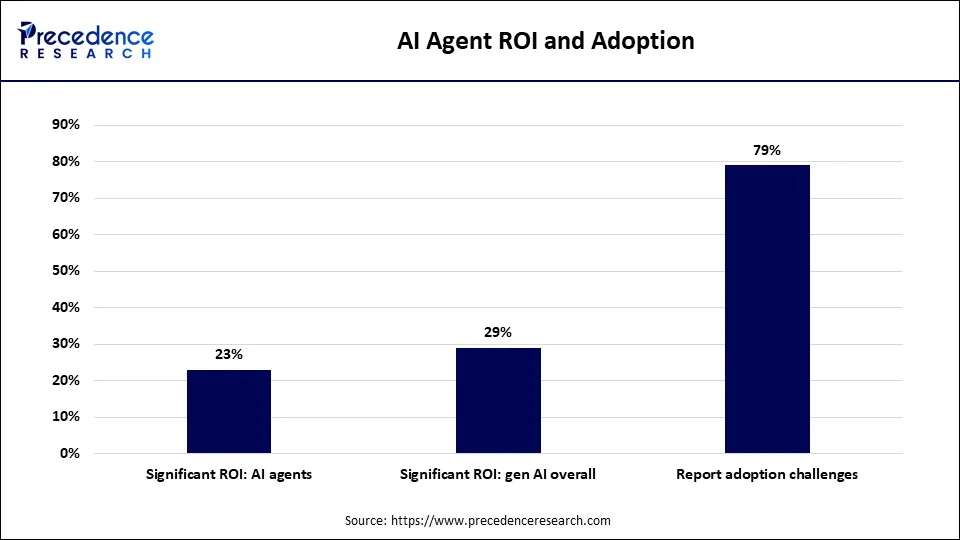
Only 23% of organizations report significant ROI from AI agents compared to 29% for generative AI, while 79% face adoption hurdles. This "adoption paradox" highlights that while individual users see massive productivity boosts, firms struggle to translate tool usage into broad organizational financial returns.
Key insight: Agentic AI shows lower initial ROI than basic generative AI because autonomous multi-step tasks require complex data integration, robust error handling, and rigid governance. Even though the core models are smart enough, companies struggle to scale the underlying systems, workflows, and infrastructure safely.
Source: Enterprise adoption statistics compiled from McKinsey State of AI (2025) and industry ROI surveys, 2026
Recent Developments
- In June 2026, Google unveiled Antigravity 2.0 at its developer conference, enabling orchestration of multiple agents working in parallel on a task; Google also started a $100/month AI developer subscription tier.
- In April 2026, Salesforce started Agentforce Operations, extending agentic automation into back-office processes across email, ERP, and even collaboration tools; in March 2026, it also launched Agentforce Contact Center.
- In March 2026, Microsoft extended its Agent Framework to the Go programming language, targeting cloud-native developers already utilizing Go for infrastructure tooling.
- In 2026, Meta Platforms launched Muse Spark 1.2 and its first coding agent, Muse Code, from Meta Superintelligence Labs. With this launch, Meta aims to compete with Anthropic’s Claude Code and OpenAI’s Codex.
- In June 2025, Gartner issued its widely cited forecast that over 40% of agentic AI projects will be canceled by the end of 2027, estimating that only about 130 of “thousands” of self-described agentic AI vendors provide genuinely agentic capability.
Key Companies and Organizations
| Company | Headquarters | Core business in agentic AI | Public information |
| Microsoft Corp. | Redmond, Washington, USA | Copilot Agents, Azure AI Foundry, Agent Framework | Emerged as a dominant industry standard in 2026 by unifying enterprise-grade infrastructure with multi-agent orchestration, and even recently expanded its capabilities to support the Go programming language for high-concurrency cloud environments. |
| Salesforce, Inc | San Francisco, California, USA | Agentforce (CRM-native AI agent platform) | Agentforce scaled rapidly by Q4 FY26, closing 29,000+ deals and even hitting $800M in ARR. This milestone, alongside millions of resolved conversations, earned Salesforce a Leader spot in the Gartner Magic Quadrant for Conversational AI Platforms for its debut year. |
| Anthropic | San Francisco, California, USA | Claude Code, Claude agent models | Completed a massive $13 billion Series F funding round, skyrocketing its post-money valuation to $183 billion, nearly tripling its worth from a $3.5 billion raise six months prior in March 2025 ($61.5 billion valuation). |
| OpenAI | San Francisco, California, USA | Operator, Codex, agentic ChatGPT tools | Closed a record-shattering $40 billion funding round contributed by SoftBank Group at a $300 billion post-money valuation, marking the largest private capital raise in corporate history. |
| Google/Alphabet Inc. | Mountain View, California, USA | Antigravity 2.0 multi-agent orchestration, Gemini agents | Announced Antigravity 2.0, expanding its original coding assistant into an independent, multi-agent orchestration platform. Alongside it, Google started a new $100/month AI Ultra subscription tier to support heavy agent execution limits, providing five times the capacity of the standard Pro plan. |
| IBM Corporation | Armonk, New York, USA | watsonx Orchestrate, enterprise agent governance | Being cited as a leading player across multiple agentic AI market reports means an organization consistently ranks in top quadrants for execution, vision, and even technology infrastructure by major analyst firms. |
| NVIDIA Corporation | Santa Clara, California, USA | AI infrastructure/compute underpinning agent workloads | AI agents need massive compute power as they use multi-step planning, reinforcement learning rollouts, and even test-time reasoning loops rather than single-pass generation. Specialized hardware, along with infrastructure providers such as NVIDIA, becomes a critical bottleneck and market leader for supplying high-bandwidth memory and clustered accelerators. |
| Meta Platforms, Inc | Menlo Park, California, USA | Muse Spark 1.2, Muse Code (coding agent) |
Muse Code, developed by Meta Superintelligence Labs under the leadership of Alexandr Wang. Programmed to compete directly with Anthropic's Claude Code and even OpenAI's Codex, the terminal-based tool utilizes the Muse Spark 1.2 model to plan, write, and validate code across large repositories in parallel worktrees. |
References
- Gartner, Inc. - Press Release, “Gartner Predicts Over 40% of Agentic AI Projects Will Be Canceled by End of 2027,” June 25, 2025
- Gartner- “Hype Cycle for Agentic AI,” 2026
- Gartner- Worldwide IT Spending Forecast, 2026
- McKinsey & Company/QuantumBlack - “The State of AI: Global Survey 2025,” November 2025
- World Economic Forum- “Future of Jobs Report 2025”
- Salesforce- Q4 FY26 Earnings Release; “State of Service,” 7th Edition (2026)
- Bloomberg- “AI Is Dominating 2025 VC Investing, Pulling in $192.7 Billion,” October 3, 2025
- eWeek- “AI Startups Raise Record $150B in 2025, Redefining Venture Capital,” January 2, 2026
- UK AI Security Institute findings, reported via TechStartups, August 5, 2026
- CNBC- “Microsoft and Google Take on Anthropic and OpenAI in AI Coding Models,” June 1, 2026
- The New Stack- “Microsoft Joins Google in Backing Go for AI Agents,” March 14, 2026
- MarTech- “Salesforce Agentforce: What You Need to Know,” April 29, 2026
About the Authors

Aditi Shivarkar
Aditi, Vice President at Precedence Research, brings over 15 years of expertise at the intersection of technology, innovation, and strategic market intelligence. A visionary leader, she excels in transforming complex data into actionable insights that empower businesses to thrive in dynamic markets. Her leadership combines analytical precision with forward-thinking strategy, driving measurable growth, competitive advantage, and lasting impact across industries.



Aman Singh
Aman Singh with over 13 years of progressive expertise at the intersection of technology, innovation, and strategic market intelligence, Aman Singh stands as a leading authority in global research and consulting. Renowned for his ability to decode complex technological transformations, he provides forward-looking insights that drive strategic decision-making. At Precedence Research, Aman leads a global team of analysts, fostering a culture of research excellence, analytical precision, and visionary thinking.

Piyush Pawar
Piyush Pawar brings over a decade of experience as Senior Manager, Sales & Business Growth, acting as the essential liaison between clients and our research authors. He translates sophisticated insights into practical strategies, ensuring client objectives are met with precision. Piyush’s expertise in market dynamics, relationship management, and strategic execution enables organizations to leverage intelligence effectively, achieving operational excellence, innovation, and sustained growth.