






 Request Consultation
A Data-Driven Look at the Global Shift to Virtual Care
Introduction
Telemedicine has evolved from a pandemic backup into a permanent global pillar of healthcare. It solves doctor shortages alongside rural access gaps. Major systems like India's eSanjeevani face a key turning point in 2026 as new funding and policies shape the future of virtual care. What began in the 1960s as a simple set of remote-consultation experiments has grown to be a wider industry addressing physician shortages, aging populations, and rural access gaps, while raising new questions about reimbursement, licensure, and clinical quality.
Key Takeaways
- The World Health Organization defines telemedicine as synchronous or asynchronous clinical care delivered at a distance. It is considered a subset of telehealth and is separate from broader digital-health activities like administrative tasks and health education.
- Teleconsultation use across OECD countries increased during the COVID-19 pandemic, jumping from 0.5 visits per patient in 2019 to a peak of 1.3 in 2021. By 2023, usage leveled off at 1.0 per patient annually, lower than the pandemic high, but double the pre-crisis baseline.
- The reported 48% peak in 2020 dropped to a stable post-pandemic baseline of roughly 12% to 16% per quarter, rather than 25%. While early 2020 emergency rules from the Centers for Medicare & Medicaid Services caused a massive spike, utilization receded as in-person care reopened.
- US Medicare telehealth flexibilities lapsed twice within five months, in October 2025 and January 2026, before Congress extended them through December 31, 2027.
- India's eSanjeevani platform is the world's largest government-led telemedicine initiative. It surpassed 318.6 million cumulative teleconsultations by late 2024, thus growing rapidly from 163 million in September 2023. It was developed by C-DAC Mohali, and the service bridges healthcare gaps across all states and union territories.
- China's internet-hospital network expanded from nearly 100 licensed platforms in 2018 to 3,340 by September 2024, thus serving 365 million users as of mid-2024.
- Teleconsultation adoption in the EU varies widely, ranging from 35% in Estonia to near-zero in Romania and Greece. Moreover, this gap is driven more by differences in government payment rules and health policies than by a lack of digital tools or internet access across these European nations.
- Mental health conditions account for 58.5% of US commercially insured patients with a telehealth claim, thus making behavioral health the dominant telemedicine use case nationally.
- U.S. digital health startups raised $14.2 billion in 2025, marking a 35% year-over-year increase. AI-enabled firms captured a dominant share of this capital. According to Rock Health, AI startups secured roughly 62% of funding in the first half of 2025 and finished the full year capturing 54% of total investment dollars.
- Cross-state licensure compacts such as the Interstate Medical Licensure Compact and PSYPACT help doctors and psychologists get licenses in multiple US states quickly. These programs make it easier to practice telehealth across state lines, and they cut down wait times and paperwork for health care workers.
Visual Intelligence: 15 Data Stories Shaping Global Telemedicine
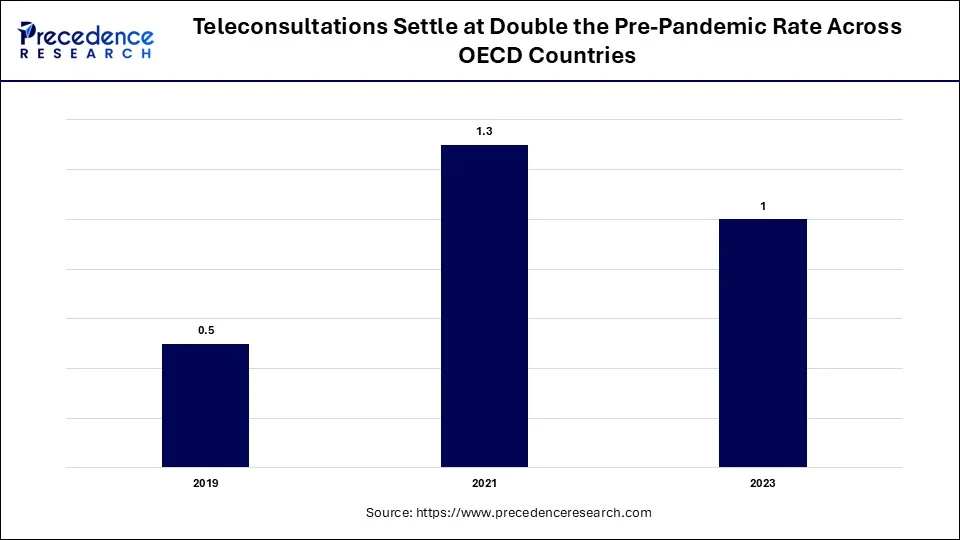
Across OECD countries, remote consultations averaged 0.5 per patient per year in 2019, peaked at 1.3 in 2021 during the COVID-19 pandemic, and stabilized at 1.0 in 2023. This trend highlights a partial retreat from pandemic highs while maintaining use well above pre-pandemic baselines. Moreover, in 2019, the average was 0.5 teleconsultations per person annually, with remote care accounting for fewer primary care interactions in most member nations. In 2021, rates more than doubled to an average of 1.3 per patient per year. Thus, in 2023, rates leveled off at 1.0 per patient per year. Israel recorded the highest utilization at 2.8 teleconsultations per individual, while Poland, Lithuania, and Spain saw the steepest post-peak declines.
Key Insight: The COVID-19 pandemic reset baseline utilization rates as it permanently altered digital infrastructure, workflow policies, and consumer expectations. Practices adopted out of emergency necessity, such as digital service delivery, remote work, and flexible operational models, proved efficient enough to retain as permanent structural standards rather than temporary fixes.
Source: OECD - "Health at a Glance 2025: OECD Indicators," November 2025.
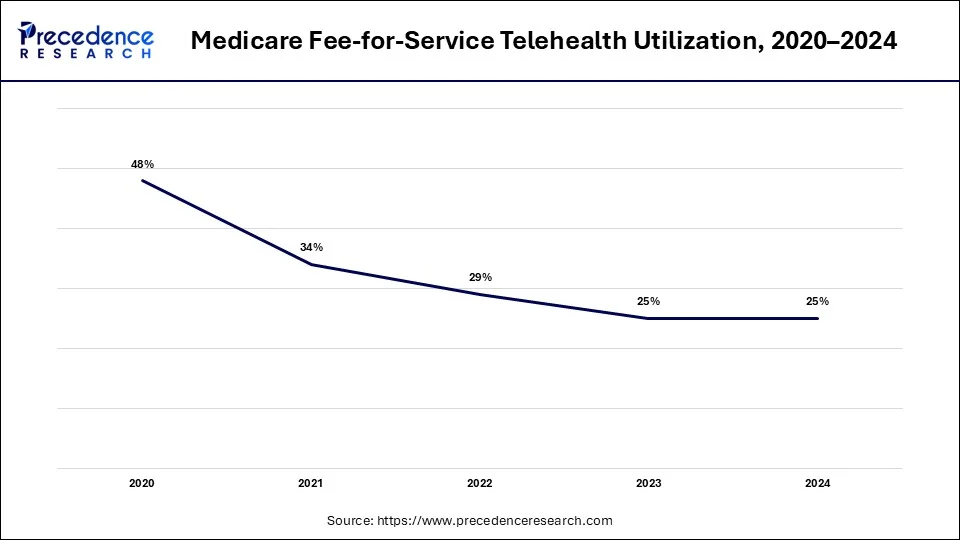
Centers for Medicare & Medicaid Services (CMS) data show that Medicare fee-for-service telehealth utilization spiked to 48% in 2020 during the COVID-19 pandemic, then declined and stabilized at a lower post-pandemic baseline by 2022–2024. In 2020, utilization peaked at 48% because of sudden expansions of pandemic emergency rules.
2021, utilization dropped to 34% as in-person care resumed. In 2022, utilization fell further to 29% annually, with quarterly rates leveling off near 13%–15%. 2023–2024 baseline maintained a steady new normal of nearly 3 million users per quarter as temporary federal flexibilities persisted.
Key Insight: The drop from 48% to 25% represents the normalization of pandemic-era shifts rather than a failure of policy. The major takeaway is that utilization has remained stable at 25% for two consecutive years, which points to a stable and even lasting baseline rather than an ongoing decline.
Source: Centers for Medicare & Medicaid Services (CMS) -"Medicare Telehealth Trends Report (Part B FFS claims data)," Snapshot received Feb. 11, 2026.
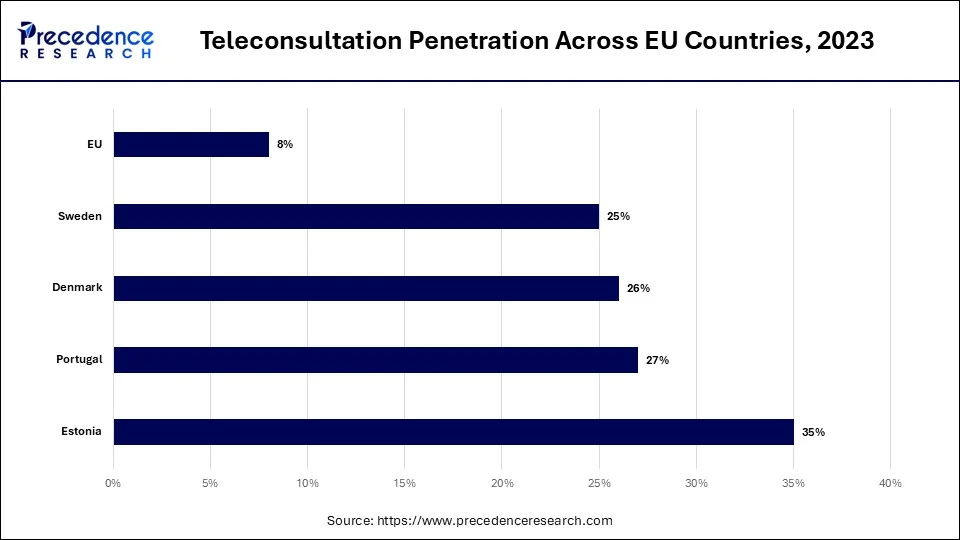
In 2023, teleconsultations accounted for more than a third of all medical doctor consultations in Estonia. Shares above a quarter were also recorded in Denmark, Portugal, and Sweden, reflecting wide variations in digital health adoption across European Union member states according to Eurostat data. High broadband and 5G penetration across Northern and Western Europe allow seamless video and phone appointments. Statutory reimbursement reforms and the removal of restrictive volume caps on virtual visits in several member states have unlocked latent patient need.
Key Insight: Disparities in EU digital health adoption stem from policy and structural challenges rather than physical hardware limits. Estonia leverages unified central integration of digitized health data, whereas Romania faces severe system fragmentation and even administrative-only electronic records.
Source: Eurostat - "Healthcare Activities Statistics - Consultations (hlth_hc_phys2)," Data extracted July 2025.
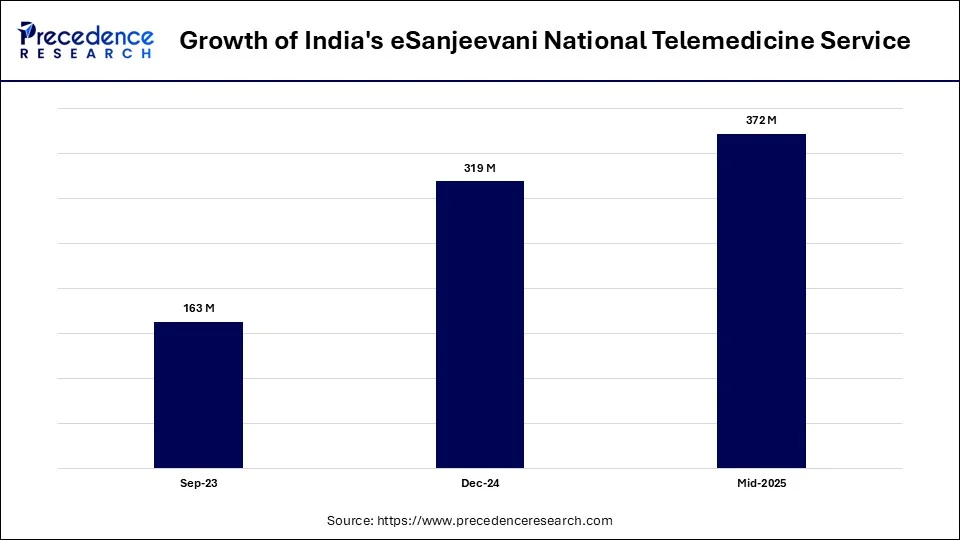
India's eSanjeevani digital health platform scaled dramatically from its 2019 launch, achieving major cumulative volume milestones: over 93 million consultations by early 2023, crossing 300 million by mid-2025, and increasing in consultations by mid-2026. In 2023, reached roughly 470 million consultations, driven heavily by Ayushman Bharat Health along with Wellness Centre (AB-HWC) integration. In 2025, crossed the 300 million consultation mark as remote triage and provider-assisted access expanded globally. In 2026, surpassed 470+ million total calls, funded by over a lakh onboarded medical providers.
Key Insight: The referenced platform is India's eSanjeevani, the world's largest government-run telemedicine service. It scaled rapidly via Ayushman Bharat Health and Wellness Centres, achieving explosive post-pandemic growth by offering free public outpatient teleconsultations and integrating deeply into national digital health frameworks.
Source: Multiple (see below) - "Oxford Open Digital Health study; PIB/Rajya Sabha reply; IBEF industry brief," 2025.
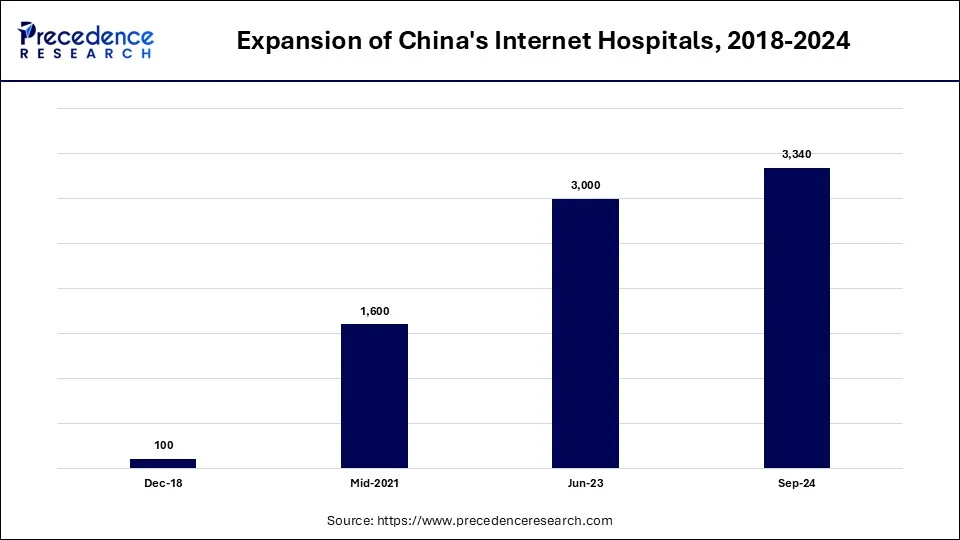
The number of National Health Commission (NHC)-licensed internet hospitals in China grew from about 100 in 2018 to more than 3,340 by the end of 2024. This rapid growth was driven by national "Internet Plus Healthcare" policies and even accelerated by the COVID-19 pandemic. In 2018, around 100 licensed internet hospitals followed new regulatory frameworks by the National Health Commission. In 2020–2021, crossed 1,600 units, as digital consultations along with online insurance payments scaled up during the pandemic. In 2022–2023, Exceeded 1,700 in mid-2022 and pushed past 3,000 by mid-2023. In 2024, surpassed 3,340 nationwide, managing over 130 million visits.
Key Insight: China has built a massive online hospital system. Each physical hospital gets a digital license to provide online care. Patients can see real doctors, get digital prescriptions, and buy medicine on the internet. Other big countries have not copied this exact model on the same huge scale.
Source: China National Health Commission (NHC) - "Data cited in Zhu et al., J Med Internet Res 26:e47523, and PMC12241070," 2024–2025.
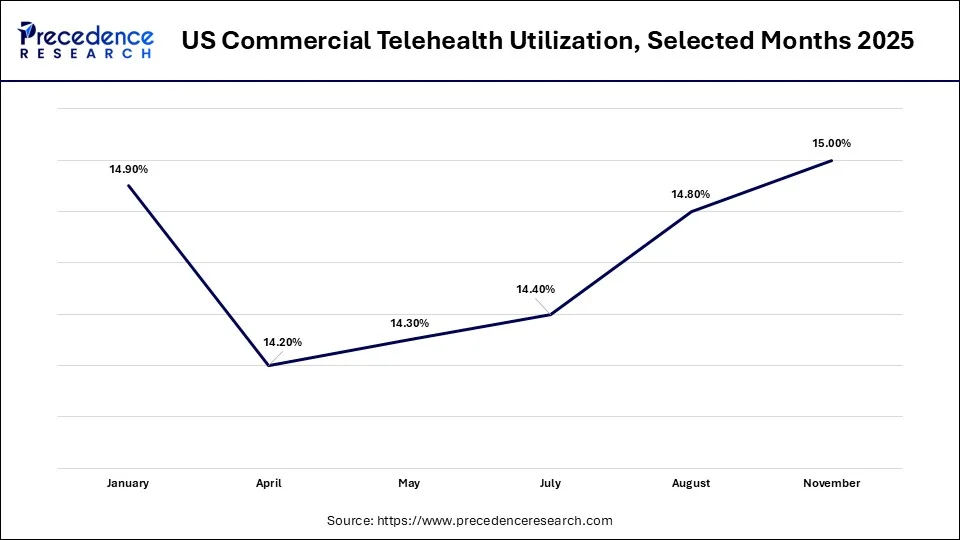
Nationally in 2025, the share of commercially insured U.S. patients with a telehealth claim hovered around 14.2% to 14.3% in the spring, such as March and April, and shifted slightly by mid-year, with overall medical claim line percentages dropping to roughly 4.9% by July, thus driven heavily by psychotherapy as well as mental health services.
Key Insight: Commercial telehealth need continued to grow into Q1 2026, with FAIR Health data showing the national share of patients with a telehealth claim thus reaching 18.4% and overall utilization climbing 10.1% from Q4 2025. Mental health diagnoses drove the majority of these virtual visits.
Source: FAIR Health - "Monthly Telehealth Regional Tracker (national data)," 2025 press releases.
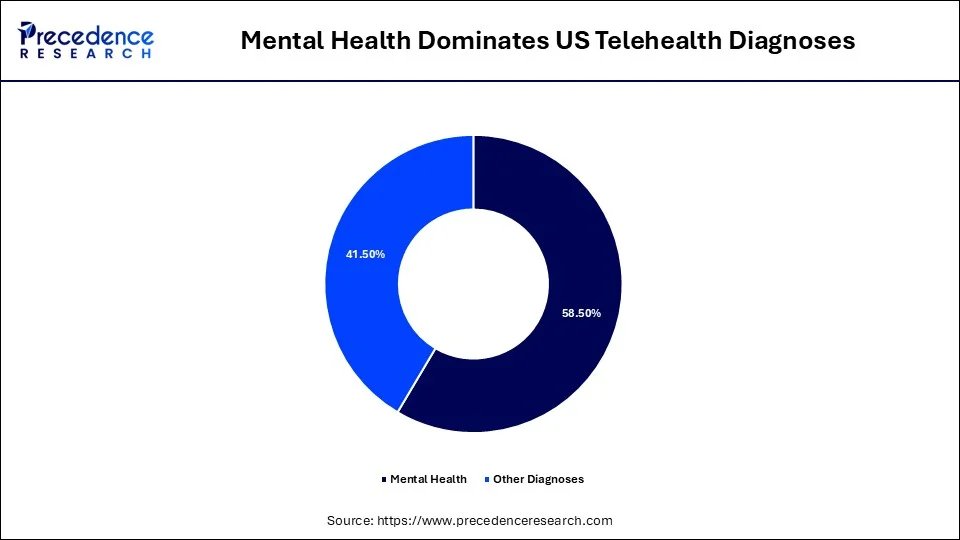
Mental health conditions represent the leading diagnostic category for telehealth patients across the United States, thus accounting for over 52% of all telehealth claims nationally. This dominance spans across every adult and pediatric age group and geographic region, reflecting a permanent shift toward virtual behavioral healthcare access. Moreover, generalized anxiety disorder and major depressive disorder consistently rank as the top specific diagnoses within this category.
Key Insight: Behavioral health is a natural fit for audio and text telemedicine as it does not need physical exams. Any national strategy or vendor plan that ignores psychiatry along with psychotherapy is missing most of the actual patient demand and real-world usage.
Source: FAIR Health - "Monthly Telehealth Regional Tracker Enters Sixth Year" press release, April 18, 2025.
US Digital Health Venture Funding by Quarter, 2025
| Quarter | Digital Health Venture Funding |
| Q1 2025 | $3.0 billion |
| Q2 2025 | $3.4 billion |
| Q3 2025 | $3.5 billion |
| Q4 2025 | $4.3 billion |
U.S. digital health venture funding in 2025 totaled nearly $14.2 billion, rebounding past 2024 levels as capital concentrated heavily in artificial intelligence and even mega-deals, though specific quarterly figures fluctuated around $3.5B to $4.4B per quarter.
Key Insight: AI-based startups captured 62% of all venture funding in the first half of 2025. Capital is not flat. Money is moving away from the broader sector and then concentrating tightly into AI-native clinical-workflow and telemedicine firms.
Source: Rock Health - "Q1–Q3 2025 Digital Health Funding Reports and JPM26 full-year update," 2025–2026.
The Chronic-Disease Burden Behind Remote Patient Monitoring: Global Adults with Hypertension, 1990-2024
| Year | Adults Aged 30–79 With Hypertension |
| 1990 | 650 Million |
| 2019 | 1.3 Billion |
| 2024 | 1.4 Billion |
According to the World Health Organization, the number of adults aged 30–79 living with hypertension globally was 650 million in 1990, which rose to 1.28 billion by 2019, and then reached an estimated 1.4 billion by 2024. In 1990, 650 million adults were affected, which is approximately a 32% age-standardized prevalence; in 2019, 1.28 billion adults were affected, which doubled from 1990 due to population growth and aging. In 2024, 1.4 billion adults were affected, with about 44% unaware of their status; only 23% were under control.
Key Insight: Remote patient monitoring is a crucial health care shift. It moves care from rare clinic visits to daily home tracking. Thus, this change helps manage the huge rise in long-term illness since 1990.
Source: World Health Organization - "Hypertension" Fact Sheet; Global Report on Hypertension: The Race Against a Silent Killer, September 2025; 2023
Source: OECD - "Health at a Glance 2025: OECD Indicators," November 2025.
Across OECD nations, remote consultations through phone or video averaged 0.5 per patient per year in 2019, surged past 1.3 during pandemic peaks, and stabilized at 1.0 per patient per year by 2023. While use dropped from peaks in countries such as Spain and Poland, overall rates remained well above pre-pandemic baselines. Moreover, in 2019, the baseline averaged 0.5 remote visits per capita, accounting for under 10% of total doctor interactions in most reporting nations. Followed by 2021, when the peak doubled to 1.3+ visits per patient as virtual care became an essential public health tool. In 2023, stabilization settled at 1.0 average visits per patient, showing a partial retreat from emergency levels while cementing digital tools into routine care.
Key Insight: The massive gap in teleconsultation utilization between Spain and Germany stems from public policy choices. Spain integrated video and phone visits directly into its national public health system. Further, Germany historically restricted remote care due to strict rules and low doctor payment rates, though policies have slowly evolved.
Source: Multiple (see below) - "CMS.gov; American College of Cardiology; K&L Gates; APTA; Forbes; Consolidated Appropriations Act, 2026," 2020–2026.
The U.S. Medicare telehealth timeline tracks the major policy changes from the March 2020 COVID-19 public health emergency declarations via the enactment of H.R. 7148, which retroactively resolved a brief early-2026 lapse and also extended vital virtual care flexibilities through December 2027. In March 2020, the federal government declared a public health emergency (PHE). The Centers for Medicare & Medicaid Services (CMS) utilizes Section 1135 waivers to drop geographic restrictions.
Key Insight: Telemedicine reimbursement keeps facing sudden shutdowns because Congress ties these rules to temporary budget deals instead of passing a permanent law. This leaves doctors as well as patients at risk during federal budget fights.
Source: World Health Organization - "Global Strategy on Digital Health 2020–2027; WHO Europe policy brief on scaling telemedicine," 2025.
The patient-to-integration care pathway maps the movement of health information and clinical workflow from initial contact to fully coordinated systemic care. Moreover, four operational stages thus combine with four cross-cutting infrastructural layers to form a secure, connected digital health framework.
Key Insight: Telemedicine programs fail when one supporting layer lags, as each layer has separate rules, funds, and laws. A good app along with willing patients are not enough if internet connection or legal approval fails.
Source: Weill Cornell Medicine; American Medical Association — "IMLC brief; IMLC Issue Brief," 2025.
The Interstate Medical Licensure Compact (IMLC) includes 40 member states, the District of Columbia, and Guam. Cumulative licensure activity has grown significantly since its 2017 launch, scaling from just three initial licenses in its first month to thousands issued monthly, streamlining multi-state practice for qualified physicians. Physicians must hold a clean disciplinary record, possess full specialty certification, as well as use a participating member state as their primary tax or practice residence.
Key Insight: With over 152,000 expedited licenses issued, the Compact has become critical plumbing for interstate telehealth, but holdout states, which include several populous ones, still force multistate platforms to maintain parallel, slower licensing tracks.
Source: Agbeyangi, A.O. & Lukose, J.M. — "Telemedicine Adoption and Prospects in Sub-Saharan Africa," Healthcare 13(7):762, MDPI (systematic review of 53 studies), March 29, 2025.
South Africa, Kenya, and Nigeria now represent the most-studied telemedicine markets in Sub-Saharan Africa. South Africa leads in adoption rates via specialist teleconsultations and chronic care, Kenya excels in mobile health (mHealth) integration for maternal and HIV care, and Nigeria aims at remote diagnosis despite major infrastructural hurdles. High integration is supported by formal health policies, provider readiness, and private sector infrastructure. Utilizes nurse-led remote sites and virtual specialist referrals.
Key Insight: Africa has no single digital health market. South Africa, Kenya, and Nigeria each demand a unique approach. Success depends on local rules, tech habits, and buyer needs.
Source: Multiple (see below) — "Teladoc Health FY2025 earnings release; PIB India; China NHC data via PMC12241070," 2025–2026.
Digital health platforms operate under vastly different structural models across the United States, India, and China. The U.S. model depends on private investor ownership and commercial insurance, India features state-funded digital public goods, and China implements a state-guided hybrid commercial-public system. In the U.S., the investor-owned model is owned by private shareholders or venture capital companies. Governed by corporate profit motives, board accountability, and strict compliance with private medical privacy laws such as HIPAA. In the Indian government-run model, it is funded, owned, and regulated directly by the state, such as the Ayushman Bharat Digital Mission. It is governed as a public digital infrastructure utility.
In China, the Hybrid Network blends state healthcare directives with vast private tech conglomerates, such as Ping An Good Doctor or Tencent-backed entities. It is governed by strict national cybersecurity and data laws, alongside public health goals.
Key Insight: A telemedicine firm can operate under three distinct business models: a B2B subscription platform, a publicly funded universal-access utility, or a licensed-hospital extension. Each model has unique financial profiles, regulatory structures, and competitive drivers; thus, it cannot be analyzed as a single category.
Recent Developments
U.S. Congress/CMS - February 3, 2026
| Date | February 3, 2026 |
| Organization | US Congress/CMS |
| Development | The Consolidated Appropriations Act, 2026 was enacted into law, extending Medicare telehealth flexibilities. |
| What Changed | It waived geographic and originating-site restrictions, expanded eligible providers, and even extended audio-only coverage through December 31, 2027. |
| Why It Matters | It ends a second telehealth reimbursement "cliff" within five months and also gives providers a two-year runway. |
| Business Significance | It removes near-term revenue uncertainty for telehealth vendors serving medicare populations, though it stops short of the permanent authorization industry groups are seeking. |
| Source | Forbes, Feb. 3, 2026; American Society of Clinical Oncology (ASCO) policy update |
U.S. federal government - October 2025 - January 2026
| Date | October 2025 - January 2026 |
| Organization | U.S. federal government |
| Development | Two separate shutdown-driven lapses in Medicare telehealth flexibilities occurred on Oct. 1, 2025, and Jan. 30, 2026. |
| What Changed | Geographic and originating-site restrictions briefly reverted to pre-pandemic rules each time before retroactive restoration. |
| Why It Matters | It demonstrated the fragility of telehealth reimbursement when it was tied to short-term federal funding bills. |
| Business Significance | It prompted renewed AMA and provider-association pressure for the permanent statutory telehealth authorization. |
| Source | K&L Gates client alert, Dec. 9, 2025; American College of Cardiology, Jan. 30, 2026 |
World Health Assembly/WHO - May 2025
| Date | May 2025 |
| Organization | World Health Assembly/WHO |
| Development | The WHA accepted extending the Global Strategy on Digital Health through 2027 and signed a follow-up 2028–2033 framework. |
| What Changed | It reaffirmed WHO's governance and scaling mandate and has 129 countries now reporting national digital health strategies. |
| Why It Matters | It signals sustained multilateral commitment to telemedicine and digital-health scale-up beyond pandemic-era urgency. |
| Business Significance | It creates a policy tailwind for vendors and NGOs aiming at government and multilateral digital-health tenders. |
| Source | MobiHealthNews, May 23, 2025 |
Teladoc Health - April 30, 2025 (announced)
| Date | April 30, 2025 (announced) |
| Organization | Teladoc Health |
| Development | It announced the acquisition of UpLift Health Technologies, a virtual mental health provider with in-network relationships covering over 100 million lives. |
| What Changed | It expands the BetterHelp segment's ability to bill via insurance rather than purely direct-to-consumer. |
| Why It Matters | It signals a strategic pivot toward insurance-based behavioral telehealth as direct-to-consumer growth slows. |
| Business Significance | It is part of a broader consolidation trend among mental-health telehealth providers amid margin pressure. |
| Source | Teladoc Health Q1 2025 results release; Tracxn company update, March 2026 |
Kassenarztliche Bundesvereinigung (KBV) & GKV-Spitzenverband, Germany - January–April 2025
| Date | January-April 2025 |
| Organization | Kassenärztliche Bundesvereinigung (KBV) & GKV-Spitzenverband, Germany |
| Development | Germany's national association of statutory health insurance physicians (KBV), along with the statutory health insurers' federation, raised the cap on video consultations. |
| What Changed | The prior 30% per-service cap was abolished retroactively to January 1, 2025; a unified cap of up to 50% of a practice's patients being treated exclusively by video took effect on April 1, 2025. |
| Why It Matters | It shows a major EU health system directly loosening reimbursement limits on telemedicine via negotiated national agreements between regulators and insurers, rather than legislation alone. |
| Business Significance | Techniker Krankenkasse, one of Germany's largest statutory health insurers, has reported a 23% rise in video consultations following the change. |
| Source | KBV, kbv.de/html/videosprechstunde.php; Deutsches Ärzteblatt, April 7, 2025; Gelbe Liste, July 25, 2025 |
China National Health Commission (NHC) - September 2024
| Date | September 2024 |
| Organization | China National Health Commission (NHC) |
| Development | NHC confirmed 3,340 licensed internet hospitals nationwide, with annual online medical service volume exceeding 100 million visits. |
| What Changed | It represents roughly a tenfold rise in licensed platforms since 2018 (from about 100). |
| Why It Matters | China's internet-hospital licensing model is now among the largest telemedicine infrastructure build-outs globally. |
| Business Significance | It opens integration opportunities for device makers, AI-triage vendors, and even insurers operating within China's regulated internet-hospital framework. |
| Source | PMC12241070 (2025), citing NHC press briefing, Sept. 12, 2024 |
PSYPACT Commission - October-November 2025
| Date | October-November 2025 |
| Organization | PSYPACT Commission |
| Development | Montana became an active PSYPACT member, and the Commission upgraded its rulebook to clarify administrative and compliance provisions. |
| What Changed | The cross-state telepsychology practice compact continues expanding toward near-national coverage. |
| Why It Matters | It illustrates how profession-specific licensure compacts are outpacing the wider, slower Interstate Medical Licensure Compact for physicians. |
| Business Significance | Telepsychology platforms can scale across state lines faster than general telemedicine platforms reliant on physician licensure. |
| Source | Telehealth.org, "Telehealth Licensure 2025–2026: Cross-State Practice," Jan. 13, 2026 |
Key Companies & Organizations
Major Companies (Publicly Traded/Large-Scale)
- Teladoc Health recorded a full-year 2025 consolidated revenue of $2.53 billion, reflecting a minor 2% decline year-over-year. The virtual-care leader functions primarily via its B2B Integrated Care segment and its direct-to-consumer mental health platform, BetterHelp, balancing whole-person digital medical services with global online therapy.
- Amwell (American Well Corporation) is a Boston-based telehealth enablement company that offers digital care delivery software and hardware to major health systems, health plans (payers), and government clients.
- Zoom Video Communications, Inc. is a cloud video platform. It provides video, voice, chat, and content sharing. Doctors and clinics use it for telemedicine to talk with patients online.
- Twilio is a cloud communications platform as a service (CPaaS) firm based in San Francisco, California. It enables software developers to embed real-time audio, video, text messaging, and authentication directly into digital health platforms via APIs, powering remote care for major providers and electronic health records such as Epic.
Government-Run/Public Platforms
- eSanjeevani is India's national telemedicine service by the Ministry of Health & Family Welfare, developed by C-DAC Mohali, and has 318.6M+ cumulative consultations.
- Regulated by China's National Health Commission (NHC), internet hospitals function as digital extensions of licensed physical medical facilities.
- The UK National Health Service (NHS) utilizes digital and remote-consultation services, including telephone, video, and online written triage, to provide faster, more flexible access to primary and secondary care.
Emerging/Recently Funded Companies
- Talkiatry closed an oversubscribed $210 million Series D funding round on February 12, 2026, contributed by Perceptive Advisors.
- Miami-based telehealth and population health platform eMed has raised a $200 million Series A round in March 2026 led by Aon, pushing its valuation past $2 billion.
- Grow Therapy secured a $150 million Series D funding round, pushing its valuation to $3 billion.
- Doctronic is an AI-assisted telehealth and patient triage platform that provides free, anonymous 24/7 symptom checks, clinical summaries, and care navigation.
- Midi Health reached unicorn status with a $100 million Series D funding round in February 2026, pushing its valuation past $1 billion.
- Sovato Health closed a $26 million Series B funding round in November 2025, bringing its total raised capital to $41 million.
Technology & Infrastructure Providers
- TytoCare integrated its FDA-cleared handheld examination hardware with Teladoc Health to fund remote physical exams.
- GlobalMed is a leading international provider of integrated virtual health platforms, clinical-grade telemedicine hardware, and even connected software solutions. Operating in over 60 countries, the firm connects remote patients with medical specialists via secure diagnostic tools and electronic health record (EHR) interoperability.
- Abridge is an advanced generative AI platform for clinical conversations that securely listens to patient-doctor encounters and then automatically drafts structured medical notes. Having surpassed its initial deployment milestone, the solution is now actively used across more than 300 major US health systems and enterprise medical centers.
Questions Answered in This Blog
- What is meant by telemedicine, and how does it differ from the broader concept of telehealth?
- How large is the worldwide telemedicine market currently, and how fast is it anticipated to grow through 2030?
- Which diagnostic category dominates US commercial telehealth visits today, and why?
- How many teleconsultations has India's eSanjeevani platform delivered, and how has it scaled since its 2019 launch?
- How has Medicare telehealth utilization in the US changed since the COVID-19 pandemic peak?
- How many internet hospitals now operate in China, and how many patients use them?
- How much venture capital is flowing into US digital health and telemedicine startups, and where is it concentrated?
- How is the remote patient monitoring market evolving alongside telemedicine?
- Exactly, which European countries have the highest share of teleconsultations, and why do national rates vary so widely?
- What has happened to US Medicare telehealth reimbursement policy over 2025–2026, and why does it keep lapsing?
- How is telemedicine adoption progressing in Sub-Saharan Africa, and which countries are leading?
- Which companies dominate the telemedicine industry, and how do their business models differ across the US, China, and India?
- What is the Interstate Medical Licensure Compact, and how does it enable cross-state telehealth?
- What role does the WHO play in shaping global digital health alongside telemedicine strategy?
- What are the core components of the telemedicine value chain, and which layers most often constrain scale-up?
What Additional Questions Can Our Full Research Report Answer?
This blog draws on public and government data, as well as institutional data. A commissioned research report can go further, combining proprietary market modeling, primary interviews, and competitive benchmarking to answer questions such as:
- What is the realistic total addressable market (TAM) for telemedicine by country when it is adjusted for insurance-reimbursement penetration and broadband access?
- How does per-consultation reimbursement for teleconsultations compare across EU member states, and where are the widest margin opportunities?
- Which countries provide the strongest combination of demand growth, infrastructure readiness, regulatory support, and reimbursement stability for telemedicine market entry over the next five years?
- What is the five-year capacity-utilization forecast for the internet hospitals in China's tier-2 and tier-3 cities?
- How will the December 2027 Medicare telehealth flexibility deadline most likely resolve, and what are the probability-weighted policy scenarios?
- How do Amwell, Teladoc Health, and Included Health (Doctor On Demand) compare on member growth, margin, and payer-contract mix?
- Which U.S. states provide the fastest path to multistate telehealth licensure given current IMLC and PSYPACT participation and even processing times?
- Which employer as well as payer segments show the highest willingness-to-pay for AI-enabled virtual-first primary care?
- How price-sensitive is direct-to-consumer teletherapy, for example, BetterHelp, Talkspace, to subscription-price changes?
- Which M&A targets in behavioral telehealth are most attractive given recent consolidation activity, for example, UpLift, Grow Therapy?
- What is the supplier landscape for remote patient monitoring hardware, and which vendors have the strongest hospital-system integration pipelines?
- Which African countries are best positioned for telemedicine market entry based on regulatory maturity, mobile penetration, and payer infrastructure?
- What is the procurement process, along with the budget cycle, for government telemedicine tenders in Sub-Saharan Africa?
- Which segments of teleradiology and teledermatology need are growing fastest, and which technology providers are capturing share?
- How does India's eSanjeevani hub-and-spoke model compare in cost-per-consultation to private Indian telemedicine platforms?
- How is AI-driven ambient clinical documentation reshaping the productivity economics of telemedicine visits?
- How does patient retention differ between synchronous video telemedicine and asynchronous store-and-forward models?
- What is the projected capacity utilization of Acute Hospital Care at Home programs via the September 2030 waiver extension?
- What are the customer-acquisition-cost benchmarks for direct-to-consumer telemedicine platforms across the US, UK, and India?
- Which technology vendors are best positioned to benefit from the European Health Data Space interoperability mandate?
- How is reimbursement parity between audio-only and video visits evolving across US states, and what is its impact on rural provider revenue?
- What procurement criteria do U.S. health systems generally use when selecting a telehealth-enablement vendor?
- What licensing and data-residency expenses do multinational telemedicine operators face when expanding into Germany versus France?
- How does the FDA's regulatory pathway for AI-driven remote monitoring devices compare with the EU Medical Device Regulation approval timeline?
- Which chronic-disease management applications, for example, diabetes, hypertension, COPD, show the strongest ROI evidence for telemonitoring-based interventions?
- What is the probability and cost impact of ransomware or cybersecurity incidents for telemedicine platforms, given elevated provider-reported attack rates in Europe?
- Which telemedicine segments- teleradiology, telepsychiatry, telecardiology- provide the highest five-year revenue CAGR by region?
- What pricing strategy should a new entrant adopt in markets with capped reimbursement, like Poland's roughly 3%-of-consultations ceiling?
- Which partnership models- hospital joint venture, platform licensing, or wholly owned- maximize margin for internet-hospital operators in China?
- How might the expiration or permanence of US Medicare telehealth flexibilities after 2027 affect long-term capital allocation by venture investors?
- How does patient demographic segmentation- age, rural/urban residence, disability status- affect telehealth utilization and unmet-demand estimates by country?
- What geographic expansion strategy should a U.S.-based telemedicine firm pursue in Latin America given the region's projected growth rate through 2030?
- What is the funding runway and burn-rate outlook for venture-backed digital health firms that reached unicorn status in 2025?
- How do procurement and reimbursement policies for telepsychiatry differ between PSYPACT member states and non-member states?
- What scenario-planning assumptions best forecast telemedicine need under a permanent versus temporary US federal reimbursement framework?
- Which specialty-society credentialing, along with malpractice-insurance frameworks, pose the greatest friction to interstate telehealth scaling?
- What competitive threats do incumbent telemedicine platforms face from EHR vendors building native virtual-care modules?
- What is the long-term customer-lifetime-value differential between employer-sponsored and direct-to-consumer telemedicine acquisition channels?
References
All sources cited throughout this report, in order of first appearance:
| World Health Organization, Regional Office for Europe | Scaling Up Telemedicine in the WHO European Region (Policy Brief) | June 6, 2025 | https://www.who.int/europe/publications/i/item/WHO-EURO-2025-12185-51957-79682 | Definition of telemedicine within telehealth; value-chain framework |
| World Health Organization | Global Strategy on Digital Health 2020–2027 | Dec. 1, 2025 (updated listing) | https://www.who.int/publications/i/item/9789240116870 | Global digital-health governance framework |
| MobiHealthNews | World Health Assembly Extends Global Strategy on Digital Health to 2027 | May 23, 2025 | https://www.mobihealthnews.com/news/world-health-assembly-extends-global-strategy-digital-health-2027 | WHA 2025 extension; 129-country strategy adoption figure |
| World Health Organization | WHO Releases First Guideline on Digital Health Interventions | April 17, 2019 | https://www.who.int/news/item/17-04-2019-who-releases-first-guideline-on-digital-health-interventions | Background on WHO telemedicine guidance |
| Centers for Medicare & Medicaid Services (CMS) | Medicare Telehealth Trends Report (Part B FFS Claims Data, Jan. 2020–Sep. 2025) | Snapshot received Feb. 11, 2026 | https://data.cms.gov/sites/default/files/2026-03/Medicare%20Telehealth%20Trends%20Snapshot%2020260305_508.pdf | US Medicare telehealth utilization statistics, 2020–2024 |
| Eurostat | Healthcare Activities Statistics – Consultations (hlth_hc_phys2) | Data extracted July 2025 | https://ec.europa.eu/eurostat/statistics-explained/index.php/Healthcare_activities_statistics_-_consultations | EU teleconsultation share by country, 2023 |
| Sood, S. et al., Oxford Open Digital Health | Adoption and Utilization of India's eSanjeevani National Telemedicine Service | Oct. 7, 2025 | https://pubmed.ncbi.nlm.nih.gov/41158553/ | eSanjeevani consultation volume through September 2023 |
| IANS / Investment Guru India | e-Sanjeevani Platform Conducts Over 31 Cr Teleconsultations: Union Minister | Feb. 5, 2025 | https://investmentguruindia.com/newsdetail/e-sanjeevani-platform-conducts-over-31-cr-teleconsultations-union-minister257355 | eSanjeevani cumulative consultations through Dec. 2024 (official Parliament reply) |
| India Brand Equity Foundation (IBEF) | India's Healthcare Revolution: How Telemedicine Is Making Healthcare More Accessible | Sept. 25, 2025 | https://www.ibef.org/blogs/india-s-healthcare-revolution-how-telemedicine-is-making-healthcare-more-accessible-across-india | eSanjeevani mid-2025 consultation and provider figures; India telemedicine policy timeline |
| Zhu et al., Journal of Medical Internet Research | Telehealth Care Through Internet Hospitals in China | 2024 (26:e47523) | https://pmc.ncbi.nlm.nih.gov/articles/PMC11015369/ | China internet hospital count and user figures through June 2023 |
| PMC12241070 (Frontiers in Public Health) | Analysis of Psychiatrists' Internet Service Patterns: China's Largest Online Mental Health Platform | 2025 | https://pmc.ncbi.nlm.nih.gov/articles/PMC12241070/ | China internet hospital count (Sept. 2024) and internet medical user figures (June 2024) |
| OECD | Health at a Glance 2025: OECD Indicators | November 2025 | https://www.oecd.org/en/publications/2025/11/health-at-a-glance-2025_a894f72e.html | OECD teleconsultation-per-patient trend, 2019/2021/2023; country-level comparison |
| OECD | Health at a Glance 2023: OECD Indicators (Digital Health chapter) | November 2023 | https://www.oecd.org/en/publications/health-at-a-glance-2023_7a7afb35-en.html | Background on 2021 teleconsultation share of all doctor consultations (19% average) |
| World Health Organization | Hypertension (Fact Sheet) | September 2025 | https://www.who.int/news-room/fact-sheets/detail/hypertension | Global and regional hypertension prevalence, 1990–2024 |
| World Health Organization | Global Report on Hypertension: The Race Against a Silent Killer | 2023 | https://www.iashonline.org/pdf/21-9-23.pdf | 1990–2019 hypertension prevalence trend; treatment-cascade data |
| Rock Health | 2025 Half-Year Funding: $6.4B Across 245 Deals | July 7, 2025 | https://rockhealth.com/rock-weekly/2025-half-year-funding-6-4b-across-245-deals/ | H1 2025 US digital health venture funding and AI-share data |
| Rock Health / Healthcare Dive | Digital Health Funding Outpacing Last Year as Huge Rounds Increase | Oct. 8, 2025 (updated Oct. 16, 2025) | https://www.healthcaredive.com/news/digital-health-funding-2025-outpacing-2024-q3-rock-health/802330/ | Q3 2025 and year-to-date funding totals |
| Fierce Healthcare | Digital Health Startups Raked in $4B During Q1 with 12 Megadeals Driving Investment: Rock Health | April 8, 2026 | https://www.fiercehealthcare.com/digital-health/digital-health-startups-raked-4b-q1-12-megadeals-driving-investment-rock-health | Full-year 2025 digital health funding total ($14.2B) |
| FAIR Health | FAIR Health's Monthly Telehealth Regional Tracker Enters Sixth Year | April 18, 2025 | https://www.prnewswire.com/news-releases/fair-healths-monthly-telehealth-regional-tracker-enters-sixth-year-302431225.html | January 2025 mental-health diagnostic share; tracker methodology |
| FAIR Health | In May, the Percentage of Patients with a Telehealth Claim Increased Nationally | Aug. 15, 2025 | https://www.prnewswire.com/news-releases/in-may-the-percentage-of-patients-with-a-telehealth-claim-increased-nationally-and-in-every-region-302524184.html | May 2025 national utilization data point |
| FAIR Health | The Percentage of Patients with a Telehealth Claim Increased ... Except the Northeast in August | Nov. 17, 2025 | https://www.prnewswire.com/news-releases/the-percentage-of-patients-with-a-telehealth-claim-increased-nationally-and-in-every-region-except-the-northeast-302616103.html | July–August 2025 national utilization data points |
| FAIR Health | In November, the Percentage of Patients with a Telehealth Claim Increased Nationally | Feb. 17, 2026 | https://www.prnewswire.com/news-releases/in-november-the-percentage-of-patients-with-a-telehealth-claim-increased-nationally-and-in-every-region-302688573.html | November 2025 national utilization data point |
| FAIR Health | Telehealth Trends from January to March 2025 | July 17, 2025 | https://www.fairhealth.org/article/telehealth-trends-from-january-to-march-2025 | Q1 2025 urban/rural utilization trend context |
| Fierce Healthcare | Telehealth Utilization Up 10.1% in Q1, Led by Mental Health Visits: FAIR Health | June 16, 2026 | https://www.fiercehealthcare.com/telehealth/telehealth-utilization-101-nationally-between-q4-2025-and-q1-2026-fair-health-tracker | Q4 2025–Q1 2026 quarterly tracker data (17.3% to 18.4%) |
| American College of Cardiology | Partial Government Shutdown Is Imminent; Telehealth Flexibilities Will Lapse | Jan. 30, 2026 | https://www.acc.org/Latest-in-Cardiology/Articles/2026/01/30/20/19/Partial-Government-Shutdown | January 2026 telehealth flexibility lapse details |
| Forbes | Congress Extends Medicare Telehealth Coverage For Two Years | Feb. 3, 2026 | https://www.forbes.com/sites/brucejapsen/2026/02/03/congress-extends-medicare-telehealth-coverage-for-two-years/ | February 2026: two-year extension through Dec. 31, 2027 |
| K&L Gates | Climbing Back Up the Telehealth Cliff: Congress Extends Medicare Flexibilities Through 30 January 2026 | Dec. 9, 2025 | https://www.klgates.com/Climbing-Back-up-the-Telehealth-Cliff-Congress-Extends-Medicare-Flexibilities-Through-30-January-2026-12-9-2025 | November 2025 continuing resolution telehealth extension |
| American Physical Therapy Association (APTA) | Government Shutdown Ended: Telehealth Flexibilities Extended Until Jan. 30, 2026 | Nov. 17, 2025 | https://www.apta.org/article/2025/11/17/government-shutdown-ended-telehealth-flexibilities-extended-until-jan-30-2026 | October–November 2025 shutdown and telehealth impact |
| Weill Cornell Medicine | Interstate Medical Licensure Compact | Accessed 2026 | https://gca.weill.cornell.edu/interstate-medical-licensure-compact | IMLC cumulative licensure statistics (April 2017–May 2025) |
| American Medical Association (AMA) | What's the Interstate Medical Licensure Compact? How Can It Help You? | June 30, 2026 | https://www.ama-assn.org/medical-residents/transition-resident-attending/what-s-interstate-medical-licensure-compact-how-can | IMLC licenses issued figure (200,000+) |
| Telehealth.org | Telehealth Licensure 2025–2026: Cross-State Practice | Jan. 13, 2026 | https://telehealth.org/news/telehealth-licensure-2025-2026-cross-state-practice-and-compacts/ | PSYPACT expansion; Montana membership; compact landscape |
| Agbeyangi, A.O. & Lukose, J.M., Healthcare (MDPI) | Telemedicine Adoption and Prospects in Sub-Saharan Africa: A Systematic Review with a Focus on South Africa, Kenya, and Nigeria | March 29, 2025 (13(7):762) | https://www.ncbi.nlm.nih.gov/pmc/articles/PMC11989057/ | Sub-Saharan Africa country adoption comparison |
| Teladoc Health, Inc. | Teladoc Health Reports First Quarter 2025 Results | April 30, 2025 | https://ir.teladochealth.com/news-and-events/investor-news/press-release-details/2025/Teladoc-Health-Reports-First-Quarter-2025-Results/default.aspx | UpLift Health Technologies acquisition announcement |
| Teladoc Health, Inc. | Teladoc Health Reports Fourth Quarter and Full Year 2025 Results | Feb. 25, 2026 | https://ir.teladochealth.com/news-and-events/investor-news/press-release-details/2026/Teladoc-Health-Reports-Fourth-Quarter-and-Full-Year-2025-Results/default.aspx | FY2025 revenue and net loss figures |
| Kassenärztliche Bundesvereinigung (KBV) | Videosprechstunde (Information for Practices on Video Consultations) | Accessed 2026 | https://www.kbv.de/html/videosprechstunde.php | Germany's 2025 video-consultation cap changes (regulatory source) |
| Deutsches Arzteblatt | Videosprechstunden in größerem Umfang möglich | April 7, 2025 | https://www.aerzteblatt.de/news/videosprechstunden-in-grosserem-umfang-moglich-3e546832-b667-434d-ab9b-ad742e7d03d0 | Germany's unified 50% video-consultation cap, effective April 2025 |
| China Human Rights (citing NHC statistical bulletin) | China's Healthcare Resources Maintain Growth Trajectory | Dec. 5, 2025 | https://en.humanrights.cn/2025/12/05/b12108e07d2944caa270b5db7bf75790.html | China national healthcare infrastructure context |
| Telehealth.org | Federal Telehealth Policy in 2026: What the Medicare Extensions Mean | Feb. 11, 2026 | https://telehealth.org/news/federal-telehealth-policy-in-2026-what-the-medicare-extensions-mean/ | 2026 policy landscape summary |
About the Authors

Aditi Shivarkar
Aditi, Vice President at Precedence Research, brings over 15 years of expertise at the intersection of technology, innovation, and strategic market intelligence. A visionary leader, she excels in transforming complex data into actionable insights that empower businesses to thrive in dynamic markets. Her leadership combines analytical precision with forward-thinking strategy, driving measurable growth, competitive advantage, and lasting impact across industries.



Aman Singh
Aman Singh with over 13 years of progressive expertise at the intersection of technology, innovation, and strategic market intelligence, Aman Singh stands as a leading authority in global research and consulting. Renowned for his ability to decode complex technological transformations, he provides forward-looking insights that drive strategic decision-making. At Precedence Research, Aman leads a global team of analysts, fostering a culture of research excellence, analytical precision, and visionary thinking.

Piyush Pawar
Piyush Pawar brings over a decade of experience as Senior Manager, Sales & Business Growth, acting as the essential liaison between clients and our research authors. He translates sophisticated insights into practical strategies, ensuring client objectives are met with precision. Piyush’s expertise in market dynamics, relationship management, and strategic execution enables organizations to leverage intelligence effectively, achieving operational excellence, innovation, and sustained growth.