



Light Rail Market Size, Companies, Share, Vehicle Production Volume, Sales Performance, Export & Import Analysis, Technology Adoption, Competitive Positioning, and Demand Trends
Light Rail Market (By Type: Tram / Streetcar, Light Rail Transit, Light Rail Transit; By Capacity/Vehicle Type: 200–400 Passengers (Mid-Capacity), More than 400 Passengers, Less than 200 Passengers, More than 400; By Application: Urban / Intra-City Transport, Inter-City Transport, Inter-City Transport; By Propulsion/Technology: Electric Propulsion, Hybrid / Alternatives, Others, Hybrid & Alternative) - Global Industry Analysis, Size, Trends, Leading Companies, Regional Outlook, and Forecast 2026 to 2035
Source: https://www.precedenceresearch.com/light-rail-market
 Get a Sample
 Table Of Content


What is the Light Rail Market Size?
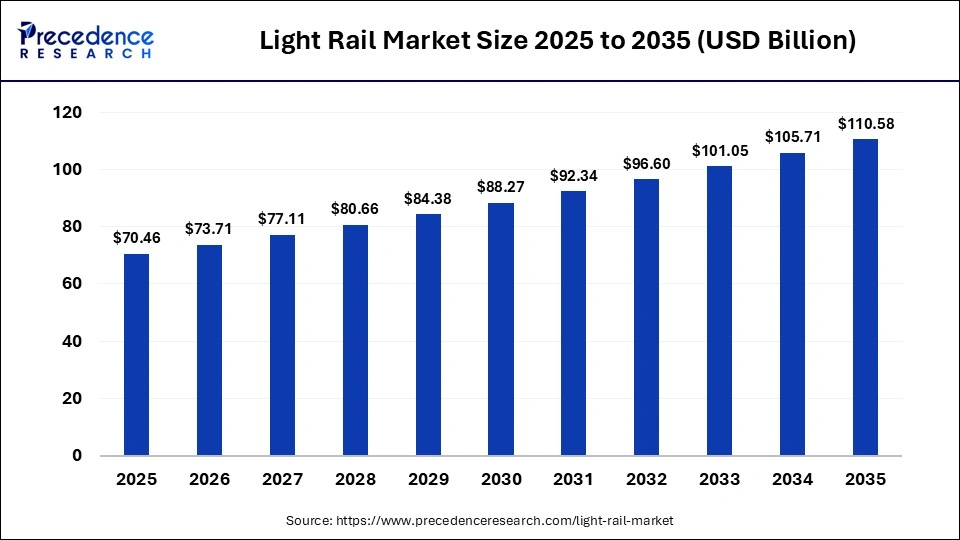
The global light rail market size is predicted to increase from USD 73.71 billion in 2026 to approximately USD 110.58 billion by 2035, expanding at a CAGR of 4.61% from 2026 to 2035. The light rail market is rising significantly due to rising urbanization, sustainable transport demand, government infrastructure investments, and environmental goals, driving adoption of efficient, low-emission urban mobility solutions.
Market Highlights
- Europe led the light rail market with the largest share of 40% in the global market in 2026.
- Asia Pacific is estimated to expand at the fastest CAGR of 5% between 2026 and 2035.
- By type, the tram/streetcar segment held an approximately 52% market share in 2026.
- By type, the light rail transit segment is projected to grow at a solid CAGR of 3.9% between 2026 and 2035.
- By capacity/vehicle type, the 200-400 passenger (mid-capacity) segment dominated the market with an approximately 50% market share in 2026.
- By capacity/vehicle type, the more than 400 segment is growing at a strong CAGR of 4.2% between 2026 and 2035.
- By application, the urban/intra-city transport segment led the light rail market and captured 65% market share in 2026.
- By application, the inter-city transport segment is expected to expand at a notable CAGR of 4.1% from 2026 to 2035.
- By propulsion/technology, the electric propulsion segment led the market and held 75% market share in 2026.
- By propulsion/technology, the hybrid & alternative segment is expected to expand at a notable CAGR of 4% from 2026 to 2035.
Is Light Rail Shaping Future Urban Transit?
The light rail is an electric rail system that operates within a city or urban area. Light rail is also designed as a suburban system that allows users to ride on their own block or in an area where there is already enough capacity for a city block or other area nearby. Thus, light rail is typically built on exclusive tracks or dedicated tracks parallel with streets.
Urban growth, increased traffic congestion, and the demand for public transportation that is environmentally friendly have created significant momentum for light rail in the global market. As a result, government and city planners have increasingly focused on developing light rail projects to modernize, connect, or expand existing transit systems or create new transit connections to areas that are currently underserved or that previously could not accommodate transit use.
The introduction of state-of-the-art technologies, such as energy-efficient vehicles, smart ticketing, and digital signalling systems, has enhanced the operational effectiveness and customer experience of many systems, increasing ridership and improving service to each area. To help expedite the construction of many light rail systems, public/private partnerships have also emerged, contributing to the formation of long-term urban mobility plans and the establishment of light rail systems as part of the broader framework of integrated sustainable transport solutions.
AI Transformation of Light Rail Represents a Revolution in Business Growth and Safety
Artificial intelligence is transforming the light rail industry by improving operational efficiency, enhancing customer experience, and strengthening safety, which is encouraging greater investment and strategic partnerships. Rail operators are increasingly deploying AI solutions for predictive maintenance, real-time defect detection, and automated inspections to reduce costs, minimize downtime, and improve service reliability. AI-driven demand forecasting and scheduling tools are optimizing train frequency and capacity utilization. In parallel, integration of computer vision and analytics is improving incident detection and passenger safety across light rail networks.
- In August 2025, NEXCOM introduces its ruggedized ATC 3520 edge AI computer for light rail, enhancing safety, real-time analytics, obstacle detection, and connectivity for smarter, more secure urban rail operations.
This advancement includes large global rail technology companies developing integrated, advanced AI vision and analytics tools, and implementing these tools across transit networks to improve infrastructure monitoring, and as a preventive measure to decrease the number of failures caused by these technologies. Furthermore, transit agencies have taken advantage of AI to improve passenger security and improve passenger experiences through advanced security measures, all of which are part of a quicker transition toward digitalization within the light rail industry that creates increased competition and greater business opportunities for the sector's players.
Light Rail Software Market Trends
- Urban Decarbonization: Light rail systems are becoming more popular to help lower carbon emissions in cities. Urban officials are committed to sustainability and are encouraging residents to use light rail instead of private vehicles while adding light rail to their plans to connect with renewable energy grids.
- Smart Integration: The latest technologies in signalling, real-time passenger information systems, predictive maintenance, Internet-of-Things-enabled monitoring, etc., are being integrated into light rail networks to increase operational efficiency, safety, and service reliability.
- Transit-Oriented Development: There is a direct relationship between light rail expansion and the development of mixed-use urban areas. By increasing density, creating commercial centers, and enhancing the value of land surrounding light rail stations, transit-oriented development will enhance ridership and provide long-term economic benefits to municipalities.
- Public Funding Push: Increased public investment in the form of green bonds and infrastructure stimulus programs will accelerate the rate at which light rail systems will be developed, especially in highly congested urban areas that cannot afford to build heavy rail transit systems or expand their bus networks.
Segmental Insights
Type Insights
What Makes Trams and Streetcars Paramount in Urban Rail Networks?
The tram and streetcar segment dominated the market for light rail with a 52% share during 2026, as these are direct routes and are generally less complex to build than a full-scale rail system. For these reasons, cities prefer tram and streetcar systems for activities such as circulation in the city center, reducing demand for parking and other services within the dense core, and facilitating transit-oriented development in the center of the city. Also, since trams and streetcars can share a lane with private vehicles, this allows for design features that help to achieve greater accessibility for disabled persons.
The light rail transit segment is expected to be the fastest growing, with a 3.9% CAGR, due to the increasingly popular mode of transit for cities as they develop beyond their central business districts and require larger and more dedicated rights-of-way for connecting suburban areas to central city districts, airports, and other locations along high-density corridors. In addition, the scalability, increased speeds, and compatibility with automated or smart signalling systems make light rail transit systems particularly attractive for rapidly urbanizing regions that are developing long-term plans for mass transit infrastructure.
Capacity/Vehicle Type Insights
Why Has the 200-400 Passengers Segment Dominated the Light Rail Market in 2026?
The 200-400 passengers segment dominated light-rail vehicles with a 50% share in 2026, which have become the most dominant vehicles in the light-rail market because they offer an ideal combination of passenger capacity, energy efficiency, and operational flexibility. Most urban corridors can support mid-capacity light-rail vehicles because they have moderate to low ridership levels, so mid-capacity vehicles are the perfect solution for these types of demand. Transit agencies also prefer mid-capacity light-rail vehicles due to their lower axle weight, shorter platform lengths, and ability to be used on current depots, enabling them to have standardization between fleets and keep operational costs under control across different transit networks.
The more than 400 passengers segment is expected to grow at the fastest CAGR of 4.2%, as it has experienced rapid growth as metropolitan areas experience increasing levels of ridership and congestion during peak hours. To meet this demand, many cities are changing their fleet to high-capacity vehicles (i.e., longer, multi-articulated trains) since these vehicles provide the highest throughput with minimal additional investments in infrastructure (i.e., additional tracks). This trend is prevalent in megacities and increasingly dense transit corridors, where limited land availability prohibits additional station expansions, directing transit operators toward solutions for creating capacity through the use of high-capacity rolling stock.
Application Insights
Why Did the Urban /Intra-city Transport Dominate the Market for Light Rail in 2026?
The urban transport/intra-city transport segment dominated the light rail market with a 65% share because of the continuing need for commuter trips, policy-directed changes in modal shares, and requirements to be environmentally sustainable. Light rail systems can efficiently provide last-mile connectivity and decrease the reliance of the public on personal motor vehicles in urban core areas. The consistent nature of the light rail system's routes and its connection to metro systems and bus networks make it the foundation of many urban mobility plans. In particular, it serves as a critical tool in cities where reducing emissions and decreasing traffic congestion are priorities.
The inter-city transport segment is set to be the fastest-growing with a 4.1% CAGR as regions are looking for a more cost-effective means of transporting people over short- to medium-distance routes compared to heavy rail, and government programs are increasingly using light rail systems to connect major cities, industrial sites, and peri-urban areas. Due to their ability to be deployed faster, their capital cost is lower, and their speed can be high enough for people to commute from rural areas to metropolitan centers, light rail poses a feasible and viable means for economically supporting balanced economic growth in the areas outside metropolitan centers.
Propulsion/Technology Insights
Why Was Electric Propulsion the Leading Technology in the Light Rail Market in 2026?
The electric propulsion segment led the light rail market with a 75% share because of its established operational experience, its efficiency in energy usage, and its alignment with many of the world's aims to reduce carbon emissions. Since a lot of existing infrastructure for light rail is electric, systems can be upgraded and fleets replaced or renewed without major disruption to existing operations. Because of their lower lifecycle emissions, lower noise emissions, and proven reliability, electric systems have become the "go to" technology for heavily funded transit projects and for long-range urban transportation planning.
The hybrid/alternative propulsion systems are set to rapidly grow at a 4% CAGR, as operators are searching for other flexibility options besides continuous overhead electrification, providing operators with new solutions to expand their systems. Battery hybrid, hydrogen, and hybrid systems are gaining interest to service heritage districts, partially electrified routes, and expansion corridors. These types of technologies aim to reduce both infrastructure and visual impacts but also open avenues for network expansion for cities seeking to balance the needs of sustainability with those of historical preservation and budget restraints.
Regional Insights
What is the Europe Light Rail Market Size and Growth Rate?
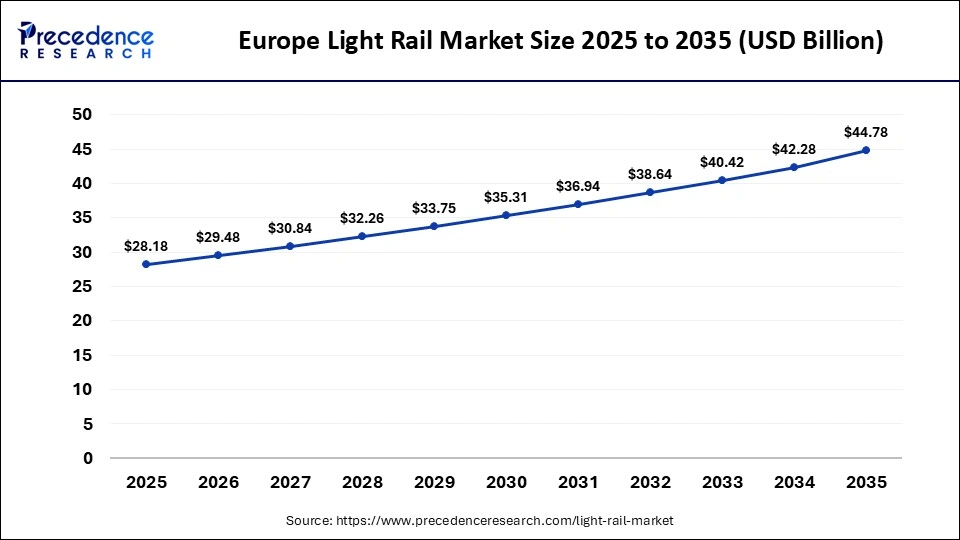
The Europe light rail market size has grown strongly in recent years. It will grow from USD 29.48 billion in 2026 to USD 44.78 billion in 2035, expanding at a compound annual growth rate (CAGR) of 4.74% between 2026 and 2035.
What Is the Impact of Europe on the Global Light Rail Market?
Europe dominated the global light rail market with a 40% share due to its long-standing commitment to public transit, dense urban planning, and strong policy alignment with climate and sustainability goals. European cities prioritize light rail systems to reduce road congestion, lower emissions, and improve urban mobility through seamless integration with buses, metro networks, cycling infrastructure, and pedestrian pathways. Continuous investment in modern rolling stock, electrification, and dedicated rights-of-way is enhancing reliability, service frequency, and passenger comfort across the region. In addition, coordinated funding mechanisms at the municipal, national, and European Union levels are supporting scalable light rail models designed to accommodate future urban growth and regional connectivity.
Germany Light Rail Market Trends
Germany remains a key contributor to the European light rail market, supported by high urban density, strong public transport usage, and consistent investment in sustainable mobility solutions. German cities continue to expand and modernize tram and light rail networks to address traffic congestion, reduce carbon emissions, and support transit-oriented urban development. Emphasis on multimodal connectivity enables commuters to seamlessly combine light rail with buses, regional trains, cycling, and walking. In parallel, government-backed initiatives are accelerating adoption of energy-efficient vehicles, digital signaling, and smart mobility solutions, strengthening Germany's position as a benchmark market for advanced and sustainable light rail systems.
Why Is Asia Pacific Experiencing the Fastest Growth of the Light Rail Market?
Rapid urbanization, increasing commuter demand, and the need to develop cities in a sustainable manner are all driving Asia-Pacific countries to expand their light rail networks. All levels of government want to find transit solutions that will allow them to ease congestion on their road systems and link new satellite towns to the city center. A mix of various regions (including coastal megacities and inland capitals) benefits from specific light rail deployments to improve access and support for economic centers. The emphasis on new technology, digital signalling systems, and local production enhances the effectiveness and durability of the region's systems.
China Light Rail Market Trends
China is leading the way with its extensive light rail network that connects major cities with second-tier cities. The government's strategy is to coordinate light rail systems with urban redevelopment projects to optimize the use of land and improve mobility. The continued implementation of advanced train control technologies and high-capacity vehicles increases the rate of throughput and enhances passenger comfort and satisfaction. Therefore, light rail systems play a critical role in the current development of cities in an environmentally sustainable way, as they are used to accommodate millions of daily trips to the ever-expanding metropolitan areas of China.
Who are the Major Players in the Global Light Rail Market?
The major players in the light rail market include Alstom SA, Siemens AG, Bombardier / Alstom (Flexity), CRRC Corporation Limited, CAF (Construcciones y Auxiliar de Ferrocarriles), Hitachi Rail, Stadler Rail AG, Kawasaki Heavy Industries, Hyundai Rotem, Mitsubishi Heavy Industries, Skoda Transportation Talgo S.A., Knorr-Bremse AG, Thales Group, Wabtec Corporation
Recent Developments
- In June 2025, GBRX starts developing an AI Opportunities Action Plan for the rail sector to drive safe, effective, large-scale adoption of artificial intelligence, improving operations, safety and passenger experience.(Source: https://news.railbusinessdaily.com)
- In May 2025, Knorr-Bremse reports strong performance in China, winning contracts to equip over 1,000 metro railcars with braking and system solutions, boosting its presence in the world's largest rail market.(Source: https://newsroom.knorr-bremse.com)
- In May 2025, Indian Prime Minister Narendra Modi officially launched several metro and light rail lines across cities, including Kolkata, Pune, and Kochi, expanding urban public transport infrastructure nationwide.(Source: https://www.railjournal.com)
Light Rail Market Segments
By Type
- Tram / Streetcar
- Light Rail Transit
- Light Rail Transit
By Capacity/Vehicle Type
- 200–400 Passengers (Mid-Capacity)
- More than 400 Passengers
- Less than 200 Passengers
- More than 400
By Application
- Urban / Intra-City Transport
- Inter-City Transport
- Inter-City Transport
By Propulsion/Technology
- Electric Propulsion
- Hybrid / Alternatives
- Others
- Hybrid & Alternative
By Region
- North America
- Europe
- Asia-Pacific
- Latin America
- Middle East & Africa
For inquiries regarding discounts, bulk purchases, or customization requests, please contact us at sales@precedenceresearch.com
Frequently Asked Questions
Tags





Ask For Sample
No cookie-cutter, only authentic analysis – take the 1st step to become a Precedence Research client
 Get a Sample




 sales@precedenceresearch.com
 Schedule a Meeting
