



Medical Waste Containers Market Size, Companies, Share, Patient Volume, Treatment Adoption Rates, Pricing Analysis, Regulatory Landscape, Competitive Positioning, and Demand Forecast
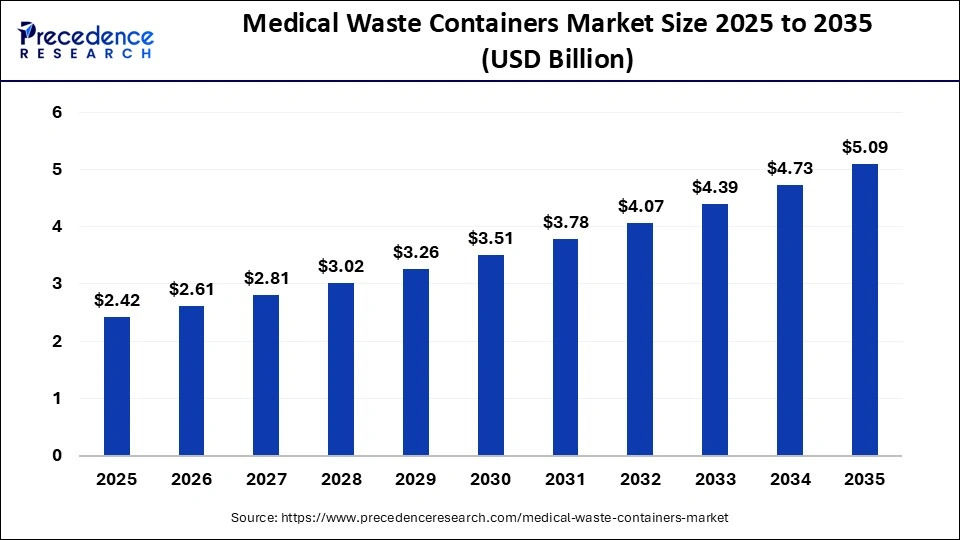
Rohan Patil, a Healthcare Industry Expert, highlights that the medical waste containers market has reached USD 2.61 billion in 2026 and is on track to reach USD 5.09 billion by 2035, advancing at a CAGR of 7.72%. Key medical waste containers market companies shaping the market include Stericycle (acquired by Waste Management Inc.), Becton, Dickinson and Company, Veolia Environnement SA, while major growth segments span By Product, By Type of Waste, By End Use.
Source: https://www.precedenceresearch.com/medical-waste-containers-market
 Get a Sample
 Table Of Content


What is the Medical Waste Containers Market Size in 2026?
The global medical waste containers market size was calculated at USD 2.42 billion in 2025 and is predicted to increase from USD 2.61 billion in 2026 to approximately USD 5.09 billion by 2035, expanding at a CAGR of 7.72% from 2026 to 2035. Rising healthcare expenditure and infrastructure development, coupled with increasing volumes of medical waste, are key factors driving growth in the market.
Key Takeaways
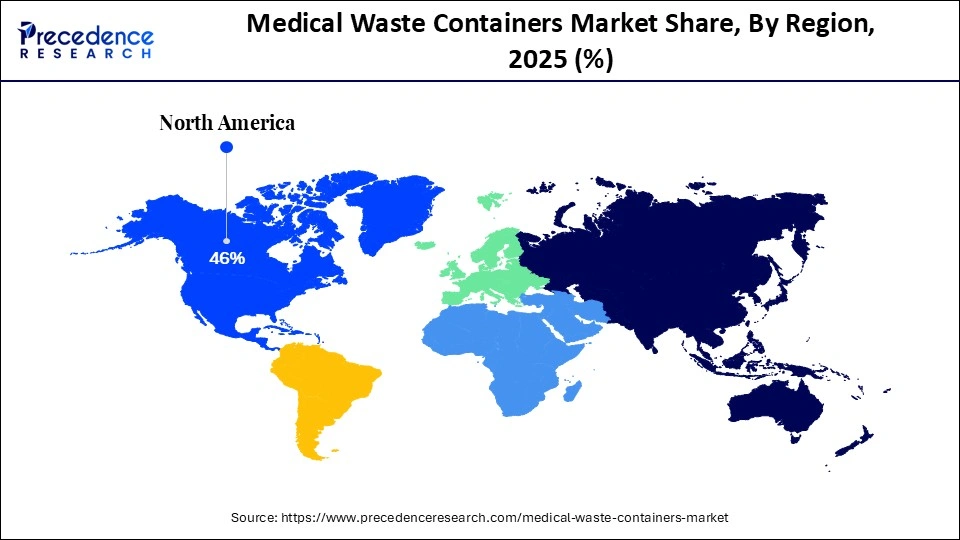
- North America led the medical waste containers market with the biggest market share of 46% in 2025.
- Asia-Pacific is expected to be the fastest-growing region in the forecasted period.
- By product, the chemotherapy containers segment held a major market share of 39% in 2025.
- By product, the Resource Conservation and Recovery Act (RCRA) containers segment is expected to grow at the fastest CAGR in the market during the forecast period.
- By type of waste, the general medical waste segment accounted for a considerable market share of 36% in 2025.
- By type of waste, the infectious medical waste segment is expected to host the fastest-growing segment in the coming years.
- By end use, the hospitals and private clinics segment captured the biggest market share of 38% in 2025.
- By end use, the diagnostic laboratories segment is expected to experience the fastest growth during the predicted timeframe.
Medical Waste Containers Market Overview
Medical waste must be carefully contained and disposed of before it is collected and consolidated for treatment. These containers are purpose-built to protect both the workers who generate medical waste and those who handle, transport, and dispose of it. From the point of generation through to final disposal, safety and compliance needs are fueling widespread adoption of medical waste containers across healthcare facilities.
Container colors typically vary by waste stream in accordance with state and federal regulations, increasing demand for differentiated, regulation-aligned products. In parallel, staff working in areas where medical waste is generated must be trained to correctly handle and dispose of healthcare waste. Such training usually covers waste segregation, proper packaging procedures, and the risks of improper waste management, all of which reinforce the need for standardized, compliant container solutions and support their consistent use.
Impact of Artificial Intelligence on Medical Waste Containers Market
The integration of artificial intelligence (AI) in waste management is a boon for environmental sustainability. The deployment of AI driven sensors and IoT enabled containers enhances safety by continuously monitoring fill levels and container integrity, and by alerting staff to potential leaks, contamination, or overflows. This proactive, real-time monitoring helps prevent accidents, reduce exposure to hazardous materials, and support a safer healthcare environment. A pilot study reported a 40% improvement in compliance rates following RFID-AI integration, underscoring the potential of smart tracking and automated alerts to strengthen adherence to waste segregation and disposal protocols.
Current medical waste management in many low- and middle-income countries relies on manual, paper-based tracking and visual checks, leading to hazardous misclassification and improper disposal, resulting in worker injuries and environmental contamination. AI driven analytics can address these inefficiencies by generating actionable insights into waste generation patterns across departments and time periods. By predicting high waste production intervals, hospitals can optimize resource allocation, adjust collection schedules, and better manage logistics and staffing, ultimately improving both operational efficiency and regulatory compliance.
Medical Waste Containers Market: Key Trends
- Smart Technology Intervention in Medical Waste Containers: The integration of smart technologies into medical waste containers is driving market growth, as containers with built in sensors, GPS tracking, and RFID technology gain widespread adoption for efficient monitoring and regulatory compliance.
- Transition Towards Next-Gen Containers: Next generation technologies, such as IoT enabled containers and AI driven monitoring, are enhancing medical waste segregation while redefining product standards and reshaping competitive dynamics in the market.
Increasing Emphasis on Safe and Sustainable Waste Handling: Heightened emphasis on environmental safety, sustainability, and infection control is driving increased preference for compliant, high performance medical waste containers across hospitals and clinics worldwide.
Market Scope
| Report Coverage | Details |
| Market Size in 2025 | USD 2.42 Billion |
| Market Size in 2026 | USD 2.61 Billion |
| Market Size by 2035 | USD 5.09 Billion |
| Market Growth Rate from 2026 to 2035 | CAGR of 7.72% |
| Dominating Region | North America |
| Fastest Growing Region | Asia-Pacific |
| Base Year | 2025 |
| Forecast Period | 2026 to 2035 |
| Segments Covered | Product, Type of Waste, End Use, and Region |
| Regions Covered | North America, Europe, Asia-Pacific, Latin America, and Middle East & Africa |
Medical Waste Containers Market Dynamics
Driver
Expansion of Healthcare Infrastructure
Rising healthcare expenditure and infrastructure development, coupled with increasing volumes of medical waste and a growing emphasis on infection control and sustainability, are accelerating demand for advanced, compliant medical waste containers. Emerging economies, such as the Middle East and Africa and Latin America, develop a specialized infrastructure to handle large volumes of medical waste.
Restraint
Improper Segregation at Source
The market faces formidable challenges, including the improper segregation of medical waste at source. Professionals can throw non-hazardous waste into hazardous waste bins, thereby increasing disposal costs and violating safety protocols. This usually occurs in regions with a lack of trained professionals with proper disposal management.
Opportunity
Expanding Training and Awareness Ecosystem
The need for structured training and awareness in medical waste handling, including segregation, packaging, and safe container usage, presents a key opportunity to drive the adoption and standardization of medical waste containers across healthcare and associated workplaces.
Segmental Insights
Product Insights
Which Product Segment Dominated the Medical Waste Containers Market?
The chemotherapy containers segment dominated the market in 2025, due to the rising prevalence of cancer and an increase in inpatient admissions of cancer patients. According to the WHO, more than 35 million new cancer cases are projected by 2050, representing a 77% increase from an estimated 20 million cases in 2022. This rapidly growing global cancer burden, driven largely by ageing populations, is significantly increasing the volume of chemotherapy-related waste.
The higher incidence of cancer and the expanding use of chemotherapy treatments are driving demand for specialized containers designed to safely collect, store, and dispose of hazardous cytotoxic waste. In addition, stringent regulatory frameworks and safety standards are compelling healthcare facilities to implement compliant medical waste management practices. These factors are collectively promoting the widespread adoption of chemotherapy containers.
The Resource Conservation and Recovery Act (RCRA) containers segment is expected to show the fastest growth over the forecast period, driven by its critical role across the entire hazardous waste lifecycle, including generation, transportation, treatment, storage, and disposal. RCRA containers are specifically engineered to address environmental risks associated with hazardous substances, such as leaks from underground storage tanks containing petroleum and other dangerous materials.
Designed in line with stringent regulatory requirements, these containers ensure compliance throughout the waste management process, encouraging healthcare providers and waste handlers to invest in RCRA-certified solutions to minimize legal liabilities and enhance overall safety standards.
Type of Waste Insights
How the General Medical Waste Segment Dominated the Medical Waste Containers Market?
The general medical waste segment held a dominant position in the market in 2025, driven by the fact that an estimated 75%–90% of waste generated by healthcare facilities is non risk general waste, according to UNEP and WHO. General medical waste consists of materials that have not been in contact with infectious agents, hazardous chemicals, or radioactive substances and do not pose a sharps hazard. More than half of this non hazardous waste stream typically comprises paper, cardboard, and plastics, reinforcing the segment's growth.
The infectious medical waste segment is expected to gain the highest market share between 2026 and 2035. Infectious waste represents about 15% of global healthcare waste, and strict regulations around its collection, treatment, and disposal are driving adoption of specialized, compliant procedures. Post COVID-19, tighter regulatory oversight and higher infection prevention standards are further boosting the demand for safe, efficient, and environmentally responsible infectious waste management solutions, supporting a strong growth outlook for this segment.
End Use Insights
Which End Use Segment Led the Medical Waste Containers Market?
The hospitals and private clinics segment led the market in 2025, due to higher patient volumes and comprehensive healthcare services. Their integrated diagnostics, specialized treatments, and inpatient care generate larger quantities of infectious, sharp, and pathological waste than other end-use segments. In addition, strict adherence to regulatory standards, reinforced by routine inspections and audits, drives proper segregation, handling, and disposal, further solidifying their leading market position.
The diagnostic laboratories segment is expected to expand rapidly in the market in the coming years, driven by strict regulatory compliance requirements for the collection, segregation, storage, and disposal of diverse medical waste streams, including general, infectious, and occasionally radioactive waste. Closely linked with hospitals and physicians, these labs handle rising test volumes using advanced instruments, prompting regulators and accrediting bodies to maintain rigorous oversight through licensing and regular audits. Growing testing demand, complex waste profiles, and sustained regulatory scrutiny also contribute to the segment's growth.
Regional Insights
North America Medical Waste Containers Market Size and Growth 2026 to 2035
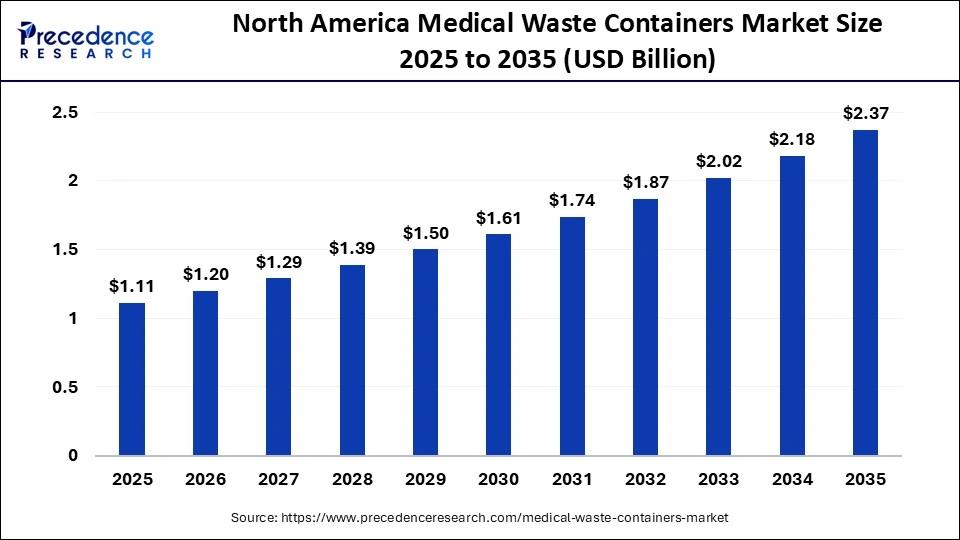
The North America medical waste containers market size is estimated at USD 1.11 billion in 2025 and is projected to reach approximately USD 2.37 billion by 2035, with a 7.88% CAGR from 2026 to 2035.
Why North America Dominated the Medical Waste Containers Market?
North America held a major market share in 2025, driven by the rapid adoption of advanced waste management technologies and a robust regulatory framework. Stringent regulations, particularly the RCRA, govern the handling, transport, and disposal of medical and hazardous waste, compelling healthcare facilities to implement compliant, specialized container solutions. The strong presence of key regulatory bodies, including the DOT, OSHA, and EPA, further reinforces adherence to strict safety and environmental standards, resulting in high adoption rates of certified medical waste containers across the region.
Additionally, the substantial volumes of regulated medical waste generated by hospitals, diagnostic laboratories, pharmaceutical manufacturers, and research institutions necessitate rigorous waste segregation, containment, and disposal practices. This combination of high waste generation, advanced technology uptake, and stringent oversight underpins North America's leading position in the global market.
U.S. Medical Waste Containers Market Size and Growth 2026 to 2035
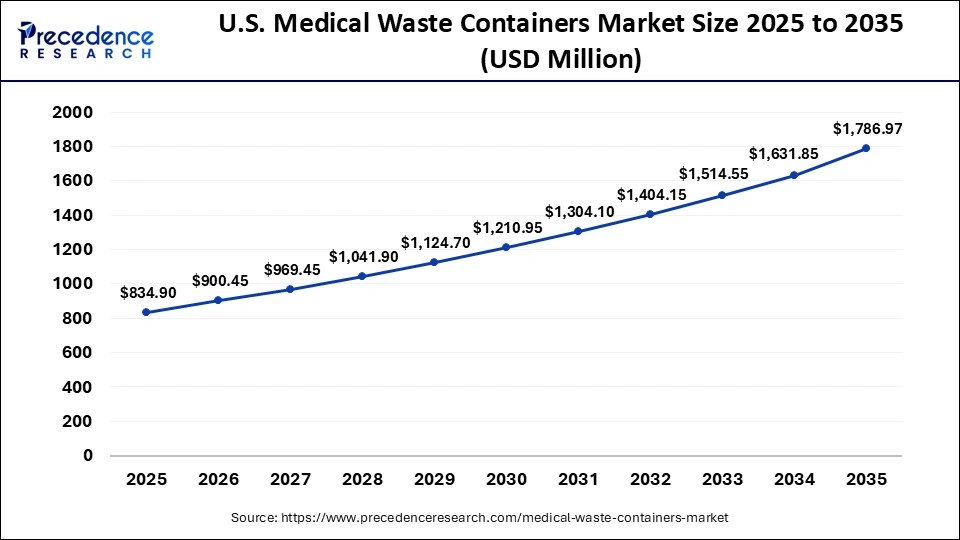
The U.S. medical waste containers market size is calculated at USD 834.90 million in 2025 and is expected to reach nearly USD 1,786.97 million in 2035, accelerating at a strong CAGR of 7.91% between 2026 and 2035.
U.S. Market Trends
The U.S. accounts for the largest share of regional revenue, supported by significant investments in smart container technologies and sustainable waste management solutions. Strong focus on infection prevention, and the growing need for safe, compliant disposal methods are collectively driving demand for specialized medical waste containers.
In addition, the presence of large integrated health systems, academic medical centers, and specialized oncology and surgical centers across major urban hubs creates a substantial and recurring volume of regulated medical waste. This concentration of high-acuity care settings, combined with ongoing modernization of waste handling infrastructure, reinforces the U.S. position as the dominant in North America.
How is Asia-Pacific Growing in the Medical Waste Containers Market?
Asia-Pacific is expected to host the fastest-growing market in the coming years, fueled by rapid industrialization, expanding manufacturing bases, accelerating urbanization, and the increasing adoption of cost efficient technologies. Government initiatives to strengthen medical waste management, alongside the rising prevalence of infectious diseases, growing hospital admissions, and an expanding medical tourism sector, are driving higher medical waste volumes and, in turn, increasing demand for medical waste containers across the region. Countries such as China, India, and emerging Southeast Asian economies are accelerating healthcare infrastructure development and technological integration, creating substantial market opportunities.
China Market Trends
China leads the market in Asia-Pacific, driven by the rising number of healthcare facilities, increasing volumes of medical waste, stricter regulatory requirements for waste management, and heightened awareness of the environmental and health risks associated with improper disposal. These dynamics are further supporting the growing demand for customized medical waste containers designed for specific types of waste, reinforcing China's position in the market.
Why is Europe Setting Higher Standards in the Medical Waste Containers Market?
Europe region is expected to grow at a significant rate of market share between 2026 and 2035, due to the tightening infection-control mandates across healthcare facilities. Puncture-resistant capsules began to be used by hospitals to carry these changes over to safer segregation practices and less contamination risk.
Germany Expanding Advanced Medical Waste Container Deployment
Germany is a major contributor to the European market, driven by the initiation of sustainable activity in hospitals and compliance programs regarding hazardous waste. According to the Federal Statistical Office of Germany, inpatient treatment volumes exceeded 16 million cases during recent healthcare reporting periods, increasing biomedical waste generation requirements. (https://link.springer.com/article/10.1186/s12889-026-27522-x)
How is the Middle East & Africa Accelerating Medical Waste Container Adoption
The Middle East and Africa region is expected to register significant growth in the market during 2026 and 2035, driven by the need for tamper-proof waste containers in the region.
Saudi Arabia Accelerating Medical Waste Container Modernization
Saudi Arabia is a major player in the Middle East and Africa market, owing to the enforcement of stricter monitoring of biomedical waste. Rising surgical procedure volumes increased demand for puncture-resistant sharps containers and high-capacity infectious waste storage systems.
Why is Latin America Emerging as a Fast-Growing Medical Waste Containers Hub?
The Latin America region is estimated to grow at a strong CAGR over the projected period, driven by the enhancement of regulatory enforcement of biomedical waste and healthcare modernization initiatives. There has been an increase in the spread of healthcare sustainability programs in several healthcare systems in Latin America, with a greater rate of implementation of reusable and recyclable medical waste containers.
Brazil Becoming a High-Growth Country in Latin America
Brazil leads the regional Latin America market, propelled by an increase in healthcare investments and this country's recent and increasingly stricter regulations around infectious waste disposal. Population growth in oncology treatment units brought about greater demand for chemotherapy and toxic drug waste disposal bins in metropolitan health care systems.
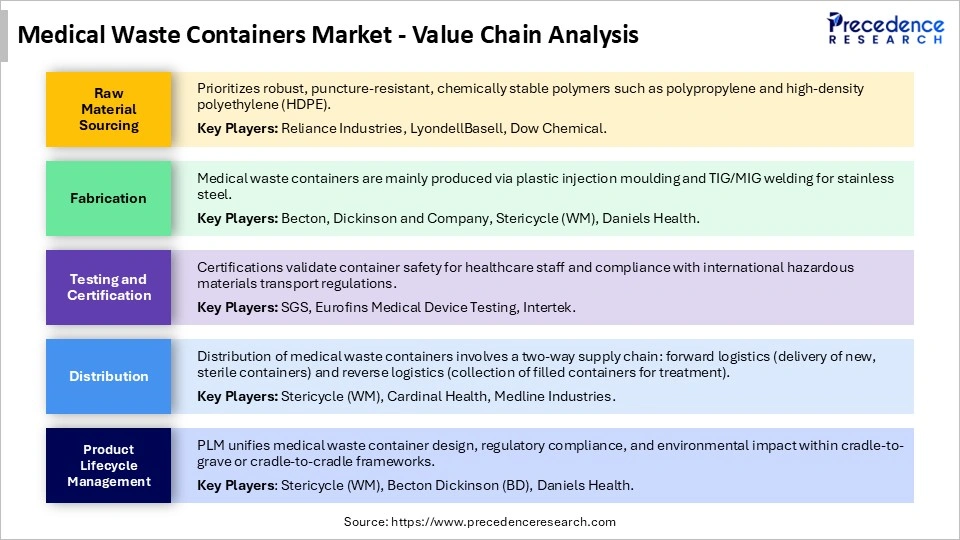
Medical Waste Containers Market Value Chain Analysis
Competitive Landscape
The global medical waste containers market is semi-consolidated with high competition among the players. There is an integrated waste collection system, which gives a competitive advantage to large healthcare waste companies. Stericycle, Veolia, Clean Harbors, Daniels Health, and BD are some of the key players. Regional companies boost their profile with contracts in hospitals and waste logistics connections.
Track and RFID technology are changing Container Waste Management Systems. Smart bins help companies with efficient real-time monitoring of waste. Advanced polymer engineering creates more puncture- and leak-resistant properties. Compliance and safety are enhanced in hospital waste segregation through automation. The emphasis will be on the adoption of sustainable technologies and reusable container technologies in upcoming competitions.
Medical Waste Containers Market Companies
- Stericycle (acquired by Waste Management Inc.)
- Becton, Dickinson and Company
- Veolia Environnement SA
- Cardinal Health
- Clean Harbors, Inc.
- Daniels Health
- SUEZ S.A.
- Sharps Medical Waste Services (formerly Sharps Compliance)
- Republic Services, Inc.
- Thermo Fisher Scientific Inc.
- Bemis Manufacturing Company
- Remondis Medison GmbH
- Mauser Packaging Solutions
- Medtronic Plc.
- Henry Schein, Inc.
Recent Developments
- In November 2025, the University Hospitals Sussex NHS Foundation Trust launched a clinical recycling scheme by partnering with an environmental charity to turn non-infectious clinical waste into reusable training tools. Approximately £35,000 was saved, and the scheme diverted 25,000 clinical items from incineration.(Source: https://www.bbc.com)
- In September 2025, UNICEF and the World Bank announced an initiative to strengthen healthcare waste management in Afghanistan through the Health Emergency Response project, which is equipping hospitals across 24 provinces with resources to improve safe waste disposal and infection prevention.(Source: https://www.unicef.org)
- In October 2025, researchers developed a method to convert medical saline containers into clean-burning fuel using pyrolysis and nanotechnology. This innovation may offer a sustainable solution to both plastic waste and growing energy demands. The goal was to develop a method that mitigates waste and yields a high-performance alternative to conventional fossil fuels.(Source: https://www.azonano.com)
Segments Covered in the Report
By Product
- Chemotherapy Containers
- Biohazardous Medical Waste Containers
- Resource Conservation and Recovery Act (RCRA) Containers
- Others
By Type of Waste
- General Medical Waste
- Infectious Medical Waste
- Hazardous Medical Waste
- Others
By End Use
- Hospitals and Private Clinics
- Diagnostic Laboratories
- Research Institutes
- Others
By Region
- North America
- Latin America
- Europe
- Asia-pacific
- Middle and East Africa
For inquiries regarding discounts, bulk purchases, or customization requests, please contact us at sales@precedenceresearch.com
Frequently Asked Questions





Ask For Sample
No cookie-cutter, only authentic analysis – take the 1st step to become a Precedence Research client
 Get a Sample




 sales@precedenceresearch.com
 Schedule a Meeting
