



Micro-mobility Charging Infrastructure Market Size, Key Companies, Company Product Portfolio, OEM Production, Aftermarket Demand, Export Dependency, Cost Structure, Adoption Rates, Company Expansion Strategies, and Competitive Landscape
Micro-mobility Charging Infrastructure Market (By Vehicle type: E- scooter, E- bikes, E-unicycles, E-skateboards; By Charger: Wired Charger, Wireless Charger; By Power Source: Battery Powered, Solar Powered; By End User: Residential, Commercial; By Geography: North America , Europe ,Asia-Pacific, Latin America, Middle East & Africa (MEA) ) - Global Industry Analysis, Size, Trends, Leading Companies, Regional Outlook, and Forecast 2026 to 2035
Source: https://www.precedenceresearch.com/micro-mobility-charging-infrastructure-market
 Get a Sample
 Table Of Content


What is the Micro-mobility Charging Infrastructure Market Size?
The global micro-mobility charging infrastructure market size is calculated at USD 8.57 billion in 2025 and is predicted to increase from USD 10.78 billion in 2026 to approximately USD 79.76 billion by 2035, expanding at a CAGR of 24.99% from 2026 to 2035. The micro-mobility charging infrastructure market is growing due to the adoption of micromobility electric vehicles.
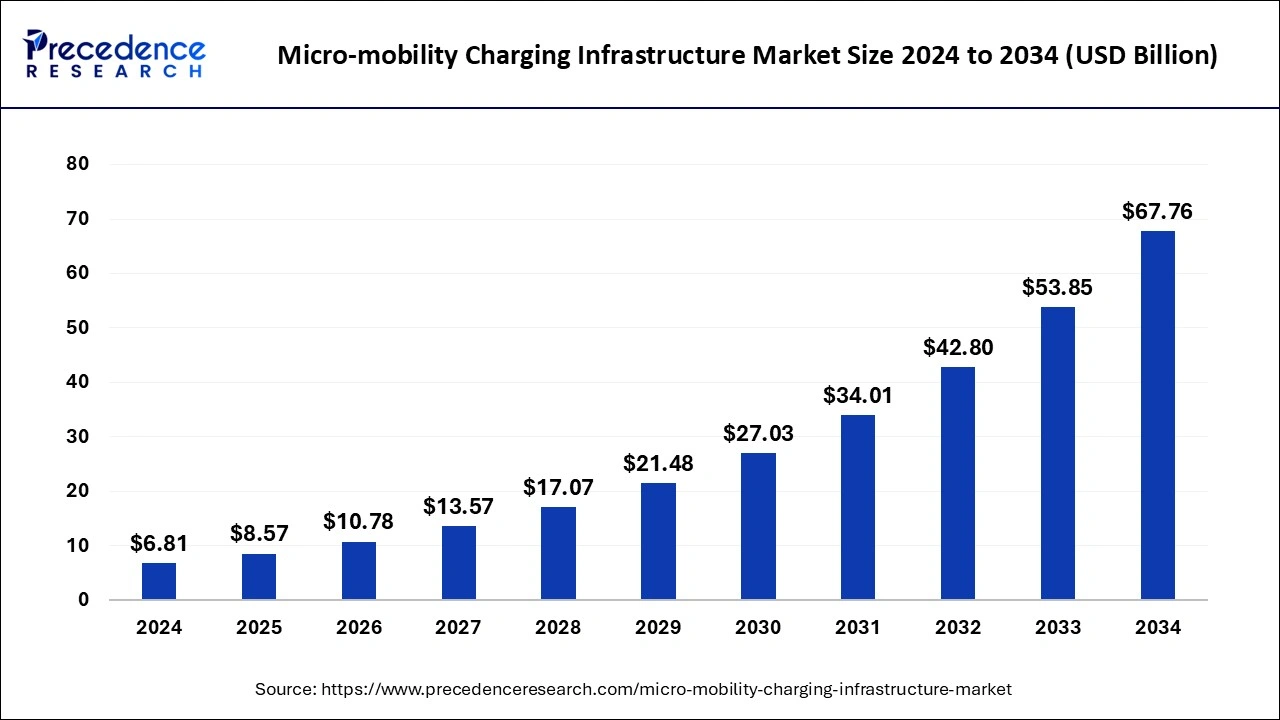
Micro-mobility Charging Infrastructure Market Key Takaways
- Asia Pacific dominated the global micro-mobility charging infrastructure market with the largest market share of 45% in 2025.
- North America is expected to expand at a double digit CAGR of 27.4% during the forecast period.
- By end user, the residential segment contributed the highest market share of 69% in 2025.
- By end user, the commercial segment is projected to grow at a solid CAGR during the forecast period.
- By vehicle type, the e-scooters segment has held a major market share of 62% in 2025.
- By charger, the wired segment generated the biggest market share of 54% in 2025.
- By charger, the wireless segment is expected to grow at a notable CAGR of 26.6% during the forecast period.
- By power source, the battery powered segment accounted for the highest market share of 57% in 2025.
- By power source, the solar-powered segment is projected to grow at a significant CAGR of 27% over the forecast period.
What is Meant by Micro-mobility Charging Infrastructure Market?
The e-scooters or the e-bikes, which is comprise of the micro mobility for sustainable travel mode due to the rising adoption of environmental policies and stringent rules to reduced environmental pollution and improve the mode of transportation. A rise in the market is expected during the forecast. Many companies across the globe are providing potential for this market to flourish. Due to the lockdown during pandemic, the demand for public transportation had declined as people were asked to stay at home. Due to this, the profits have suffered to a large extent. The expected market expansion has also hindered during the forecast period.
There has been a strain on the economy and many businesses have come down. Since many people are working from home there's been a decline in the revenue. When covering long distance or for longer drives, charging stations are required. The costs of these charging stations vary some charge by the minute, while others charged by the energy received. Charging racks are set up, which also help in solving the parking situation for scooters and bike. When the vehicles are parked in the charging rack, it reduces the risk of theft. Also, it provides for a fixed location for the customers to look at. The wireless charging system or the charging infrastructure reduces the need for servicing as it eliminates any mechanical wear and tear.
How is AI Transforming the Charging Infrastructure?
AI assists in addressing important issues in the micro-mobility sector, including damage detection, pricing schemes, fleet rebalancing, and parking management. AI systems started to optimize charging schedules according to customer preferences, grid capacity, and energy consumption.
Predictive maintenance of charging infrastructure was made possible by machine learning techniques, guaranteeing dependability and effectiveness. The future of micromobility will be more shaped by AI technology as it develops further, propelling the sector toward more intelligent and environmentally friendly urban transportation options.
Micro-mobility Charging Infrastructure Market Outlook
- Industry Growth Overview: The market is experiencing solid, double-digit growth driven by rapid urbanization, growing fuel costs, and smart city initiatives, with e-scooters leading demand, and major trends targeting on integration with public transport, eco-friendly solutions, and also innovative charging tech such as solar-powered or inductive chargers to meet increasing need for sustainable, convenient last-mile transport.
- Major Investors: Major investors in micro-mobility charging infrastructure involve Venture Capitalists (VCs) such as Sequoia Capital, B Capital Group, Accel; Corporate Investors from tech, auto, and energy sectors (e.g., Tata Power, Bosch, Samsung); Government Grants & Initiatives (such as US Joint Office funding); and even Micro-mobility Operators themselves (Ather Energy, Lime).
- Startup Ecosystem: It is booming, driven by high fuel costs, urbanization, and green initiatives, creating huge opportunities for innovative solutions such as smart charging, battery swapping, and even integrated networks for e-scooters/bikes.
What are the Growth Factors in the Micro-mobility Charging Infrastructure Market?
- Increasing investments: As many nations are increasing investments in micro-mobility like electric scooters and other modes of transport, this happens to be a factor in the growth of this infrastructure. Land investments are made in order to install this infrastructure in many countries for ease of use of micro-mobility.
- Sustainability & reduction of carbon footprint: Other factors that help in the growth of this market is the reduction of carbon footprint, which happens due to the increased greenhouse gas emissions.
- Increased public awareness: Also, public awareness in the public regarding the flexible transport alternative and the surging focus of government towards renewable sources are the most important factors for boosting the micro-mobility charging infrastructure.
- Technological advancements: Various technological developments, progressions, and growing trends compel automobile companies to produce environmentally friendly vehicles. The sales of e-bikes are expected to rise due to the development of various charging stations globally
Market Scope
| Report Coverage | Details |
| Market Size by 2035 | USD 79.76 Billion |
| Market Size by 2026 | USD 10.78 Billion |
| Market Size in 2025 | USD 8.57 Billion |
| Growth Rate from 2026 to 2035 | CAGR of 24.99% |
| Largest Market | Asia Pacific |
| Base Year | 2025 |
| Forecast Period | 2026 to 2035 |
| Segments Covered | Vehicle Type, Power Source, Charger, End User, Geography |
| Regions Covered | North America, Europe, Asia-Pacific, Latin America, and Middle East & Africa |
Market Dynamics
Driver
Growing fuel prices
New energy vehicles (NEVs) with cost-effective, energy-efficient, and environmentally friendly characteristics have become popular trends as a result of the automotive industry's success in reforming the sector to address challenges, including environmental pollution, rising gas costs, and the energy crisis. NEV users may feel "superior" in their social circle compared to fuel car users, which might be a result of their favorable reputation and social standing. Additionally, a number of studies demonstrate that people's psychological attitudes toward using NEVs are reflected in their views toward the environment and gasoline prices, with positive sentiments toward NEVs encouraging people to switch from their current fuel-powered vehicles to NEVs.
Restraint
Range anxiety & other barriers
Consumer concerns about a number of significant battery-related difficulties, including restricted range, lengthy charging times, a shortage of charging stations, and expensive starting costs, pose significant obstacles to the widespread adoption of BEVs. Current approaches to overcoming these obstacles include stationary vehicle-to-vehicle (V2V) charging, expanding battery capacity, and constructing more charging stations.
Opportunity
Better infrastructure development
Although home charging presently satisfies the majority of charging demand, public chargers are becoming more and more necessary to offer the same degree of accessibility and convenience as traditional car refueling. Public PHEV charging should be included in (and encouraged by) policy-making on the adequate availability of charging stations, even if PHEVs are less dependent on public charging infrastructure than BEVs.
Segments Insights
[[segment_insights]]
Regional Insights
[[regional_insights]]
Value Chain Analysis of Micro-mobility Charging Infrastructure Market
- Vehicle Assembly and Integration
It involves a multi-step process, from the production of individual components to the final installation alongside integration with the electrical grid together with smart city networks. The primary goal is to manufacture reliable, safe, and interoperable charging solutions for e-bikes, e-scooters, and e-rickshaws. - Testing and Quality Control
It includes a comprehensive, multi-stage process which ensures safety, performance, interoperability, and even regulatory compliance from production to operation. This involves rigorous testing of both hardware as well as software components.
Micro-mobility Charging Infrastructure Market Companies
- Robert Bosch, GmbH: Bosch provides software, hardware, and even integrated solutions for micro-mobility charging, aiming on smart, connected, and efficient energy management, which includes a large charging network app, backend systems for fleet operators, and hardware for vehicles, supporting seamless integration with smart city/building energy grids for improving charging with solar/dynamic pricing.
- Bikeep: Bikeep provides secure, smart, docked charging and even parking hubs for e-bikes and e-scooters, thus, featuring frame/wheel locking, alarms, integrated surveillance, and connectivity for easy access through phone/transport card, solving theft/vandalism.
Other Major Key Players
- Bike energy.
- Ather energy
- Flower turbines.
- Ground control systems.
- Perch mobility.
- Solum PV.
- Magment GmbH.
- The Mobility House GmbH.
- SWIFTMILE
Recent Developments
- In December 2024, the largest EV charger manufacturer in India, Servotech Power Systems Ltd., partnered with LESSzwei GmbH (LESS2), a globally operating German company that assists the German government in accomplishing its goals in the area of sustainable development in the infrastructure sector, to create and implement cutting-edge, fully solar-powered EV charging infrastructure for micro-mobility, including e-bikes, e-scooters, and e-cargo bikes, in German cities.
- In July 2024, In Amsterdam, New York, re:Charge and the Capital District Transportation Authority (CDTA) are testing a brand-new universal wireless charging system for e-bikes. The CDPHP Cycle! The shared micro-mobility program is supported by this effort.
Segments covered in the Report
[[segment_covered]]
For inquiries regarding discounts, bulk purchases, or customization requests, please contact us at sales@precedenceresearch.com
Frequently Asked Questions





Ask For Sample
No cookie-cutter, only authentic analysis – take the 1st step to become a Precedence Research client
 Get a Sample




 sales@precedenceresearch.com
 Schedule a Meeting
