



Multilingual LLM Market Trends, Companies, Revenue / Sales Performance, Subscriber Growth, Pricing Strategies, Cloud Adoption, Infrastructure Expansion, Competitive Landscape, and Industry Outlook
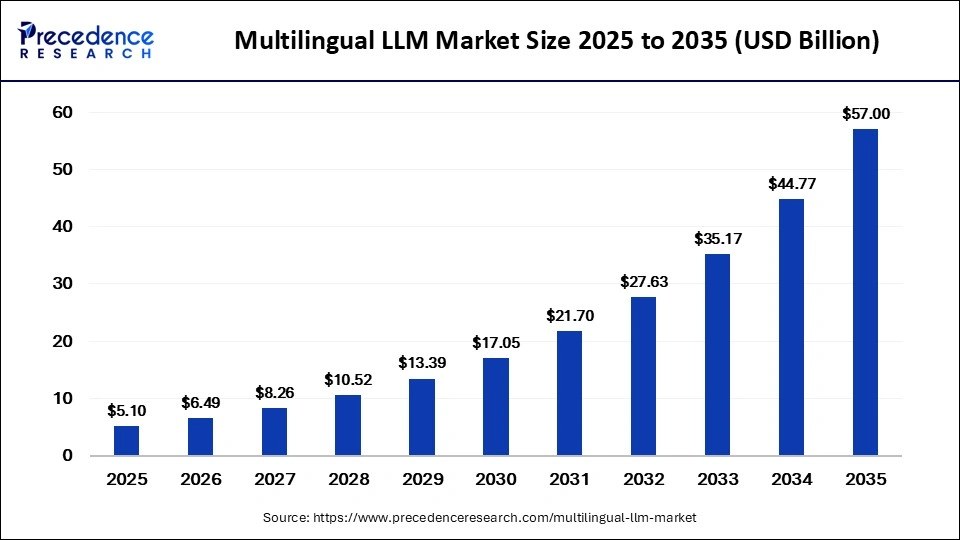
ICT industry specialist Gautam Mahajan estimates the multilingual LLM market at USD 6.49 billion in 2026, with continued technology adoption expected to take the market to USD 57.00 billion by 2035 at a CAGR of 27.30%. Leading multilingual LLM market providers such as OpenAI, Google, Microsoft, Meta are expanding their capabilities across segments including By Model Type, By Deployment Model, By Technology, By Application, By End-Use Industry, By Organization Size.
Source: https://www.precedenceresearch.com/multilingual-llm-market
 Get a Sample
 Table Of Content


What is the Multilingual LLM Market Size in 2026?
The global multilingual LLM market size accounted for USD 5.10 billion in 2025 and is predicted to increase from USD 6.49 billion in 2026 to approximately USD 57.00 billion by 2035, expanding at a CAGR of 27.30% from 2026 to 2035. The market is driven by the global growth of non-English digital economies. Regions like APAC, including India, China, South Korea, the Middle East, and South America, need local language AI services for meaningful participation.
Key Takeaways
- North America dominated the global market with a share of 42% in 2025.
- Asia-Pacific is expected to grow at the fastest CAGR of 32.5% during the forecast period.
- By deployment mode, the cloud-based segment accounted for a revenue share of 85% in the multilingual LLM market in 2025.
- By deployment mode, the on-premise segment is expected to grow at a 12.5% CAGR between 2026 and 2035.
- By technology, the transformer models segment accounted for a revenue share of 40% in the market in 2025.
- By technology, the RAG segment is expected to grow at the fastest 31.5% CAGR between 2026 and 2035.
- By application, the translation and localization segment accounted for a revenue share of 28% in the multilingual LLM market in 2025.
- By application, the content generation segment is expected to grow at the fastest 30.5% CAGR between 2026 and 2035.
- By end-use industry, the IT and telecom segment accounted for a revenue share of 30% in the market in 2025.
- By end-use industry, the retail and e-commerce segment is expected to grow at the fastest 31.5% CAGR between 2026 and 2035.
Market Overview
The multilingual LLM market consists of AI models programmed to understand, process, and generate text across multiple languages, breaking down language barriers for global applications. Businesses are increasingly accepting AI for content curation, generation, and localization, demanding models that can understand cultural nuances and handle brand voice across borders. The need for more natural, efficient, and interactive AI experiences drives the acceptance of multilingual agents in customer service and even virtual assistant roles.
How is AI Influencing the Multilingual LLM Market?
Artificial intelligence is fundamentally changing the market from an English-centric landscape into a truly worldwide, "glocalized" ecosystem. Countries are thus investing in sovereign AI to guarantee models reflect local languages and cultural values, like Bhashini in India. This limits reliance on Western-centric models and enhances accuracy in regional dialects. The market is rapidly moving toward models that simultaneously process text, voice, and video, providing more intuitive interfaces. AI has moved beyond simple word-for-word translation to understanding cultural context, idiomatic expressions, and tone.
Multilingual LLM Market Trends
- Multilingual capability is now a core architectural objective, with the specialized models trained to manage diverse language nuances, not just translation.
- Models are evolving to process image, text, and audio concurrently, with trends thus highlighting multimodal integration for improved global communication.
- Domain-specific LLMs, for example, finance, legal, and healthcare, are growing rapidly, providing higher accuracy for specialized languages.
- The content generation and the curation segment hold the largest revenue share, with firms using multilingual LLMs to create marketing and media content.
Market Scope
| Report Coverage | Details |
| Market Size in 2025 | USD 5.10 Billion |
| Market Size in 2026 | USD 6.49 Billion |
| Market Size by 2035 | USD 57.00 Billion |
| Market Growth Rate from 2026 to 2035 | CAGR of 27.30% |
| Dominating Region | North America |
| Fastest Growing Region | Asia Pacific |
| Base Year | 2025 |
| Forecast Period | 2026 to 2035 |
| Segments Covered | Model Type, Deployment Model, Technology, Application, End-Use Industry, Organization Size, and Region |
| Regions Covered | North America, Europe, Asia-Pacific, Latin America, and Middle East & Africa |
Market Dynamics
Drivers
Enterprise Adoption of Generative AI
The enterprise adoption of generative AI is the driving factor for the multilingual LLM market because firms are shifting from experimental AI to production-ready applications, which must function across global markets. Firms face high reputation risks if AI assistance in Japanese, Spanish, or Arabic is inferior to English. They demand multilingual models to offer uniform quality. Multinational firms use multilingual LLMs to generate culturally relevant content along with product descriptions in dozens of languages simultaneously, decreasing operational expenses and improving engagement.
Restraint
High Computational and Financial Costs
The high computational and financial costs act as a major restraint on the global multilingual LLM industry because training and deploying models over multiple languages require exponential increases in resources compared to monolingual models. Multilingual models demand vast, high-quality datasets in dozens of languages to avoid performance gaps. Acquiring, cleaning, and annotating this diverse data is resource-intensive and expensive.
Opportunity
Domain-Specific Models
Domain-specific models are an opportunity in the global multilingual LLM market because they solve the accuracy, trust, and expense issues of general-purpose models by specializing in industry-specific language, jargon, and multilingual nuances. They provide higher reliability for enterprise applications in sectors such as healthcare, law, and finance. In regulated sectors such as finance and healthcare, DSMs offer fewer hallucinations and more accurate, thus verifiable information compared to general-purpose LLMs. Organizations can deploy these models on private servers, enabling them to train AI on proprietary, sensitive information without it leaving their secure environment.
Segment Insights
Deployment Model Insights
The Cloud-based Segment Held 85.00% of Market Share in 2025
The cloud-based segment dominated the multilingual LLM market with a share of 85% in 2025, owing to AI-as-a-service dominance. Moreover, cloud LLMs can effortlessly scale up or down based on real-time traffic, which is vital for unpredictable AI workflows. Organizations gain instant access to advanced hardware, for example, NVIDIA H100s, which would be cost-prohibitive to own privately.
Multilingual LLM Market Share, By Deployment Mode, 2025-2035 (%)
| Deployment Mode | 2025 | 2035 | CAGR (%) |
| Cloud-based | 85.00% | 92.00% | 30.50% |
| On-premise | 15.00% | 8.00% | 12.50% |
The on-premise segment held a 15% share of the market in 2025 and is expected to grow at the fastest CAGR of 12.5% during the projection period. This is mainly due to the data security. Many regulations demand that sensitive information, mainly in local languages, stay within geographical or corporate boundaries, which cloud services usually cannot guarantee. Moreover, enterprises can fine-tune multilingual models on their own proprietary datasets, which results in higher accuracy for specific dialects or terminologies, which is vital for international business.
Technology Insights
Multilingual LLM Market Share, By Technology, 2025-2035 (%)
| Technology | 2025 | 2035 | CAGR (%) |
| Transformer Models | 40.00% | 35.00% | 24.50% |
| RAG | 20.00% | 25.00% | 31.50% |
| Fine-tuned Models | 20.00% | 18.00% | 25.5% |
| Open-source Frameworks | 20.00% | 22.00% | 28.5% |
Why Did the Transformer Models Segment Lead the Multilingual LLM Market in 2025?
The transformer models segment held a dominant position in the market, with a share of 40% in 2025, driven by the core architecture. Moreover, parallel processing capabilities enable them to train on vast, diverse multilingual datasets much faster than previous architectures. The core innovation of "self-attention" allows these models to understand complex linguistic nuances over 7,000+ languages by thus weighing the relationships between words regardless of their distance in a sentence.
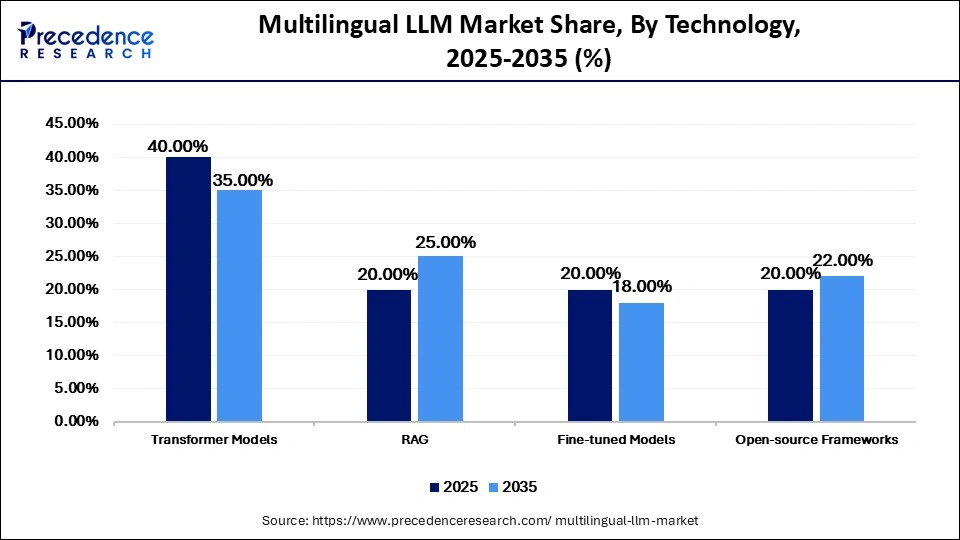
The RAG segment held a 20% share of the market in 2025 and is expected to grow at the fastest CAGR of 31.5% during the projection period, driven by real-time knowledge integration. RAG grounds LLM responses in verifiable and external knowledge sources, for example, proprietary databases and documents. This dramatically decreases the tendency of LLMs to generate plausible-sounding but incorrect data. RAG systems allow users to cite sources, enabling them to verify information and raise trust in critical sectors like law and healthcare. By retrieving relevant facts first, the model thus prioritizes accurate, context-aware information over pre-trained general knowledge.
The fine-tuned models segment held 20% of the market share in 2025, due to the availability of pre-trained models and low cost. Fine-tuned models adapt pre-trained models to specialize in specific languages, dialects, or domain-specific tasks. These models are predominantly used in low-resource machine translation, regional and cultural specialization, and domain-specific workflows.
Application Insights
What Made the Translation and Localization Dominant Segment in the Multilingual LLM Market in 2025?
The translation and localization segment dominated the global market with the largest share of 28% in 2025, because of its core multilingual needs. LLM-powered chatbots offer 24/7 support in multiple languages, decreasing operational costs while enhancing customer satisfaction. Beyond translating existing content, LLMs generate original, culturally resonant marketing materials along with product descriptions on demand.
Multilingual LLM Market Share, By Application, 2025-2035 (%)
| Application | 2025 | 2035 | CAGR (%) |
| Translation & Localization | 28.00% | 26.00% | 25.50% |
| Customer Support & Chatbots | 22.00% | 24.00% | 29.5% |
| Content Generation | 20.00% | 22.00% | 30.50% |
| Knowledge Management | 15.00% | 14.00% | 26.50% |
| Voice Assistants | 15.00% | 14.00% | 28.00% |
The customer support and chatbots segment held the second-largest market share of 22% in 2025, due to the increasing need for large and small enterprises to provide customized services. The use of multilingual LLM models enable companies to serve a larger population in diverse countries irrespective of language barriers.
The content generation segment held a 20% share of the market in 2025 and is expected to grow at the fastest CAGR of 30.5% during the projection period. This is mainly due to the generative AI expansion. Multilingual models allow firms to create tailored content in dozens of languages simultaneously, improving customer engagement by decreasing the marginal cost per language.
End-Use Industry Insights
The IT and Telecom Segment Held a 30% Share of the Multilingual LLM Market in 2025
The IT and telecom segment held a dominant position in the market with a share of 30% in 2025 because of early adopters. As developers of AI technology itself, IT/ITeS firms are quick to integrate new AI tools. High R&D investments and even access to skilled manpower allow faster experimentation and the deployment of LLM-based solutions. By using LLMs to assist developers, improve software packages, and speed up the development of 5G and IoT services.
Multilingual LLM Market Share, By End-Use Industry, 2025-2035 (%)
| End-Use Industry | 2025 | 2035 | CAGR (%) |
| IT & Telecom | 30.00% | 32.00% | 29.50% |
| Retail & E-commerce | 20.00% | 22.00% | 31.50% |
| BFSI | 15.00% | 14.00% | 26.50% |
| Healthcare | 12.00% | 13.00% | 28.50% |
| Media & Entertainment | 13.00% | 12.00% | 27.50% |
| Government | 10.00% | 7.00% | 26.00% |
The retail and e-commerce segment held a 20% share of the market in 2025 and is expected to grow at the fastest CAGR of 31.5% during the projection period. This is mainly due to the customer engagement. Retailers must reach international users in their native languages to build trust and raise conversion rates. Multilingual LLMs enable automated, accurate, and culturally nuanced translation of product descriptions, reviews, and even marketing content, eliminating the demand to build separate, expensive content teams for every new market.
The healthcare segment held a 12% market share in 2025, driven by multilingual diagnostics. Multilingual medical LLMs are important for translating complex jargon into accessible language for patients, thus facilitating real-time interpretation for non-native speakers and enhancing access to care. These models can be trained to recognize cultural and legal nuances, improving patient trust and enhancing communication, which is vital for international healthcare accessibility.
Regional Insights
North America Multilingual LLM Market Size and Growth 2026 to 2035
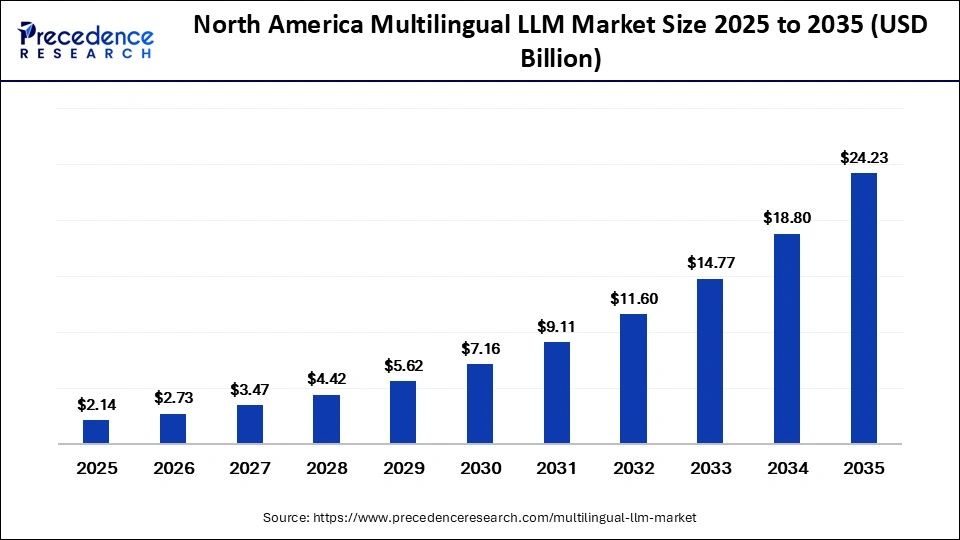
The North America multilingual LLM market size is estimated at USD 2.14 billion in 2025 and is projected to reach approximately USD 24.23 billion by 2035, with a 27.47% CAGR from 2026 to 2035.
Why North America Led the Global Multilingual LLM Market?
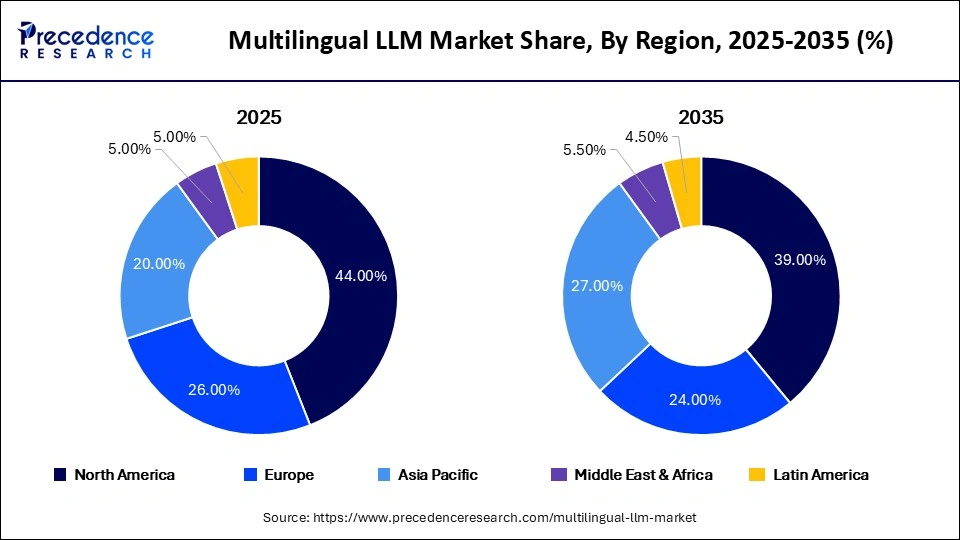
North America led the market by holding a major share of 42% in 2025. This is because of the strong AI ecosystem, hyperscalers, and foundational model leadership. The region boasts advanced computing infrastructure alongside significant R&D spending, accelerating LLM development. Increased need for multilingual services in the U.S. market, driven by diverse demographics and global business operations, fuels specialized model growth.
U.S. Multilingual LLM Market Size and Growth 2026 to 2035
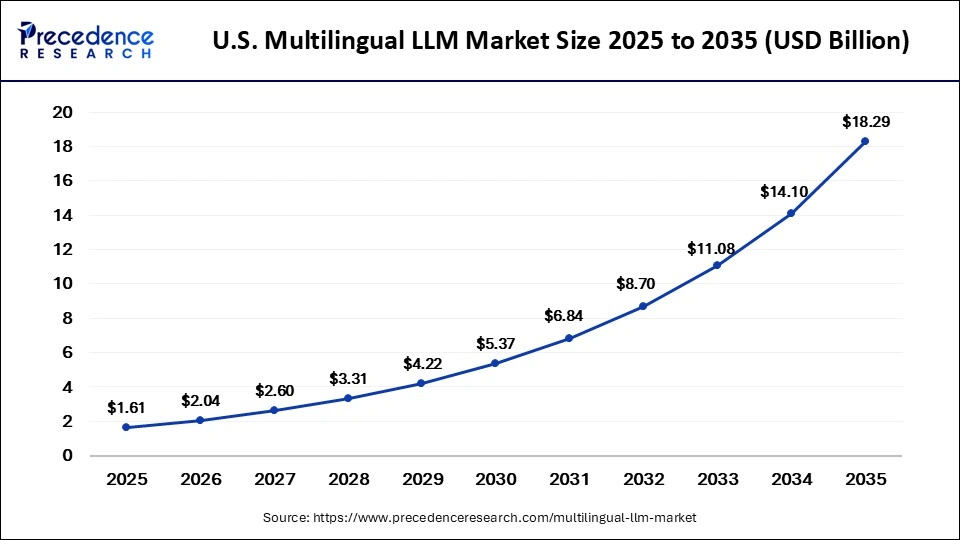
The U.S. multilingual LLM market size is calculated at USD 1.61 billion in 2025 and is expected to reach nearly USD 18.29 billion in 2035, accelerating at a strong CAGR of 27.51% between 2026 and 2035.
U.S. Market Analysis
The U.S. market is driven by a high need for enterprise-grade NLP, chatbots, and localized content generation. The ability to understand and generate content in non-English languages is vital for U.S. multinationals looking to penetrate emerging APAC markets, boosting the need for robust multilingual models.
Asia Pacific: The Fastest-Growing Region
Asia-Pacific held the second-largest market share of 26% in 2025 and is expected to grow at the fastest CAGR of 32.5% during the projection period, driven by high language diversity, a large user base, and strong local AI models in China and India. The region has become a powerhouse for AI training data, enabling better tuning of models in regional languages. Further, the rapid adoption in sectors such as healthcare, finance, and manufacturing fuels the need for automated, localized customer service and tools.
China Market Analysis
China's market is driven by models such as DeepSeek v3 and Moonshot AI's Kim K. Chinese players excel in low-cost, high-performance, multilingual, and code-related tasks, rapidly narrowing the gap with U.S. proprietary models. Thus, Chinese-language prompts are second only to English in token volume, and Chinese models are increasingly optimized for Southeast Asian and numerous global languages.
How is Europe Growing in the Multilingual LLM Market?
Europe held 22% of the market share in 2025, driven primarily by the multilingual regulation and enterprise adoption. Europe's stringent data privacy regulations demand AI solutions that comply with strict data protection laws, thus making tailored European models preferred over global ones. Moreover, the demand for precise, cross-border, and cross-cultural communication in business and public services demands high-quality, multilingual AI.
UK Market Analysis
The growth is driven by the necessity for advanced Natural Language Processing in automation, customer service, and data analytics across UK-based enterprises. The UK's role as a global business hub needs strong models capable of high-performance translation, along with content generation in languages beyond English, mainly for finance and legal services.
Multilingual LLM Market Companies
- OpenAI
- Microsoft
- Meta
- Anthropic
- Alibaba Cloud
- Tencent
- Naver
- Cohere
- AI21 Labs
- Hugging Face
- Baidu
- SAP
- IBM
- AWS
Recent Developments
- In February 2026, Alibaba Cloud, the digital technology and intelligence backbone of Alibaba Group, collaborated with Olympic Broadcasting Services (OBS) and the International Olympic Committee (IOC) to deploy advanced cloud and AI technologies for the Olympic and Paralympic Winter Games Milano Cortina 2026. These technologies are designed to improve viewing experience for global audiences, enhance operational efficiency for broadcasters, and create new ways to capture, manage, and preserve Olympic content at scale. (Source: https://www.alibabacloud.com)
- In January 2026, Google released TranslateGemma, a new suite of open translation models built on the Gemma 3 architecture. The models are programmed to run in a range of environments, from mobile and edge devices to user hardware and cloud accelerators, and are available as open models for developers and researchers.(Source: https://www.infoq.com)
Segments Covered in the Report
By Model Type
- Text-based Multilingual LLMs
- Multimodal Multilingual LLMs
- Domain-Specific Multilingual Models
By Deployment Model
- Cloud-based
- On-premise
By Technology
- Transformer-based Models
- Retrieval-Augmented Generation (RAG)
- Fine-tuned Multilingual Models
- Open-source LLM Frameworks
By Application
- Translation and Localization
- Customer Support and Chatbots
- Content Generation
- Knowledge Management
- Voice Assistants
By End-Use Industr
- IT and Telecom
- BFSI
- Retail and E-commerce
- Healthcare
- Media and Entertainment
- Government
By Organization Size
- Large Enterprises
- Small and Medium Enterprises (SMEs)
By Region
- North America
- Latin America
- Europe
- Asia-pacific
- Middle and East Africa
For inquiries regarding discounts, bulk purchases, or customization requests, please contact us at sales@precedenceresearch.com
Frequently Asked Questions
Tags





Ask For Sample
No cookie-cutter, only authentic analysis – take the 1st step to become a Precedence Research client
 Get a Sample




 sales@precedenceresearch.com
 Schedule a Meeting
