



Government Launches CBDC-Based DBT for PMGKAY Beneficiaries
Published: 18 Aug 2026
Author: Gautam Mahajan



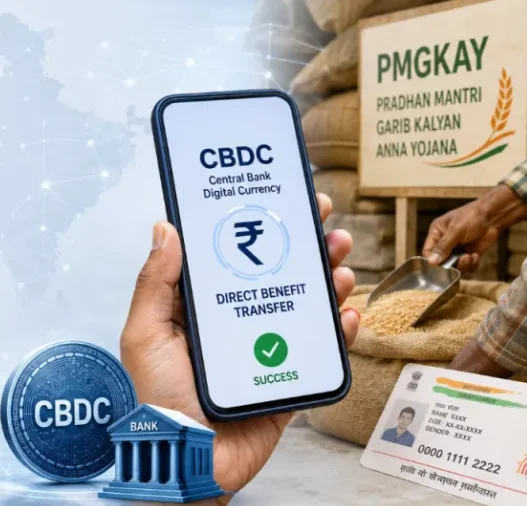
On 14 August 2026, in Chandigarh and Dadra & Nagar Haveli, the Indian government implemented a direct benefit transfer system based on CBDC for recipients of the Pradhan Mantri Garbib Kalyan Anna Yojana. The program transfers food-related benefits to qualified beneficiaries via digital wallets using India’s Digital Rupee infrastructure. The initiative aims to enhance the way government aid reaches recipients by integrating central bank digital currency technologies into a comprehensive welfare program.
Under the new arrangement, users can utilize the digital benefit to make qualified food purchases from participating retailers. The technology can offer more insight into the flow and utilization of subsidy funds because transactions are conducted digitally. The implementation is being used by the government to evaluate how CBDC technology might facilitate welfare disruption and possibly be modified for future public benefit initiatives.
The initiative is a crucial step in determining how digital financial technology can be integrated with India's current welfare distribution framework. It may also provide beneficiaries with a more convenient way to access their entitlements while reducing reliance on physical cash or traditional payment procedures. Digital records can assist authorities in tracking transactions more efficiently and identifying potential gaps in the delivery process.
Impact on Agriculture Industry
The CBCD-based DBT project may improve the relationship between India's food distribution system, which is tied to agriculture, and digital financial infrastructure. PMGKAY can enhance the digital flow of food-related benefits to qualified beneficiaries and increase transaction visibility because it is centered on food security. Beneficiary-authorized retailers and the larger food supply ecology may be able to coordinate more effectively as a result.
Impact on the Digital Payment Market
The global digital payment market size is accounted for USD 170.24 billion in 2025 and is predicted to increase from USD 200.03 billion in 2026 to approximately USD 790.59 billion by 2035, expanding at a CAGR of 16.60% from 2026 to 2035.
The project increases the use of digital payments in the provision of public benefits. Growing smartphone use, more internet access, a rise in cashless transactions, and government digitalization initiatives are all significant factors propelling the digital payment market, according to previous research. India's growing digital financial ecosystem now has a new public sector use thanks to the adoption of the Digital Rupee for food subsidies.
Additionally, the implementation may encourage retailers taking part in government social programs to use digital payments more frequently. Businesses may require more frequently. Businesses may require more robust payment acceptance infrastructure and technology that can handle new types of digital currency as more public services implement digital transaction systems. This could help India's digital payment ecosystems grow more broadly.
Fintech companies working on digital identity, payment security, wallet technology, and government payment infrastructure may find new business opportunities because of the move, which may also push the digital payment industry toward more specialized government applications. Payment providers may need to develop systems that can manage purpose-based benefits to verify eligible uses and maintain clear transaction records.
Impact on the Mobile Wallet Market
The global mobile wallet market size is valued at USD 12.85 billion in 2025 and is predicted to increase from USD 16.31 billion in 2026 to approximately USD 104.69 billion by 2034, expanding at a CAGR of 26.30% from 2025 to 2034.
Since digital wallets are used to obtain the CBDC-based benefit, the program is equally relevant to the mobile wallet market. According to Precedence Research, the adoption of smartphones, contactless payments, digitalization, and growing consumer desire for electronic transactions are all significant factors contributing to the expansion of mobile wallets.
Digital wallets could become more useful than traditional payment methods if they are used for social benefits. Wallet platforms may need to provide features such as beneficiary identification of transaction limitations, payment tracking, and merchant verification. As governments and financial organizations investigate further uses for digital currencies, this may motivate providers to create more specialized wallet infrastructure.
Additionally, the effort may help beneficiaries and participating ships become more accustomed to wallet-based transactions. Providers can concentrate on enhancing accessibility, security, and stability as digital wallets are linked to more financial and public services. This could lead to further prospects for mobile wallet technologies in institutional payment applications and government services.
The use of mobile wallets for welfare delivery may also encourage beneficiaries and participating merchants to accept digital financial services more readily. In response, wallet providers may enhance accessibility, security features, and simple payment interfaces. Eventually, these advancements may enable mobile wallets to fulfill a wider range of institutional and public sector payment requirements.
About the Government of India
The federal government of India oversees public welfare, national policy, and food security initiatives. It has progressively integrated digital technologies into financial inclusion programs for government services and subsidy distribution systems.
The CBDC-based DBT implementation under PMGKAY is an attempt to link India's developing digital rupee infrastructure with the government's food support framework. The government hopes to increase the transparency and ease of monitoring of subsidy distribution by transferring the benefit through a digital channel. Experience gained from the implementation in Chandigarh and Dadra & Nagar Haveli will be useful in determining if CBDCs might be used in other public service and welfare initiatives.
The governments' larger emphasis on leveraging digital infrastructure to enhance public service delivery is also reflected in this effort. If the model works, policymakers may be able to assess comparable CBDC technology uses in other benefit plans with the support of the pilot's experience. As a result, digital currencies may eventually play a bigger part in India's public sector financial systems.
The initiative also reflects the government's overall effort to use digital infrastructure for more efficient delivery of public services. The experience gained from this rollout can assist authorities in comprehending the practical requirements of using CBDC technology for welfare benefits. If the model produces the anticipated outcomes, it might encourage more investigation of digital currency applications in other government initiatives.