



MicroCloud Hologram Introduces Hybrid CPU-FPGA Quantum AI Simulator
Published: 10 Mar 2026
Author: Precedence Research



MicroCloud Hologram Inc. has proposed a new quantum AI simulator that uses a hybrid computing structure combining traditional CPUs with field-programmable gate arrays (FPGAs). The approach is designed to improve the efficiency of simulations used in complex artificial intelligence workloads.
The company reported that the simulator can estimate quantum kernels for image classification nearly 500 times faster than traditional CPU-only simulation under similar computing conditions. This significant performance improvement comes from implementing key computational functions directly on FPGA hardware, which allows data to be processed closer to the hardware level instead of relying entirely on software execution.
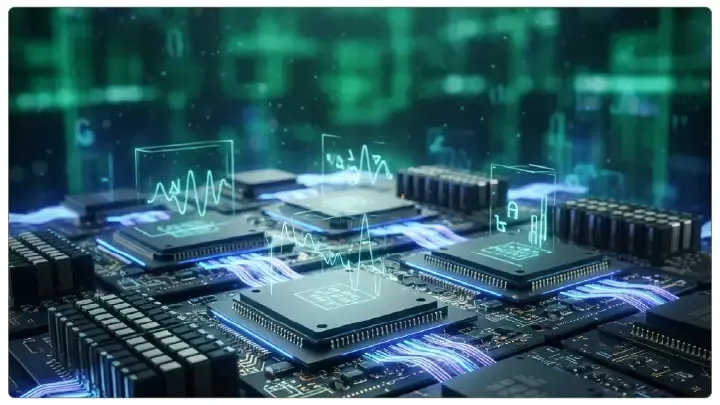
According to Precedence Research, the hardware acceleration market size accounted for USD 4.85 billion in 2025 and is predicted to increase from USD 6.97 billion in 2026 to approximately USD 181.47 billion by 2035, expanding at a CAGR of 43.65% from 2026 to 2035 as demand rising use of artificial intelligence, cloud services, and advanced analytics is creating demand for high-performance processing solutions.
The technology focuses on application-specific quantum kernels used in image recognition and classification models. The HOLO has developed a hardware-accelerated platform to stimulate quantum machine learning algorithms, focusing on image classification tasks. The HOLO system introduced a method to verify a quantum algorithm for image classification. The image sample is first compressed into fixed-dimensional feature vectors. These features are then translated into rotation angle parameters to input into the quantum circuit. The experiment concluded that deeper quantum kernels can improve classification accuracy and simulation complexity.
The company plans to further develop its hybrid CPU-FPGA quantum AI simulator and expand the system to support more complex quantum circuit structures and a wider range of quantum kernel models. It also aims to introduce automated tools that help map quantum circuits directly onto hardware.
Ongoing Advancement Accelerates the Hardware Acceleration Market
The hybrid CPU-FPGA quantum AI simulator is not only a hardware optimization but also an innovation in the computational field. Such developments highlight the growing role of hardware acceleration in modern computing. As artificial intelligence workloads become complex, companies are increasingly adopting mixed architectures, including GPUs, FPGAs, ASICs, and other accelerators to deliver fast and more efficient performance.
A recent report by Precedence Research highlights that the hardware acceleration market is benefiting from growing digital transformation, AI adoption, cloud infrastructure expansion, and edge computing, which are driving accelerated demand across industries worldwide.