



Hardware Acceleration Market Trends, Companies, Revenue / Sales Performance, Manufacturing Yield, Fab Capacity, Export & Import Dynamics, Supply Chain Analysis, Competitive Landscape, and Growth Forecast
Hardware Acceleration Market (By Type of Accelerator: Graphics Processing Units (GPUs), AI Accelerators, Video Processing Units, Cryptographic Accelerators, Regular Expression & Others; By Application: Deep Learning Training & AI/ML, Public Cloud Inference, Enterprise Inference/Cloud Acceleration, Others (e.g., Data Processing, Analytics); By Deployment Mode: On-Premises, Cloud-Based, Hybrid; By End-Use Industry: IT & Telecom/Data Centres, Automotive, Healthcare, BFSI, Retail/Others) - Global Industry Analysis, Size, Trends, Leading Companies, Regional Outlook, and Forecast 2026 to 2035
Source: https://www.precedenceresearch.com/hardware-acceleration-market
 Get a Sample
 Table Of Content


What is the Hardware Acceleration Market Size in 2026?
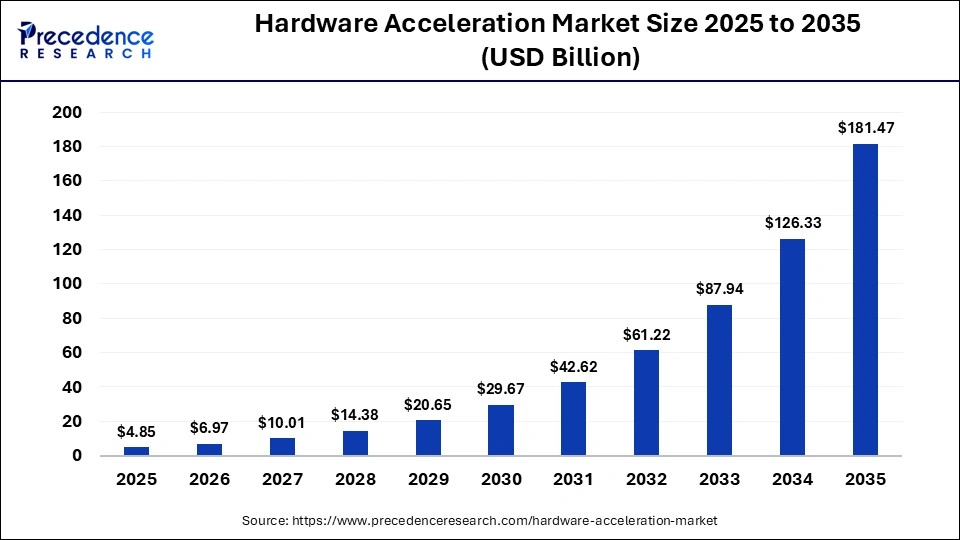
The global hardware acceleration market size accounted for USD 4.85 billion in 2025 and is predicted to increase from USD 6.97 billion in 2026 to approximately USD 181.47 billion by 2035, expanding at a CAGR of 43.65% from 2026 to 2035. The hardware acceleration market is growing because the rising use of artificial intelligence, cloud services, and advanced analytics is creating demand for high-performance processing solutions.
Key Takeaways
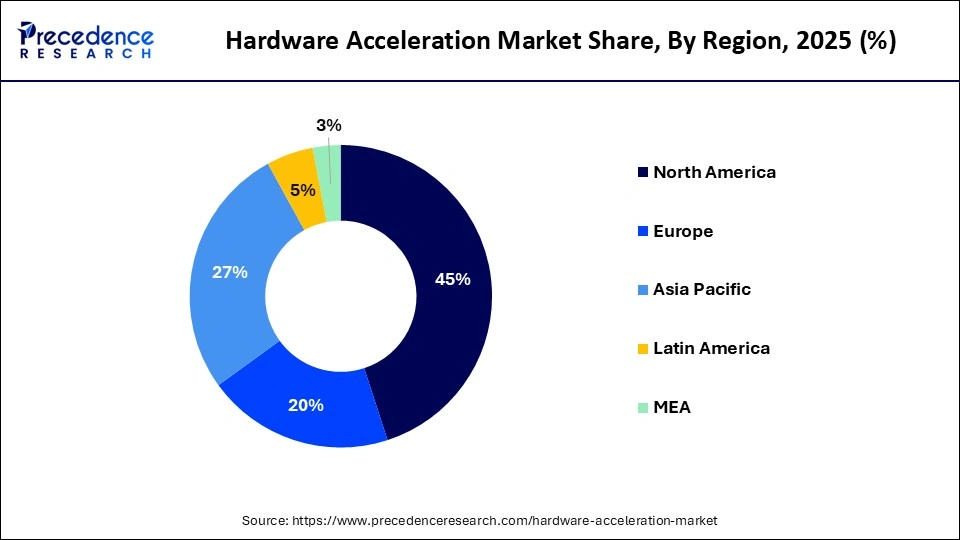
- North America dominated the hardware acceleration market in 2025, with approximately 45% share.
- Asia Pacific is expected to be the fastest-growing region between 2026 and 2035.
- By type of accelerator, the graphics processing units (GPUs) segment held a dominant position in the market with a share of approximately 45% in 2025.
- By type of accelerator, the AI accelerators segment is expected to grow at the fastest CAGR during the forecast period.
- By application, the deep learning training and AI/ML segment registered its dominance over the global market with a share of approximately 40% in 2025.
- By application, the enterprise inference/cloud acceleration segment is expected to expand rapidly in the market with a CAGR in the coming years.
- By deployment mode, the on-premises segment dominated the hardware acceleration market with a share of approximately 46% in 2025.
- By deployment mode, the cloud-based segment is expected to show the fastest growth with a CAGR over the forecast period.
- By end user industry, the IT and telecom/data centres segment led the global market with a share of approximately 38% in 2025.
- By end user industry, the automotive segment is expected to witness the fastest growth in the market with a CAGR over the forecast period.
Market Overview
The hardware acceleration market refers to technology that enhances computing performance by offloading specific tasks from general-purpose CPUs to specialized hardware such as GPUs, FPGAs, ASICs, and other accelerators. These components improve speed, efficiency, and throughput for compute-intensive workloads in AI/ML, data centres, high-performance computing, and real-time analytics. Growing digital transformation, AI adoption, cloud infrastructure expansion, and edge computing are driving accelerated demand across industries worldwide.
What are the Growth Factors and Market Trends?
- The hardware acceleration market is influenced by the growing adoption of artificial intelligence and machine learning. These require powerful processors and accelerators. Therefore, companies are investing in research and development to create advanced and efficient hardware solutions.
- The growing importance of artificial intelligence has attracted many semiconductor companies into the AI chip market. The rising competition in the field pushes companies to improve chip performance, efficiency, and pricing to stay in the market.
- Companies are highly utilizing cloud-based acceleration services, which give scalability and a flexible solution. These solutions allow businesses to use advanced computational resources without extensive on-premises infrastructure.
- Energy consumption is a critical concern for large computing systems. Companies are focusing on designing processors that deliver strong performance while using less power. Energy -efficient designs help companies control operational costs.
- AI chips are used in many industries such as healthcare, automotive, and financial institutions. As more industries adopt tools, demand for advanced chip continue to grow in the market.
Market Scope
| Report Coverage | Details |
| Market Size in 2025 | USD 4.85 Billion |
| Market Size in 2026 | USD 6.97 Billion |
| Market Size by 2035 | USD 181.47 Billion |
| Market Growth Rate from 2026 to 2035 | CAGR of 43.65% |
| Dominating Region | North America |
| Fastest Growing Region | Asia Pacific |
| Base Year | 2025 |
| Forecast Period | 2026 to 2035 |
| Segments Covered | Type of Accelerator, Application, Deployment Mode, End-Use Industry, and Region |
| Regions Covered | North America, Europe, Asia-Pacific, Latin America, and Middle East & Africa |
Segmental Insights
Type of Accelerator Insights
Why the Graphics Processing Units (GPUs) Segment Dominated the Hardware Acceleration Market?
The graphics processing units (GPUs) segment registered its dominance over the global market with a share of approximately 45% in 2025. The graphics processing units are well-suited for handling the heavy computing demands of artificial intelligence. Technology firms, research labs, and cloud service providers rely on GPUs to manage deep learning tasks and large data workloads. GPUs can process many calculations at the same time, which makes them suitable for handling large datasets and workloads. They are commonly used in data centres where complex AI training takes place.
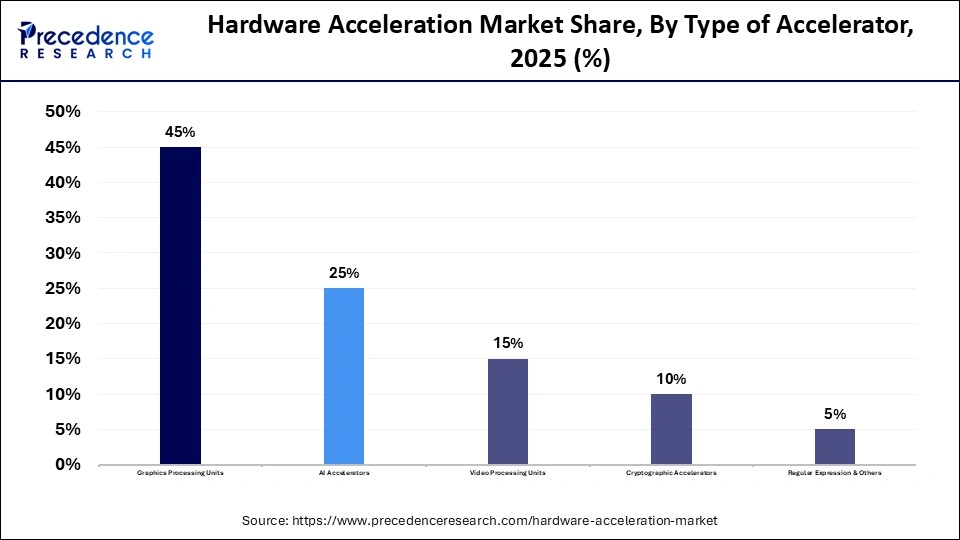
The AI accelerators segment is expected to gain the highest CAGR of the hardware acceleration market over the forecast period. AI accelerators are specialized chips developed to run AI workloads more efficiently than traditional processors. These chips focus on specific AI operations such as pattern detection and real-time data analysis. Many companies are investing in AI accelerators to improve performance while using less energy. As many industries are adopting AI, which demands dedicated chips to handle the workloads, this helps in segment growth in the market.
Application Insights
What Made the Deep Learning Training and AI/ML Segment Lead the Hardware Acceleration Market?
The deep learning training and AI/ML segment accounted for a considerable revenue share of 40% in the market in 2025. Deep learning training & AI/ML is one of the most demanding areas in the hardware accelerator market. The model is trained using a massive volume of data repeatedly, so the model can learn patterns and improve accuracy. Technology companies, research labs, and cloud providers depend on these processors to train models used in image recognition and advanced analytics. The growing number of generative AI applications continues to drive significant demand in this segment.
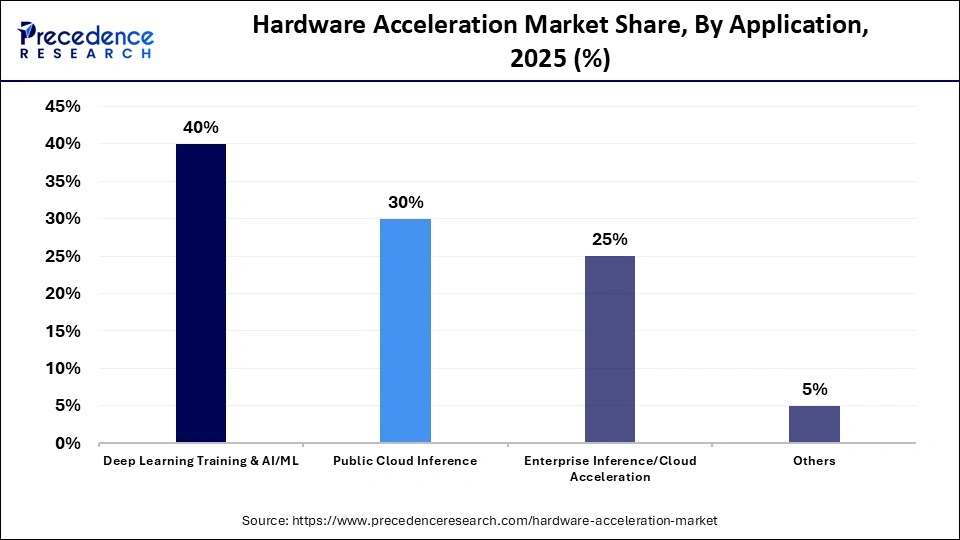
The enterprise inference/cloud acceleration segment is expected to witness the fastest growth in the hardware acceleration market with a CAGR over the forecast period. After the AI model is trained, interface systems use that model to deliver results in real time. Cloud-based inference allows scalable deployment of AI applications without building their own infrastructure. Reliable and efficient chips are essential to keep these services running smoothly at scale. As more companies integrate AI into operations, demand for enterprise inference/cloud acceleration continues to grow in the market.
Deployment Mode Insights
Why Did the On-Premises Segment Hold the Largest Share of the Hardware Acceleration Market?
The on-premises segment dominated the global market with a share of approximately 46% in 2025 because many organisations prefer to keep their computing system within their own facility. In this setup, hardware accelerators such as GPUs and other high-performance processors are directly installed in the company's data centre. This approach is used in sectors like healthcare and government, where data security and strict regulatory control are critical. The installation cost is higher, but companies prioritize data protection and stability, which is leading the segment dominance in the market.
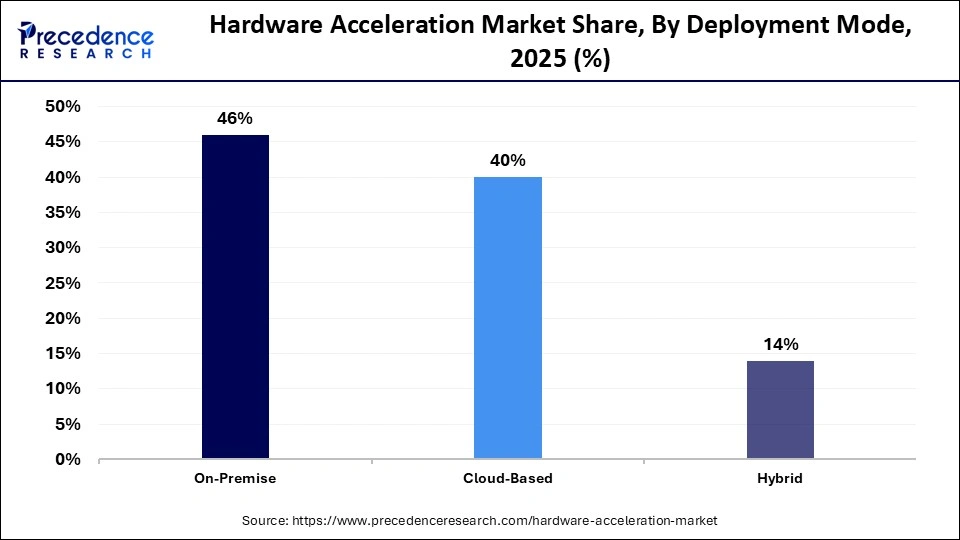
The cloud-based segment is expected to grow at the fastest CAGR in the hardware acceleration market in the coming years because companies are shifting towards flexible and scalable computing solutions. Companies are preferring cloud platforms to access accelerators instead of purchasing and maintaining their own hardware. This model is useful for AI development, data analytics, and other heavy tasks that may require large resources for a short time. This approach is beneficial for startups and mid-sized companies as it offers access to advanced computing power without the high cost of building and maintaining data centres.
End-Use Industry Insights
Why Did the IT and Telecom/Data Centres Segment Dominate the Hardware Acceleration Market?
The IT and telecom/data centres segment held a dominant position in the market with a share of approximately 38% in 2025. These sectors manage a huge amount of digital traffic every day, from cloud services and video streaming to artificial intelligence applications. Companies rely on hardware accelerators and other high-performance processors to keep systems running smoothly and efficiently. This technology handles complex workloads and improves overall performance. As demand for cloud computing and digital services grows, the need for faster and more efficient processing solutions increases in the market.
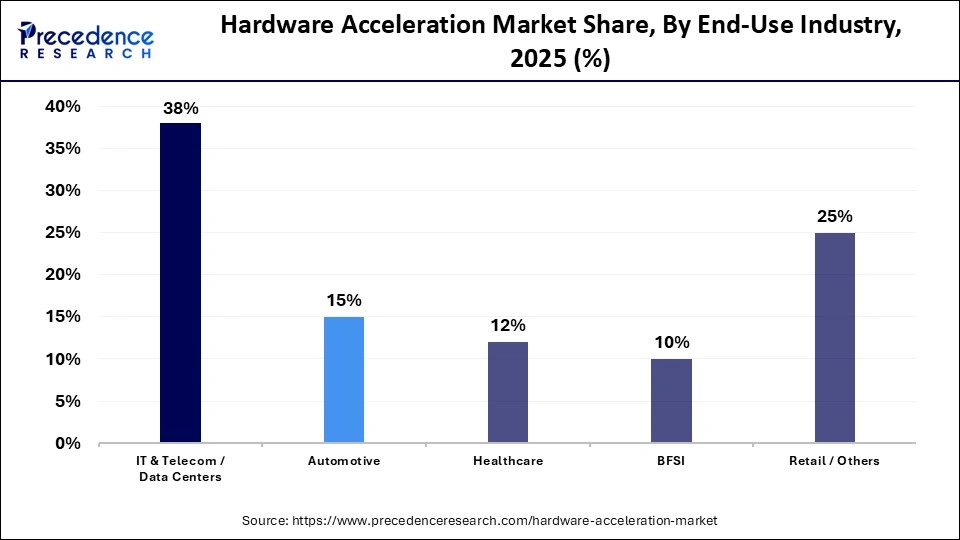
The automotive segment is expected to expand rapidly in the hardware acceleration market in the coming years because vehicles are adopting more advanced digital technologies. Modern cars are equipped with cameras, sensors, and connected systems that generate data consistently. Automotive companies are investing in advanced processors to ensure the system responds instantly and operates safely. The industry is moving towards electric vehicles and autonomous driving vehicles, creating demand for high-performance processors, further contributing to the growth of the segment in the market.
Regional Insights
North America Hardware Acceleration Market Size and Growth 2026 to 2035
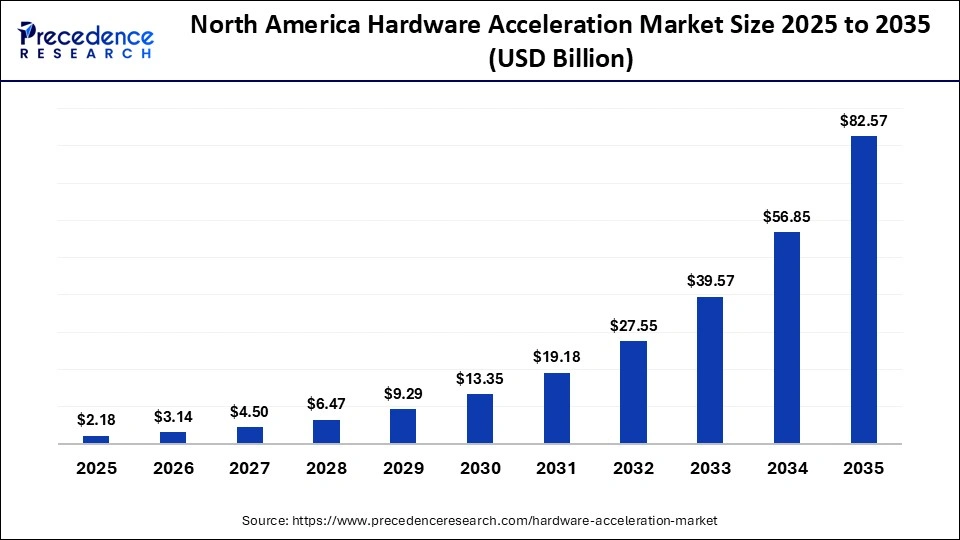
The North America hardware acceleration market size is estimated at USD 2.18 billion in 2025 and is projected to reach approximately USD 82.57 billion by 2035, with a 43.83% CAGR from 2026 to 2035.
What Factors Made the North America Region the Dominant Region in the Market?
North America dominated the global hardware acceleration market with a share of approximately 45% in 2025 due to its strong technology ecosystem and significant investment in AI and machine learning. The presence of major technology firms, cloud service providers, and semiconductor developers is creating demand for GPUs and specialized processors. Industries such as finance, healthcare, and digital media are highly adopting these solutions to manage complex workloads and massive data. These factors support the dominance of the region in the market.
U.S. Hardware Acceleration Market Size and Growth 2026 to 2035
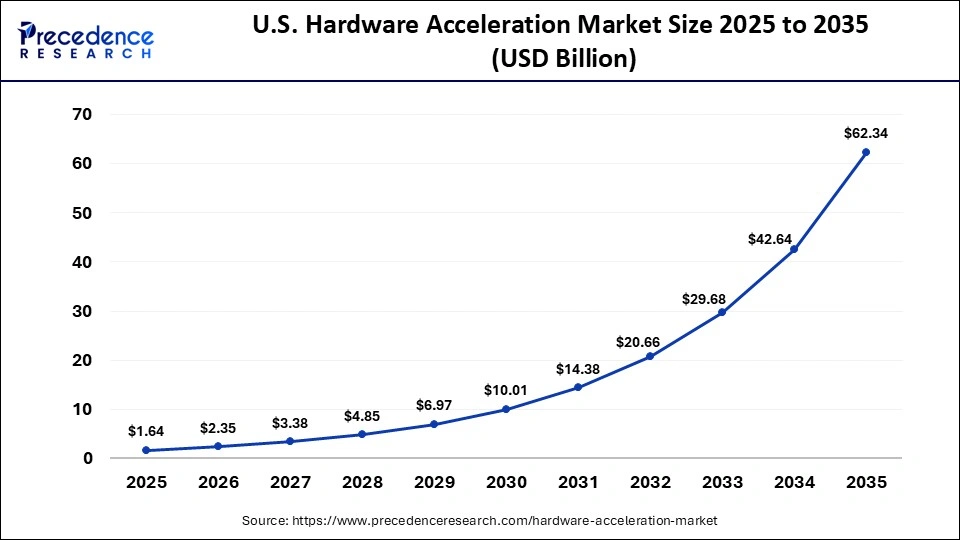
The U.S. hardware acceleration market size is calculated at USD 1.64 billion in 2025 and is expected to reach nearly USD 62.34 billion in 2035, accelerating at a strong CAGR of 49.81% between 2026 and 2035.
U.S. Market Trends
The U.S. plays a central role in the global hardware accelerator market. The US is the primary contributor, with key players like NVIDIA, Intel, and Google. The companies rely on hardware accelerators to handle artificial intelligence training, real-time analytics, and other heavy computer tasks. The regulatory support for innovation and research is further driving growth in the market.
Which Factors Influence the Fastest Growth of the Asia Pacific Market?
Asia Pacific is expected to grow at the fastest CAGR in the hardware acceleration market during the forecast period. The growth of the region is driven by rapid digitalization, increasing investments in AI, and growing demand for cloud services. Countries such as India, China, Japan, and South Korea are strengthening their technology infrastructure, and local companies are adopting accelerated computing to support digital services and advanced manufacturing. The increasing number of data centres and the rapid expansion of online services are also contributing to the market growth.
China Market Trends
China plays a major role in the Asia Pacific hardware acceleration market due to its large technology industry. Local technology companies are adopting hardware accelerators to support AI applications, cloud services, and large data processing. The country is expanding its centre capacity and investing heavily in artificial intelligence research. The government is promoting the development of domestic semiconductor technologies.
Which Factors Made Europe a Significantly Growing Region in the Market?
Europe is expected to grow at a notable CAGR in the foreseeable future because industries in the region invest in modern computing capabilities. The growth is driven by increasing demand for high-performance computing and strict regulation across the region. The region has the presence of leading companies such as AMD and IBM, which are actively investing in research and development. Government in the region supports initiatives aimed at digital transformation and innovation, which further support market expansion in the region.
What are the Key Trends in the Hardware Acceleration Market in Latin America? 
The Latin American market is expected to witness significant growth, due to a shift toward AI inference workloads and edge acceleration rather than large-scale AI training clusters, largely because enterprises are prioritizing cost-efficient deployment models with lower latency and reduced power consumption. There's also a significant trend in the region toward using edge AI and FPGA-based acceleration systems to achieve energy-efficient computing solutions. Enterprises are placing accelerators closer to end users and industrial applications to increase response times, decrease reliance on bandwidth, and support critical operations.
Brazil Market Trends
Brazil is emerging as the most influential market in the region, supported by strong investments in AI infrastructure and cloud computing ecosystems. The country is witnessing rising deployment of GPU-enabled facilities and FPGA-based systems in banking, telecom, and industrial automation applications.
What are the Advancements in the Hardware Acceleration Market in the Middle East and Africa?
The Middle East and Africa are expected to have significant market growth in the upcoming years. A major technological advancement shaping the MEA hardware acceleration market is the deployment of next-generation AI superclusters and GPU-intensive cloud infrastructure. Also, the growing adoption of edge AI acceleration technologies across telecom, industrial automation, healthcare, and energy sectors. The rollout of 5G infrastructure across GCC countries is increasing demand for low-latency AI inference platforms powered by FPGAs and specialized accelerators deployed closer to the data source.
UAE Market Trends
This country holds a leadership position in this region due in large part to investments in AI tech infrastructure, hyperscale data centers, and sovereign computing projects. Saudi-backed companies are plowing billions into AI-ready and advanced computing frameworks with facility-equipped capacities behind them. While operators are implementing liquid cooling technologies along with high-bandwidth networking solutions to help meet the thermal management and power requirements associated with accelerator-intensive systems.
Hardware Acceleration Market Companies
- Advanced Micro Devices (AMD)
- Achronix Semiconductor
- Amazon Web Services (AWS)
- Apple (Silicon/Neural Engines)
- Broadcom Inc.
- Cisco Systems, Inc.
- Dell Technologies Inc.
- Google LLC
- Hewlett Packard Enterprise (HPE)
- Huawei Technologies Co., Ltd.
- Intel Corporation
- Micron Technology, Inc.
- NVIDIA Corporation
- Oracle Corporation
- Qualcomm Technologies, Inc.
- Xilinx Inc.
- IBM Corporation
- Lenovo Group Limited
- Fujitsu Ltd
- VMware Inc
- Cisco Systems Inc
- AlphaLab Gear
Recent Developments
- In October 2025, Qualcomm announced the release of new Artificial Intelligence accelerator chips to compete with NVIDIA, the dominating company in AI chip and AMD second -place player. The launch highlights Qualcomm's strengthening of its position in the fastest-growing AI chip market. This announcement increased stocks by 11%, showing strong investor interest in expanding the AI hardware market.(Source: https://www.cnbc.com)
- In January 2025, Qdrant, a leading high-performance open-source vector database, launched a GPU-accelerated vector indexing solution designed for real-time AI applications. The system works across different hardware platforms and supports GPUs from NVIDIA and AMD. It helps developers build search indexes faster and manage large volumes of AI data more efficiently.(Source: https://www.businesswire.com)
Segments Covered in the Report
By Type of Accelerator
- Graphics Processing Units (GPUs)
- AI Accelerators
- Video Processing Units (VPUs)
- Cryptographic Accelerators
- Regular Expression & Others
By Application
- Deep Learning Training & AI/ML
- Public Cloud Inference
- Enterprise Inference/Cloud Acceleration
- Others (e.g., Data Processing, Analytics)
By Deployment Mode
- On-Premises
- Cloud-Based
- Hybrid
By End-Use Industry
- IT & Telecom/Data Centres
- Automotive
- Healthcare
- BFSI
- Retail/Others
By Region
- North America
- Asia Pacific
- Europe
- Latin America
- Middle East & Africa
For inquiries regarding discounts, bulk purchases, or customization requests, please contact us at sales@precedenceresearch.com
Frequently Asked Questions





Ask For Sample
No cookie-cutter, only authentic analysis – take the 1st step to become a Precedence Research client
 Get a Sample




 sales@precedenceresearch.com
 Schedule a Meeting
