



MDA Space Introduces MDA AURORA Software-Defined Satellite for Government and Military Customers
Published: 15 Sep 2026
Author: Laxmi Narayan



On 10 September 2026, MDA Space introduced MDA AURORA™ Black, a new addition to its range of software-defined satellites that is targeted at defence, aerospace and satellite applications. Building on the flexibility offered by software-defined satellite technology, AURORA™ Black allows satellite capabilities to be modified as operational requirements change. The platform has been unveiled as governments and defence organizations place increasing highlights on resilient space infrastructure, secure communications and the ability to quickly respond to changing mission needs. The major defence users increasingly focus on flexibility, which is not possible with traditional satellite systems that depend on fixed hardware setups.
By creating a satellite platform geared towards defence, MDA Space is placing itself in a position to take part in a market where adaptability, scalability, resilience, and rapid technological evolution are becoming increasingly crucial for future space missions. The announcement supports the growing convergence between space technology and national security, where MDA AURORA™ Black is used for communications, intelligence, surveillance, and other defence operations.
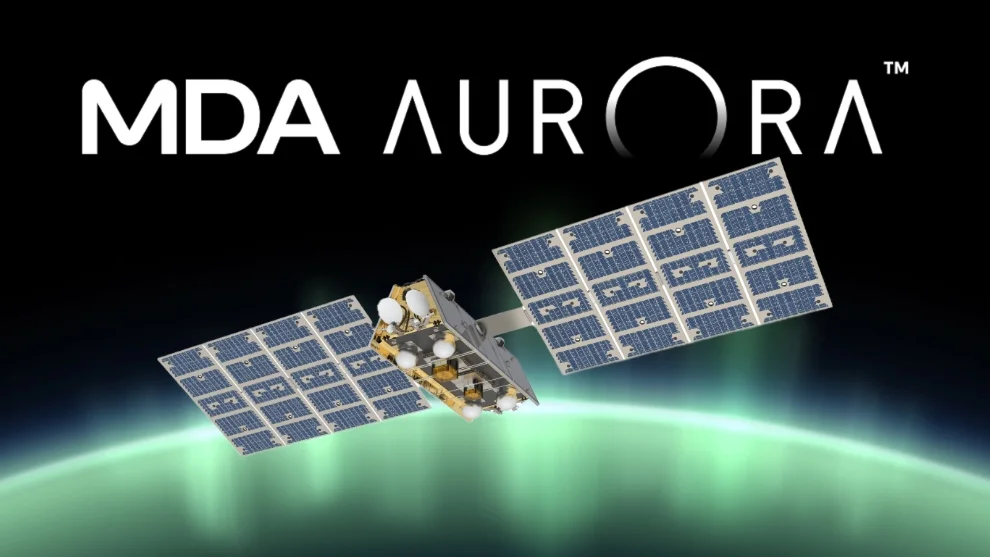
Impact on the Military Aircraft Industry
The global military aircraft market size was valued at USD 48.30 billion in 2024 and is predicted to hit around USD 76.17 billion by 2034, growing at a CAGR of 4.66% from 2025 to 2034.
According to Precedence Research, military organisations are becoming increasingly dependent on satellite-coordinated communications and data services. In theory, a software-defined satellite platform would enable capabilities to be altered in response to changes in mission priorities and thus lessen the requirement for fixed configurations. The defence industry could gain considerable advantages from a more flexible satellite infrastructure, as resilience and elasticity have become vital operational requirements.
Governments adopting such systems will require careful consideration of cybersecurity, resistance to interference, supply-chain security, and the system's long-term reliability. This would help the military aircraft sector to respond more effectively to emerging threats and to evolving operational environments. The technology could improve interoperability among different military networks and missions.
Impact on the Satellite Industry
The global satellite market size was estimated at USD 362.28 billion in 2025 and is predicted to increase from USD 391.99 billion in 2026 to approximately USD 780.24 billion by 2035, expanding at a CAGR of 7.97% from 2026 to 2035.
According to Precedence Research, the satellite industry is currently employing a greater number of spacecraft that are controlled by software and can be altered digitally, a development that has been reinforced by the unveiling of AURORA™ Black. As demand for reliable satellite networks continues to increase, flexibility is likely to become even more crucial in the global satellite manufacturing infrastructure.
Unlike traditional satellites, which require substantial hardware modifications each time their missions are changed, that drive the implementation of software-defined satellites. The AURORA™ Black project may cause satellite manufacturers to place greater prominence on digital payloads, onboard processing, automated production, and adjustable communication technologies. Overall, this kind of flexibility is an advantage to satellite operators who wish to prolong the life of their satellites and make good use of their resources.
Impact on the Aerospace Industry
The global aerospace market size is calculated at USD 402.75 billion in 2025 and is predicted to increase from USD 434.17 billion in 2026 to approximately USD 846.30 billion by 2035, expanding at a CAGR of 7.71% from 2026 to 2035.
According to Precedence Research, aerospace customers prefer technologies that can function in complex and constantly changing environments to those which are designed for a specific and fixed mission. AURORA™ Black could have an effect on the broader aerospace technology sector by encouraging greater integration between satellite systems, software, communications systems, and mission operations. The software-defined satellites can help drive this change by making the capabilities of spacecraft more adaptable and possibly easier to upgrade the aerospace framework.
Stronger partnerships are being formed between existing aerospace companies and specialist technology providers. This may create new opportunities for companies involved in satellite electronics, secure communications, software, cybersecurity, and ground infrastructure. Given that military space programmes are expanding, the demand is expected to rise for MDA AURORA™ Black, which offers resilience and operational flexibility.
Expert Opinion
As per expert point of view, MDA Space introducing AURORA™ Black is important. Today's defence customers require space systems which can respond at the same speed as the threats they have to face. AURORA™ Black signifies a symbol of the broader move occurring in the military space sector towards adaptable, software-based infrastructure. The traditional method of designing a satellite with a mainly fixed mission is becoming less attractive as communications requirements, security situations, and operational priorities change quickly.
A software-defined construction offers a possible solution by increasing the flexibility of the spacecraft's digital section. This strategy supports aspects such as cybersecurity, electronic resilience, interoperability, manufacturing scale, and lifecycle support, which will be equally important. Additionally, the actual benefits will depend on how reliably that flexibility can be achieved in tough defence conditions. An expert observed that if MDA Space is able to merge flexibility with strong security and reliable performance, the platform could become a leading choice in the expanding satellite market.