



NetDragon and HKUST Associates to Develop Medical Technology Research and Deepen Interdisciplinary Partnership
Published: 15 Sep 2026
Author: Gautam Mahajan



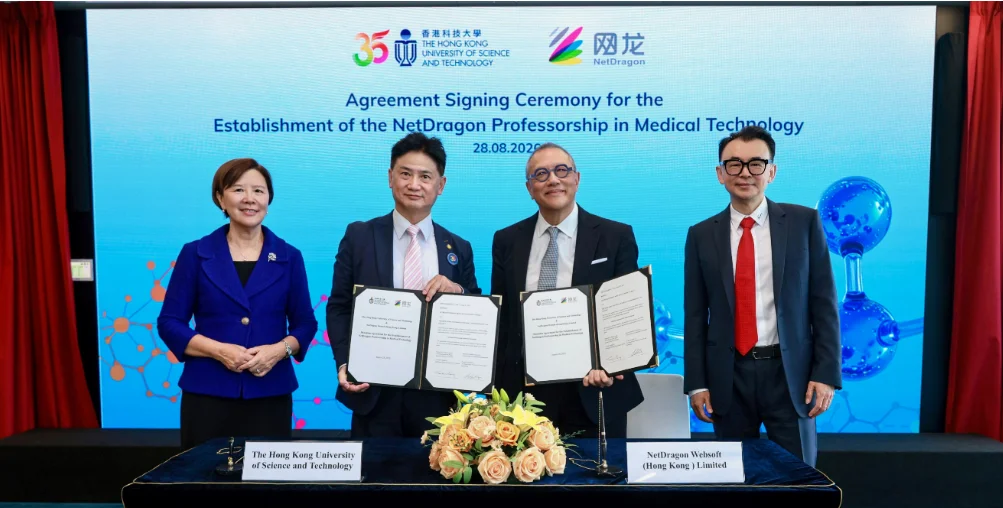
On 10th September 2026, the agreement brings together NetDragon's experience in digital technologies with HKUST's academic and research capabilities to grab new opportunities in the fields of healthcare and medical technology. By combining the commercial expertise in technology that NetDragon has with research led by the university, the two organisations may be able to accelerate the progress and implementation of innovative healthcare solutions. This partnership validates how important it is for technology companies to work together, because the healthcare sector connects artificial intelligence, digital platforms, data analytics and advanced scientific research.
The collaboration demonstrates the broader trend towards interdisciplinary approaches in medical innovation, with expertise from computing, medical science and healthcare frameworks. Healthcare systems are seeking to achieve improved results, greater efficiency, and more personalised care that driving the long-term success of this collaboration. Partnerships of this kind could play a momentous role in turning research capabilities into practical technologies that are of benefit to patients and healthcare professionals.
Impact on the Digital Health Industry
The global digital health market size is calculated at USD 420.08 billion in 2025 and is predicted to increase from USD 483.07 billion in 2026 to approximately USD 1,171.24 billion by 2035, expanding at a CAGR of 10.8% from 2026 to 2035.
According to Precedence Research, the healthcare sector might gain from greater cooperation between technology companies and R&D practices. At present, they aim to improve patient care, simplify their operations, and assist with clinical decision-making. As the medical sector needs sophisticated digital tools, this partnership that combines research expertise with technology development into practical healthcare applications.
Hospitals and healthcare providers would receive technologies and digital integration that had been designed with real-world clinical requirements. The partnership shows how collaboration can be employed to deal with healthcare problems that require expertise from a number of scientific and technological fields. Additionally, interdisciplinary research could then be focused on areas such as artificial intelligence, digital health, the analysis of medical data, and intelligent healthcare platforms.
Impact on the Medical Device Industry
The global medical devices market was valued at USD 719.61 billion in 2026 and is projected to reach USD 1,209.42 billion by 2035, expanding at a CAGR of 5.94% from 2026 to 2035.
According to Precedence Research, medical technology companies generally need access to advanced scientific knowledge and to specialist researchers and testing facilities. Alliances in the field of medical technology could lead to greater innovation by joining commercial development with academic research. If they are to produce new solutions, universities in turn can benefit from industry knowledge and a better understanding of actual market requirements.
As competition in the medtech sector intensifies, partnerships that combine deep research with technological expertise may become more indispensable for developing differentiated medical devices and services. Bringing these advantages together could shorten the time it takes to transition from research to practical medical technologies. Additionally, the collaboration could encourage innovation in fields such as healthcare software, intelligent medical systems, and data-driven diagnostic solutions.
Impact on the Artificial Intelligence (AI) Industry
The global Artificial Intelligence (AI) Market size was USD 757.58 billion in 2025, is calculated at USD 900.00 billion in 2026, and is expected to reach around USD 4,216.29 billion by 2035, expanding at a CAGR of 18.73% from 2026 to 2035.
According to Precedence Research, technology companies, principally those involved in artificial intelligence and digital platforms, could then play a more active role in healthcare research. It might prove the commercial advantage of bringing powerful computing capabilities together with scientific research in healthcare and medicine. So working with academic researchers would allow technology companies to meet these challenges in a systematic manner.
NetDragon and HKUST collaboration would help speed up progress in AI applications in healthcare and provide technology experts with the opportunity for digital transformation. This is because healthcare involves some of the most demanding uses of artificial intelligence, requiring a high degree of accuracy, consistency, attention to privacy, and a good understanding of the particular medical infrastructure.
Expert Opinion
From an expert point of view, the collaboration between NetDragon and HKUST is important because, at the present time, most medical innovation depends on corporations. Technology companies can supply the skills required for development, provide the necessary digital infrastructure, and bring practical experience. In the healthcare sector, this collaboration can offer scientific knowledge, give access to researchers, and carry out continuous investigation into difficult problems.
The most promising field will be that in which artificial intelligence, data solutions, engineering, and medical science are combined. The solutions have to prove that they are reliable, make sure that sensitive information is protected, comply with regulatory requirements, and finally offer real value to patients and to healthcare professionals. Though, even if a technical success is achieved, the objective is to turn research into healthcare applications.