



North America Allergy Diagnostics Market Size, Key Companies, Company Market Share, Patient Volume, Treatment Adoption Rates, Pricing Analysis, Regulatory Landscape, Competitive Positioning, and Demand Forecast
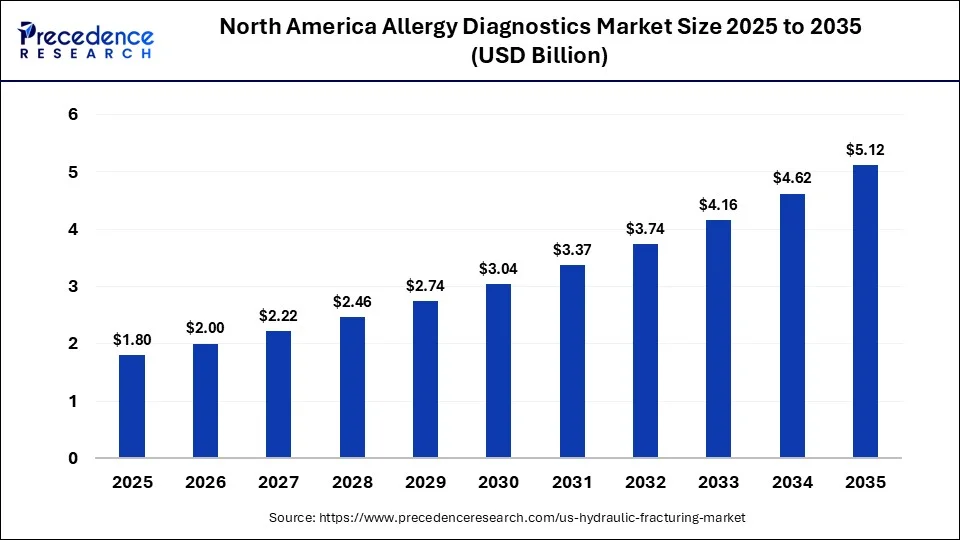
The North America allergy diagnostics market reached USD 2 billion in 2025. The market growth is attributed to the rising prevalence of allergic diseases, advances in diagnostic technologies, and growing research activities. These trends were analysed by our Senior Researcher, Deepa Pandey, to curate this report. Her report benefits device manufacturers, clinical laboratories & reference labs, CROs, digital health startups, and medical distributors.
Source: https://www.precedenceresearch.com/north-america-allergy-diagnostics-market
 Get a Sample
 Table Of Content


North America Allergy Diagnostics Market Size, Share, Trends, and Forecast Analysis 2035
The North America allergy diagnostics market is expanding as rising allergy prevalence, improved disease awareness, and growing demand for accurate diagnostic testing increase the need for advanced testing solutions. The North America allergy diagnostics market is forecasted to expand from USD 2 billion in 2026 to USD 5.12 billion by 2035, growing at a CAGR of 11.03% from 2026 to 2035. The United States represents the largest national market, supported by established healthcare infrastructure, specialist practices, and laboratory testing capabilities, while Canada and Mexico offer additional growth opportunities through improved diagnostic access and laboratory modernization.
Key Takeaways
- The North America allergy diagnostics market was valued at approximately USD 2.9 billion in 2025, with a separate estimate placing it at USD 2.95 billion.
- The market is projected to reach approximately USD 9 billion by 2033 under one forecast scenario, reflecting an 11.8% CAGR.
- An alternative market estimate projects growth from USD 2.6 billion in 2025 to USD 6.2 billion by 2033, at a CAGR of approximately 11.8%.
- North America accounted for approximately 36.6% of the global allergy diagnostics market in 2025, highlighting its importance as a major regional market.
- The United States recorded diagnosed allergic conditions in 11.03% of adults and 29.5% of children in 2024, supporting demand for allergy testing.
- Seasonal allergies affected 25.2% of U.S. adults and 20.6% of children in 2024, while food allergies affected 6.7% of adults and 5.3% of children.
- Consumables accounted for approximately 69.6% of North American allergy diagnostics revenue in 2025, making reagents, assays, and testing kits the primary recurring revenue sources.
- Leading companies collectively accounted for more than 35% of global allergy diagnostics revenue in 2025, while another estimate placed the combined share of three major multinational players at approximately 47.8%.
- The U.S. allergy diagnostics market was estimated at approximately USD 2.23 billion in 2025, making it the region's largest national market.
- An advanced allergy-testing platform expanded its coverage to 218 allergens and 82 extracts, using data from almost 400,000 real-world test results to inform panel design.
Introduction
Rising Allergy Burden and Recurring Testing Demand Expand the North American Diagnostics Opportunity
The North America allergy diagnostics market is estimated at approximately USD 2 billion in 2026 and could exceed USD 5.12 billion by 2035. In the United States, 11.03% of adults and 29.5% of children had at least one diagnosed allergic condition in 2024. Seasonal allergies affected 25.2% of adults and 20.6% of children, while food allergies affected 6.7% and 5.3%, respectively. These categories overlap and should not be treated as unique patient populations.
Market growth is driven not only by allergy prevalence but also by testing rates, allergens assessed per patient, adoption of specific IgE assays, repeat testing, and laboratory versus in-vivo procedures. Recurring consumables revenue, analyzer placements, laboratory contracts, and expanded test menus support long-term commercial opportunities.
The United States remains the largest revenue market, supported by high healthcare spending, specialist practices, hospital laboratories, and established diagnostic infrastructure. Canada offers growth opportunities through laboratory procurement and specialist access, while Mexico presents emerging potential from private laboratory expansion, improved diagnostic accessibility, and modernization of clinical testing infrastructure.
Key Coverage
- North American market sizing, historical performance, and 2025 baseline.
- Revenue forecasts through 2030 and 2033, with an extended 2035 outlook.
- United States, Canada, and Mexico market comparisons.
- Patient prevalence, testing penetration, and diagnostic utilization.
- In-vitro versus in-vivo testing economics.
- Recurring consumables revenue and installed analyzer base.
- Competitive concentration, market entry barriers, and emerging technologies.
Market Size - Recurring Reagent Consumption and Higher-Value Testing Support Market Expansion
The North America market was valued at approximately USD 2.9 billion in 2025, with a separate estimate placing revenue at USD 2.95 billion. Under the cited 11.8% CAGR scenario, the market is projected to reach approximately USD 9 billion by 2033, representing an incremental revenue opportunity of about USD 3.6 billion. Differences between market estimates are commercially significant because the baseline affects implied market shares, revenue-per-test assumptions, and investment potential; therefore, estimates should not be blended into a single consensus figure.
The research first establishes a consistent market perimeter to ensure reliable historical and forecast calculations and avoid double counting across diagnostic instruments, reagents, and outsourced laboratory testing. The forecast model is primarily driven by diagnosed and suspected patient volumes, testing intensity per patient, and realized revenue per test or test panel. Additional factors include product mix, reimbursement dynamics, laboratory consolidation, and the shift toward comprehensive allergen profiling, which collectively influence market growth and revenue realization.
Key Coverage
- Historical market estimates for 2021-2024 and a 2025 base year.
- Annual forecasts through 2033, with an extended 2035 scenario.
- Revenue growth, CAGR, and incremental market opportunity.
- Country-level market contributions and forecast trajectories.
- Instrument, consumables, and service revenue.
- Base, upside, and downside scenarios.
- Sensitivity to testing penetration, pricing, and assay mix.
Segmentation Analysis - In-Vitro Testing and Consumables Anchor the Commercial Model
The market can be analyzed across product and service, test methodology, instrument type, allergen category, customer setting, and geography.
By product and service, consumables represent a major recurring revenue segment, including assay reagents, allergen extracts, calibration materials, controls, and testing kits. Instruments generate more episodic revenue but establish installed bases that drive subsequent consumables demand.
By test methodology, in-vitro testing, particularly allergen-specific IgE blood tests, remains important for laboratory-based testing and broad allergen panels. In-vivo methods, including skin-prick and patch testing, remain relevant for specialist clinical assessment.
By allergen category, inhaled allergens represent a key segment associated with seasonal and perennial allergic disease, while food-allergy testing is driven by pediatric evaluation and clinical differentiation between sensitization and clinically meaningful allergy. Drug allergens and other allergen categories represent additional demand.
By customer setting, testing is distributed across hospitals, diagnostic laboratories, specialty clinics, and other healthcare settings, with demand influenced by testing volumes, clinical requirements, and workflow preferences.
Market Dynamics - Disease Awareness and Diagnostic Precision Increase Testing Complexity
The demand outlook reflects the interaction of allergy prevalence, physician referral patterns, diagnostic awareness, and the availability of more comprehensive testing. The 2024 U.S. prevalence figures establish a sizeable potential patient pool, but prevalence alone does not translate directly into addressable testing revenue. Diagnosis rates, insurance coverage, clinical guidelines, and access to allergists determine how much of that population enters the diagnostic pathway.
Three structural drivers are particularly relevant. First, persistent allergic rhinitis and suspected food allergies generate demand for allergen identification. Second, growing emphasis on precision medicine supports testing that distinguishes sensitization to individual allergen components. Third, automated laboratory platforms can improve throughput and standardization, particularly where laboratories process large volumes of routine samples.
Constraints include inappropriate testing, false-positive results, limited specialist access, and the risk of interpreting sensitization as confirmed clinical allergy. Broad screening without a compatible clinical history can create unnecessary follow-up and increase total healthcare costs. In vitro and in vivo methods are therefore complementary rather than universally interchangeable.
Key Coverage
- Patient prevalence versus clinically indicated testing.
- Physician referral and diagnostic conversion rates.
- Clinical utility and limitations of specific-IgE testing.
- Access constraints and regional diagnostic disparities.
- Laboratory consolidation and automation economics.
- Growth opportunities in precision allergy assessment.
How is the North American Allergy Diagnostics Market Structured, and Which Competitive Capabilities Are Shaping Market Leadership?
The North America allergy diagnostics market is estimated at approximately USD 2.6 billion in 2025 and is projected to reach about USD 6.2 billion by 2033, implying an 11.8% CAGR over 2026-2033. The competitive structure is shaped by a combination of large diagnostics and life-sciences companies, specialist allergy-testing providers, and regional manufacturers, with competition extending across in-vitro specific-IgE testing, in-vivo testing, immunoassay platforms, allergen extracts, consumables, and laboratory services.
Available market estimates indicate that leading players collectively account for more than one-third of global allergy-diagnostics revenue, highlighting a market with meaningful concentration but substantial participation from specialist and regional companies.
Our analysis indicates that competitive advantage is increasingly determined by the breadth of the testing ecosystem rather than by individual assay availability. Companies with established analyzer or installed-platform footprints can generate recurring consumables and reagent demand, while specialist players can differentiate through allergen coverage, specialized testing capabilities, clinical relationships, and focused customer segments. The U.S. remains the principal revenue center within North America, with one current estimate placing its 2025 market at approximately USD 2.23 billion, versus a substantially smaller Canadian market. Our assessment is that this creates two distinct competitive strategies: scale-based platform economics for larger diagnostic companies and specialization-based differentiation for focused allergy-diagnostics providers.
In our view, the most significant competitive shift is occurring around technology depth, clinical utility, and the ability to integrate testing into laboratory workflows. Specific-IgE immunoassays remain central to laboratory-based diagnosis, while multiplex testing, component-resolved diagnostics, automation, broader allergen panels, and improved analytical performance are becoming increasingly important areas of differentiation. Regulatory developments also influence competitive positioning: the U.S. laboratory-developed-test framework has undergone significant changes, including the 2024 FDA final rule and its subsequent regulatory developments, increasing the importance of regulatory readiness and test-validation capabilities.
Which Companies Capture the Largest Share of the North American Allergy Diagnostics Market, and Where Is Competitive Power Concentrated?
The North America allergy diagnostics market generated approximately USD 2.60 billion in 2025 and is projected to reach USD 6.20 billion by 2033, representing an 11.78% CAGR. Consumables accounted for approximately 69.6% of regional revenue in 2025, indicating that recurring reagent, assay, and testing-kit demand represents the principal revenue pool rather than one-time instrument sales. North America also represented approximately 36.6% of the global allergy diagnostics market in 2025, reinforcing the region's importance as a competitive and commercial center.
Our analysis indicates that market leadership is concentrated among a relatively limited group of multinational and specialist diagnostic companies, but competitive strength is not determined by revenue scale alone. Available industry estimates indicate that leading players collectively accounted for more than 35% of the global allergy diagnostics market in 2025, while another recent market assessment estimates that three major multinational players together represented approximately 47.8% of global 2025 revenue. These estimates are based on different market definitions and should therefore be interpreted directionally rather than as directly comparable market shares. Our assessment is that the most meaningful competitive distinction lies in the combination of installed platforms, recurring consumables revenue, allergen-test breadth, automation, laboratory relationships, and geographic reach. This means companies with a strong installed base can potentially reinforce their position through recurring consumables demand, while specialist players can compete through focused allergy portfolios and differentiated testing capabilities.
In our view, the key strategic implication is that market-share movement should be assessed alongside the quality and sustainability of each company's allergy-specific commercial exposure. A company with a large overall diagnostics business does not necessarily have equivalent strength in allergy diagnostics; consequently, ranking based solely on total corporate revenue can obscure actual competitive positioning. The analysis therefore evaluates allergy-specific revenue exposure, estimated market share, share movement, product or service mix, installed-base strength, technology capabilities, allergen coverage, geographic presence, customer reach, and recurring consumables exposure to distinguish scale from genuine allergy-diagnostics competitiveness.
Tentative Leading Company Universe - 20 Participants Across Allergy Diagnostics, Platforms, Assays, and Specialist Testing
| Company | Headquarters | Competitive Role | Core Capability | Key Allergy Application |
| Thermo Fisher Scientific | Waltham, U.S. | Platform / Diagnostics Leader | Specific-IgE Testing | In-vitro Allergy Testing |
| Danaher | Washington, DC, U.S. | Diversified Diagnostics | Immunodiagnostics | Laboratory Testing |
| Siemens Healthineers | Forchheim, Germany | Diagnostics Platform | Automated Immunoassays | Clinical Laboratories |
| Minaris Medical America | U.S. | Allergy Specialist | OPTIGEN Allergy Testing | Allergen-Specific IgE |
| HYCOR Biomedical | U.S. | Allergy Specialist | Allergy Immunodiagnostics | In-vitro Testing |
| Lincoln Diagnostics | U.S. | Allergy Specialist | Skin-Testing Products | In-vivo Diagnostics |
| HollisterStier Allergy | Spokane, U.S. | Allergy Specialist | Allergen Extracts | Allergy Testing & Extracts |
| Stallergenes Greer | London, U.K. | Allergy Specialist | Allergen Extracts | Allergy Diagnostics Ecosystem |
| Allergy Therapeutics | Worthing, U.K. | Allergy Specialist | Allergen Products | Allergy Assessment & Treatment |
| EUROIMMUN | Lübeck, Germany | Immunodiagnostics Specialist | Immunoassay Technologies | Allergy & Autoimmune Testing |
| AESKU.Group | Wendelsheim, Germany | Diagnostics Specialist | Immunoassay Products | Allergy-Related Testing |
| HOB Biotech Group | Suzhou, China | Diagnostics Specialist | Allergy Testing Platforms | In-vitro Diagnostics |
| R-Biopharm | Darmstadt, Germany | Diagnostics Specialist | Immunoassays | Allergy & Laboratory Testing |
| bioMérieux | Marcy-l'Étoile, France | Diversified Diagnostics | Clinical Diagnostics | Laboratory Workflows |
| Abbott | Abbott Park, U.S. | Diversified Diagnostics | Immunoassay Infrastructure | Clinical Laboratories |
| Neogen | Lansing, U.S. | Specialist Testing | Allergen Detection | Food & Environmental Testing |
| Omega Diagnostics | Alva, U.K. | Diagnostics Specialist | Immunodiagnostic Assays | Allergy-Related Testing |
| Erba Group | London, U.K. | Diagnostics Supplier | Laboratory Diagnostics | Clinical Laboratories |
| DASIT Group | Milan, Italy | Diagnostics Specialist | Allergy & Immunodiagnostics | Laboratory Testing |
| Reacta Healthcare | Deeside, U.K. | Allergy Specialist | Food-Allergy Challenge Materials | Food-Allergy Assessment |
Which Technology Shifts Are Most Likely to Reshape the North American Allergy Diagnostics Market?
North America represented approximately 36.6% of the global allergy diagnostics market in 2025, reflecting its relatively advanced diagnostic infrastructure and adoption of automated immunoassay, multiplex testing, and molecular approaches. Within the broader technology landscape, automated immunoassay analyzers currently represent a major commercial platform, while multiplex/component-resolved approaches are gaining importance because they can evaluate multiple allergen-specific IgE responses from a single sample. Component-resolved diagnostics can also identify sensitization at the individual allergen-molecule level, helping distinguish genuine sensitization from cross-reactivity in appropriate clinical settings.
Our analysis indicates that the technology transition is not simply from conventional to “advanced” testing; it is toward greater diagnostic resolution, automation, and information density per patient sample. Multiplex platforms can simultaneously evaluate numerous allergens, while component-resolved diagnostics increasingly enable clinicians to characterize sensitization at the molecular level. However, adoption is not uniform: clinical utility, interpretation requirements, reimbursement, platform availability, and evidence supporting specific applications continue to influence utilization. Our assessment is that technologies capable of combining broad allergen coverage with clinically actionable results are likely to create the strongest differentiation, rather than platforms competing solely on the number of allergens tested.
In our view, the most significant strategic implication is that technology leadership will increasingly depend on the integration of assay performance, automation, allergen coverage, workflow efficiency, and clinical interpretation. The emergence of data-driven multiplex platforms illustrates this direction: one recent platform development expanded coverage to 218 allergens and 82 extracts, using analysis of almost 400,000 real-world test results to inform panel design. This demonstrates how accumulated testing data can become an innovation asset alongside the underlying assay technology.
How Are Regulatory and Reimbursement Requirements Shaping Market Access and Adoption of Allergy Diagnostics in North America?
The regulatory and reimbursement environment is becoming an increasingly important determinant of commercial adoption across North American allergy diagnostics. In the U.S., allergy testing is generally subject to medical-necessity requirements linking the selected test to the patient's clinical history, symptoms, suspected allergen exposure, and physician assessment. Current Medicare guidance distinguishes between in-vivo testing and serum specific-IgE testing and places limitations on broad, non-targeted screening approaches. For example, CMS guidance indicates that singleplex allergen-specific IgE testing can be considered reasonable and necessary when supported by documented clinical indications, while indiscriminate multiplex screening may face coverage limitations.
Our analysis indicates that reimbursement is not simply a financial consideration; it directly influences which diagnostic technologies can achieve scalable clinical adoption. The distinction between clinically targeted testing and broad screening creates different commercialization pathways for conventional specific-IgE assays, multiplex platforms, and emerging component-resolved approaches. At the same time, the regulatory environment for laboratory-developed tests has remained dynamic: the FDA's 2024 LDT final rule was subsequently vacated by a federal district court in March 2025, and the FDA issued a rule in September 2025 reverting the regulatory text to its prior form. Our assessment is that regulatory flexibility, reimbursement eligibility, evidence requirements, and documentation burden will increasingly differentiate technologies not only by analytical performance but also by their ability to secure practical market access.
In our view, the most significant implication is that regulatory and reimbursement readiness can become a competitive capability in its own right. Technologies offering broader allergen coverage or higher diagnostic resolution may have commercial potential, but adoption can remain constrained where clinical utility, coverage criteria, coding, evidence requirements, or provider workflow are not sufficiently established. Conversely, testing approaches that align clearly with documented clinical need and established reimbursement pathways may achieve broader utilization even without being the most technologically sophisticated. This makes coverage status, reimbursement economics, regulatory pathway, and evidence requirements critical inputs when assessing the addressable market for emerging allergy-diagnostic technologies.
North America Allergy Diagnostics Market Segments Covered in the Report
By Test Type
- In-vitro
- In-vivo
By In vitro Test Type
- Specific IgE
- Total IgE
- Multiplex
- Component-resolved diagnostics
By Allergen Type
- Food
- Aeroallergens
- Drug
- Venom
- Contact
By Product & Service
- Assays/consumables
- Instruments
- Extracts
- Kits
- Laboratory services
By Technology
- Immunoassay
- ELISA
- Multiplex
- Molecular/Component-resolved
By Customer / End User
- Hospitals
- Diagnostic Laboratories
- Allergy Clinics
- Physician offices
For inquiries regarding discounts, bulk purchases, or customization requests, please contact us at sales@precedenceresearch.com
Frequently Asked Questions
Tags





Ask For Sample
No cookie-cutter, only authentic analysis – take the 1st step to become a Precedence Research client
 Get a Sample
.webp)



 sales@precedenceresearch.com
 Schedule a Meeting
