



Nursing Homes and Long-Term Care Facilities Market Size, Companies, Share, Patient Volume, Treatment Adoption Rates, Pricing Analysis, Regulatory Landscape, Competitive Positioning, and Demand Forecast
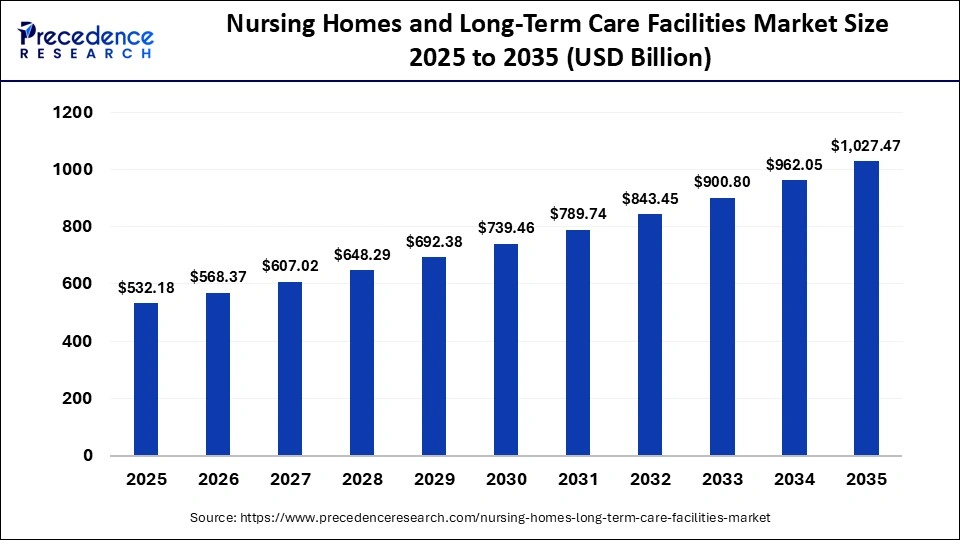
Deepa Pandey, a Healthcare Industry Expert, highlights that the nursing homes and long-term care facilities market has reached USD 568.37 billion in 2026 and is on track to reach USD 1,027.47 billion by 2035, advancing at a CAGR of 6.80%. Key nursing homes and long-term care facilities market companies shaping the market include Amedisys, Inc., Brookdale Senior Living Inc., Care UK Ltd., Colisée Group, while major growth segments span By Facility Type, By Service Type, By Ownership, By Payer.
Source: https://www.precedenceresearch.com/nursing-homes-and-long-term-care-facilities-market
 Get a Sample
 Table Of Content


What is the Nursing Homes and Long-Term Care Facilities Market Size in 2026?
The global nursing homes and long-term care facilities market size accounted for USD 532.18 billion in 2025 and is predicted to increase from USD 568.37 billion in 2026 to approximately USD 1,027.47 billion by 2035, expanding at a CAGR of 6.80% from 2026 to 2035. The market growth is attributed to the rapidly aging global population and rising demand for long-term care services.
Key Takeaways
- North America dominated the nursing homes and long-term care facilities market with a 40% share in 2025.
- Asia Pacific is expected to grow at the fastest CAGR of 8.5% between 2026 and 2035.
- By facility type, the nursing homes segment held a 35% share of the market in 2025.
- By facility type, the assisted living facilities segment held a 25% share of the market in 2025 and is expected to grow at the fastest CAGR of 7.5% between 2026 and 2035.
- By service type, the long-term care segment held a major market share of 45% in 2025.
- By service type, the short-term rehabilitation segment held a 20% market share in 2025 and is expected to grow at a 7.5% CAGR during the forecast period.
- By ownership, the private segment contributed the highest market share of 50% in 2025.
- By ownership, the public segment held a 30% market share in 2025 and is estimated to grow at a strong CAGR of 5.5% over the projection period.
- By payer, the public insurance segment contributed the largest market share of 45% in 2025.
- By payer, the private insurance segment held a 30% share of the market in 2025 and is expected to grow at the fastest CAGR of 7.5% between 2026 and 2035.
Market Overview
The growing aging population across the globe is a major driver accelerating demand for nursing homes and long-term care facilities. Population ageing is putting pressure on countries to provide adequate long-term care. According to the Health at a Glance 2023 by the Organization for Economic Co-operation and Development (OECD), over 242 million people in OECD countries were aged 65+ in 2021, including more than 64 million aged 80+.
Long-term care facilities and nursing homes are healthcare institutions that offer 24x7 medical care, rehabilitation, and support in the everyday activities of life. These centers combine caring nursing care and online monitoring systems to guarantee patient safety and the effectiveness of care delivery. Furthermore, increasing demand for sophisticated healthcare services is likely to support market expansion.
Impact of Artificial Intelligence on the Nursing Homes and Long-term Care Facilities Market
Artificial intelligence is revolutionizing the nursing homes and long-term care facilities market by providing more active, efficient, and personalized elderly care services. Predictive analytics enabled by AI is increasingly used by care providers to detect early signs of health decline. Furthermore, these facilities are using AI to plan staff shifts optimally and reduce caregiver workload, which is dealing with persistent workforce shortages within the industry.
Major Market Trends
- Integration of Robotics for Elderly Assistance: The use of robot technologies is gaining momentum to support mobility, medication delivery, and routine caregiving in a facility. The increased use of robotics is changing the operational efficiency and redrawing models of care delivery in the long-term care setting.
- Growing Demand for Post-Acute and Rehabilitation Services: Increasing hospital discharges are fueling demand for skilled nursing and transitional care facilities.
- Development of Specialized Memory Care Units: Rising dementia-focused care facilities are propelling demand for advanced and targeted long-term care services.
Market Scope
| Report Coverage | Details |
| Market Size in 2025 | USD 532.18 Billion |
| Market Size in 2026 | USD 568.37 Billion |
| Market Size by 2035 | USD 1,027.47 Billion |
| Market Growth Rate from 2026 to 2035 | CAGR of 6.80% |
| Dominating Region | North America |
| Fastest Growing Region | Asia Pacific |
| Base Year | 2025 |
| Forecast Period | 2026 to 2035 |
| Segments Covered | Facility Type, Service Type, Ownership, Payer, and Region |
| Regions Covered | North America, Europe, Asia-Pacific, Latin America, and Middle East & Africa |
Market Dynamics
Drivers
Rising Prevalence of Chronic Diseases Among the Elderly
The rising prevalence of chronic diseases among the elderly population drives the growth of the nursing homes and long-term care facilities market. Chronic conditions, including cardiovascular diseases, diabetes, respiratory conditions, and neurological impairments, necessitate constant monitoring and long-term treatment to manage symptoms and reduce risk factors. Multimorbidity complicates the treatment plans and increases reliance on skilled nursing and rehabilitation. Therefore, the increasing disease burden is boosting the need for progressive care approaches that combine medical therapy and long-term care.
Restraint
Workforce Shortages and High Staff Turnover Rates
The major restraining factor for the nursing homes and long-term care facilities market is a persistent shortage of skilled healthcare workforce, coupled with high staff turnover rates. This leads to increased training and recruitment costs for operators, while also reducing service quality and limiting the capacity of facilities to expand and meet growing demand.
Opportunity
Government Support and Healthcare Funding Initiatives
Spurring government support and healthcare funding initiatives are expected to enhance accessibility and affordability of long-term care services, creating immense opportunities in the market. Countries are investing more in elderly care infrastructure and expanding healthcare systems to meet rising demand. Additionally, the growing aging population and increasing life expectancy are expected to drive long-term growth in the market.
Segment Insights
Facility Type Insights
Nursing Homes and Long-Term Care Facilities Market Share, By Facility Type, 2025-2035 (%)
| Facility Type | 2025 | 2035 | CAGR (%) |
| Nursing Homes | 35.00% | 33.00% | 5.50% |
| Assisted Living Facilities | 25.00% | 26.50% | 7.50% |
| Continuing Care Retirement Communities (CCRCs) | 20.00% | 21.50% | 7.20% |
| Skilled Nursing Facilities (SNFs) | 20.00% | 19.00% | 6.00% |
The Nursing Homes Segment Dominated the Market With a 35% Share in 2025
In 2025, the nursing homes segment held a major share of 35% in the nursing homes and long-term care facilities market. This is primarily due to the growing elderly population worldwide, which requires 24/7 medical supervision and long-term care. These facilities help ease the burden on hospitals by managing long-duration care cases that extend beyond acute treatment settings. Additionally, the expansion of specialized nursing homes, including memory care and high-dependency care units, is further supporting segment growth.
The assisted living facilities segment held a 25% share of the market in 2025 and is expected to grow at the fastest CAGR of 7.5% between 2026 and 2035. This is mainly due to the increasing need for flexible care models that balance independent living and medical assistance. This approach is especially preferred by the aging population who do not require full-time nursing care but still need assistance with daily activities and health monitoring. Additionally, rapid urbanization and expansion of residential infrastructure are improving accessibility and driving the adoption of assisted living services.
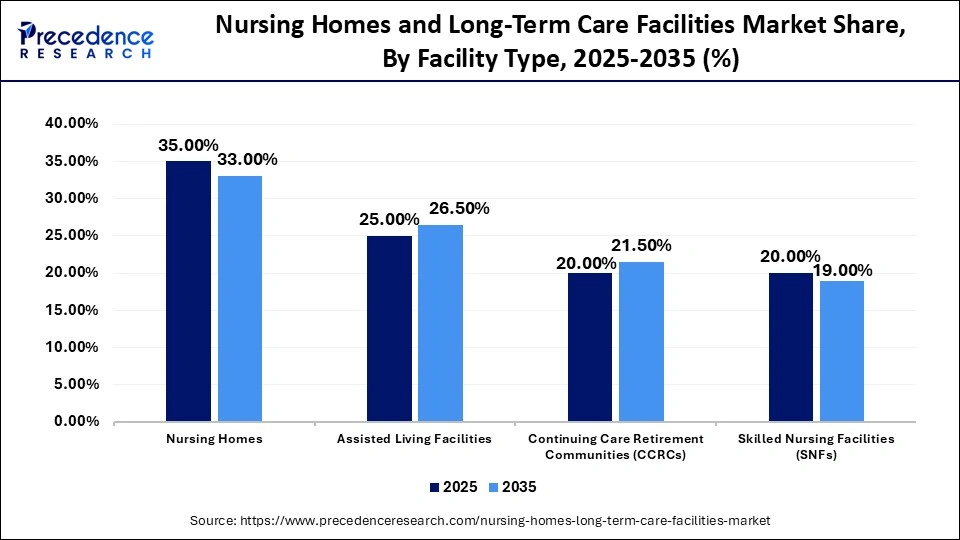
The continuing care retirement communities (CCRCs) segment held a 20% share of the market in 2025 and is expected to grow at a 7.2% CAGR during the projection period. This is primarily due to the increasing adoption of integrated care ecosystems for aging populations. CCRCs provide a seamless continuum of care, reducing the need for relocation and improving long-term care stability for elderly individuals. Additionally, growing demand from middle- and high-income groups for structured retirement planning solutions is further supporting segment growth.
The skilled nursing facilities (SNFs) segment contributed the 20% market share in 2025 and is estimated to grow at a strong CAGR of 6% over the projected period. The growth of the segment is attributed to the rising number of hospital releases needing short-term medical care and recovery help. SNFs are multidisciplinary rehabilitation facilities that provide clinical services and enhance recovery, and lower the readmission rates. The increasing number of surgical procedures and prevalence of chronic diseases propel the demand for skilled nursing facilities.
Service Type Insights
Nursing Homes and Long-Term Care Facilities Market Share, By Service Type, 2025-2035 (%)
| Service Type | 2025 | 2035 | CAGR (%) |
| Long-term Care | 45.00% | 43.00% | 5.80% |
| Short-term Rehabilitation | 20.00% | 21.50% | 7.50% |
| Hospice & Palliative Care | 20.00% | 19.50% | 6.50% |
| Memory Care (Alzheimer's & Dementia Care) | 15.00% | 16.00% | 8.20% |
The Long-Term Care Segment Dominated the Market in 2025
The long-term care segment dominated the nursing homes and long-term care facilities market with a share of 45% in 2025. This is mainly due to the increased burden of chronic diseases, multimorbidity, and functional dependency in older populations. Long-term care services provide round-the-clock care management, drug administration, and aid in daily living activities, such as bathing, mobility, and nutrition.
Demand for these services is high due to the need for structured care environments for patients requiring long-term and intensive support. According to the Centers for Medicare & Medicaid Services, over 1.2 million individuals received institutional long-term care services in certified facilities in 2024. Additionally, steady patient inflows requiring extended care are driving this segment.
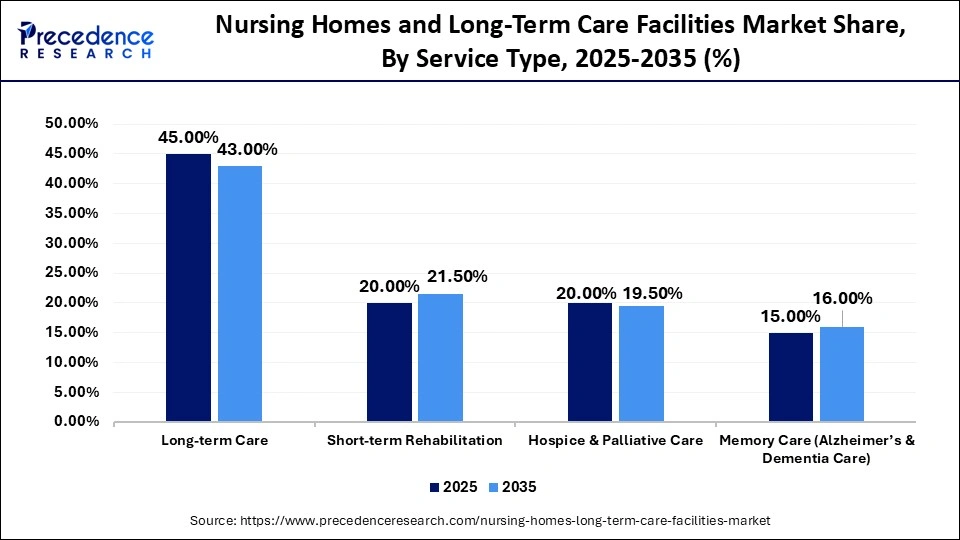
The short-term rehabilitation segment held a 20% share of the market in 2025 and is expected to grow at a significant CAGR of 7.5% in the coming years, driven by the rising number of surgical procedures, which significantly propels the demand for rehabilitation services. Rehabilitation services are being prioritized as the means of streamlining the process of hospital discharge and cutting down on readmission rates.
The hospice & palliative care segment held a 20% share of the market in 2025 and is expected to grow at a 6.5% CAGR during the projection period, owing to increasing understanding of end-of-life care, which focuses on pain control, emotional support, and quality of life. The demand for hospice and palliative care is expected to rise as a result of the growing prevalence of life-limiting illnesses. The rising preference for end-of-life care services also supports segmental growth.
The memory care (alzheimer's & dementia care) segment accounted for a 15% market share in 2025 and is estimated to grow at a strong CAGR of 8.2% over the projected period. This is mainly due to the rising occurrence of Alzheimer's disease, dementia, and other forms of cognitive impairment across the ageing population. The segment growth is also driven by the increasing worldwide burden of neurodegenerative diseases.
Ownership Insights
Nursing Homes and Long-Term Care Facilities Market Share, By Ownership, 2025-2035 (%)
| Ownership | 2025 | 2035 | CAGR (%) |
| Private | 50.00% | 52.00% | 7.20% |
| Public | 30.00% | 28.00% | 5.50% |
| Non-profit | 20.00% | 20.00% | 6.00% |
Why Did the Private Segment Dominated the Market in 2025?
The private segment dominated the nursing homes and long-term care facilities market with the largest share of 50% in 2025. This is mainly due to the increased investment by the private sector in advanced infrastructure, premium amenities, and technology-driven care solutions. Additionally, the growing inflow of private capital in the elderly care provision is expected to boost segmental growth in the coming years.
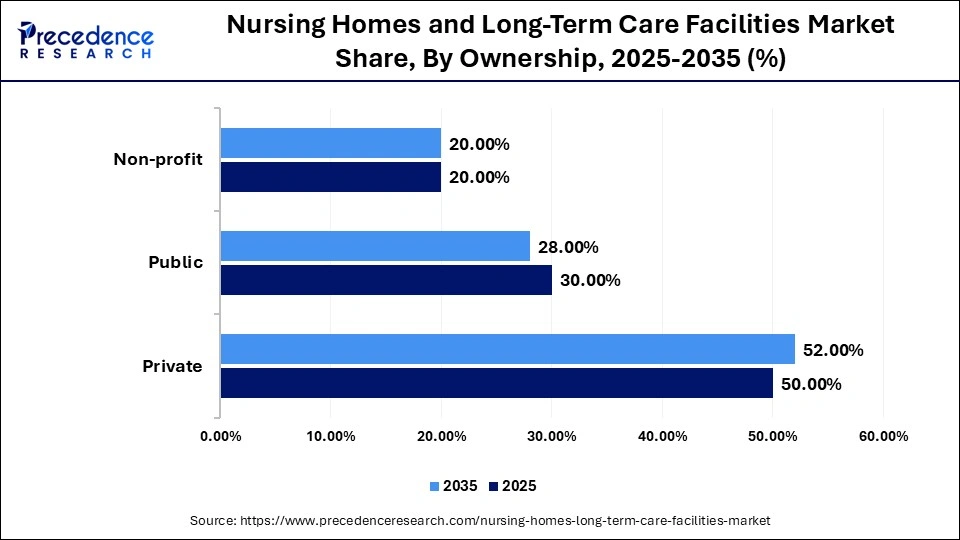
The public segment held a 30% share of the market in 2025 and is expected to grow at a healthy CAGR of 5.5% between 2026 and 2035, supported by government-funded programs aimed at providing accessible care services. The segment plays a major part in serving low and middle-income people who need affordable long-term care options. Public healthcare facilities are extremely regulated and have complete care protocols to provide basic quality of service.
The non-profit segment held a 20% market share in 2025 and is expected to grow at a significant CAGR of 6% in the upcoming period. This is mainly due to the significant contribution of non-profit organizations to community-based and affordable care services. Moreover, these organizations are investing heavily in specialized care programs as a way of meeting the challenge of changing healthcare needs. These organizations also play a key role in providing affordable care services, particularly in developed regions.
Payer Insights
The Public Insurance Segment Held a 45% Share of the Market in 2025
The public insurance segment dominated the nursing homes and long-term care facilities market with a share of 45% in 2025. This is mainly due to the extensive coverage offered through government-backed healthcare programs for elderly populations. Increasing public funding and higher financial allocations toward elderly care within national healthcare systems are further supporting sustained segment growth.
Nursing Homes and Long-Term Care Facilities Market Share, By Payer, 2025-2035 (%)
| Payer | 2025 | 2035 | CAGR (%) |
| Public Insurance | 45.00% | 43.00% | 5.80% |
| Private Insurance | 30.00% | 32.00% | 7.50% |
| Out-of-Pocket | 25.00% | 25.00% | 6.50% |
The private insurance segment held a 30% market share in 2025 and is estimated to grow at a strong CAGR of 7.5% over the projected period, due to its expanding role in financing long-term care services among higher-income populations. Private insurers are also covering long-term care policies that are specialized and cater to extended stays and advanced medical treatments.
The out-of-pocket segment held a 25% share of the market in 2025 and is expected to grow at a significant CAGR of 6.5% between 2026 and 2035, driven by gaps in public and private healthcare financing systems, particularly in emerging economies. In regions with limited insurance coverage, families often bear the direct cost of long-term care services, supporting steady segment demand.
Regional Insights
North America Nursing Homes and Long-Term Care Facilities Market Size and Growth 2026 to 2035
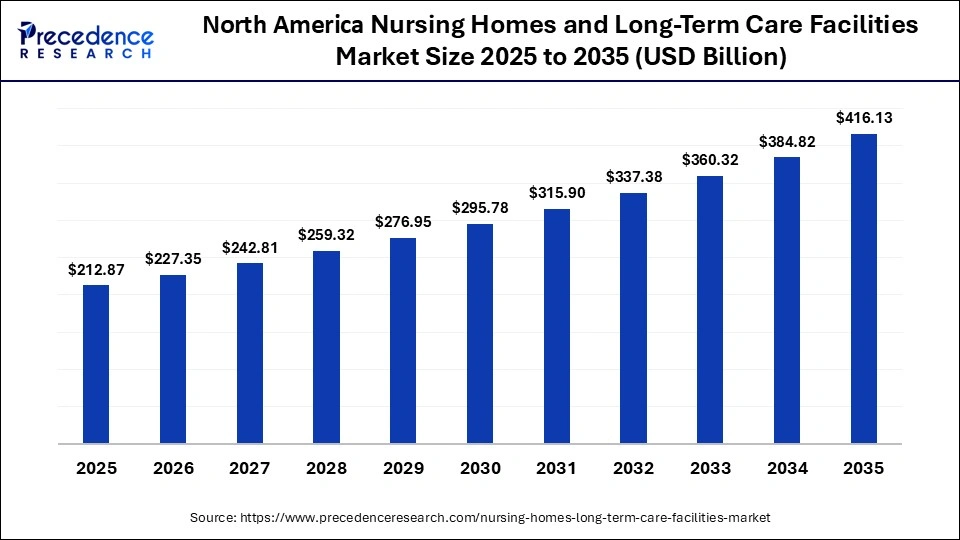
The North America nursing homes and long-term care facilities market size is estimated at USD 212.87 billion in 2025 and is projected to reach approximately USD 416.13 billion by 2035, with a 6.93% CAGR from 2026 to 2035.
What Made North America the Dominant Region in the Market in 2025?
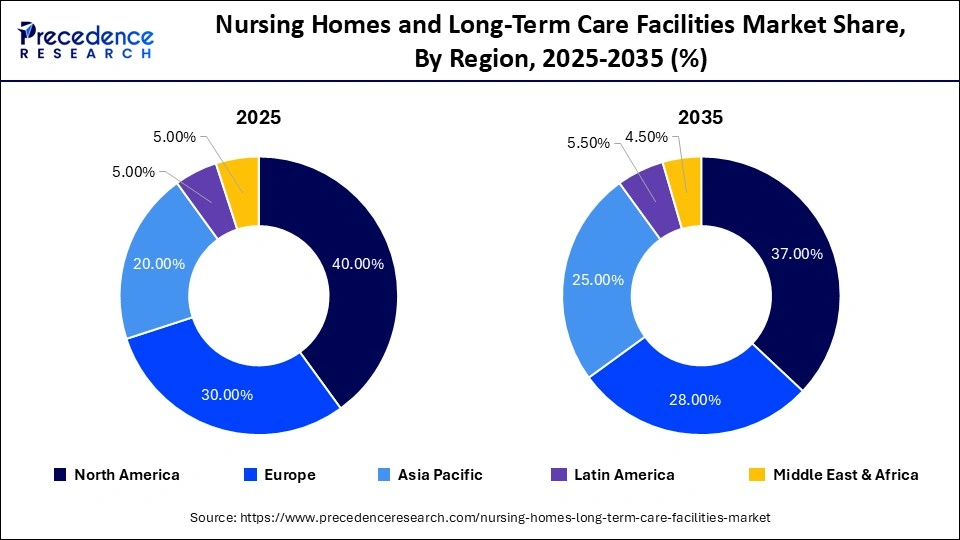
North America led the nursing homes and long-term care facilities market, capturing the largest revenue share of 40% in 2025. This is mainly due to the presence of advanced skilled nursing facilities, assisted living networks, and post-acute care infrastructure. There is a high demand for continuous care management, driven by high life expectancy and the rising prevalence of chronic diseases. Growing focus on patient-centered and technology-based care models in this region also drives the market.
U.S. Nursing Homes and Long-Term Care Facilities Market Size and Growth 2026 to 2035
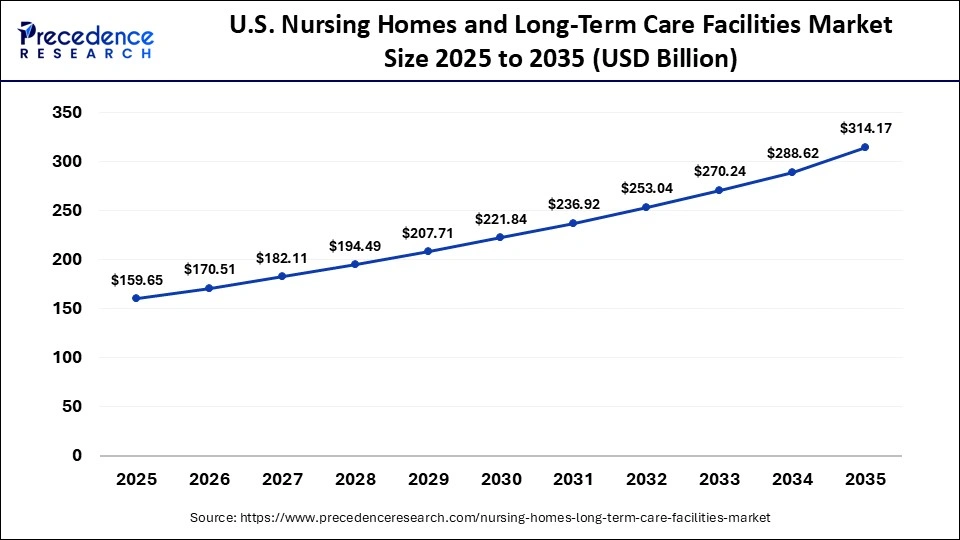
The U.S. nursing homes and long-term care facilities market size is calculated at USD 159.65 billion in 2025 and is expected to reach nearly USD 314.17 billion in 2035, accelerating at a strong CAGR of 7.00% between 2026 and 2035.
U.S. Market Analysis
The U.S. leads the market within North America, driven by a rapidly growing elderly population and expanding long-term care infrastructure. The country is strengthening its skilled nursing, assisted living, and home-based care systems to meet rising demand. In 2025, the Centers for Medicare and Medicaid Services reported over 68 million Medicare enrollees, significantly supporting demand for elderly care services.
Europe: The Second-Largest Shareholder
Europe held the second-largest market share of 30% in 2025 and is estimated to grow at a strong CAGR of 5.8% over the projected period. This is mainly due to the rising geriatric population and increasing demand for residential, home-based, and community care services. The Nuffield Trust highlighted that the UK recorded more than 410,000 care home residents in 2025, indicating sustained institutional care demand. Additionally, the regions' integrated care provision schemes and focus on social support services further facilitate the nursing homes and long-term care facilities market growth in the coming years.
Germany Market Analysis
Germany is a major contributor to the nursing homes and long-term care facilities market in Europe, supported by its well-structured long-term care insurance system and rapidly aging population. According to the European Commission Directorate-General for Health and Food Safety, Germany continued to expand its elderly care services throughout 2025, further strengthening demand for long-term care facilities.
Asia Pacific: The Fastest-Growing Region
Asia Pacific held a share of 20% in 2025 and is expected to grow at the fastest CAGR of 8.5% between 2026 and 2035, driven by a rising geriatric population and declining traditional family-based caregiving systems. Governments across the region are increasingly investing in healthcare infrastructure, insurance coverage, and elder care programs to meet the growing demand for long-term care services.
Japan Market Analysis
In Japan, the market is driven by a rapidly aging population and a well-developed long-term care system. The country's established long-term care insurance program supports both institutional and home-based care services. Additionally, declining family caregiving capacity and ongoing urbanization trends are further supporting market growth.
Nursing Homes and Long-term Care Facilities Market Value Chain Analysis
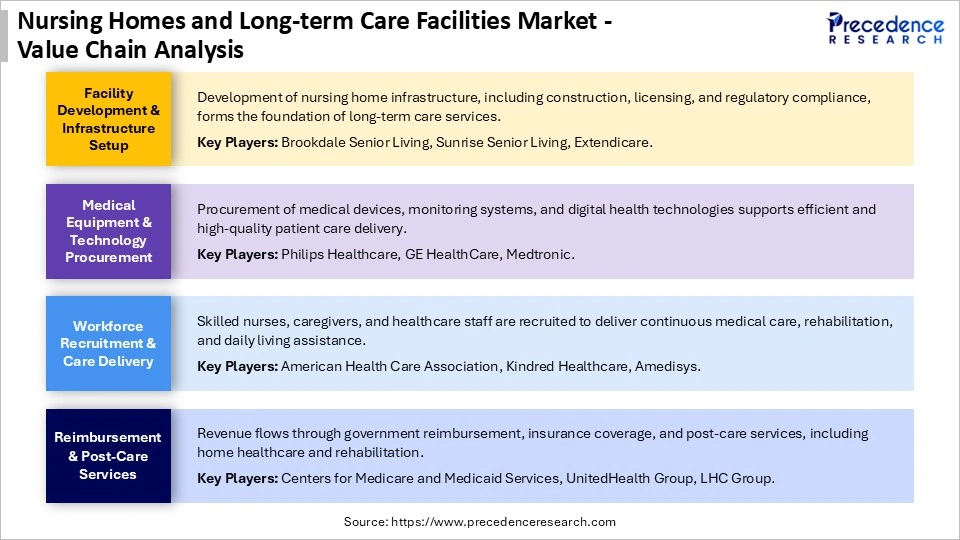
Nursing Homes and Long-Term Care Facilities Market Companies
- Amedisys, Inc.
- Brookdale Senior Living Inc.
- Care UK Ltd.
- Colisée Group
- Diversicare Healthcare Services, Inc.
- Ensign Group, Inc.
- Extendicare Inc.
- Genesis HealthCare, Inc.
- Golden LivingCenters
- Kindred Healthcare LLC
- Korian Group
- LHC Group, Inc.
- Orpea Group
- Sienna Senior Living Inc.
- Sunrise Senior Living, LLC
Recent Developments
- In March 2026, TPG launched One Aged Care, integrating ECON Healthcare, Orange Valley Nursing Homes, and Ambulance Medical Service to deliver unified senior care services across Singapore and Malaysia.(Source: https://www.tpg.com)
- In March 2026, Geri Care expanded its footprint by opening a new Skilled Nursing Facility and clinic in Bengaluru, marking its 12th facility amid India's rapidly growing elderly population.(Source: https://www.tribuneindia.com)
Segments Covered in the Report
By Facility Type
- Nursing Homes
- Assisted Living Facilities
- Continuing Care Retirement Communities (CCRCs)
- Skilled Nursing Facilities (SNFs)
By Service Type
- Long-term Care
- Short-term Rehabilitation
- Hospice & Palliative Care
- Memory Care (Alzheimer's & Dementia Care)
By Ownership
- Publi
- Private
- Non-profit
By Payer
- Public Insurance
- Private Insurance
- Out-of-Pocket
By Region
- North America
- Latin America
- Europe
- Asia-pacific
- Middle and East Africa
For inquiries regarding discounts, bulk purchases, or customization requests, please contact us at sales@precedenceresearch.com
Frequently Asked Questions





Ask For Sample
No cookie-cutter, only authentic analysis – take the 1st step to become a Precedence Research client
 Get a Sample
.webp)



 sales@precedenceresearch.com
 Schedule a Meeting
