



Open Banking Market Trends, Companies, Revenue / Sales Performance, Subscriber Growth, Pricing Strategies, Cloud Adoption, Infrastructure Expansion, Competitive Landscape, and Industry Outlook
Open Banking Market (By Service Type/Financial Service: Banking & Capital Markets, Payments, Digital Currencies, Value-Added Services/Others; By Component/Service Offering: Transactional/Account & Payment APIs, Communicative/Informative Services, Others; By Deployment Type: Cloud-based, On-Premise, Hybrid; By Distribution Channel: Bank Channels, Apps/Platforms, Distributors & Aggregators; By End-User: Banks & Traditional Financial Institutions, Fintech & Third-Party Developers, SMEs & Enterprises, Consumers/Individuals) - Global Industry Analysis, Size, Trends, Leading Companies, Regional Outlook, and Forecast 2026 to 2035
Source: https://www.precedenceresearch.com/open-banking-market
 Get a Sample
 Table Of Content


What is the Open Banking Market Size?
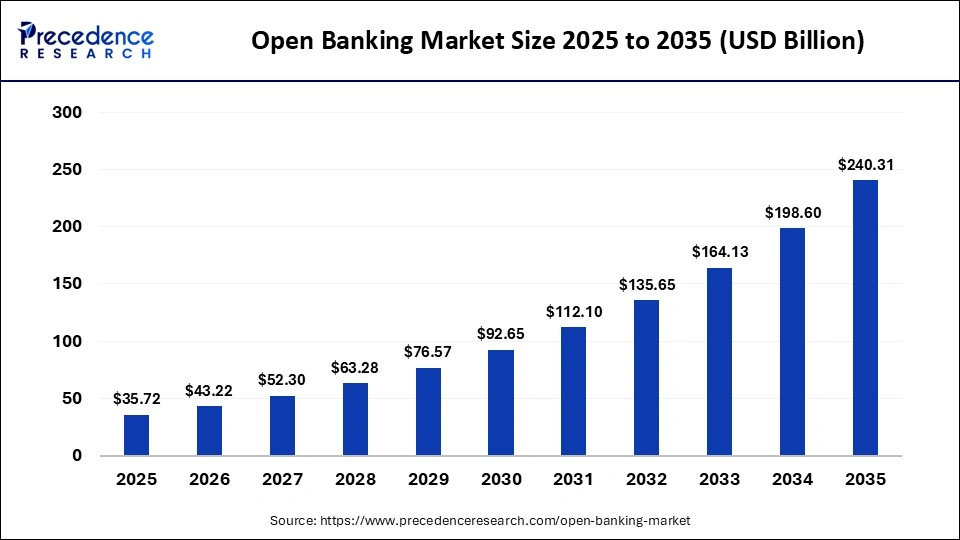
The global open banking market size accounted for USD 35.72 billion in 2025 and is predicted to increase from USD 43.22 billion in 2026 to approximately USD 240.31 billion by 2035, expanding at a CAGR of 21.00% from 2026 to 2035. This market is growing due to increasing demand for secure data sharing, digital financial services, and personalized banking experiences powered by APIs and fintech innovation.
Market Highlights
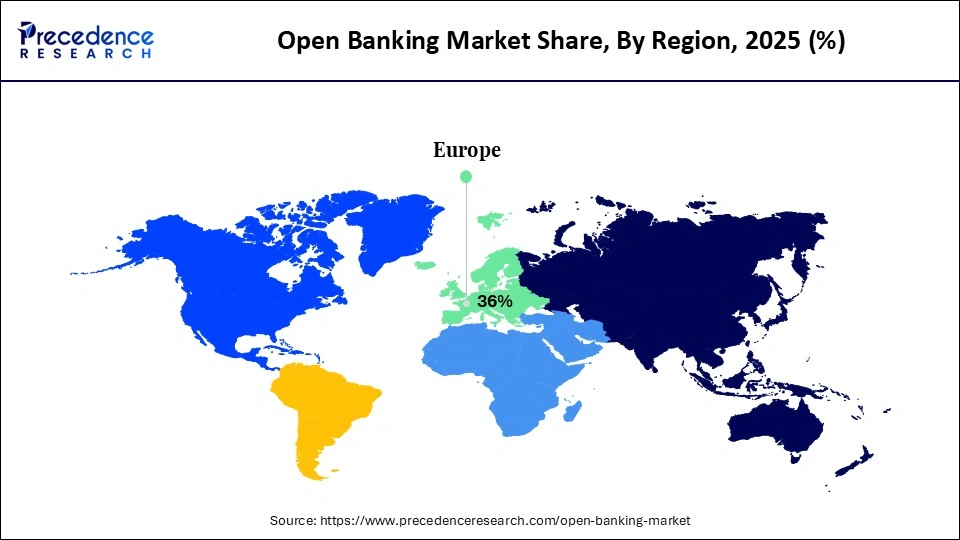
- Europe dominated the global open banking market with a major revenue share of approximately 36% in 2025.
- Asia Pacific is expected to grow at the fastest CAGR between 2026 and 2035.
- By service type/financial service, the banking & capital segment generated the biggest market share of approximately 46% in 2025.
- By service type, the payments segment is expected to expand at the fastest CAGR between 2026 and 2035.
- By component/service offering, the transactional/account & payment APIs segment contributed the highest market share of approximately 50% in 2025.
- By component/service offering, the communicative/informative services segment is expected to grow at a strong CAGR between 2026 and 2035.
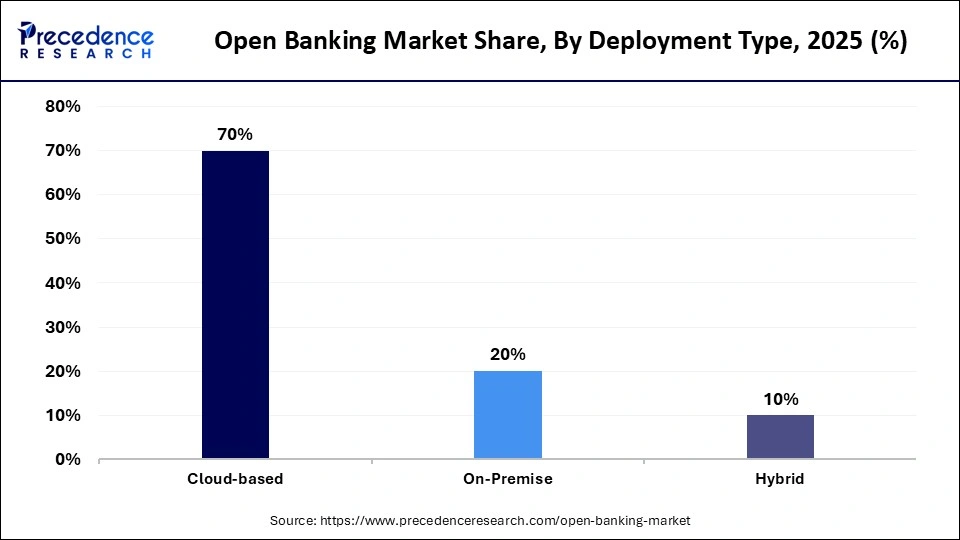
- By deployment type, the cloud-based segment dominated the market with a 70% share in 2025 and is expected to maintain its leadership position in the coming years.
- By distribution channel, the bank channels segment generated the biggest market share of approximately 60% in 2025.
- By distribution channel, the apps/platforms segment is expected to expand at the fastest CAGR between 2026 and 2035.
- By end user, the banks & traditional financial institutions segment contributed the highest market share of approximately 40% in 2025.
- By end user, the fintech & third-party developers segment is expected to grow at a robust CAGR between 2026 and 2035.
Market Overview
The open banking market is expanding as banks leverage APIs to securely provide third parties with access to customer data, enabling personalized digital services such as financial management tools and instant payments. The growth of the market is driven by increasing fintech partnerships, supportive regulatory frameworks, and rising consumer demand for seamless digital banking experiences worldwide. Additionally, advancements in APIs, cloud computing, and data analytics enable secure data sharing, while businesses benefit from improved customer insights, new revenue streams, and enhanced user experiences.
How is AI Driving Innovation in the Open Banking Market?
Artificial intelligence is boosting the open banking market by enabling real-time data analysis, personalized financial insights, smarter credit scoring, and advanced fraud detection. By enhancing security efficiency and customer experience through integration with open APIs, it speeds up market expansion. AI also improves user engagement by enabling automated customer service via chatbots and virtual assistants. By using data-driven decision-making and predictive analytics, it also assists financial institutions in finding new revenue streams.
Key Trends
- Rising API Adoption: Banks are increasingly implementing open APIs to enable seamless integration with fintech platforms and third-party service providers.
- Growing Fintech Collaborations: Strategic partnerships between traditional banks and fintech firms are accelerating innovation and expanding digital service portfolios.
- Expansion of Embedded Finance: Open banking is driving embedded financial services within e-commerce, retail, and non-banking digital platforms.
- Increase in Digital Payment Solutions: Account-to-account (A2A) payments and real-time payment systems are gaining traction.
- Regulatory Support and Compliance Frameworks: Government initiatives promoting secure data sharing are strengthening market growth.
- AI and Data Analytics Integration: Financial institutions are leveraging AI for fraud detection, credit assessment, and personalized banking.
- Focus on Enhanced Cybersecurity: Advanced encryption and authentication systems are being adopted to ensure secure data exchange.
- Rising Consumer Demand for Financial Transparency: Customers prefer platforms offering better financial visibility, budgeting tools, and control over data.
Future Market Outlook
- SME Digital Lending Expansion: Open data access enables faster and more accurate credit assessment for small businesses.
- Personalized Wealth Management Services: Data-driven advisory platforms can offer tailored investment solutions.
- Growth in Emerging Markets: Increasing smartphone penetration and digital banking adoption create untapped opportunities.
- Development of Cross-Border Payment Solutions: Open banking can simplify and reduce the cost of international transactions.
- Expansion of Banking-as-a-Service (BaaS): Financial institutions can monetize APIs by offering infrastructure to fintech startups.
- Integration with Insurtech and Regtech: Collaboration with insurance and regulatory technology firms can create new value streams.
- Advanced Financial Data Monetization: Secure and consent-based data sharing opens new revenue models.
- Innovative Customer Experience Platforms: AI-powered budgeting apps, financial dashboards, and smart assistants present strong growth potential.
How is Open Banking Building a More Resilient and Future Ready Financial Ecosystem?
Open banking enhances financial system resilience through encouraging competition, innovation, and safe data exchange between institutions. It encourages a variety of service models and lessens reliance on a single banking channel by decentralizing access to financial data via APIs. Ecosystems are made secure and organized by regulatory frameworks like PSD2 and comparable international projects. Adaptability to market disruptions is strengthened by the combination of real-time payments, AI-driven analytics, and fintech collaboration. The infrastructure required for scalable and robust financial innovation is provided by open banking as digital financial services expand.
Market Scope
| Report Coverage | Details |
| Market Size in 2025 | USD 35.72 Billion |
| Market Size in 2026 | USD 43.22 Billion |
| Market Size by 2035 | USD 240.31 Billion |
| Market Growth Rate from 2026 to 2035 | CAGR of 21.00% |
| Dominating Region | Europe |
| Fastest Growing Region | Asia Pacific |
| Base Year | 2025 |
| Forecast Period | 2026 to 2035 |
| Segments Covered | Service Type/Financial Service, Component/Service Offering, Deployment Type, Distribution Channel, End-User, and Region |
| Regions Covered | North America, Europe, Asia-Pacific, Latin America, and Middle East & Africa |
Market Dynamics
Driver
Need for Personalized Digital Financial Services
The increasing demand for personalized digital financial services and seamless banking experiences is a major driver for the market. Financial institutions are increasingly adopting open banking frameworks to enable secure data sharing, improve customer engagement, and accelerate innovation in digital payment ecosystems. The rapid growth of fintech companies, mobile banking platforms, and API-driven financial services is further contributing to market expansion globally. Additionally, supportive government regulations and initiatives promoting financial transparency, competition, and consumer data control are encouraging widespread adoption of open banking solutions.
Restraint
Data Privacy & Security Risks
Despite significant growth potential, the open banking market faces restraints associated with cybersecurity risks, data privacy concerns, and regulatory complexities. Financial institutions must ensure secure customer authentication and protect sensitive financial information from cyber threats and unauthorized access. In addition, differences in regulatory frameworks and API standardization across regions can create operational challenges for banks and fintech providers. Limited consumer awareness regarding data-sharing practices and concerns about third-party access to financial information may further hinder broader market adoption.
Opportunity
Technological Advancements
The growing integration of artificial intelligence, embedded finance, and real-time payment technologies is creating substantial opportunities within the market. Businesses are increasingly leveraging open banking APIs to develop customized lending, wealth management, budgeting, and payment solutions for consumers and enterprises. Emerging economies with expanding digital banking adoption and rising smartphone penetration are also offering strong growth potential for market participants. Furthermore, the increasing demand for cross-border payments, digital wallets, and Banking-as-a-Service (BaaS) platforms is expected to generate new revenue opportunities across the financial ecosystem.
Segment Insights
Service Type/Financial Service Insights
What made banking & capital the dominant segment in the open banking market?
The banking & capital segment dominated the market with a 46% share in 2025 because core banking services, such as account information services, payments, lending, and cash management, are the primary use cases enabled by open APIs. Financial institutions and fintechs heavily adopt open banking to improve customer onboarding, real-time payments, credit assessment, and personalized financial products, which directly impact revenue generation. Additionally, strong regulatory mandates initially focused on retail banking data sharing, further accelerating adoption within the banking and capital markets segment.
The payments segment is expected to grow at the fastest CAGR in the coming years because API-enabled account-to-account (A2A) payments offer faster, lower-cost alternatives to traditional card networks. Open banking supports real-time payments, instant fund transfers, and seamless checkout experiences, which are increasingly demanded by consumers and merchants. Additionally, reduced transaction fees, improved security through strong customer authentication, and the rise of e-commerce and digital wallets are accelerating adoption across both retail and business payment use cases.
Component/Service Offering Insights
What made transactional/account & payment APIs the leading segment in the open banking market?
The transactional/account & payment APIs segment led the market with a major share of 50% in 2025 since they serve as the foundation of open banking. These APIs make it possible to initiate payments, share secure data, and access accounts in real time. These APIs are given top priority by financial institutions to guarantee both customer transparency and regulatory compliance. The dominance of these APIs is further reinforced by their direct involvement in services that generate revenue.
The communicative/informative services segment is expected to grow at the fastest CAGR in the coming years because of an increase in the need for individualized insights and financial data analytics. AI-driven recommendations improve credit scores, and budgeting tools are made possible by these services. Adoption is fueled by growing consumer preference for financial transparency and intelligent financial management tools.
Deployment Type Insights
Why is the cloud-based segment dominating the open banking market?
The cloud-based segment dominated the market while holding a 70% share in 2025 and is expected to maintain its leadership position in the coming years. This is because of its capacity for faster API deployment cost effectiveness and scalability. Cloud infrastructure supports high transaction volumes, regulatory compliance, and secure data exchange, while enabling real-time analytics and seamless fintech integration. Ongoing innovations in cybersecurity and hybrid cloud models are expected to sustain the segment's dominant position in the market.
Distribution Channel Insights
Why did the bank channels segment dominate the open banking market?
The bank channels segment dominated the market with a 60% share in 2025 because banks serve as the primary custodians of customer financial data and are central to account information and payment services. Leveraging their existing customer base, trust, and regulatory compliance frameworks, banks can offer secure API access to third-party providers, enabling personalized financial services and seamless transactions. Additionally, banks' established infrastructure and partnerships with fintechs make them the most effective and widely adopted distribution channel for open banking solutions.
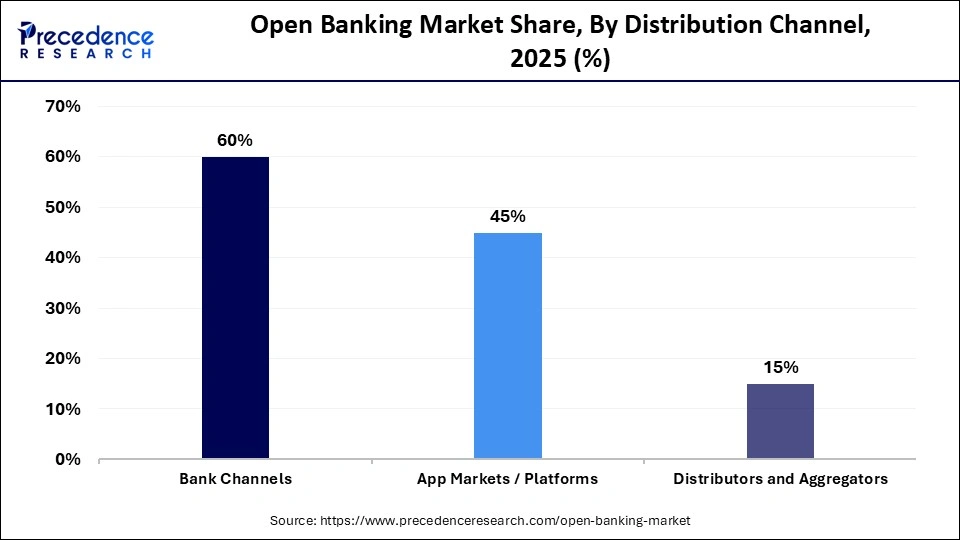
The apps/platforms segment is expected to grow at the fastest CAGR in the coming years because third-party apps and digital platforms provide consumers with convenient, integrated financial services across multiple banks. Platforms offering budgeting tools, payments, investment tracking, and multi-bank connectivity enhance user experience and drive engagement. Growth is further fueled by super apps, embedded finance models, and the expanding fintech ecosystem, which leverage open banking APIs to deliver seamless, personalized services outside traditional banking channels.
End User Insights
Why did the banks & traditional financial institutions segment dominate the open banking market?
The banks & traditional financial institutions segment dominated the market with a 40% share in 2025. This is because they control a large volume of customer account data and core banking systems. As the primary focus of regulatory mandates, banks are central to open banking implementation. Their leadership is further strengthened by investments in API management and ongoing digital transformation initiatives.
The fintech & third-party developers segment is expected to grow at the fastest CAGR in the upcoming period because they leverage APIs to create innovative financial products, such as digital wallets, lending platforms, and personal finance apps. Their agility allows rapid deployment of personalized services and seamless integration across multiple banks, meeting rising consumer demand for convenience and real-time financial management. Additionally, supportive regulatory frameworks and partnerships with traditional banks enable fintechs and developers to scale quickly, driving segment growth.
Regional Insights
What is the Europe Open Banking Market Size and Growth Rate?
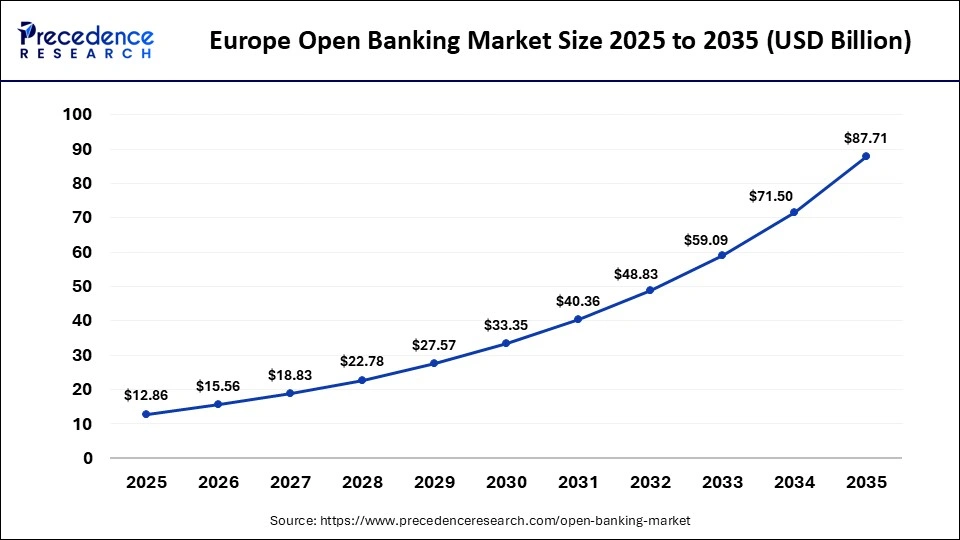
The Europe open banking market size has grown strongly in recent years. It will grow from USD 12.86 billion in 2025 to USD 87.71 billion in 2035, expanding at a compound annual growth rate (CAGR) of 21.17% between 2026 and 2035.
What made Europe the dominant region in the open banking market?
Europe dominated the open banking market by holding a 36% share in 2025. This is due to the early adoption of open API standards and robust regulatory frameworks such as PSD2. Government regulations pushed banks to exchange consumer data securely, spurring innovation. There is a high adoption of digital banking services. Additionally, strong digital banking infrastructure, high smartphone penetration, and consumer demand for personalized financial services have reinforced Europe's leadership in open banking.
Germany Market Analysis
Germany is a leading contributor to the European open banking market due to its highly digitalized banking industry and strict compliance with PSD2 regulations. Strong API standardization, the presence of major banks and fintech hubs in Frankfurt and Berlin, and growing consumer preference for digital payments and account aggregation are driving adoption. Additionally, collaborations between fintechs and traditional banks are fostering innovation in digital payment and lending solutions.
How is the opportunistic rise of Asia Pacific in the market?
Asia Pacific is expected to grow at the fastest CAGR in the coming years because of government-supported digitalization initiatives, rapid fintech expansion, and increasing adoption of digital payments. The introduction of open banking regulations in countries like Australia, Singapore, and India, combined with rising smartphone penetration and a large unbanked population, is creating significant growth opportunities in the region.
India Market Analysis
India is experiencing rapid growth in open banking driven by initiatives like India Stack, UPI, and the Account Aggregator framework, which enable scalable real-time payments and secure data sharing. Key growth factors include the rise of fintech startups, increasing smartphone penetration, and widespread adoption of digital payments. Expansion of financial inclusion programs and embedded finance models is expected to further accelerate India's open banking market.
Which Factors Drive the Open Banking Market in North America?
North America is expected to grow at a notable CAGR in the foreseeable future, due to the increasing use of fintech solutions, API-enabled banks, and the rising demand for customized financial solutions. Open banking technology is used by banks, payment organizations, and fintech players for better lending, payment processing, budgeting, and account aggregation services. Other factors that contributed to the growth of open banking in the region include high levels of internet penetration and digital financial management preferences among consumers.
U.S. Market Trends
The U.S. market is driven by the adoption of digital banking services and an emphasis by regulators on consumers' rights over their financial data. CFPB's Personal Financial Data Rights regulation ensured that banks could safely share information with consumers and third-party firms authorized by consumers. Financial organizations began investing heavily in APIs to facilitate real-time access to personal financial data and enhance consumer engagement in the banking process.
Will Latin America Grow in the Open Banking Market?
Latin America is expected to grow at a considerable CAGR in the upcoming period, due to the fintech industry's growth, financial inclusion projects, and the increased usage of digital payments. The open banking concept enables greater access to credit, payments, and customized financial services for underbanked individuals and small firms. Higher penetration of smartphones and the internet enables people to embrace financial apps.
Brazil Market Trends
Brazil leads the market in Latin America because of its sophisticated open finance model and its developed Pix payment ecosystem. The Central Bank of Brazil backed open finance in order to foster healthy competition, innovation, and consumer sovereignty regarding their financial information. Banks and Fintechs were offering their products through APIs that could enable fast transfers, loans, and money management for customers. Growing consumer trust towards digital finance platforms was also aiding the spread of open banking.
How is the Middle East and Africa Growing in the Open Banking Market?
The Middle East and Africa are expected to grow at a considerable CAGR in the upcoming period, due to regional improvements in the banking industry, digitalization, fintech advancements, and digital payments. Government organizations and central banks encourage the use of open finance models to increase financial inclusion, transparency, and healthy competition in the banking sector. Investments in banking infrastructures have played a role in developing API-based financial systems in many countries.
UAE Market Trends
The UAE market is driven by safe exchange of information, increased user control, and the availability of different financial products. A rich fintech environment, along with the smart moves made by the government led to innovative solutions for online banking services. Banks use open API in improving payments, loan management platforms, and user experience.
Who are the Major Players in the Global Open Banking Market?
The major players in the open banking market include Plaid Inc., Tink (Visa), Yodlee/Envestnet, TrueLayer, Token.io, Salt Edge, Bud Financial, Figo, Mambu, MX Technologies, GoCardless Ltd., Stripe, Inc., Jack Henry & Associates, Inc., OpenWrks, and BBVA Open Platform.
Recent Developments
- In February 2026, Amazon announced the launch of Pay by Bank in the UK through a partnership with TrueLayer. This service allows UK customers to pay for purchases directly from their bank accounts using biometric authentication or a PIN. It is designed for faster checkout and quicker refunds.
(Source: https://www.openbankingexpo.com) - In February 2026, Wrisk announced the acquisition of Atto to create an integrated platform for embedded finance and protection. The platform aims to offer hyper-personalised insurance products using open banking data by combining Wrisk's insurance infrastructure with Atto's real-time financial intelligence. The integration of credit and risk insights is intended to simplify underwriting and provide more accurate, automated coverage for global automotive and consumer brands.
(Source: https://www.prnewswire.com)
Segments Covered in the Report
By Service Type/Financial Service
- Banking & Capital Markets
- Payments
- Digital Currencies
- Value-Added Services/Others
By Component/Service Offering
- Transactional/Account & Payment APIs
- Communicative/Informative Services
- Others
By Deployment Type
- Cloud-based
- On-Premise
- Hybrid
By Distribution Channel
- Bank Channels
- Apps/Platforms
- Distributors & Aggregators
By End-User
- Banks & Traditional Financial Institutions
- Fintech & Third-Party Developers
- SMEs & Enterprises
- Consumers/Individuals
By Region
- North America
- Europe
- Asia-Pacific
- Latin America
- Middle East & Africa
For inquiries regarding discounts, bulk purchases, or customization requests, please contact us at sales@precedenceresearch.com
Frequently Asked Questions
Tags





Ask For Sample
No cookie-cutter, only authentic analysis – take the 1st step to become a Precedence Research client
 Get a Sample




 sales@precedenceresearch.com
 Schedule a Meeting
