



Induced Pluripotent Stem Cell (iPSC) Therapy Market Revenue and Forecast by 2033
Published: 24 Oct 2025
Author: Precedence Research



Induced Pluripotent Stem Cell (iPSC) Therapy Market Revenue and Trends 2025 to 2033
The global induced pluripotent stem cell (iPSC) therapy market is driven by rising rail infrastructure projects, lightweight material demand, and innovation in sustainable transport. The induced pluripotent stem cell (iPSC) therapy market is driven by increasing regenerative medicine applications and advancements in personalized and cell-based therapeutic research.
Factors Contributing to Growth of iPSC Therapy Industry?
The market for induced pluripotent stem cell (iPSC) therapy is growing because of rising demand for regenerative medicines, a growing prevalence of chronic diseases, and advancements in cellular reprogramming technologies. iPSC therapy involves reprogramming adult somatic cells into a pluripotent state, allowing different cell types to be differentiated for therapeutic use. iPSCs demonstrate a strong potential in personalized medicine, drug discovery, and tissue regeneration.
Furthermore, the rising amount of investment in stem cell research, and favorable regulatory frameworks are also contributing to growth of the industry. Their ability to overcome ethical issues with embryonic stem cells makes iPSCs a promising tool for next-generation routes to therapeutics and disease modeling.
Segmental Analysis
- By Cell Origin / Linage - Hematopoietic cells dominate because they are integral to therapies for blood disorders, as well as to research in transplantations, evidence of significant potential to treat leukemia and anemia through iPSC-derived blood cells.
- By Application - Regenerative medicine accounts for the largest share as iPSC therapies are utilized in medicine to restore damaged tissue/organs to improve cell-based human therapies oriented to treat neurodegenerative diseases, cardiac issues and musculoskeletal disease.
- By Product & Services - iPSC-derived cells account for the largest share since they serve to ensure utility as components in disease modeling, drug discovery, and personalized medicine applications, providing the unique method across clinical and basic research for either application.
- By End-User - Pharmaceuticals and biotech industry contains the dominant ozidometric share for rising investments and foci in the field of drug screen or toxicity testing for iPSC-derived therapies, and regenerative medicine as part of dignity and therapeutic development initiatives.
- By Workflow - Reprogramming retains the largest share as it provides the foundational step to making iPSCs from somatic cells in a new regenerative research paradigm to advance cell therapy and disease modeling.
Regional Analysis
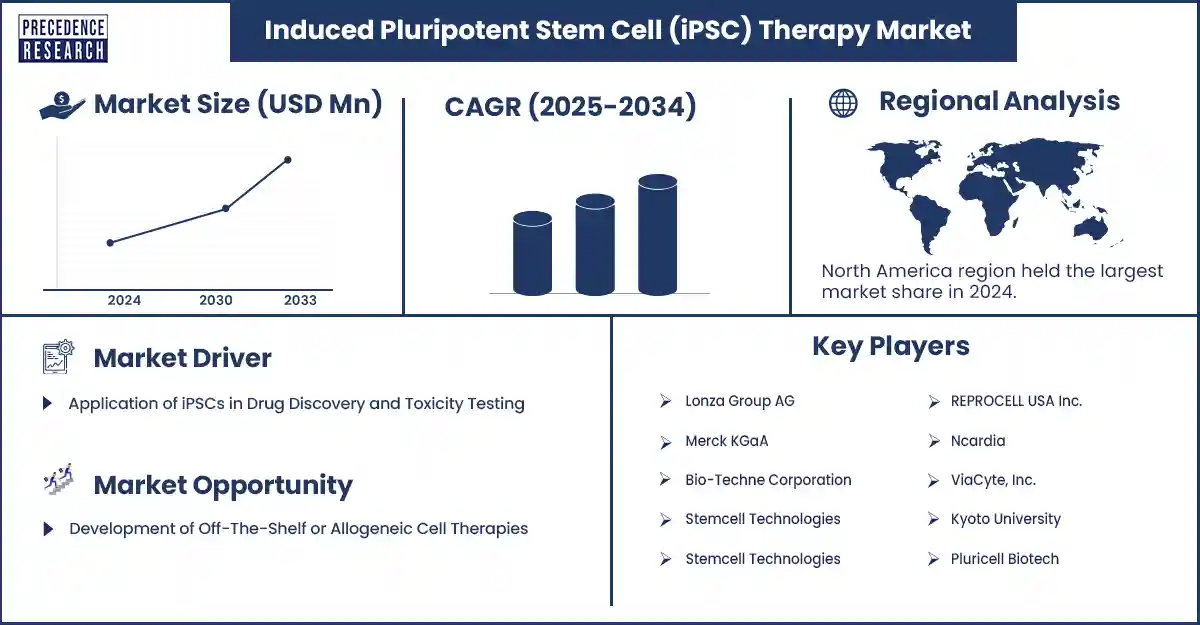
North America remains the largest iPSC therapy market due to its dense academic-industry ecosystem, significant public and private funding, established clinical-trial infrastructure, and clearer regulatory pathways for translation. Strong GMP manufacturing capacity, experienced cell-therapy developers, and continuing reimbursement discussions drive commercialization. Collaborations of hospitals, centers of research, and biomanufacturers streamline patient recruitment and scale-up. Continuous investment in workforce skills, automation, and centralized facilities for processing cells further sustains leadership.
Asia Pacific is the fastest-growing region for iPSC therapy, driven by increased interest in biotech investment, rising clinic trial activity, and larger patient populations to support enrollment. Regulatory agencies are also evolving their frameworks to encourage trials and local manufacturing. Cost efficiencies and increased capacity for contract-manufacturing are demonstrating to be profitable. Significant collaborations amongst domestic research institutes and multinational partners, and government programs to foster infrastructure for cell-therapy, are fueling rapid commercial and translational activity.
Induced Pluripotent Stem Cell (iPSC) Therapy Market Coverage
| Report Attribute | Key Statistics |
| Quantitative Units | Revenue in USD million/billion, Volume in units |
| Largest Market | North America |
| Base Year | 2024 |
| Regions Covered | North America, Europe, Asia-Pacific, Latin America, and the Middle East & Africa |
Recent Development
- In April 2025, I Peace, Inc., announced the launch of its personalized iPS cell production and longevity-focused rejuvenation therapies in the United States.
(Source: https://ipeace.com)
Key Players in Induced Pluripotent Stem Cell (iPSC) Therapy Market
- Fujifilm Cellular Dynamics, Inc.
- Cellular Dynamics International, Inc.
- Stemcell Technologies Inc.
- Lonza Group Ltd.
- Thermo Fisher Scientific Inc.
- ReproCELL Inc.
- Ncardia
- Stemina Biomarker Discovery, Inc.
- Axol Biosciences Ltd.
- Fate Therapeutics
- Cellular Reprogramming Inc.
- Pluripotent Stem Cell Foundation
- Cynata Therapeutics Ltd.
- Viacyte, Inc.
- iPS Academia Japan
- Megakaryon Corporation
- BlueRock Therapeutics
- Century Therapeutics
- Cellapy Therapeutics
- RoslinCT
Get this report to explore global market size, share, CAGR, and trends, featuring detailed segmental analysis and an insightful competitive landscape overview @ https://www.precedenceresearch.com/sample/7021
You can place an order or ask any questions, please feel free to contact us at sales@precedenceresearch.com |+1 804 441 9344