



Procurement as a Service Market Revenue to Attain USD 29.58 Bn by 2035
Published: 18 May 2026
Author: Precedence Research



Procurement as a Service Market Revenue and Trends 2026 to 2035
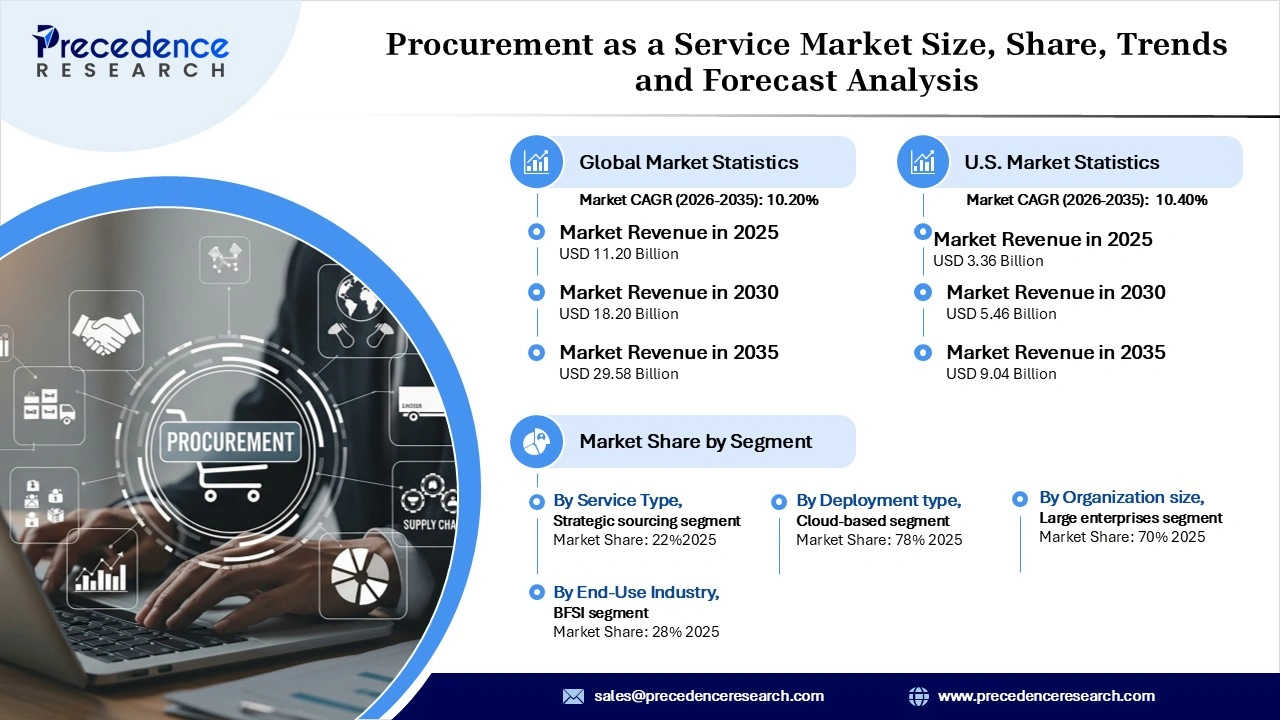
The global procurement as a service market revenue reached USD 11.20 billion in 2025 and is predicted to attain around USD 29.58 billion by 2035 with a CAGR of 10.20%. The market is experiencing continued growth as corporates outsource their procurement functions to external providers to reduce costs, streamline supplier management, increase operational efficiency, while seamlessly running complex global supply chains with more agility and accuracy.
Market at a Glance
The procurement as a service market is contracting out procurement activities to specialized third-party entities that are assigned responsibility for sourcing processes, supplier negotiation, contract administration, spending data analysis, and the purchasing process through digital platforms staffed by professionals. Through this process, enterprises can better manage their purchasing process, limit operational costs, maintain compliance standards, and gain better visibility into supplier relationships. Examples include various manufacturing, healthcare, retail, IT, and finance sectors that can easily benefit from improved purchasing that increases profitability.
The scope of the market extends across strategic sourcing, procure-to-pay operations, supplier lifecycle management, contract oversight, category management, and spend intelligence. It covers small businesses to multinational enterprises and supports industries seeking cost control, digital procurement tools, risk reduction, and scalable purchasing expertise across domestic and global supply networks.
Market Forecast for the Procurement as a Service Market
Network-Based Procurement Ecosystems Are Expanding Fast
SAP states its Business Network connects millions of companies worldwide, transacting trillions of dollars in business commerce every year. As supplier ecosystems become digital and interconnected, procurement as a service providers gain a major opportunity to manage sourcing and transactions across these networks for clients.
Growing Need for Procurement Services
According to McKinsey, procurement departments are currently overseeing 50% more expenditure per full-time employee compared to five years ago. This indicates that smaller internal teams are taking on greater responsibilities, creating an ideal opportunity for outsourced procurement partners to meet demand without increasing staffing levels.
Rising Demand in the Procurement as a Service Market
- In 2023, public procurement expenditure across the OECD stood at 12.7% of GDP, increased by 12.2% in 2019. It reflects growing transaction counts, supplier networks, and sourcing complexity.
- Among the OECD-EU member states, observed procurement spend of 14.8% in 2023, marking trends in procurement and logistics that are growing with the advancement of systems and information digitalization methods.
- The OECD reports that AI is being used for spend classification, helping in dealing with fraud of suppliers, management of contracts, etc., and some indication that procurement is emerging as a technology-mediated service sector economy.
Market Segmentation Overview
- By service type, the strategic sourcing segment dominated the procurement as a service market with a 22% market share in 2025, as companies are emphasizing proper vendor selection, better cooperation between suppliers and buyers for a consistent output. Moreover, with the recent increase in international sourcing, the demand further intensified. In addition, AI-backed tools facilitated quicker supplier comparisons and more precise negotiations.
- By service type, the contract management segment is expected to grow at the fastest CAGR of 10.4% in the market between 2026 and 2035, as enterprises seek faster approvals, compliance management, and contract automation. Rising use of e-signatures, cloud-based contract platforms, and automated lifecycle tracking is likely to shorten procurement cycles while improving vendor relationships.
- By deployment mode, the cloud-based segment dominated the market with a 78% market share in 2025 and is expected to maintain its leading position with a CAGR of 12.5% in the coming years, due to the rising adoption of AI and machine learning technologies in cloud-based solutions and strong demand for multi-location procurement management. Also, companies favor scalable, flexible, and lower-cost procurement systems over legacy infrastructure. SaaS adoption accelerated across enterprises needing centralized visibility, multi-location purchasing control, and easier access to analytics, supplier data, and automated workflows.
- By organization size, the large enterprises segment held a major revenue share of 70% in the procurement as a service market in 2025, as they required centralized procurement systems across multiple departments and regions. Their strong focus on strategic sourcing, supplier governance, spend analytics, and end-to-end automation, and the rising demand for improved vendor and supplier collaboration, made outsourced procurement services a practical operating choice.
- By organization size, the small and medium enterprises (SMEs) segment is steadily growing with a CAGR of 13% in the market between 2026 and 2035, due to affordable and available cloud procurement tools becoming more accessible. Smaller firms are increasingly pursuing cost reductions, process automation, and expanding use of AI and machine learning solutions without building expensive in-house procurement teams from the ground up.
- By end-use industry, the BFSI segment accounted for a considerable revenue share of 28% in the market in 2025, due to the growing adoption of digital procurement platforms in financial services and increasing demand for cost-effective procurement and supplier management solutions. Strong emphasis on compliance and spend management, demand for outsourced procurement expertise.
- By end-use industry, the retail and e-commerce segment is expected to expand rapidly in the market with a CAGR of 11.2% in the coming years, as e-commerce platforms require an efficient procurement solution. Businesses are likely to invest in procurement services that optimize inventory sourcing, supplier management optimization, and AI-led purchasing decisions across fast-moving sales channels.
Regional Analysis
North America held a major revenue share of 40% in the procurement as a service market in 2025, due to the solid concentration of the world’s biggest procurement service providers. Major enterprises are progressively implementing automation in spend analytics, contract management, and enhancing purchase-to-pay processes, while established service providers contribute to market maturity. Companies in the United States have leveraged massive outsourcing demand through wide-ranging procurement transformation efforts.
Asia-Pacific held 18% of the market share in 2025 and is expected to grow at the fastest CAGR of 12.5% in the market during the forecast period, due to the swift adoption of digital procurement by emerging markets in response to growing supplier networks, rising costs, and the increasing international trade efforts. The increase in manufacturing output and strong e-commerce growth should generate demand for flexibility in sourcing solutions and automated procurement processes. In China, vibrant manufacturing ecosystems would only enhance pressure on transparency among suppliers and better spending control measures. India seems to be on track for immense success as small and medium-sized enterprises utilize cloud-based procurement services to scale up the purchasing processes.
Procurement as a Service Market Coverage
| Report Attribute | Key Statistics |
| Market Revenue in 2025 | USD 11.20 Billion |
| Market Revenue by 2035 | USD 29.58 Billion |
| CAGR from 2026 to 2035 | 10.20% |
| Quantitative Units | Revenue in USD million/billion, Volume in units |
| Largest Market | North America |
| Base Year | 2025 |
| Regions Covered | North America, Europe, Asia-Pacific, Latin America, and the Middle East & Africa |
Top Companies in the Procurement as a Service Market
SAP Ariba is a leading application that aims to improve business by facilitating the purchase process transformation. Coupa Software combines simple spend management tools and AI-driven optimization of business expenditures, which has turned out to be a major success. GEP consists of consulting experience along with digital acquisition technologies and heavy consulting, while Ivalua makes use of a customized end-to-end system that offers flexible and personalized strategies tailored directly to large organizations. Oracle Procurement Cloud provides very positive elements of seamless integration with the ERP, which makes it suitable for companies and organizations already integrated into the Oracle ecosystem. Zycus expanded with AI-enhanced procurement tools and autonomous sourcing applications.
Segments Covered in the Report
By Service Type
- Strategic Sourcing
- Spend Analysis
- Supplier Management
- Contract Management
- Procurement Operations
- Supplier Risk Management
By Deployment Mode
- Cloud-based
- On-premise
By Organization Size
- Large Enterprises
- Small and Medium Enterprises (SMEs)
By End-Use Industry
- BFSI
- Retail and E-commerce
- Manufacturing
- Healthcare
- IT and Telecom
- Energy and Utilities
- Government
By Region
- North America
- Latin America
- Europe
- Asia-pacific
- Middle and East Africa
Get this report to explore global market size, share, CAGR, and trends, featuring detailed segmental analysis and an insightful competitive landscape overview @ https://www.precedenceresearch.com/sample/8417
You can place an order or ask any questions. Please feel free to contact us at sales@precedenceresearch.com |+1 804 441 9344