



Vehicle Control Unit Companies | Forecast by 2033
Published: 17 Sep 2024
Author: Precedence Research



Vehicle Control Unit Market Growth, Trends and Report Highlights
The global vehicle control unit market surpassed USD 57.51 billion in 2023 and is estimated to cross around USD 88.63 billion by 2033, growing at a CAGR of 4.42% during the forecast period.
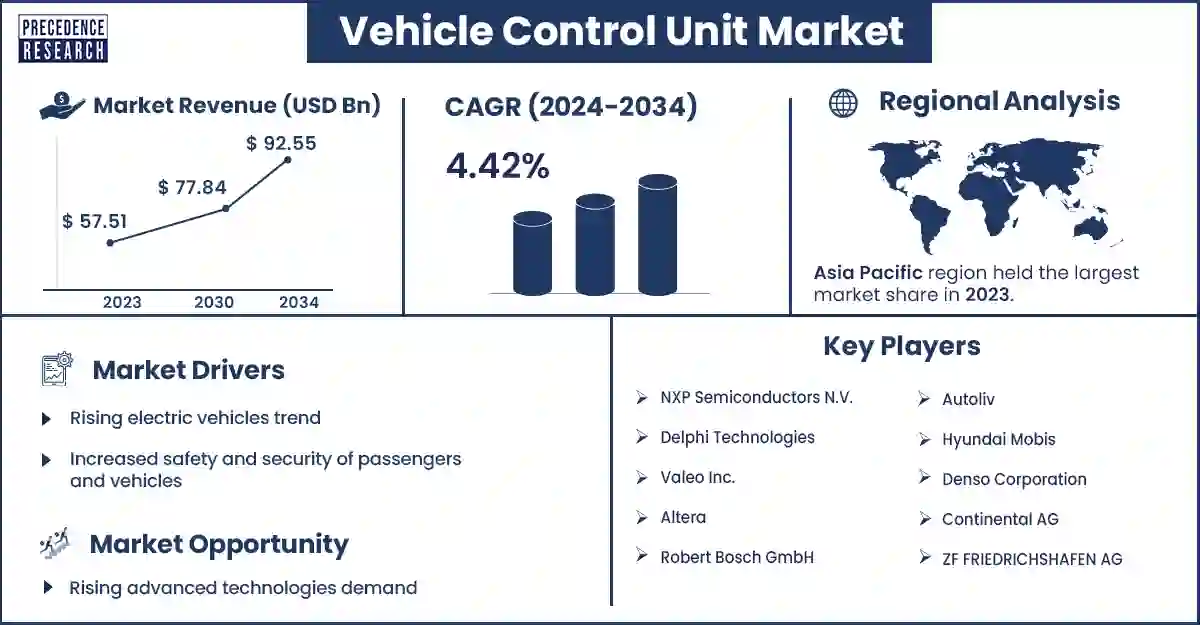
Market Overview
A vehicle function is regulated by an electric vehicle control unit in complex vehicle wiring systems or as a gateway between individual controller Area Networks (CAN)(. Various applications such as evaluating and controlling lighting system, anti-theft system are handled by this control unit. For electric and connected powertrains, the vehicle control unit delivers torques, operation and gear shift strategies, high-voltage and 48V coordination, charging control, onboard transport diagnosis, monitoring, thermal management etc. the electric passenger car, truck, off-road vehicle and combustion engine applications rely on vehicle control unit (VCU). According to projections, increased integration of advanced technologies into recent electric vehicles for improved performance will drive growth of the electric car control unit sector.
Growth Factors
- The vehicle control unit is crucial for electric vehicles as it serves as the brain within the vehicle system. These factors lead to increased consumer demand for vehicle control units.
- Likewise, they deal with the thermal management system, electrical motors drive as well as battery/power managements to make them work in unison and effectively.
- Some advantages of using a vehicle control unit in cars include better user-interface, automation options and updatable software via internet connection.
- Other benefits are enhanced vehicle diagnostics, streamlining of operations and improved safety standards for vehicles and their passengers. This is what leads to the growth of this sector.
The Market will Expand with a Growing need for Energy-Efficient Vehicles
Control units are needed to manage different functions in electric vehicles which makes them quite complex. The need for these control units hence tends to go up. They are essential for optimizing the performance of electric vehicles, they however help the performance of the vehicle by controlling the delivery of power, torque distribution and other factors like acceleration, efficiency and overall driving experience. Hence, as the sales and demand of electric cars increase, so does the market. Moreover, sensor data fusion, object detection and decision-making algorithms in autonomous driving necessitate a standard or advanced control unit system that can be used in electric vehicle transition. Thus, this need is also projected to increase the demand for electric vehicle control units in the years ahead while promoting the growth of the vehicle control unit market.
Vehicle Control Unit Market Key Companies
- Texas instruments-USA
- Mitsubishi Electric Corporation-Japan
- ZF FRIEDRICHSHAFEN AG-Germany
- Continental AG-Germany
- Denso Corporation-Japan
- Hyundai Mobis-Korea
- Autoliv-Sweden
- Robert Bosch GmbH-Germany
- Altera (Intel Corporation)-USA
- Valeo Inc.-France
- Delphi Technologies-United Kingdom
- NXP Semiconductors N.V.-Netherlands
Recent Innovations
| Company Name | Texas |
| Headquarters | Dallas, Texas, United states |
| Recent Development | In June2019, Texas Instruments introduced an system that was the industry’s first to integrate a controller and transceiver for controller Area Network with Flexible Data Rate (CAN FD) |
| Company Name | Mitsubishi |
| Headquarters | Chiyoda City, Tokyo, Japan |
| Recent Development | In February 2019, Mitsubishi announced that is has developed what is believed to be world’s smallest power unit for a two-motor hybrid electric vehicle, measuring just 2.7 liters in volume, offering a world-leading 150 kVA/I power density. The motor also boasts top class output-power density of 23 kW/I. |
Regional Insights
Forthcoming period is anticipated to witness Asia Pacific as least and biggest region for vehicle control unit market.
In 2023, Asia Pacific led the market. During the estimation period, Asia Pacific is likely to be the fastest expanding region in the vehicle control unit market. Furthermore, this region’s market drivers include increased demand for autonomous driving capabilities in electric vehicles including BEVs, HEVs, and PHEVs. Also, several OEMs are based in Asia Pacific, specifically Japan and China, who have made advancing the technology related to vehicle electronics their R&D focus. In fact, it can be said that automotive technologies found in Japan in Japan are significant for Asia-Pacific region. This country has established itself as a leader in technologically advanced cars with advanced automotive electronics.
Rapidly growing sales of electric cars in China and strong R&D activities within its automobile industry drive up sales of vehicle control units there. On the other hand, India presents an immense opportunity for vehicle control unit makers given its supportive government policies towards electric vehicles into Indian market is another hindrance to growth of sale volume.
Market Potential and Growth Opportunity
Emerging software technologies were spawned by the emergence of autonomous vehicles. The similar factor is seen to act as an opportunity for the vehicle control unit market. The automotive cockpit has also acquired several additional functionalities. They include battery management system, advanced gesture controls, reconfigurable instrument cluster and charging indicator. Most ultra-premium and even luxury automobiles across the globe are manufactured with a minimum of two exclusive displays that indicate HVAC information, parking infotainment and car diagnostics.
Such growing feature inclusion is anticipated to propel growth in the driver assistance system market for vehicles in future times. This trend is more pronounced in developed economies where there is a higher purchasing power. Thus, the electronic systems are increasingly being integrated to improve safety, comfort and convenience. This would necessitate powerful VCUs in vehicles with interrelated functions but small size.
Vehicle Control Unit Market Highlights
| Report Attribute | Key Statistics |
| Market Revenue in 2024 | USD 60.05 Billion |
| Market Revenue by 2033 | USD 88.63 Billion |
| CAGR | 4.42% |
| Quantitative Units | Revenue in USD million/billion, Volume in units |
| Largest Market | Asia Pacific |
| Base Year | 2023 |
| Regions Covered | North America, Europe, Asia-Pacific, Latin America, and Middle East & Africa |
Market News
- March 15, 2023 – Stuttgart, Germany – Bosch, a global leader in automotive technology, announced the launch of its latest AI-powered Vehicle Control Unit (VCU) designed specifically for electric vehicles (EVs). The new VCU, named Bosch EV-Logic 360, integrates advanced artificial intelligence and machine learning algorithms to optimize energy efficiency, battery management, and autonomous driving functionalities.The ADAS section was all but that in charge during that period while it is predicting an increase now for vehicle electronics.
Market Segments
By Vehicle Type
- Commercial Vehicle
- Passenger car
By Propulsion Type
- BEV
- HEV
- PHEV
By Voltage Type
- 12/24V
- 36/48V
By Offering Type
- Hardware
- Software
By Function
- Autonomous Driving
- Predictive Technology
By Communication Type
- CAN
- LIN
Get this report to explore global market size, share, CAGR and trends, featuring detailed segmental analysis and an insightful competitive landscape overview@ https://www.precedenceresearch.com/checkout/4944
You can place an order or ask any questions, please feel free to contact at sales@precedenceresearch.com | +1 804 441 9344