


Procalcitonin Testing Market Size, Key Companies, Company Product Portfolio, Hospital Procurement Trends, Manufacturing Capacity, Sales Performance, Regulatory Approvals, Company Market Share, and Forecast
Payal Rabde, a Healthcare Industry Expert, highlights that the procalcitonin testing market has reached USD 352.59 million in 2026 to USD 664.76 million by 2035, expanding at a CAGR of 7.30%. Key procalcitonin testing market companies shaping the market include Thermo Fisher Scientific, Roche Diagnostics, bioMérieux while major growth segments span product, test setting, technology, application, end user, region.
Source: https://www.precedenceresearch.com/procalcitonin-testing-market
 Get a Sample
 Report Description


Procalcitonin Testing Market Size, Trends, Share, and Innovations 2035
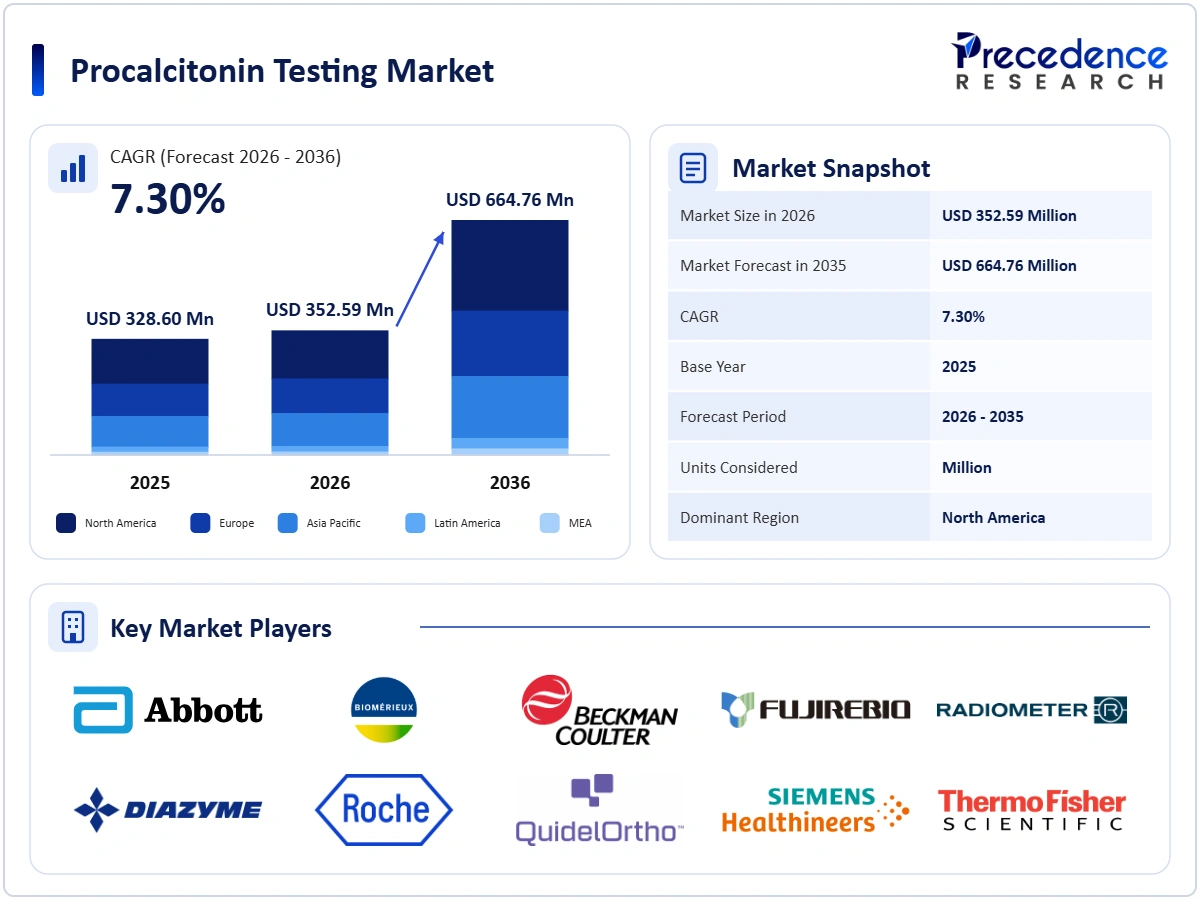
The procalcitonin testing market is forecasted to expand from USD 352.59 million in 2026 to USD 664.76 million by 2035, expanding at a CAGR of 7.30% from 2026 to 2035.
Key Takeaways
Market Size & Growth Outlook
- Market size in 2025: USD 328.60 million
- Estimated market size in 2026: USD 352.59 million
- Projected market size by 2035: USD 664.76 million
- CAGR (2026-2035): 7.30%
Regional Market Spotlight
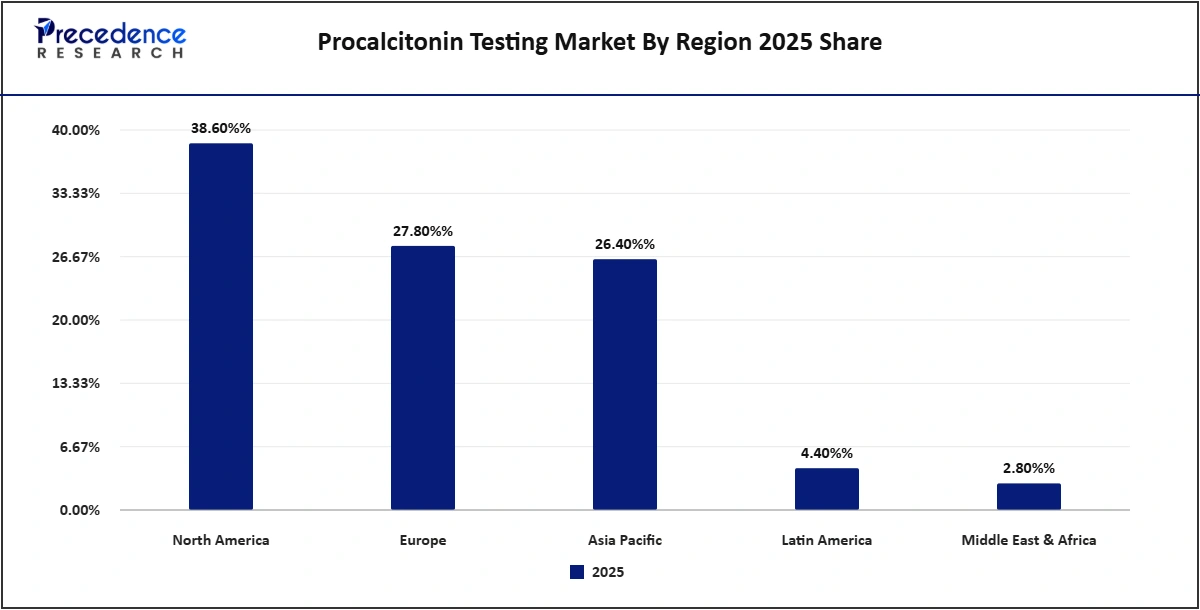
- North America led the market with a 38.60% with USD 126.84 million share in 2025.
- Europe accounted for 27.80% with USD 91.35 million of the market in 2025.
- Asia Pacific accounted for 26.40% with USD 86.75 million of the market in 2025 and is projected to be the fastest-growing region, at a CAGR of 8.88% from 2025 to 2035.
Segmental Spotlight
- By product, the reagents & consumables segment accounted for 79.60% with USD 261.57 million in 2025.
- By test setting, the laboratory-based testing segment accounted for 88.20% with USD 289.83 million in 2025.
- By technology, the chemiluminescence & electrochemiluminescence immunoassays segment accounted for 64.80% with USD 212.93 million in 2025.
- By application, the sepsis & systemic bacterial infections segment accounted for 48.60% with USD 159.70 million in 2025.
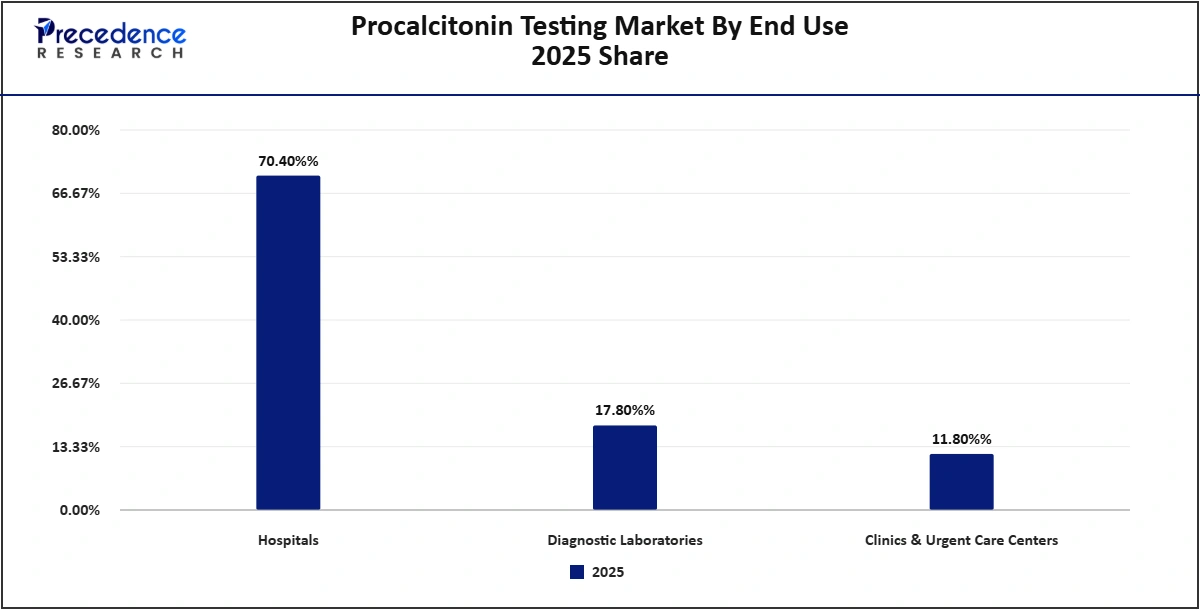
- By end use, the hospitals segment accounted for 70.40% with USD 231.33 million in 2025.
Procalcitonin Testing Market Size and Forecast, 2025-2035 (USD Million)
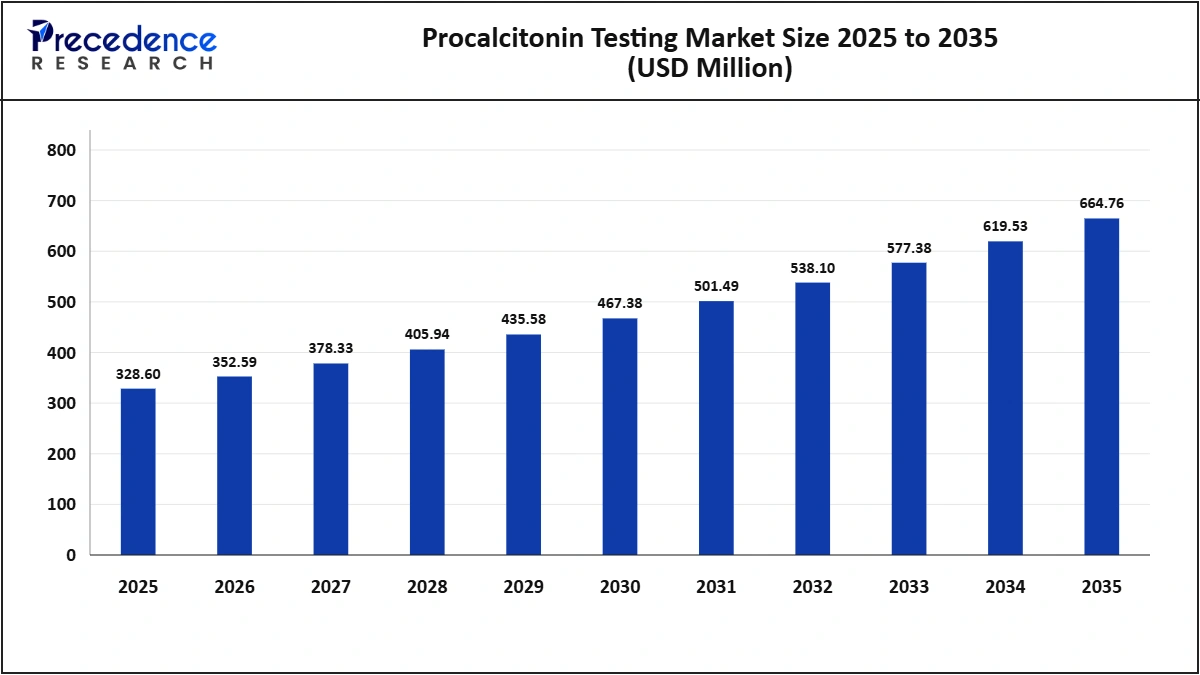
Note: 2025 is the base year; 2026-2035 values are forecasts.
Sources: Expert interviews, secondary sources, Precedence Research database, and Precedence Research analysts.
The procalcitonin testing market is projected to grow from USD 328.60 million in 2025 to USD 664.76 million by 2035 because hospitals use PCT results to assess sepsis risk in emergency and intensive care patients and to guide when antibiotics can be safely stopped. Stewardship programmes and wider assay availability increase testing volumes, lifting the market to USD 467.38 million by 2030 and sustaining a CAGR of 7.30% from 2026 to 2035.
- Analyst View: We built the estimate from annual PCT test volumes in emergency departments, intensive care units, and general wards by region, multiplied by average reagent prices per test, plus analyzer, point-of-care system, and software revenue. Volumes reflect sepsis and lower respiratory tract infection admissions, stewardship protocols and the number of laboratories offering PCT. The total was cross-checked against the PCT-related revenue of leading immunoassay and chemistry suppliers and against published estimates, which places our base year slightly above the comparable figures. The growth rate reflects rising testing in Asia and decentralised settings, moderated by price competition in mature laboratory markets.
Market Trends
- PCT guides antibiotic duration in stewardship programmes.
- Assays expand onto open chemistry analyzers.
- Whole-blood point-of-care platforms emerge.
- PCT results feed electronic sepsis alerts.
- Serial testing tracks treatment response.
- China drives high test volumes.
Drivers, Restraints and Opportunities
Driver
Sepsis and serious bacterial infections are a leading cause of hospital deaths and admissions. PCT helps clinicians distinguish bacterial from viral infections and decide when antibiotics can be stopped. Antimicrobial stewardship programmes aim to reduce unnecessary antibiotic use. PCT assays are available on most major immunoassay and many chemistry analyzers. Rising antimicrobial resistance increases the value of accurate infection biomarkers.
Restraint
Results can vary between assays, and clinical cut-offs depend on consistent calibration. Some clinical studies have shown limited benefit of PCT-guided protocols in certain settings. Reimbursement may not cover serial testing. Product recalls and quality issues can affect confidence. Price competition in mature laboratory markets reduces revenue per test.
Opportunity
Rapid point-of-care PCT can support decisions in emergency departments, urgent care, and smaller hospitals. Integration with sepsis software and other biomarkers can improve risk assessment. Growing hospital capacity in Asia offers volume growth. Outpatient respiratory infection testing could expand use beyond hospitals. Multi-marker panels may increase test value.
Market Segmentation: 2025 Share and Value
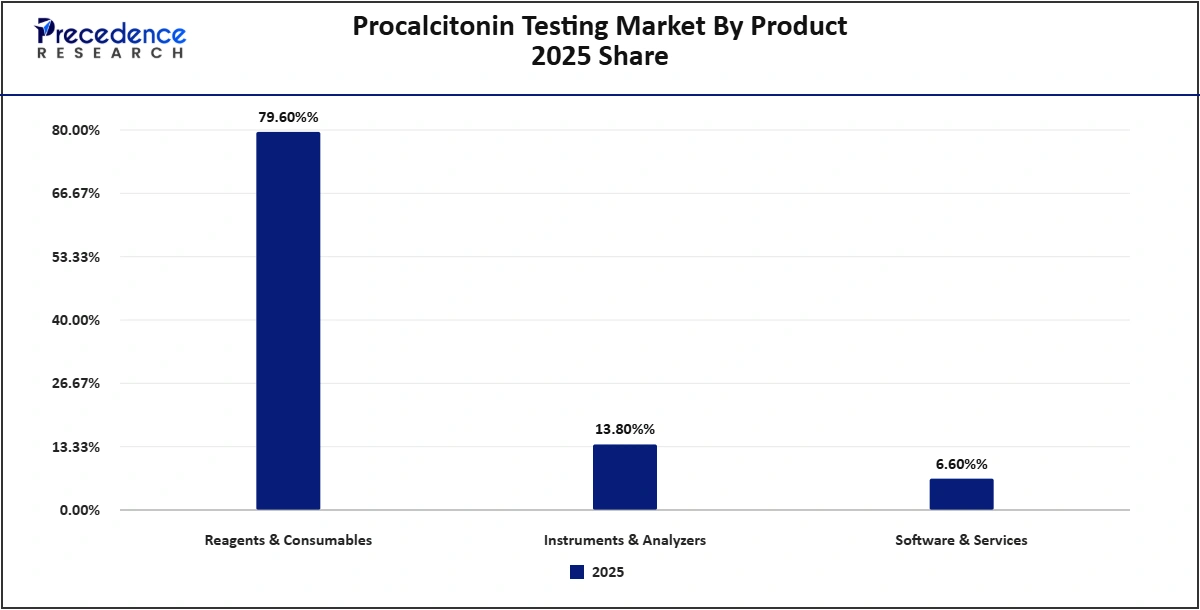
Procalcitonin Testing Market By Product 2025 Share
Note: 2025 is the base year.
Sources: Expert interviews, secondary sources, Precedence Research database, and Precedence Research analysts.
Reagents and consumables accounted for 79.60% with USD 261.57 million in 2025 because PCT assays run on large installed bases of immunoassay and chemistry analyzers, and each patient sample consumes reagents, calibrators, and controls. Many patients receive serial PCT tests to track infection and guide antibiotic duration, multiplying reagent use. Instruments and analyzers, at 13.80% with USD 45.35 million, include dedicated immunoassay systems and point-of-care readers. Software and services, at 6.60% with USD 21.69 million, are the fastest-growing product as hospitals link PCT results to sepsis alerts and stewardship dashboards.
Procalcitonin Testing Market By Test Setting 2025 Share & Size
| Segments | 2025 Share | 2025 Market Value |
| Laboratory-Based Testing | 88.20% | USD 289.83 million |
| Point-of-Care Testing | 11.80% | USD 38.77 million |
Note: 2025 is the base year.
Sources: Expert interviews, secondary sources, Precedence Research database, and Precedence Research analysts.
Laboratory-based testing accounted for 88.20% with USD 289.83 million in 2025 because most PCT tests are run on automated analyzers in central hospital laboratories, which deliver results within about an hour. Point-of-care testing, at 11.80% with USD 38.77 million, is the fastest-growing setting as rapid whole-blood systems allow emergency departments, urgent care centres and smaller hospitals to obtain results in minutes.
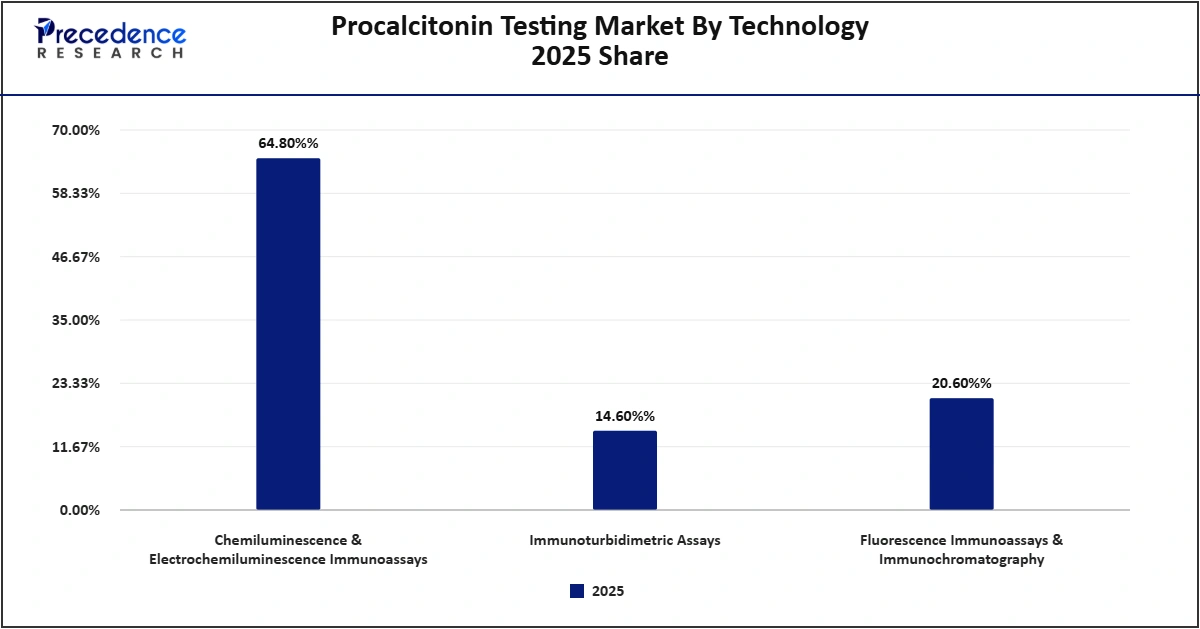
Procalcitonin Testing Market By Technology 2025 Share
Note: 2025 is the base year.
Sources: Expert interviews, secondary sources, Precedence Research database, and Precedence Research analysts.
Chemiluminescence and electrochemiluminescence immunoassays accounted for 64.80% with USD 212.93 million in 2025 because high-throughput immunoassay platforms from major suppliers run most PCT tests. Fluorescence immunoassays and immunochromatography, at 20.60% with USD 67.69 million, are the fastest-growing technology, supported by point-of-care use and strong uptake in China. Immunoturbidimetric assays account for 14.60% with USD 47.98 million and allow PCT testing on open chemistry analyzers without dedicated instruments.
Procalcitonin Testing Market by Application 2025 Share & Size
| Segments | 2025 Share | 2025 Market Value |
| Sepsis & Systemic Bacterial Infections | 48.60% | USD 159.70 million |
| Lower Respiratory Tract Infections | 24.80% | USD 81.49 million |
| Antibiotic Stewardship & Treatment Monitoring | 18.20% | USD 59.81 million |
| Others | 8.40% | USD 27.60 million |
Note: 2025 is the base year.
Sources: Expert interviews, secondary sources, Precedence Research database, and Precedence Research analysts.
Sepsis and systemic bacterial infections accounted for 48.60% with USD 159.70 million in 2025 because PCT is widely used to assess sepsis risk in emergency and intensive care. Lower respiratory tract infections account for 24.80% with USD 81.49 million; antibiotic stewardship and treatment monitoring, at 18.20% with USD 59.81 million, is the fastest-growing application; and others account for 8.40% with USD 27.60 million.
Procalcitonin Testing Market By End Use 2025 Share
Note: 2025 is the base year.
Sources: Expert interviews, secondary sources, Precedence Research database, and Precedence Research analysts.
Hospitals accounted for 70.40% with USD 231.33 million in 2025; diagnostic laboratories accounted for 17.80% with USD 58.49 million, and clinics and urgent care centres, at 11.80% with USD 38.77 million, are the fastest-growing end use.
- Analyst View: Segment values were allocated by matching test volumes, reagent prices and system placements to products, settings, technologies, applications and end uses. Reagents lead because of recurring use, and laboratory testing leads because most hospitals run PCT on central analyzers. We expect point-of-care testing, fluorescence immunoassays and stewardship applications to gain share.
Regional Analysis
Procalcitonin Testing Market By Region 2025 Share
Note: 2025 is the base year.
Sources: Expert interviews, secondary sources, Precedence Research database, and Precedence Research analysts.
North America accounted for 38.60% with USD 126.84 million in 2025, supported by hospital sepsis protocols, antimicrobial stewardship requirements, and FDA-cleared PCT assays from several suppliers. Europe, at 27.80% with USD 91.35 million, is supported by long-standing PCT use in intensive care and respiratory infection management, particularly in Germany, Switzerland, and France. Asia Pacific, at 26.40% with USD 86.75 million, is the fastest-growing region, supported by very high PCT test volumes in China, domestic assay makers, and expanding hospital laboratories in India and Southeast Asia. Latin America, at 4.40% with USD 14.46 million, and the Middle East and Africa, at 2.80% with USD 9.20 million, are smaller markets where PCT use is concentrated in large hospitals.
North America accounted for 38.60% with USD 126.84 million in 2025. Hospital sepsis programmes and stewardship requirements support PCT testing. Several suppliers hold FDA clearance for automated PCT assays, including recent clearances for open chemistry systems. Emergency departments increasingly use PCT in sepsis workups.
Europe accounted for 27.80% with USD 91.35 million in 2025. PCT has been used in European intensive care units for many years. Clinical studies from Switzerland and other countries support PCT-guided antibiotic decisions. Germany, France, and Switzerland are major markets.
Asia Pacific accounted for 26.40% with USD 86.75 million in 2025 and is the fastest-growing region. China performs a very large number of PCT tests, supported by domestic immunoassay and point-of-care suppliers. Japan has established PCT use in hospitals. India and Southeast Asia are expanding laboratory capacity.
Latin America accounted for 4.40% with USD 14.46 million in 2025. PCT use is concentrated in large private and public hospitals in Brazil and Mexico. Cost limits wider adoption.
The Middle East and Africa accounted for 2.80% with USD 9.20 million in 2025. Gulf hospitals use PCT in intensive care. Access in Africa is limited.
Analyst View: Regional shares were built from test volumes, reagent prices, and system placements in each region. North America leads on value because of higher prices and protocol-driven testing, while China contributes large volumes. We assign Asia Pacific the highest growth premium because testing volumes are expanding fastest there.
Top 10 Companies in the Procalcitonin Testing Market
| Rank | Company Name | Market-Specific Revenue (USD Million) | 2025 Share | Key Products / Business | Headquarters |
| 1 | Thermo Fisher Scientific | 62.00 | 18.87% | B·R·A·H·M·S PCT biomarker technology and licensing | United States |
| 2 | Roche Diagnostics | 58.00 | 17.65% | Elecsys B·R·A·H·M·S PCT assay | Switzerland |
| 3 | bioMérieux | 34.00 | 10.35% | VIDAS B·R·A·H·M·S PCT assay | France |
| 4 | Siemens Healthineers | 26.00 | 7.91% | ADVIA Centaur and Atellica B·R·A·H·M·S PCT assays | Germany |
| 5 | Abbott | 22.00 | 6.70% | ARCHITECT and Alinity B·R·A·H·M·S PCT assays | United States |
| 6 | QuidelOrtho | 14.00 | 4.26% | VITROS B·R·A·H·M·S PCT assay | United States |
| 7 | Beckman Coulter | 12.00 | 3.65% | Access PCT and AU chemistry PCT assays | United States |
| 8 | Fujirebio | 8.00 | 2.43% | Lumipulse G B·R·A·H·M·S PCT assay | Japan |
| 9 | Radiometer | 6.00 | 1.83% | AQT90 FLEX point-of-care PCT | Denmark |
| 10 | Diazyme Laboratories | 4.00 | 1.22% | Immunoturbidimetric PCT assays | United States |
Note: Company revenues and shares are 2025 estimates.
Sources: Company press releases, expert interviews, secondary sources, Precedence Research database and Precedence Research analysts.
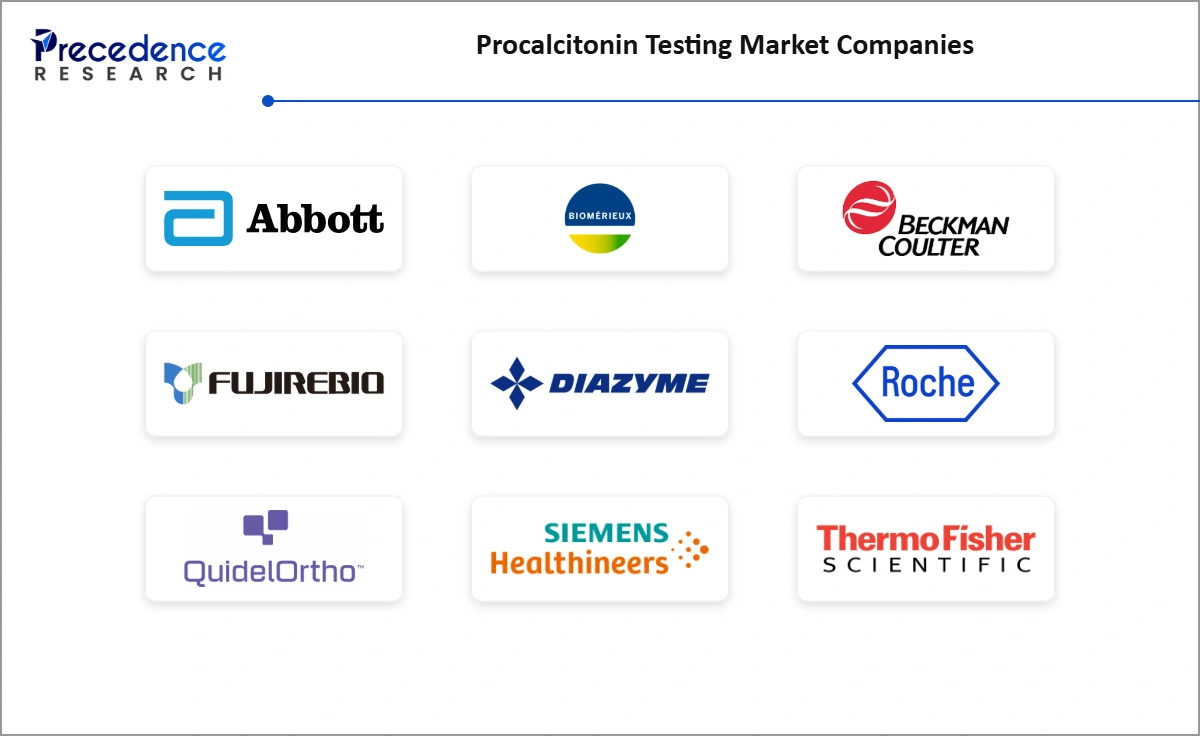
Thermo Fisher led the procalcitonin testing market with an estimated 18.87% with USD 62.00 million of 2025 revenue, followed by Roche at 17.65% with USD 58.00 million and bioMérieux at 10.35% with USD 34.00 million. Thermo Fisher Scientific leads because its B·R·A·H·M·S PCT technology underpins many of the PCT assays used worldwide, generating revenue through its own products and through licensing to immunoassay partners.
Roche holds a strong position through the Elecsys B·R·A·H·M·S PCT assay on its large installed base of cobas immunoassay analyzers, and bioMérieux supplies the VIDAS B·R·A·H·M·S PCT assay and acquired SpinChip Diagnostics in January 2025 to add a rapid whole-blood point-of-care immunoassay platform. Siemens Healthineers, Abbott, QuidelOrtho, Beckman Coulter and Fujirebio offer PCT assays on their analyzers, while Radiometer provides point-of-care testing and Diazyme and DiaSys offer immunoturbidimetric assays for open chemistry systems.
The top 10 companies accounted for an estimated 74.86% with USD 246.00 million of 2025 revenue, while the remaining 25.14% with USD 82.60 million was shared among Chinese immunoassay and point-of-care makers, DiaSys, and other chemistry reagent suppliers. The procalcitonin testing market is concentrated around the B·R·A·H·M·S PCT technology and major immunoassay platforms, because PCT assays are sold as part of broader analyzer menus. Competition centres on assay availability on installed analyzers, turnaround time, calibration consistency, point-of-care formats, and price, with domestic suppliers competing strongly in China.
Recent Developments
- In May 2025, DiaSys Diagnostic Systems received FDA 510(k) clearance for Procalcitonin FS with matching calibrators and controls, allowing PCT testing on clinical chemistry analyzers.
- In January 2025, BioMérieux acquired the remaining shares of SpinChip Diagnostics, gaining a rapid whole-blood point-of-care immunoassay platform for emergency and decentralised testing.
Procalcitonin Testing Market Segments
By Product
- Reagents & Consumables
- Instruments & Analyzers
- Software & Services
By Test Setting
- Laboratory-Based Testing
- Point-of-Care Testing
By Technology
- Chemiluminescence & Electrochemiluminescence Immunoassays
- Immunoturbidimetric Assays
- Fluorescence Immunoassays & Immunochromatography
By Application
- Sepsis & Systemic Bacterial Infections
- Lower Respiratory Tract Infections
- Antibiotic Stewardship & Treatment Monitoring
- Others
By End Use
- Hospitals
- Diagnostic Laboratories
- Clinics & Urgent Care Centers
By Region
- North America
- U.S.
- Canada
- Mexico
- Europe
- Germany
- U.K.
- France
- Italy
- Spain
- Rest of Europe
- Asia Pacific
- China
- Japan
- India
- South Korea
- Taiwan
- Rest of Asia Pacific
- Latin America
- Brazil
- Argentina
- Rest of Latin America
- Middle East & Africa
- GCC
- South Africa
- Rest of MEA
Research Methodology
The procalcitonin testing market was defined as procalcitonin immunoassay reagents, calibrators, controls, analyzers, point-of-care systems, and related software, worldwide. The 2025 base year was built bottom-up from PCT test volumes by care setting and region, average reagent prices and system placements, and checked top-down against the PCT-related revenue of leading immunoassay and chemistry suppliers. Segment, regional and company values were allocated from products, test settings, technologies, applications, end uses and regional demand.
Key estimates were verified by cross-checking company disclosures, regulatory and industry data, and published third-party estimates, and inputs that could not be reconciled were excluded. All segment, regional, and company figures were reconciled to the same 2025 base year, and the 2026-2035 forecast, which applies a constant CAGR from the 2025 base, was recalculated and validated.
Analyst View: Overall Market
The procalcitonin testing market is a steady, reagent-driven market linked to sepsis care and antibiotic stewardship. Our estimate links demand to test volumes, reagent prices, and system placements, so the forecast follows hospital admissions, stewardship protocols, and point-of-care adoption. The main upside comes from point-of-care formats and Asian growth, while the main risks are assay variability and price competition.
Sources and References
- bioMérieux. "bioMérieux acquisition of SpinChip immunoassays". 2025-01-13. SpinChip acquisition. https://www.biomerieux.com/us/en/journalists/press-releases/acquisition-SpinChip-immunoassays.html
- Innolitics FDA database. "K242294 DiaSys Procalcitonin FS". 2025-05-09. DiaSys clearance. https://fda.innolitics.com/device/K242294
- Technology Networks. "Fujirebio Diagnostics announces FDA clearance of Lumipulse G B·R·A·H·M·S PCT assay". Undated. Fujirebio assay.https://www.technologynetworks.com/diagnostics/product-news/fujirebio-diagnostics-announces-fda-clearance-of-lumipulse-g-brahms-pct-assay-304981
For inquiries regarding discounts, bulk purchases, or customization requests, please contact us at sales@precedenceresearch.com
Frequently Asked Questions





Ask For Sample
No cookie-cutter, only authentic analysis – take the 1st step to become a Precedence Research client
 Get a Sample




 sales@precedenceresearch.com
 Schedule a Meeting