



QR Code Labels Market Size, Companies, Production Capacity, Production & Manufacturing Efficiency, Sales Volume, Export & Import Dependency, Adoption Rates, Cost Structure, Recycling Rate, and Supply Chain Metrics
QR Code Labels Market (By Type: Digital Printing, Flexographic Printing, Offset Printing, Gravure Printing, Others (Screen/Thermal); By Application: Marketing & Advertising, Inventory Management, Mobile Payments, Personal & Security Use; By Industry Vertical: Retail & Consumer Goods, Pharmaceuticals & Healthcare, Logistics & Transportation, Food & Beverage, Others (Automotive, Luxury); By Format: Dynamic QR Codes, Static QR Codes) - Global Industry Analysis, Size, Trends, Leading Companies, Regional Outlook, and Forecast 2026 to 2035
Source: https://www.precedenceresearch.com/qr-code-labels-market
 Get a Sample
 Table Of Content


What is the QR Code Labels Market Size?
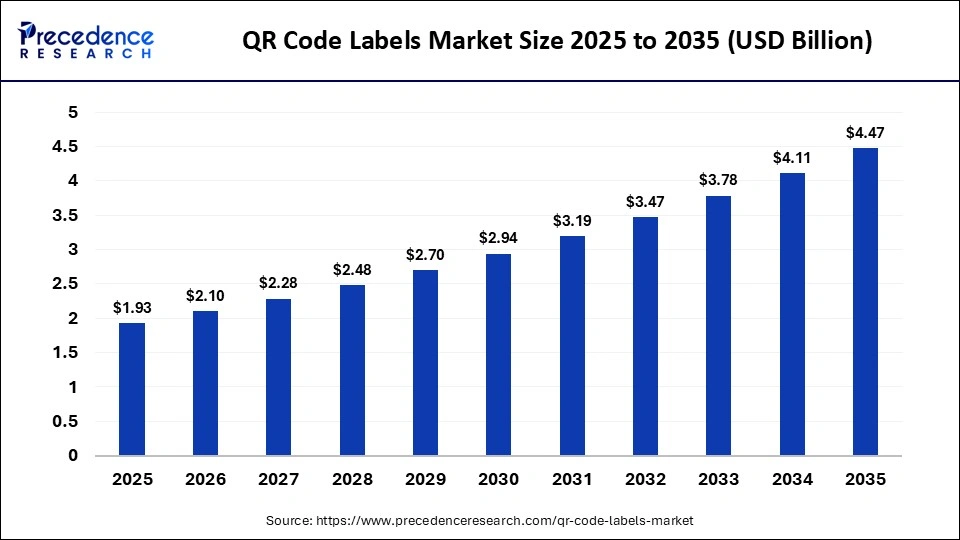
The global QR code labels market size was calculated at USD 1.93 billion in 2025 and is predicted to increase from USD 2.10 billion in 2026 to approximately USD 4.47 billion by 2035, expanding at a CAGR of 8.75% from 2026 to 2035. This market is experiencing robust growth, driven by a rapid shift towards smart and interactive packaging, supporting contactless customer engagement.
Market Highlights
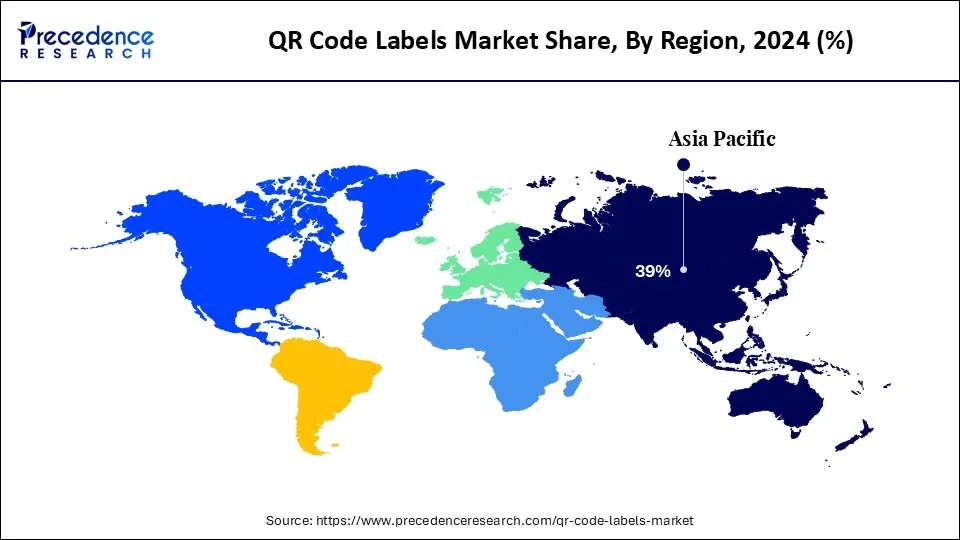
- Asia-Pacific dominated the global market with a share of approximately 38.8% in 2025 and is expected to be the fastest-growing region between 2026 and 2035.
- By type (printing technology), the digital printing segment held a dominant position in the QR code labels market with a share of approximately 42.3% in 2025.
- By type (printing technology), the flexographic printing segment is expected to grow at the fastest CAGR during the forecast period.
- By application, the marketing & advertising segment led the global market with a share of approximately 34.2% in 2025.
- By application, the mobile payments segment is expected to witness the fastest growth in the market over the forecast period.
- By industry vertical, the retail & consumer goods segment registered its dominance over the global market with a share of approximately 36.5 % in 2025.
- By industry vertical, the pharmaceuticals & healthcare segment is expected to show the fastest growth over the forecast period.
- By format, the dynamic QR codes segment held a dominating revenue share of approximately 64.4% in the market in 2025 and is expected to sustain as a leader in the upcoming period.
What are QR Code Labels?
The global QR code labels market comprises the production and distribution of physical labels embedded with two-dimensional matrix barcodes. These labels facilitate high-speed data retrieval for product authentication, real-time inventory tracking, and contactless consumer engagement, bridging physical goods with digital content across the retail, logistics, healthcare, and manufacturing sectors. Additionally, QR code labels support a better supply chain and faster recall management. The low cost and easy adoption with the existing system make it suitable for use in small businesses and large industries worldwide.
What is the Role of AI in the QR Code Labels Market?
Artificial intelligence (AI) is transforming the market by making labels smarter, more secure, and more interactive. It helps analyze scan data and customer preferences to create personalized and relevant experiences. It improves scanning accuracy by enhancing readability in low light and on damaged surfaces. For brands, AI makes it possible to use dynamic QR codes that update content automatically, allowing real-time promotions, product updates, and safety alerts. In marketing, AI-based insights help companies to optimize QR code design, positioning, and timing to increase engagement. These advancements make QR code labels more powerful tools for data-based decision-making and enhance customer connection.
QR Code Labels Market Trends
- The growing preference for contactless services has increased QR label usage in industries. QR code provides easy and quick access for making payments and checking product authenticity. This trend supports speed, hygiene, and convenience in healthcare and public service environments.
- Manufacturers are now using recyclable materials and eco-friendly printing methods to create QR code labels. This shift minimizes waste, supports sustainability, and meets rising customer demand for eco-friendly packaging.
- Companies are adopting QR code labels to make smart and interactive packaging. These labels allow customers to quickly access product details, usage guidance, and special offers, increasing customer engagement and enhancing the overall experience.
- QR code labels are helping businesses to track products throughout the supply chain, from production to delivery. This improves supply chain control and recall management, ensuring regulatory compliance.
Market Scope
| Report Coverage | Details |
| Market Size in 2025 | USD 1.93 Billion |
| Market Size in 2026 | USD 2.10 Billion |
| Market Size by 2035 | USD 4.47 Billion |
| Market Growth Rate from 2026 to 2035 | CAGR of 8.75% |
| Dominating Region | North America |
| Fastest Growing Region | Asia Pacific |
| Base Year | 2025 |
| Forecast Period | 2026 to 2035 |
| Segments Covered | Type, Application, Industry Vertical, Format, and Region |
| Regions Covered | North America, Europe, Asia-Pacific, Latin America, and Middle East & Africa |
Segmental Insights
Type (Printing Technology) Insights
Why the Digital Printing Segment Dominated the QR Code Labels Market?
The digital printing segment held a dominant position in the market with a share of approximately 42.3% in 2025 because it provides greater flexibility, speed, and customization. It allows businesses to print unique QR codes and variable data. With minimal setup requirements for small production volumes, it is ideal for marketing, electronic, and e-commerce packaging.
Digital printing delivers high-quality output that ensures that QR codes are easy to scan, supporting smooth product tracking, reliable authentication, and better customer engagement. Increasing preference for customized packaging, dynamic QR codes, and smart labeling further strengthens the digital printing segment's dominance in the market.
The flexographic printing segment is expected to show the fastest growth over the forecast period due to its cost efficiency, rapid production, and suitability for large-volume printing. It is widely used in retail, logistics, food & beverages, and consumer goods packaging, where a huge number of labels are required consistently. Flexographic technology supports printing on multiple materials, such as paper, plastic, foils, and films, making it ideal for a wide range of packaging formats. Its long-lasting, moisture-resistant labels ensure QR code scanning throughout handling, transportation, and storage. Advances in printing machines, ink quality, and improved plate technology greatly increased print clarity, making flexographic labels suitable for precise and accurate QR code scanning.
Application Insights
How the Marketing & Advertising Segment Dominated the QR Code Labels Market?
The marketing & advertising segment dominated the market with a share of approximately 34.2% in 2025 because brands majorly depend on interactive and engaging channels to attract customers. QR code labels allow businesses to connect printed advertisements with digital platforms, giving customers quick access to discounts, product information, social media, and surveys. This direct connection allows brands to track customer interest, measure campaign performance, and adjust marketing strategies accordingly.
Food brands, event organizers, retailers, and consumer goods companies widely use QR codes on billboards, packaging, posters, and promotional materials to increase customer engagement. The rapid growth of smartphone usage and easy internet access has supported this trend, making scanning simple and convenient for users.
The mobile payments segment is expected to witness the fastest growth in the market over the forecast period, because of growing preferences for digital and contactless payment methods. QR codes make it easy and affordable for businesses to accept payments without the need for complex infrastructure.
This attracts street vendors, small businesses, and retailers to use a QR-based payment system. Consumer preference has increased due to easy and convenient QR code payment and reduced physical interaction, offering a smooth and comfortable payment process. E-commerce platforms and service providers are highly adopting QR-based payments to improve transaction speed and customer experience.
Industry Vertical Insights
Which Industry Vertical Segment Led the QR Code Labels Market?
The retail & consumer goods segment accounted for a considerable revenue share of approximately 36.5% in the market in 2025 because brands use QR codes regularly to interact directly with customers at the point of purchase. Shoppers often scan codes to check product details, verify authenticity, or read usage instructions. Since retail products move quickly and are sold in high volumes, companies prefer QR labels as a low-cost and flexible way to update information without redesigning packaging each time.
In many cases, these codes are connected to digital services such as warranty registration and a customer feedback system. Supermarkets and e-commerce sellers also use QR codes for inventory tracking. This improves supply chain visibility and helps operations run more smoothly. Marketing teams prefer QR labels since they can turn simple packaging into an interactive tool for customers to improve engagement.
The pharmaceuticals & healthcare segment is expected to expand rapidly in the market in the coming years. This growth is mainly driven by increasing safety regulations and the need for better product traceability. Many drug manufacturers and health authorities are promoting a digital labeling system to reduce the risk of counterfeit medicines and ensure patients receive authentic products. QR codes make it easier to track each batch from manufacturing to pharmacy, which improves overall transparency in the supply chain.
Patients can scan the code and quickly read dosage, side effects, storage conditions, and expiry details in their own language. New rules in many countries now encourage or require digital access to product details, which helps to adopt the technology faster. Since healthcare depends heavily on accuracy and reliability, many companies are increasing their investment in QR label systems, boosting the segment's growth.
Format Insights
Why Did the Dynamic QR Codes Segment Dominated the QR Code Labels Market?
The dynamic QR codes segment held the largest revenue share of approximately 64.4% in 2025 and is expected to grow at the fastest CAGR in the market during the forecast period because it offers flexibility and real-time content updates that static codes cannot. Unlike static codes, which always link to the same information, dynamic codes allow brands to change the location of content without reprinting labels, making them highly cost-effective for large production runs.
This adaptability supports targeted marketing campaigns, product promotions, and updated regulatory information without waste. In addition, dynamic QR codes enable detailed analytics, allowing companies to track scan behavior, customer location, and engagement patterns, data that helps refine marketing strategies and improve user experience. The increasing adoption of smartphones and demand for personalized, interactive experiences have further pushed companies to choose dynamic solutions.
Regional Insights
What is the Asia Pacific QR Code Labels Market Size?
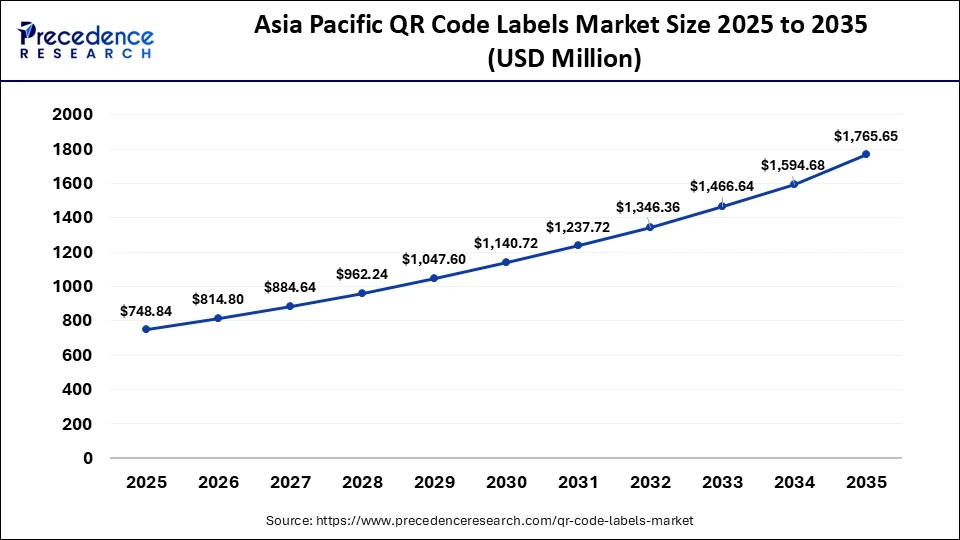
The Asia Pacific QR code labels market size is expected to be worth USD 1,765.65 million by 2035, increasing from USD 748.84 million by 2025, growing at a CAGR of 8.96% from 2026 to 2035.
Why Asia-Pacific Dominated the QR Code Labels Market?
Asia-Pacific is expected to witness the fastest growth during the predicted timeframe and is expected to sustain as a leader in the upcoming period because of its huge consumer volume, strong digital environment, and early adoption of QR-based technologies in day-to-day life. Countries such as China, Japan, India, and South Korea have widely implemented QR codes into payments, healthcare, transportation, and public services. The burgeoning manufacturing and packaging industries promote large-scale production of QR code labels for consumer goods, food & beverages, pharmaceuticals, and electronics to provide product information.
Many brands are using QR codes to provide product details and usage information to verify authenticity, which improves the consumer experience of shopping. Small and medium businesses are also adopting QR code labels because they are inexpensive and easy to update, unlike traditional printed information. Governments across the Asia-Pacific are promoting cashless transactions, a digital identity system that is further accelerating the use of QR code labels.
China QR Code Labels Market Trends
China's market is experiencing strong growth, driven by strong digital infrastructure and increasing use of QR codes across everyday life. QR codes are frequently used in daily routine for making payments, transportation services, and retail shopping across China. The rapid expansion of e-commerce increases the demand for QR labels for order verification, warehouse tracking, and customer engagement. QR-based payments are widely accepted across urban and rural areas, potentiating the demand for durable and scannable QR labels.
Affordable and easy access to the internet and smartphones have made QR code usage simple for both businesses and consumers. Brands are using QR code labels to connect offline products with online platforms such as brand websites and social commerce, encouraging customers to adopt QR code labels. With continuous innovation, strong consumer trust, supportive government initiatives, and large-scale industrial use, China's is expected to experience steady growth.
Who are the Major Players in the Global QR Code Labels Market?
The major players in the QR code labels market include Avery Dennison Corporation, CCL Industries Inc., Zebra Technologies Corporation, SATO Holdings Corporation, Lintec Corporation, 3M Company, Uniqode, Scanova, QR TIGER Pte Ltd., Tencent Holdings Ltd., Ant Group Co., Ltd., PayPal Holdings, Inc., Packtica SDN Bhd, Unitag SAS, and Flowcode Inc.
Recent Developments
- In January 2026, Romania proposed a new cosmetic labeling rule requiring QR codes, encouraging brands towards smart labels, digital access to product ingredients, and compliance-driven adoption across the European market. The draft law proposed that the website connected to QR codes must remain accessible for at least 12 months after the last batch is sold.(Source: https://www.packaginginsights.com)
- In January 2026, AM Labels expanded its portfolio with the addition of an affordable, high-resolution coding system, the M2 thermal inkjet printer. The printer is easy to operate and can be integrated directly into production lines to deliver accurate variable data at speed. The printer can operate at fast print speeds of up to 100 meters per minute.(Source: https://www.labelsandlabeling.com)
- In December 2025, the Indian government mandated QR codes on top medicines and APIs to improve traceability, fight counterfeiting, and boost digital labeling adoption across the pharmaceutical packaging. It marks a major regulatory push to strengthen transparency and tighten quality control across India's pharmaceutical supply chain.(Source: https://medicaldialogues.in)
- In February 2025, QR Squared service helps brands upgrade their barcodes into QR codes to be scanned at point-of-sale or by consumers to access brand and product information. The platform complies with GSI standards and is designed to be easy to use in a simple three-step process.(Source: https://packagingeurope.com)
Segments Covered in the Report
By Type (Printing Technology)
- Digital Printing
- Flexographic Printing
- Offset Printing
- Gravure Printing
- Others (Screen/Thermal)
By Application
- Marketing & Advertising
- Inventory Management
- Mobile Payments
- Personal & Security Use
By Industry Vertical
- Retail & Consumer Goods
- Pharmaceuticals & Healthcare
- Logistics & Transportation
- Food & Beverage
- Others (Automotive, Luxury)
By Format
- Dynamic QR Codes
- Static QR Codes
By Region
- North America
- Europe
- Asia-Pacific
- Latin America
- Middle East & Africa
For inquiries regarding discounts, bulk purchases, or customization requests, please contact us at sales@precedenceresearch.com
Frequently Asked Questions
Tags





Ask For Sample
No cookie-cutter, only authentic analysis – take the 1st step to become a Precedence Research client
 Get a Sample




 sales@precedenceresearch.com
 Schedule a Meeting
