



Quantum Annealing Equipment Market Size, Share and Trends 2026 to 2035
Quantum Annealing Equipment Market (By Component: Hardware (Systems), Software & Algorithms, Services; By Deployment Mode: On-Premises, Cloud-Based; By Application: Optimization, Machine Learning, Simulation & Modeling, Cryptography; By End-User Industry: BFSI (Banking & Finance), Healthcare & Pharmaceuticals, Aerospace & Defense, Transportation & Logistics, Energy & Power) - Global Industry Analysis, Size, Trends, Leading Companies, Regional Outlook, and Forecast 2026 to 2035
Source: https://www.precedenceresearch.com/quantum-annealing-equipment-market
 Get a Sample
 Table Of Content


What is Quantum Annealing Equipment Market Size?
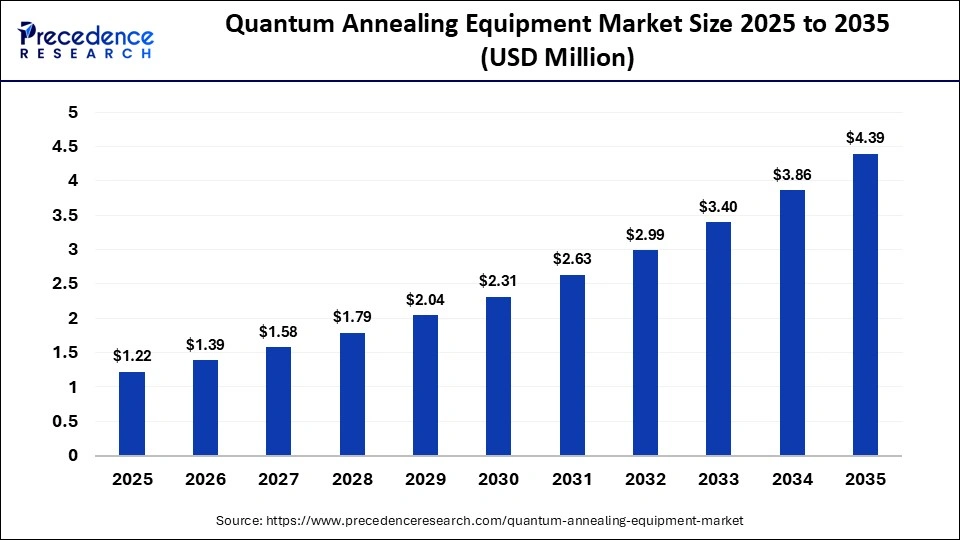
The global quantum annealing equipment market size was calculated at USD 1.22 billion in 2025 and is predicted to increase from USD 1.39 billion in 2026 to approximately USD 4.39 billion by 2035, expanding at a CAGR of 13.65% from 2026 to 2035. The market is driven by the growing need to solve complex optimization problems faster and more efficiently across industries such as logistics, finance, and advanced research.
Market Highligts
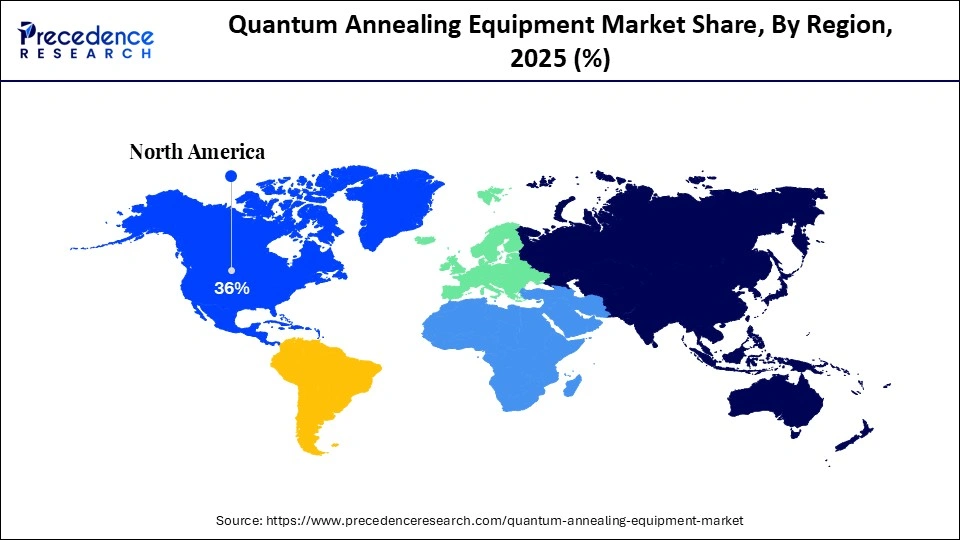
- By region, North America dominated the global quantum annealing equipment market with a major share of 36.0% in 2025.
- By region, Asia Pacific is expected to grow at the fastest CAGR in the market during the forecast period.
- By component, the hardware segment held a dominant position in the market by holding a share of 64% in 2025.
- By component, the software & algorithms segment is expected to grow at the fastest CAGR in the market between 2026 and 2035.
- By deployment mode, the on-premises segment registered its dominance in the global market by holding a major share of 52% in 2025.
- By deployment mode, the cloud-based segment is expected to witness the fastest growth in the market over the forecast period.
- By application, the optimization segment accounted for a major market share of 42% in 2025.
- By application, the machine learning segment is expected to grow at the highest CAGR during the study period.
- By end-user industry, the BFSI segment led the global market with a share of 26% in 2025.
- By end-user industry, the healthcare & pharmaceuticals segment is expected to expand rapidly in the market with a significant CAGR in the coming years.
Market Overview
The quantum annealing equipment market focuses on solving highly complex combinatorial optimization problems using specialized quantum hardware. These systems are applied in logistics optimization, financial portfolio modeling, drug discovery, traffic routing, and materials science simulations, where classical computing methods face scalability and performance limitations. Market growth is driven by rising demand for high-performance optimization tools across data-intensive industries, while increased investments in quantum research by governments, academia, and commercial enterprises are accelerating technological development and commercial adoption.
Quantum Annealing Equipment Market Trends
- Growing adoption of quantum annealing systems in logistics, finance, and manufacturing is addressing complex optimization problems at speeds and scales unattainable with conventional computing methods.
- Hybrid approaches combining quantum annealing with classical computing are increasing, enhancing performance, scalability, and practical applicability for enterprise-level optimization workloads.
- Improvements in qubit stability, coherence, and system scalability are making quantum annealing equipment more reliable and accurate, enabling viable commercial use.
- Cloud-based access to quantum annealing platforms is expanding, allowing organizations to experiment and deploy solutions without extensive infrastructure or in-house expertise.
- Strategic collaborations among hardware and software vendors, research institutions, and enterprises are strengthening the ecosystem and driving application-specific innovations.
How is AI Integration Influencing the Quantum Annealing Equipment Market?
Artificial intelligence is enhancing both the performance and commercial viability of the quantum annealing equipment market. Machine learning techniques help tune parameters, reduce errors, and calibrate qubits, improving solution accuracy and system stability. AI also optimizes hybrid quantum-classical workflows by intelligently allocating tasks between quantum annealers and classical processors for maximum computational efficiency. Furthermore, AI-driven analytics identify suitable applications across logistics, finance, drug discovery, and manufacturing optimization. By accelerating learning cycles and improving decision-making, AI integration lowers adoption barriers and shortens deployment timelines.
Market Scope
| Report Coverage | Details |
| Market Size in 2025 | USD 1.22 Billion |
| Market Size in 2026 | USD 1.39 Billion |
| Market Size by 2035 | USD 4.39 Billion |
| Market Growth Rate from 2026 to 2035 | CAGR of 13.65% |
| Dominating Region | North America |
| Fastest Growing Region | Asia Pacific |
| Base Year | 2025 |
| Forecast Period | 2026 to 2035 |
| Segments Covered | By Component, Deployment Mode, Application, End-User Industry, and region |
| Regions Covered | North America, Europe, Asia-Pacific, Latin America, and Middle East & Africa |
Segment Analysis
Component Insights
Why Did the Hardware Segment Dominate the Quantum Annealing Equipment Market?
The hardware segment dominated the market with a major revenue share of 64% in 2025 because the performance and capabilities of quantum annealers are highly dependent on their physical components, such as qubits, superconducting circuits, and cryogenic systems. Significant investments in hardware development have been necessary to achieve stable, scalable, and efficient quantum processing, making it the primary revenue driver. Additionally, hardware innovation directly impacts computational speed, problem-solving capacity, and energy efficiency, which are critical factors for enterprises and research institutions. As a result, the demand for advanced, reliable quantum annealing hardware outpaced software and services in the market.
The software & algorithms segment is expected to grow at the fastest CAGR in the market between 2026 and 2035. This is mainly due to increasing enterprise focus on bridging real-world problems with quantum-compatible formulations. Expansion is being driven by rising demand for optimization libraries, hybrid quantum-classical algorithms, and middleware platforms that simplify access to quantum hardware. Additionally, quantum annealing software plays a growing role in integrating with AI, machine learning, and traditional high-performance computing, broadening its functional scope and practical applications. This combination of accessibility and enhanced capabilities is accelerating software adoption in the market.
Deployment Mode Insights
What Made On-Premises the Leading Segment in the Quantum Annealing Equipment Market?
The on-premises segment led the market with a share of 52% in 2025, driven by strong demand for data security, regulatory compliance, and operational control. Industries such as BFSI, defense, and advanced research facilities prefer on-site systems to maintain full ownership of sensitive data and proprietary optimization processes. On-premises installations also enable hardware customization, optimal performance for specific workloads, and reduced latency for critical applications. Furthermore, early adopters typically have the financial resources and technical expertise to manage complex cryogenic and control infrastructure, reinforcing the segment's market leadership.
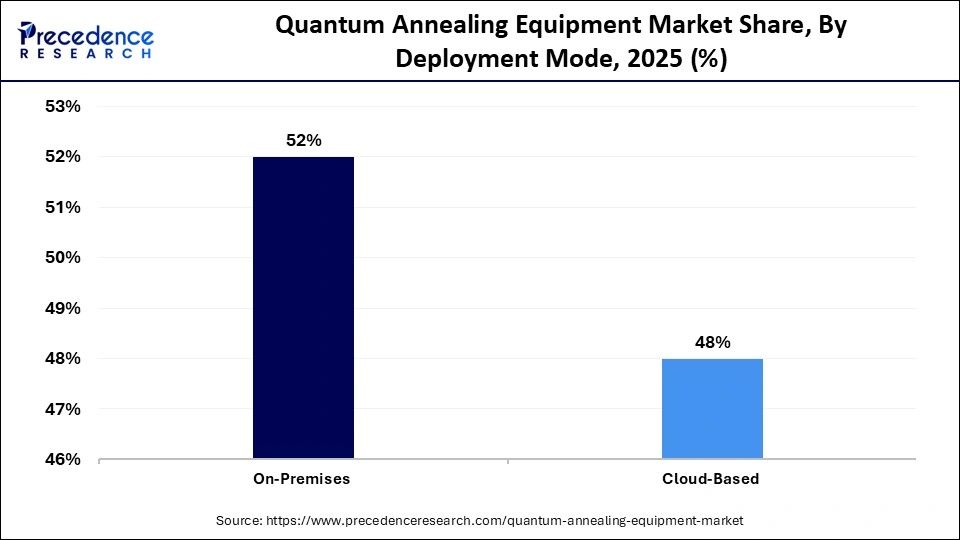
The cloud-based segment is expected to expand at the fastest CAGR in the market over the forecast period due to its low entry barriers and pay-per-use model, making it accessible to startups, SMEs, and research teams without large capital investments. Increasing partnerships between cloud providers and quantum hardware companies are expanding global availability and ease of use. Cloud deployment also enables rapid experimentation, scalability, and seamless integration with classical computing resources, supporting hybrid workflows. These advantages are driving broader adoption as more users recognize the practical benefits of quantum annealing through cloud access.
Application Insights
Why Did the Optimization Segment Lead the Quantum Annealing Equipment Market?
The optimization segment led the global market with a share of 42% in 2025, as quantum annealers excel at solving large-scale combinatorial optimization problems. Industries such as logistics, manufacturing, energy, and finance use these systems for scheduling, routing, supply chain optimization, and portfolio management. Quantum annealing can explore larger solution spaces than classical methods, delivering faster and more accurate results. Early enterprise pilots have demonstrated benefits like cost reduction, improved efficiency, and enhanced decision-making, driving immediate adoption due to clearly defined, practical use cases.
The machine learning segment is expected to expand at the fastest rate in the market in the coming years because quantum annealers can tackle computationally intensive tasks such as feature selection, clustering, pattern recognition, and training optimization more efficiently than classical systems. Industries are increasingly exploring hybrid quantum-classical ML solutions to enhance model performance, scalability, and accuracy. Advances in quantum algorithms and software tools are making quantum-assisted machine learning more practical and accessible. With the rapid adoption of AI, businesses are turning to quantum annealing to accelerate learning processes and handle larger, more complex datasets.
End-User Industry Insights
How Does the BFSI Segment Hold a Major Share of the Quantum Annealing Equipment Market?
The BFSI segment led the global market while holding a 26% share in 2025. This is mainly due to the strong demand for advanced optimization and risk analysis tools in this industry. Financial institutions face large datasets and complex problems in areas such as banking, mortgage lending, portfolio optimization, fraud detection, credit scoring, and derivatives pricing, where quantum annealing delivers faster and more accurate solutions. Additionally, the sector has the financial resources and strategic motivation to adopt emerging technologies early, supporting its leadership in the market.
The healthcare & pharmaceuticals segment is expected to expand at the fastest CAGR in the market in the coming years, driven by applications in drug discovery, molecular modeling, and compound screening that are challenging for conventional computing. Quantum annealing is also being explored for medical imaging analysis, resource scheduling, and treatment optimization. Key growth factors include rising R&D investment, increasing data volumes, and the need to shorten drug development cycles, making quantum solutions increasingly attractive to the sector.
Region Insights
How Big is the North America Quantum Annealing Equipment Market Size?
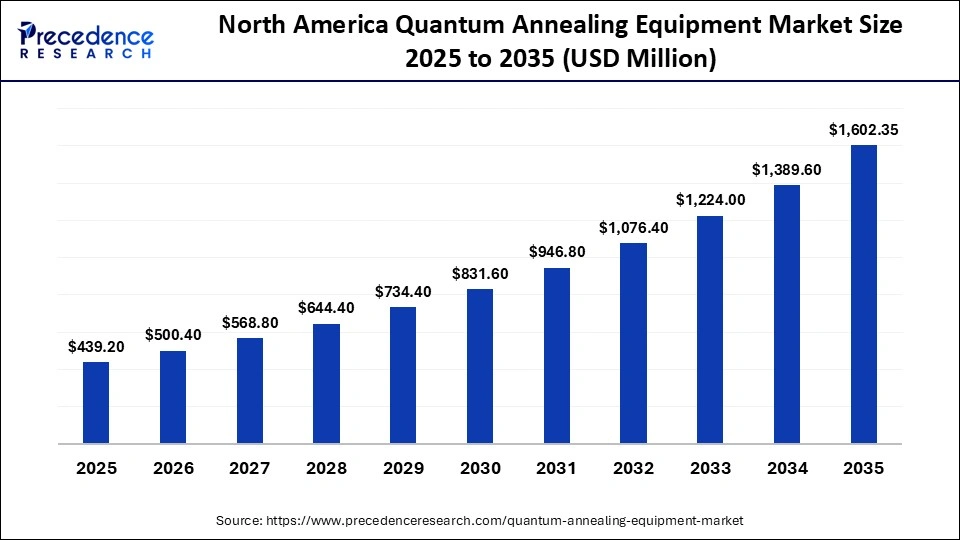
The North America quantum annealing equipment market size is estimated at USD 439.20 million in 2025 and is projected to reach approximately USD 1,602.35 million by 2035, with a 13.82% CAGR from 2026 to 2035.
What Made North America the Leading Region in the Global Quantum Annealing Equipment Market?
North America led the global quantum annealing equipment market by capturing a 36.0% share in 2025. The region's dominance in the market is driven by the strong presence of leading quantum technology companies, advanced research institutions, and substantial government investment. High R&D spending and a mature cloud computing ecosystem have accelerated the commercialization of quantum annealing equipment in the region. Innovation is further supported by strategic partnerships between hardware vendors, software developers, and universities. Additionally, favorable regulatory support and the availability of skilled quantum professionals enable rapid deployment and experimentation.
What is the Size of the U.S. Quantum Annealing Equipment Market?
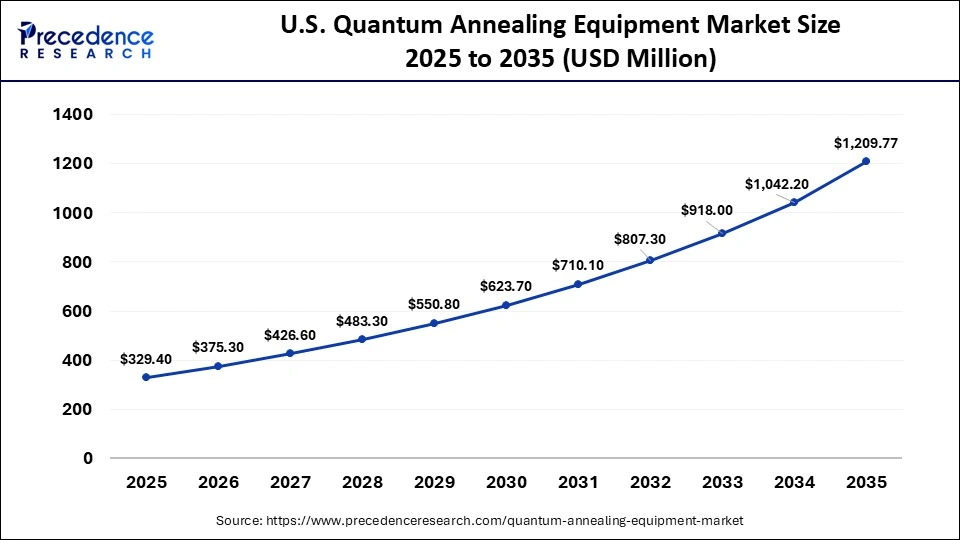
The U.S. quantum annealing equipment market size is calculated at USD 329.40 million in 2025 and is expected to reach nearly USD 1,209.77 million in 2035, accelerating at a strong CAGR of 13.89% between 2026 to 2035.
U.S. Market Trends
The U.S. is the major contributor to the North American quantum annealing equipment market due to its strong concentration of leading quantum technology companies, advanced research institutions, and substantial government funding. High investments in R&D, early commercialization efforts, and a mature cloud computing ecosystem have accelerated the development and adoption of quantum annealing solutions in the country.
What Makes Asia Pacific the Fastest-Growing Region in the Quantum Annealing Equipment Market?
Asia Pacific is expected to grow at the fastest CAGR in the market during the forecast period, driven by substantial investments in quantum research, infrastructure development, and talent building across China, Japan, South Korea, and India. Rapid digital transformation in manufacturing, logistics, smart cities, and financial services is increasing demand for optimization-focused quantum solutions. The region's expanding semiconductor ecosystem and growing adoption of AI-driven decision-making further supports the integration of quantum annealing. Additionally, collaborations between global quantum technology providers and local research institutions are accelerating technology transfer and commercialization.
China Market Trends
The quantum annealing equipment market in China is growing due to its heavy government investment in quantum research, infrastructure development, and national quantum initiatives. The country's strong focus on advanced manufacturing, AI-driven optimization, and a growing semiconductor ecosystem is accelerating the adoption and integration of quantum annealing technologies.
Why is Europe Considered a Significantly Growing Area in the Quantum Annealing Equipment Market?
Europe is expected to grow at a significant CAGR in the upcoming period, driven by strong European Union–led quantum strategies and innovation programs. Countries such as Germany, the UK, France, and the Netherlands are investing heavily in quantum research centers, pilot projects, and public–private partnerships. Europe's focus on sustainability, energy efficiency, and advanced manufacturing aligns well with key quantum annealing applications. In addition, the region's emphasis on ethical AI and secure computing is encouraging responsible and structured adoption of quantum technologies.
Who are the major players in the global quantum annealing equipment market?
The major players in the quantum annealing equipment market include D-Wave Quantum Inc., Fujitsu Limited (Digital Annealer), NEC Corporation, Hitachi, Ltd., Toshiba Corporation, IBM Corporation, Google Quantum AI, Microsoft (Azure Quantum), Amazon Web Services (Amazon Braket), Rigetti Computing, Quantinuum, Lockheed Martin Corporation, Quantum Computing Inc. (QCI), Northrop Grumman, and Automatski
Recent Developments
- In January 2026, D-Wave posted considerable developments in annealing and gate-model quantum computing technologies, consolidating its dual-platform approach. The development will increase customer flexibility because it enables more quantum workloads and hybrid computing applications. (Source: https://www.dwavequantum.com)
- In November 2025, Quandela collaborated with OVHcloud to release MerLin, the primary programming language and quantum machine learning, on the platform of OVHcloud in the middle of 2026. It is a partnership that attempts to speed up the creation of hybrid quantum-classical applications in a secure, sovereign environment in Europe, in the cloud. (Source: https://www.quandela.com)
- In October 2025, NVIDIA launched NVIDIA NVQLink, an open architecture system that is structured to closely co-locate the use of GPS computing with quantum computers. The innovation has made it possible to create much faster quantum supercomputers, which are of great use in hybrid quantum-classical workloads. (Source: https://nvidianews.nvidia.com)
Segments Covered in the Report
By Component
- Hardware (Systems)
- Software & Algorithms
- Services
By Deployment Mode
- On-Premises
- Cloud-Based
By Application
- Optimization
- Machine Learning
- Simulation & Modeling
- Cryptography
By End-User Industry
- BFSI (Banking & Finance)
- Healthcare & Pharmaceuticals
- Aerospace & Defense
- Transportation & Logistics
- Energy & Power
By Region
- North America
- Europe
- Asia-Pacific
- Latin America
- Middle East & Africa
For inquiries regarding discounts, bulk purchases, or customization requests, please contact us at sales@precedenceresearch.com
Frequently Asked Questions





Ask For Sample
No cookie-cutter, only authentic analysis – take the 1st step to become a Precedence Research client
 Get a Sample




 sales@precedenceresearch.com
 Schedule a Meeting
