



Self-Driving Cars Market Size, Key Companies, Company Market Share, Vehicle Production Volume, Sales Performance, Export & Import Analysis, Technology Adoption, Competitive Positioning, and Demand Trends
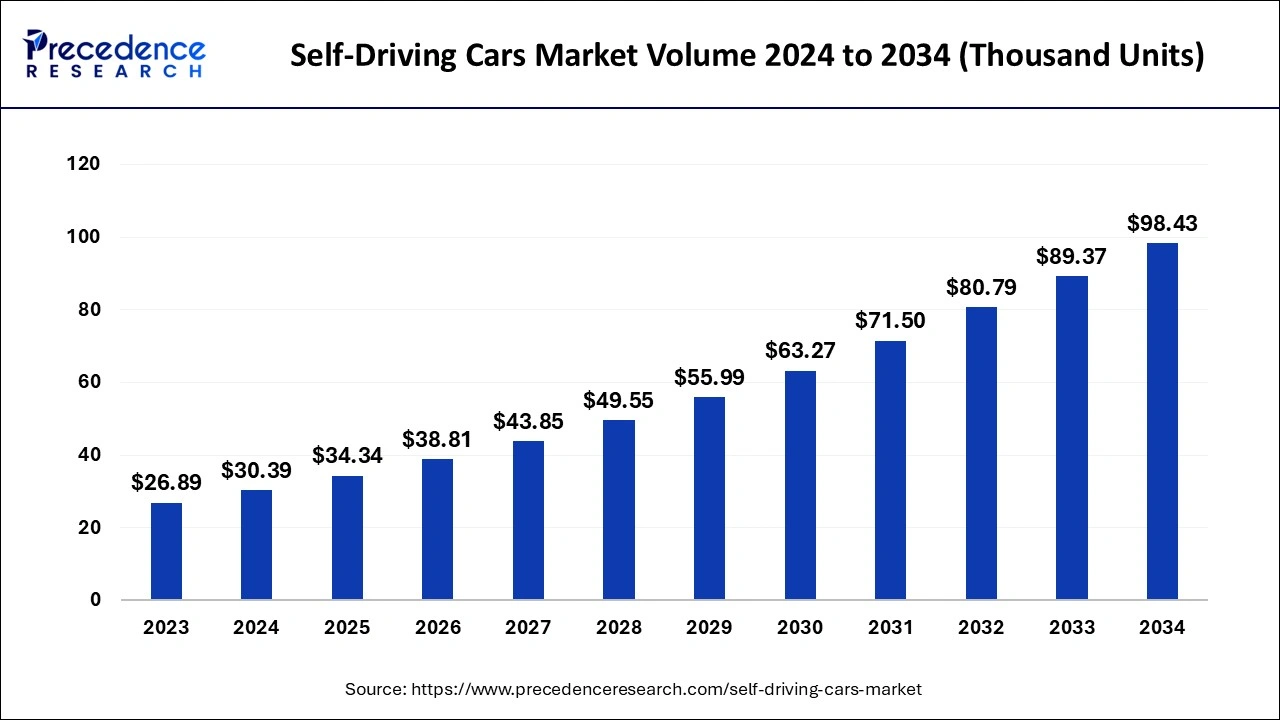
According to automotive sector expert, Laxmi Narayan notes that the self-driving cars market stands at USD 38.81 thousand units in 2026 and is expected to reach 98.43 thousand units by 2034, growing at a CAGR of 12.05%. Leading self-driving cars market companies such as Tesla, General Motors (GM/Cruise), NVIDIA are driving market development across segments including By Type, Vehicle Type, Application, System, Electric Vehicle, Component, Level of Autonomy.
Source: https://www.precedenceresearch.com/self-driving-cars-market
 Get a Sample
 Table Of Content


What is the Self-Driving Cars Market Size?
The global self-driving cars market volume accounted for 38.81 thousand units in 2026 and is predicted to reach around 107.17 thousand units by 2035, growing at a CAGR of 12.05% from 2025 to 2034.
Self-Driving Cars Market Key Takeaways
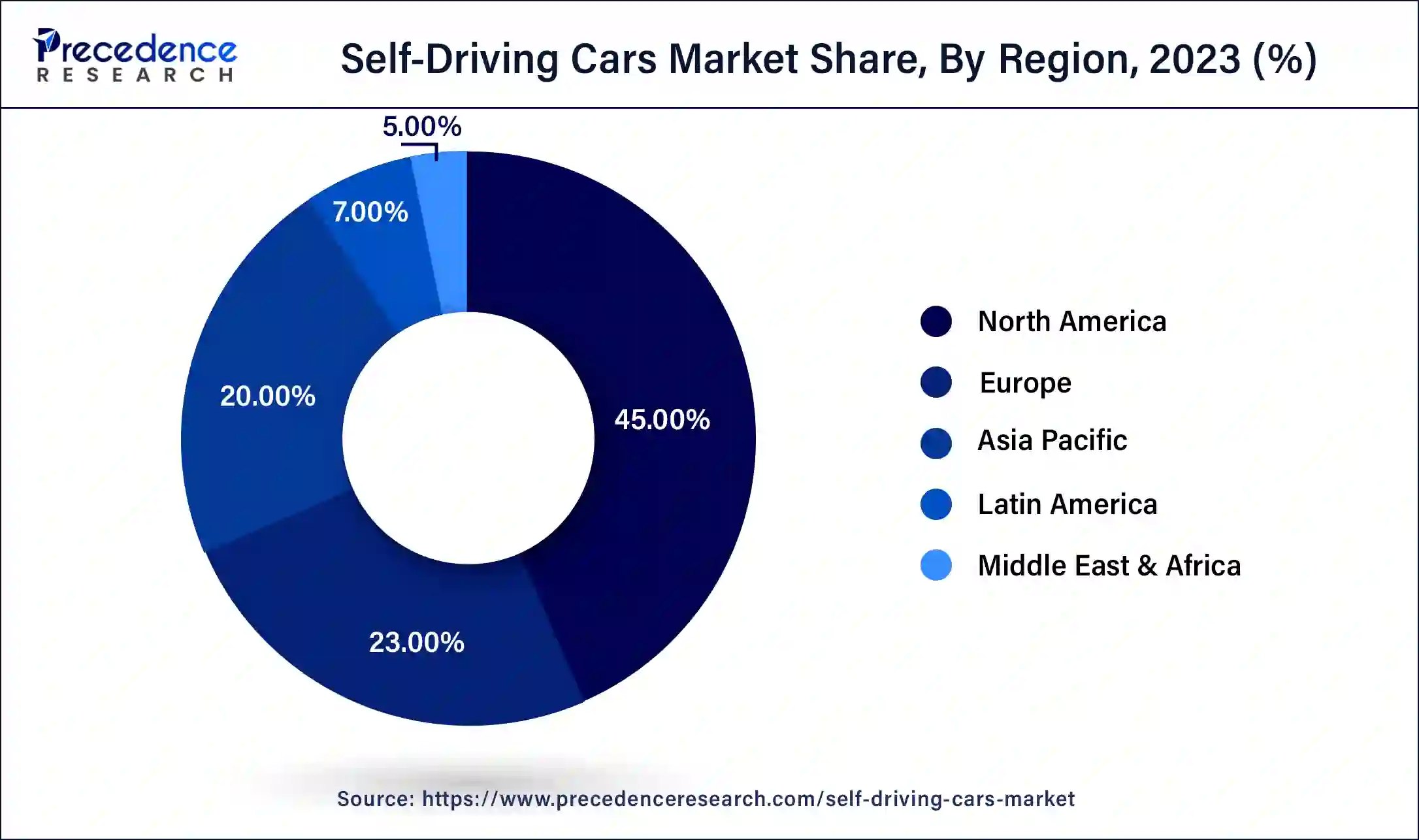
- North America dominated the market with the highest market share of 45% in 2025.
- By type , the semi autonomous car segments dominated the global market in 2025.
- By vehicle type, the passenger car segment held the largest share of the market in 2025.
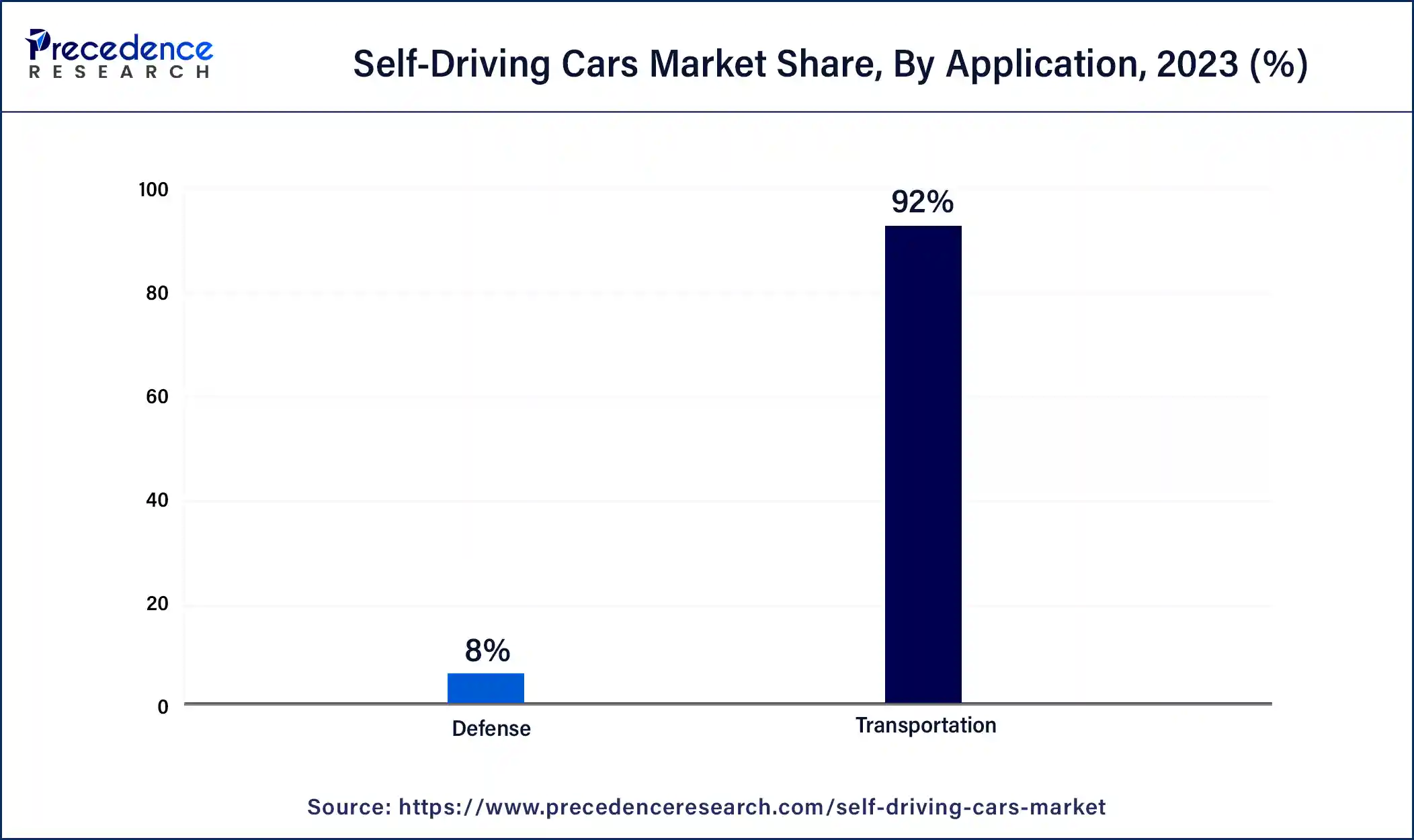
- By application , the transportation segment led the global market with share of 92% in 2025.
Market Overview
The self-driving cars are also known as autonomous vehicles which have a great potential for growth in the automobile sector. In order to carry out the operations automatically the self-driving cars are made up of numerous sensors. These sensors help the navigation process by performing situational analysis, trajectory control and motion planning. Due to the increased connectivity of these vehicles the threat of these cars getting hacked is increasing. Many organizations are developing anti hacking algorithms for the self-driving cars in order to prevent hacking. The developments of electric vehicle charging points would greatly affect the growth of autonomous vehicles as many autonomous vehicles are driven using the electrical power. Demand for luxury cars will further increase the demand for these self-driving cars during the forecast period. There has been a considerable growth in China and India, among others developing nations. The standard of living has also changed and improved in many developing countries due to a considerable increase in the spending power.
There was an increased use of personal transportation during pandemic. Increase in the fear of acquiring the disease and in order to follow the government restrictions there was a significant effect on the transportation and the mobility sector. There was a great amount of uncertainty in the market during the pandemic. This hampered the business growth. There was a growing panic among the consumers due to the increasing number of Hospitalized patients and that's occurring due to COVID 19. This fear increased the use of personal transport.
AI Integration Steering the Future of Self-Driving Cars
AI integration greatly enhances self-driving cars by enabling real-time decision-making, predictive analysis, and adaptive learning for safer and more efficient navigation. Through advanced algorithms, AI processes large amounts of data from sensors, cameras, and radar to identify objects, forecast movement, and prevent collisions. Machine learning improves route planning, traffic flow, and energy use, while neural networks increase perception accuracy in complex situations. Additionally, AI supports ongoing system updates, personalized driving experiences, and better communication between vehicles and infrastructure, collectively boosting reliability and public trust in autonomous driving technology.
Self-Driving Cars Market Growth Factors
Safety features is the most important factor for automotive customers across the world. The compulsion imposed by the government regarding safety features of LDW, AEB, EBS and many others have forced the manufacturers to incorporate such facilities into the recent vehicles. These facilities prove to be the basic feature in the self driving vehicles which proves to be a driving factor for the company. This improves the driving experience and quality provided by the vehicle. Many different types of safety features have been developed in order to help the drivers and lower the number of accidents across the world. Major OEMs such as Honda and Toyota are launching vehicles with safety features like blind spot detection, forward collision warning, rear cross traffic, and automatic emergency braking as a standard in all its vehicles. Self-driving cars could play a important role in reducing this number of accidents and provide a safe and efficient driving experience for the customers. Active safety systems such as blind spot detection, automatic emergency braking are the technologies that are providing a boost to the self-driving cars market. Increasing demand for the luxury vehicles in developing and developed nations will further strengthen the demand for self-driving cars in the coming years. In developing countries such as China and India, among others the growth rate for the self-driving cars is more. German car brands like as BMW, Mercedes-Benz, and Audi dominate the global luxury automobiles market.
Market Outlook
- Industry Growth Overview: The self-driving cars market is experiencing rapid expansion driven by advancements in artificial intelligence, sensor fusion, and connectivity technologies. Growing demand for autonomous mobility, improved safety, and efficient transportation systems is boosting global adoption and industry innovation across automotive sectors.
- Sustainability Trends: There is a strong focus on integrating electric and hybrid powertrains, optimizing energy efficiency through AI-driven navigation, and reducing carbon emissions. Manufacturers emphasize recyclable materials, eco-friendly production processes, and shared autonomous mobility models to support greener, smarter, and more sustainable urban transportation ecosystems.
- Global Expansion: The market is expanding globally, driven by technological collaborations, supportive government regulations, and increasing investments in intelligent mobility infrastructure. Key automotive and tech companies are expanding operations across North America, Europe, and Asia-Pacific, fostering large-scale testing, deployment, and commercialization of autonomous driving solutions worldwide.
- Major investors: Major investors in the self-driving cars market include leading technology firms, venture capitalists, and automotive giants such as Alphabet, Intel, SoftBank, Toyota, and Baidu. These investors fund AI development, sensor innovation, and autonomous vehicle startups, accelerating commercialization and global deployment of self-driving mobility technologies.
- Startup Ecosystem: The startup ecosystem in the market is fueled by innovations in AI algorithms, sensor technology, and autonomous software platforms. Emerging companies focus on safety, real-time data processing, and cost-effective solutions, attracting strong investments and strategic partnerships from global automakers and tech leaders.
Market Scope
| Report Coverage | Details |
| Market Volume by 2034 | 98.43 Thousand Units |
| Market Volume in 2026 | 38.81 Thousand Units |
| Market Volume in 2025 | 34.34 thousand Units |
| Market Growth Rate from 2025 to 2034 | CAGR of 12.05% |
| Largest Market | Asia Pacific |
| Base Year | 2025 |
| Forecast Period | 2025 to 2034 |
| Segments Covered | Type, Vehicle, Application, System, Electric Vehicle, Components, Level of Autonomy, and Regions |
| Regions Covered | North America, Europe, Asia-Pacific, Latin America, and Middle East & Africa |
Segmental Insights
Type Insights
On the basis of the type, the semi autonomous car segment is expected to dominate the market during the forecast period. Semi autonomous segment has the largest market share in the global market. The semi autonomous cars have various levels of automation. The various levels are level 1, 2 and 3. They shall be our fastest growth of level two and Level 3 automation of semi autonomous car segment in the market. The penetration rate of level two and three is more as compared to level one. Increasing technological developments in level 2 and Level 3 is driving the growth of the market. There are many other features that are included in the semi autonomous vehicles segment like the adaptive cruise control, intelligent park assist etc. The intelligent emergency breaking and intelligent park assisting are the segments that are expected to show the fastest growth in the market. The automatic emergency breaking system is expected to be a standard across all the vehicles according to the National Highway Traffic Highway Safety Association.
Vehicle Type Insights
On the basis of the vehicle type, the passenger car segment is expected to have the largest market share during the forecast period. Due to the rapid urbanization across the developing nations and increase it to manned in the developed nations the passenger car segment is expected to grow during the forecast period. Higher demographic growth, improved standards of living and the increase in the purchasing power in the developing nations are the most important factors that are leading to high growth of this market. There's an increased production of cars across the globe in many developed as well as the developing nations due to a great demand for these self driven cars. Various organizations and governments or investing a great amount of percentage in the development of these technologically advanced vehicles which will help in enhancing the safety features in order to prevent accidents on the roads. Self driven cars are able to provide convenience and comfort which is helping in creating a high demand for the self driven cars in the market.
Apart from the passenger car segment the commercial car segment is also expected to have a good amount of share in the self driven cars market. The Ensemble consortium and Netherlands organization partnered with the European Union. This partnership is aiming for applied scientific research in order to implement a multi brand truck for the European highways which will help in improving the traffic capacity. These technologically advanced drugs will be able to reduce the carbon dioxide emissions in Europe. And the fuel consumption shall be less as compared to the other vehicles.
Application Insights
On the basis of application, the transportation segment has dominated the market for the self-driving cars which had a share of about 92% in 2025. Due to an increased funding provided by the government for this self-driving car trails is driving the market. In order to have more innovations in the transportation industry the Intelligent Mobility Fund was provided by the government in the UK. The transportation could be either commercial or industrial transportation. In the future it is expected that there shall be a hired option of driverless technology in transportation as there is and increasing amendment in the transport regulations by the US government. These improved transport regulations are creating a gateway for the self driving cars in this region.
Apart from US the Europe is also expected to emerge as a lucrative market for self-driving cars. Due to an increasing preference from the consumers there is a growth in the market of self-driving cars which are technologically advanced products offered to this market.
Regional Insights
How North America dominate Market Revenue in 2025?
North America dominated the self-driving cars market revenue in 2025. The market growth in the region is attributed to the increasing demand for autonomous vehicles, rising research and development activities in manufacturing, increasing introduction programs and funding and increasing focus on regularization of the use of self-driving cars.
The North America region had the largest market share till the recent years. The North American region accounted for a volume a share of about 45% till the year 2025. The growth of the self driving cars in this market is due to the amendments in the traffic regulations in the US. Due to these amendments there shall be an incorporation what is self driving cars on the public roads in the United states. In order to make transport completely autonomous this regulation is being adopted across all the states in the United states. Due to an increasing demand of the mobility as a service sector it is expected that the market shall grow well for the self driving cars in the future.
U.S. Self-Driving Cars Market Size and Growth 2025 to 2034
The U.S. self-driving cars market volume was valued at 12.26 thousand units 2026 and is predicted to reach around 31.27 thousand units by 2034, at a CAGR of 12.13% from 2025 to 2034.
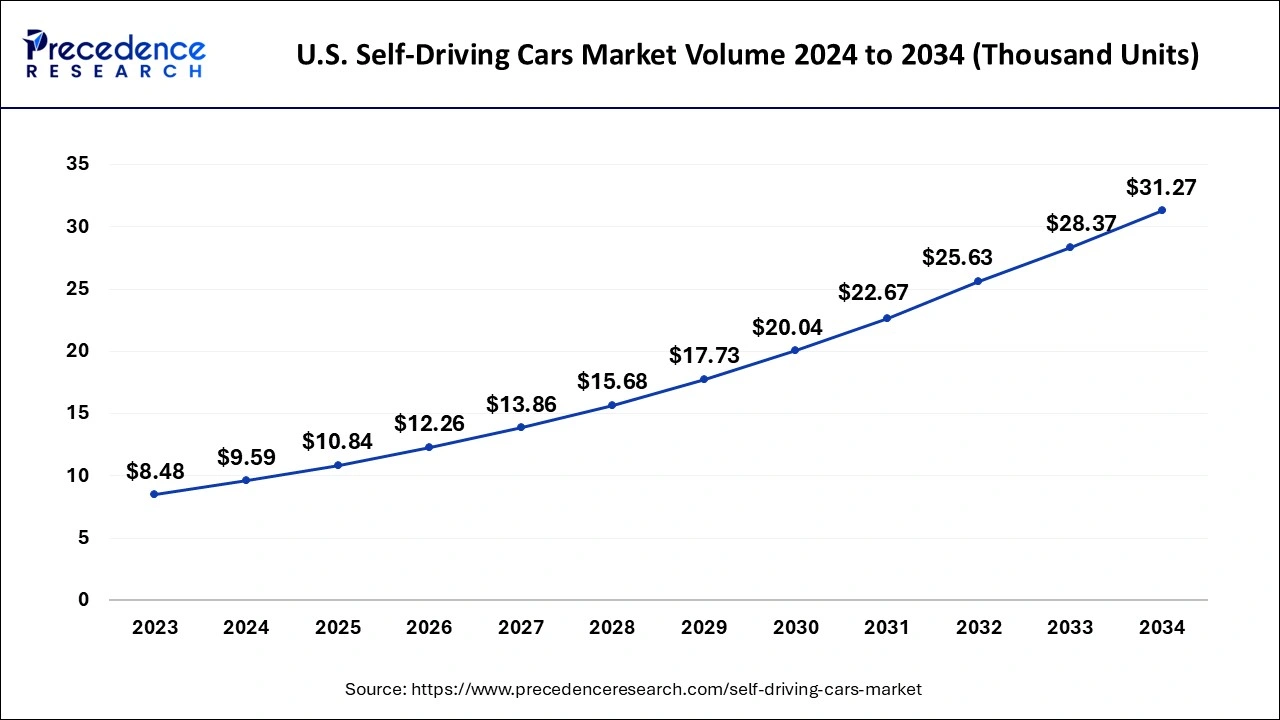
The U.S. and Canada are dominating countries driving the market growth. The U.S. is the major manufacturing country in the autonomous cars. The U.S. is leading the world in the development and deployment of autonomous driving technology.
There are about 170 autonomous technology programs conducted by various companies such as Pennsylvania, Florida, Texas, and more. For instance, up to 10% of global self-driving cars sales by 2030.
Asia Pacific Self-Driving Cars Market Trends
Asia Pacific is expected to grow fastest during the forecast period. The market growth in the region is driven by the increasing presence of leading technology companies and automakers and increasing manufacturing powerhouses. China and India are the fastest growing countries accelerating the market growth. There are 33 Autonomous Vehicles startups in India such as Playment, Minus Zero, Swaayatt Robots and AutoNxt Automation. An average of 2 new companies have been launched annually over the last 10 years.
Europe Self-Driving Cars Market Trends
Europe is expected to experience significant growth in the market due to strong government support, investments in connected and autonomous vehicle (CAV) technologies, and the presence of advanced automotive manufacturing infrastructure. Germany, in particular, is a leading country driving this growth, supported by major OEMs, extensive R&D facilities, and favorable regulations that encourage testing and deployment of autonomous vehicles. Additionally, rising consumer interest in safer and more efficient mobility solutions, coupled with collaborations between tech companies and automakers, is accelerating the adoption of self-driving technologies across the region.
Latin America Self-Driving Cars Market Trends
Latin America is poised for strong growth due to accelerating vehicle adoption, rapid expansion of electrified and connected vehicles, and increasing automaker investments in advanced mobility technologies. Brazil, as the region's automotive powerhouse, is especially influential, boosted by rising EV/hybrid adoption, expanding infrastructure, and regulatory support for autonomous and driver assistance innovations. These elements combine to create fertile ground for the rollout of self-driving and semi-autonomous vehicles across the region.
Middle East and Africa Self-Driving Cars Market Trends
The market is MEA is likely to grow at a steady rate in the coming years. Saudi Arabia is spearheading the rise of the market in the Middle East & Africa (MEA), thanks to bold initiatives under its Vision 2030 smart mobility agenda, including public robotaxi trials in Riyadh and an ambition to make 15 % of public transport autonomous by 2030. The Kingdom's investment in enabling infrastructure, like smart roads and vehicle-to-infrastructure communications, along with regulatory frameworks inviting global partners, accelerates the adoption of autonomous vehicle technologies in both passenger and goods transport.
Value Chain Analysis
- Raw Material Sourcing: This stage involves the procurement of metals, semiconductors, optical sensors, and lithium-ion battery materials.
Organizations: BASF SE, Umicore, LG Chem, Sumitomo Metal Mining, and Samsung SDI. - Component Manufacturing: Production of sensors (LiDAR, radar, cameras), processors, AI chips, and connectivity modules.
Organizations: NVIDIA Corporation, Intel (Mobileye), Velodyne Lidar, Bosch, and Continental AG. - Vehicle Assembly and Integration: Integration of autonomous driving systems, electric powertrains, and AI software into vehicle platforms.
Organizations: Tesla, Waymo (Alphabet), General Motors (Cruise), BMW, and Toyota Motor Corporation. - Aftermarket Service and Spare Parts: Maintenance of autonomous systems, software updates, replacement of sensors and components, and cybersecurity monitoring.
Organizations: Bosch Mobility Solutions, Aptiv PLC, Continental AG, ZF Friedrichshafen, and authorized dealership networks.
Competitive Landscape
The self-driving cars market is an expanded thought of the automakers and automation that pushed car innovation. The reach and demand of robotaxis accelerated driverless services. The integration of smart software and AI adhering to the necessary safety standards is a valuable contribution to market expansion. The remarkable battery electric platforms are the robust base for market development. The well-known giants such as Tesla, General Motors (GM/ Cruise), NVIDIA, Mercedes-Benz and Waymo (Alphabet) are promoting excellence in automation in the car profile.
Company Profiles
Tesla
- HQ: Austin, Texas.
- Founded: 2003
- Ownership: Multinational Automotive and Clean Energy Company.
- Business Overview: Tesla's main business is to sell and design electric vehicles and follow the modern EV trends to fit the customer criteria for innovative vehicles with supercharger and FSD software perks. The company also contributes to green development by producing solar roofs, battery systems and solar panels.
- Products: Cybertruck, Model Y, Model 3, etc.
- Geographic Presence: The company's commercial process and customer engagement are across Europe, China and North America. The sales business is across all regions.
- Revenue: Tesla's revenue to date since 2026 started is $28.24 billion.
- Recent Development: In July 2026, Elon Musk gave an insight into Tesla's China business and how it might be separated from the U.S. business to control the rising geopolitical tension. Further, the partnership with SpaceX may also reflect some transitions.
- Key Strategies: The fundamental strategy of the company is to expand its EV designs and focus on market innovation needs.
General Motors (GM/Cruise)
- HQ: Detroit, Michigan, United States and Cruise LLC's HQ is in San Francisco, California.
- Founded: 2013
- Ownership: Technology and Cruise-based company
- Business Overview: GM'S business since its Cruise acquisition has been sincerely covering the robotaxi to unify and promote the potential value of self-driving technology. ADAS is the heart of the company's business.
- Products: Level 2 hands-free driving technology, Level 3 driving, etc.
- Geographic Presence: The company's core business covers 29 countries.
- Revenue: GM's revenue in 2025 was $5.4 billion and is expected to grow in the coming years.
- Recent Development: In August, GM put in efforts to shape and develop the self-driving car concept. The company collected data for the self-driving technology to bolster the market presence in favor of the company's smart expansion.
- Key Strategies: The motive of bolstering the cruise business alongside concentrating on active vehicle designs and innovations is the main agenda of the company.
NVIDIA
- HQ: Santa Clara, California, USA.
- Founded: 1993
- Ownership: Technology Company
- Business Overview: Current business strategy is to promote and deploy AI power in hardware systems. Whereas gaming and robotics are blooming in favor of the company's profit, which instantly delivers a robust platform for the market.
- Products: GPUs, CUDA, software tools, etc.
- Geographic Presence: The company mainly covers the U.S., Asia Pacific and Europe.
- Revenue: NVIDIA's 2027 Q2 fiscal revenue is predicted to peak by 106%.
- Recent Development: In January 2026, Nvidia excitedly ramped up the new self-driving car technology that will attract more business via product integration. This allows AI to showcase it's long standing potential in the market growth policy.
- Key Strategies: The company aims to focus on new technologies supporting the integration. Whereas its efforts in the gaming partnerships are the company's smart highlight.
Mercedes-Benz
- HQ: Stuttgart, Germany
- Founded: 1886
- Ownership: Luxury Car Brand
- Business Overview: The company's business stands on a luxurious portfolio since the EVs are modernizing with the designs, integration concept and mobility. The great model commercial strategies are part of the company's smart business.
- Products: Mercedes-AMG, Mercedes-Maybach, etc.
- Geographic Presence: The sales of this brand are across 180 nations.
- Revenue: The 2026 Q2 revenue is noted as €32.1 billion, followed by the Q1 revenue of €31.6 billion.
- Recent Development: In March 2025, Mercedes-Benz received approval for special marker lights in self-driving vehicles in Germany. This encouraged the brand to upgrade its innovation status and contribute to the market.
- Key Strategies: The main motive of the brand is to expand its luxurious collection and commercialize the innovation on international platforms.
Waymo (Alphabet)
- HQ: Mountain View, California.
- Founded: 2009
- Ownership: Autonomous Driving Technology Company
- Business Overview: Waymo's main business is to render services via its Waymo One platform. It also manages paid weekly rides. Its expansion speaks volumes about the service and management quality that highlights seamless user engagement.
- Products: Waymo One, Waymo Driver, etc.
- Geographic Presence: The company's service chain covers 11 U.S. metropolitan areas.
- Revenue: The company's 2026 revenue to date is $355 million.
- Key Strategies: The company's core strategy is to enhance the robotaxi services and build a standard for autonomous innovations across its 11 U.S. metropolitan areas.
Recent Development
- In January 2025, Waymo announced plans to expand its autonomous driving technology testing to over 10 new U.S. cities, including San Diego and Las Vegas. This expansion aims to collect diverse road data and refine its AI perception systems in different traffic and environmental conditions. The move marks a strategic effort to accelerate national deployment of fully autonomous ride-hailing services.
(Source: futuretransport-news.com) - In March 2025, Waymo partnered with Uber to launch fully driverless robotaxi services in Atlanta. The fleet, consisting of around 100 autonomous vehicles, operates across a 65-square-mile zone. This collaboration combines Uber's ride-hailing platform with Waymo's advanced autonomous technology, enhancing accessibility and public trust in self-driving mobility.
(Source: ackodrive.com) - In July 2025, Pony.ai began mass production and road testing of its 7th-generation autonomous robotaxi platform in China. The Gen-7 model integrates 100% automotive-grade components and has achieved a 70% reduction in hardware costs, making it more scalable for commercial deployment. It is designed to be compatible with multiple vehicle types, supporting broad adoption in urban environments.
(Source: ir.pony.ai) - In August 2025, AEye, Inc. unveiled its OPTIS lidar system, a full-stack perception platform powered by AI and NVIDIA Jetson Orin. The system delivers ultra-high-resolution 3D sensing up to 1 kilometer, allowing self-driving cars to detect obstacles with greater accuracy. Its software-defined architecture enables flexible performance adjustments for varying driving scenarios.
(Source: aeye.ai) - In October 2025, Lucid Group announced the upcoming launch of a mid-size electric vehicle integrated with NVIDIA DRIVE AGX Thor computing systems and a comprehensive sensor suite, including lidar, radar, and cameras. The vehicle aims to deliver near-Level 4 autonomous capabilities with enhanced performance and safety features. Lucid's initiative reflects its strategy to blend luxury EV design with advanced autonomous driving technologies.
(Source: prnewswire.com) - In June 2025, Ride-sharing firm Uber Technologies officially launched its autonomous vehicle service in Atlanta through its partnership with Waymo, Alphabet's self-driving car division. The aim behind this launch was to follow the successful deployment in Austin, Texas.
- Mobileye, Intel Corporation, Fiat Chrysler Automobiles , and BMW Group Signed MoU in August 2021 to Develop Autonomous Vehicles.
- Pony.ai Announces to Raise $400 Million from in February 2020 to Develop Autonomous Driving
- Pony.ai, which is an autonomous driving company, raised USD 400 million from Toyota Motor Corporation to expand their partnership in mobility services that they provide. This collaboration will help in developing autonomous driving technology and it will also help in deploying mobility services.
- Mobileye and Willer Announced their Partnership on Autonomous in July 2020
- Mobileye which is an Intel Company, announced its partnership with Willer which is a transportation service provider. The collaboration will help in order to launch a self-driving robo taxi service in the region of Japan and many other parts of Southeast Asia region.
- The Center for connected and autonomous vehicles was established in the UK. This government department it's focusing on all the legislations which could allow the testing of motorways in the nation
- January 2021 – Cruise and General Motors (G.M.) Partnered with Honda company in order to Expand its Autonomous Vehicle Mobility Service across the world.
- Honda announced its collaboration with G.M. and Cruise on self-driving vehicles for the autonomous vehicle mobility service (MaaS) business in Japan which is based on the developmental and the commercial agreements which were signed in the year 2018.
Segments Covered in the Report
By Type
- Fully Autonomous
- Semi- Autonomous
By Vehicle Type
- Passenger Cars
- Commercial Vehicles
By Application
- Transportation
- Defense
By System
- Adaptive Cruise Control (ACC)
- Adaptive Front Light (AFL)
- Automatic Emergency Braking (AEB)
- Blind Spot Detection (BSD)
- Cross Traffic Alert (CTA)
- Driver Monitoring System (DMS)
- Forward Collision Warning (FCW)
- Intelligent Park Assist (IPA)
- Lane Departure Warning (LDW)
- Night Vision System (NVS)
- Pedestrian Detection System (PDS)
- Road Sign Recognition (RSR)
- Tire Pressure Monitoring System (TPMS)
- Traffic Jam Assist (TJA)
By Electric Vehicle
- Battery Electric Vehicles (BEV)
- Hybrid Electric Vehicles (HEV)
- Plug-in Hybrid Electric Vehicle (PHEV)
- Fuel Cell Electric Vehicle (FCEV)
By Component
- Camera Unit
- LiDAR
- Radar Sensor
- Ultrasonic Sensor
- Infrared Sensor
By Level of Autonomy
- L1
- L2
- L3
- L4
- L5
By Geography
- North America
- U.S.
- Canada
- Europe
- U.K.
- Germany
- France
- Asia-Pacific
- China
- India
- Japan
- South Korea
- Malaysia
- Philippines
- Latin America
- Brazil
- Rest of Latin America
- Middle East & Africa (MEA)
- GCC
- North Africa
- South Africa
- Rest of the Middle East & Africa
For inquiries regarding discounts, bulk purchases, or customization requests, please contact us at sales@precedenceresearch.com
Frequently Asked Questions
Tags





Ask For Sample
No cookie-cutter, only authentic analysis – take the 1st step to become a Precedence Research client
 Get a Sample




 sales@precedenceresearch.com
 Schedule a Meeting
