



Luxury Car Market Size, Key Companies, Company Market Share, Vehicle Production Volume, Sales Performance, Export & Import Analysis, Technology Adoption, Competitive Positioning, and Demand Trends
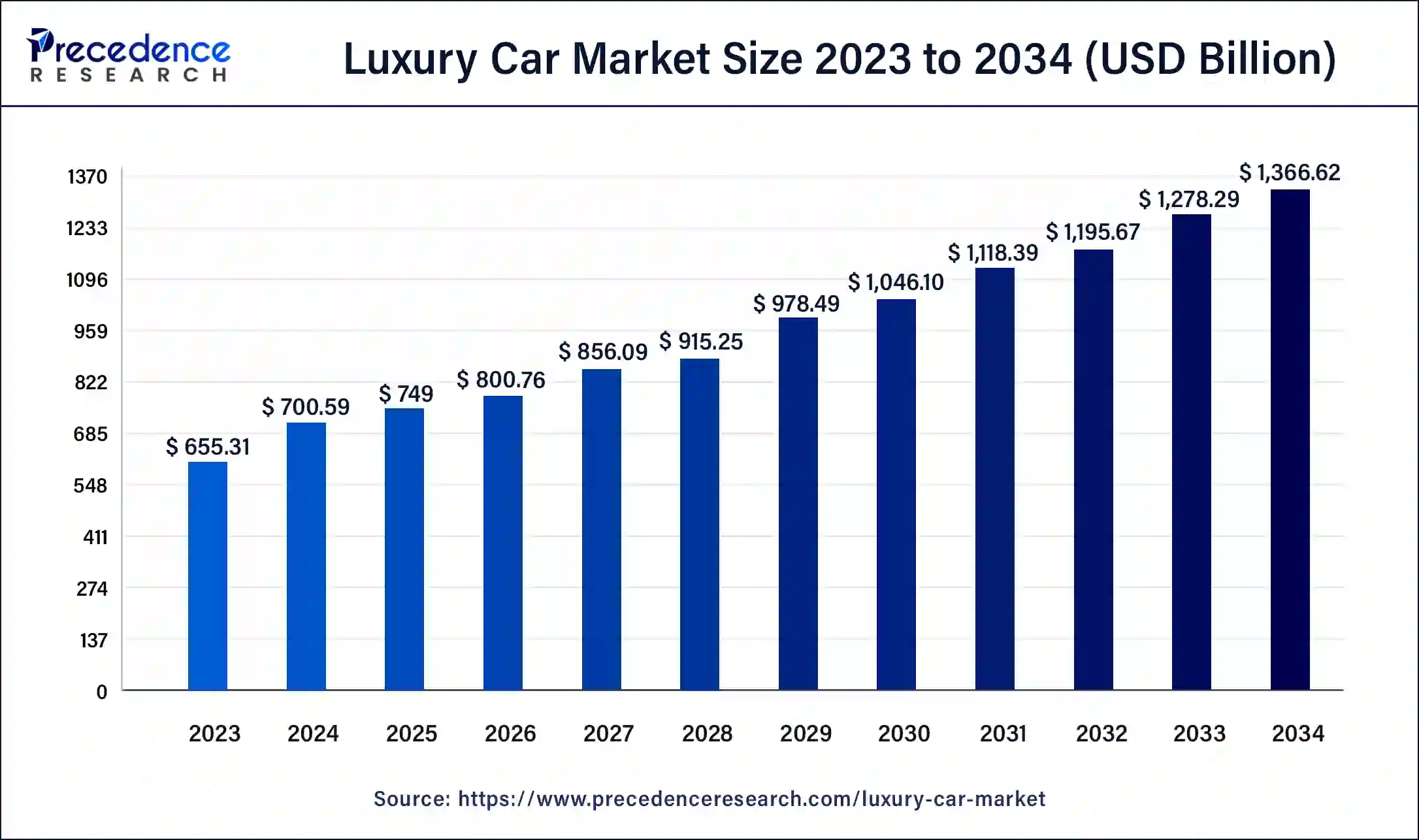
The global luxury car market is projected to grow from USD 800.76 billion in 2026 to USD 1,366.62 billion by 2034, registering a CAGR of 6.91%. Growth is driven by rising disposable incomes, strong demand for premium SUVs, advancements in electric and AI-integrated vehicles, and a shift toward technologically advanced, safer, and more luxurious mobility experiences across Europe, Asia Pacific, and North America.
Source: https://www.precedenceresearch.com/luxury-car-market
 Get a Sample
 Table Of Content


Luxury Car Market Size and Forecast 2025 to 2034
The global luxury car market size was evaluated at USD 800.76 billion in 2026 and is anticipated to reach around USD 1,366.62 billion by 2034, growing at a CAGR of 6.91% over the forecast period 2025 to 2034. The luxury car market is proliferating due to the consumer's shift from sedans to SUVs, owing to the increasing disposable incomes across various regions, along with the new launch of automotive by major key players.
Luxury Car Market Key Takeaways
- The global luxury car market was valued at USD 700.59 billion in 2024.
- It is projected to reach USD 1,366.62 billion by 2034.
- The luxury car market is expected to grow at a CAGR of 6.91% from 2025 to 2034.
- Europe accounted for the largest market share of 40% in 2024.
- Asia Pacific is expected to grow at the fastest-growing market during the forecast period.
- By vehicle type, the sport utility segment has held the biggest market share of 59% in 2024.
- By vehicle type, the hatchback segment is expected to expand at a notable CAGR of 6.82% over the forecasted years.
- By propulsion type, the internal combustion engine (ICE) segment contributed the biggest market share of 72% in 2024.
- By propulsion type, the electric segment is projected to grow at a solid CAGR of 7.83% over the forecast period.
AI Impact on the Luxury Car Market
AI is significantly impacting the luxury car market. Two revolutions are the talk of the automotive industry. One of them is the incorporation of AI into luxury cars so that they can drive without human intervention. The best example of AI and automotive integration is the TESLA car, which is a self-driving car launched by the Tesla group.
Safety features can be integrated with the AI with the help of machine learning algorithms. They can automatically make real-time decisions while traveling by navigating through the roads with sensors around them. AI-integrated cars, therefore, are the future of the globe. For instance, TESLA' Autopilot' is the first advanced driver assistance systems incorporated with luxury cars to make the car self-driving.
- In March 2025, Wayve introduced embodied AI driving testing in Germany. The hub, located in Baden-Württemberg, will serve as a key site for refining Wayve's advanced driver assistance systems (ADAS) and scalable automated driving technologies.
Market Overview
The luxury car market is expanding due to the increasing inclination towards lavish lifestyles across the globe and the prestigious aura around the automotive, along with an increasing number of affluent individuals and groups in emerging countries who are attracted to luxury vehicles and tend to buy them. Moreover, technological advancements such as hybrid electric vehicles and electric vehicles are immensely affecting the market position globally. Major market key players are investing heavily in multimedia luxury cars due to the increasing demand from various regions.
Region-wise, Europe and North America are significantly growing due to the presence of major key players in the region, plus a group of wealthy people tend to buy such a luxurious vehicle. Also, companies are heavily investing in cutting-edge technology and its implementation in the automotive industry.
- In January 2022, Mercedes-Benz introduced Mercedes-Benz EQS, its top-of-the-line luxury sedan, as the first luxury electric car in India. The car is locally produced in India, making it the country's first luxury electric vehicle.
Luxury Car Market Growth Factors
- Increasing production of luxury cars across the globe, fuelling the luxury car market.
- Rising disposable income.
- People perceive a sense of prestige when buying luxury cars.
- High safety features are incorporated with such luxury cars, gaining traction among wealthy people.
- Major key players are investing heavily in adopting newer technology into luxury cars to make them more attractive and safer.
- The increasing popularity of large SUVs in China is also proliferating the market.
- Increasing group of affluent people across the globe.
Market Scope
| Report Coverage | Details |
| Market Size by 2034 | USD 1,366.62 Billion |
| Market Size in 2025 | USD 749 Billion |
| Market Growth Rate from 2025 to 2034 | CAGR of 6.91% |
| Largest Market | Europe |
| Base Year | 2024 |
| Forecast Period | 2025 to 2034 |
| Segments Covered | Vehicle Type, Propulsion Type, and Regions |
| Regions Covered | North America, Europe, Asia-Pacific, Latin America and Middle East & Africa |
Market Dynamics
Driver
Better performance with high safety features
A significant driving factor for the proliferation of the luxury car market is the better performance and advanced safety features available in it. As compared to economy cars, the luxury car provides much better safety options, such as airbags, traction control, safety door locks, and multimedia systems equipped with highly advanced technology like AI. Another driving factor in buying a luxury car is that it withstands even a fatal accidental crash, gaining the traction of wealthy groups across the globe.
- According to Forbes data, 71% of luxury vehicles are equipped with ABS, traction control, side airbags, and more technologies.
Restraint
High cost of repairing the luxury car
A major drawback that the luxury car market is witnessing is the substantial amount needed to repair; even small damage in the luxury car hinders the growth of the market. It is very hard to track the shop that can repair perfectly to such highly advanced and technologically equipped care, which causes more damage if not repaired properly. Moreover, a luxury car depreciates more than a normal budget-friendly car. In a nutshell, buying a luxury car is a costly affair that only affluent people can handle; it is not affordable for middle-class or upper-middle-class people.
Opportunity
Expansion of SUVs world widely
The major opportunity that the luxury car market holds is the rising inclination to buy SUVs with various features and spaciousness. Luxury cars like SUVs are gaining traction among high-profile and ultra-high-profile individuals due to their versatility, stylish appearance, prestigious look, and sense of safety with advanced technology built into them. Families and young professionals are more attracted to luxury cars like SUVs, creating lucrative opportunities for the market on a global scale. The enhanced driving features and highly robust build of SUVs are the attractive parts that resonate with both the demand for safety and appearance.
Region-wise, China and North America are the prime buyers of luxury SUVs, which are in high demand from these countries. Economic conditions and climate also play important roles in influencing the luxury car market. Overall economic prosperity, including high disposable income, is the major reason behind the dynamics of the market.
- In China's SUV market, the Tesla Model Y remains a remarkable presence, whether battery-electric or not; the all-electric crossover became the most popular SUV in China from January to August 2024.
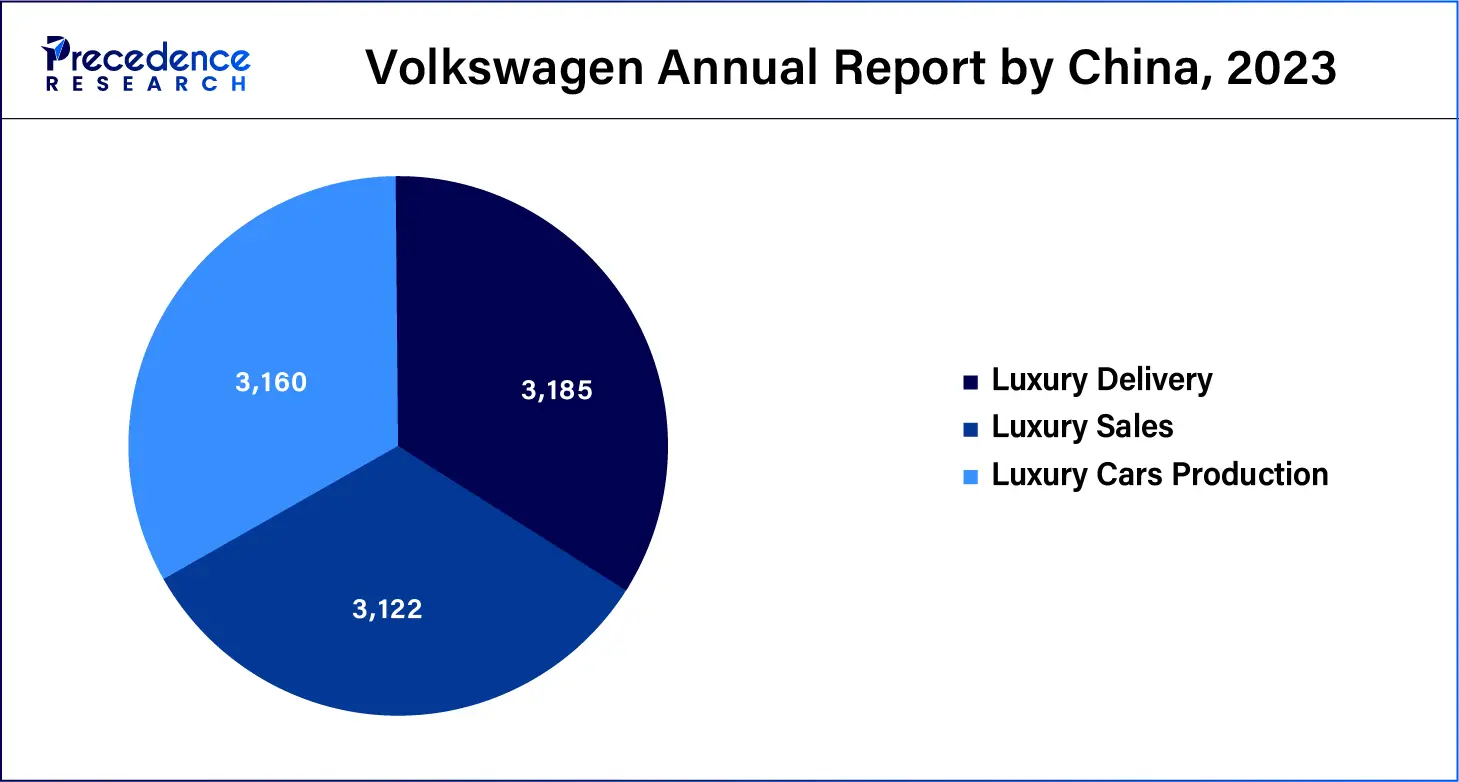
- According to data compiled by Yiech, the Tesla Model Y was sold in the Chinese domestic auto sector in 292,489 units from January to August 2024.
Market Concentration & Characteristics
The luxury car market is distinguished by high growth potential, fueled by technological innovations, and rising wealth, coupled with the increasing consumer preferences for sustainable and advanced vehicles. The major players in the market include Mercedes-Benz, BMW, and Audi, along with other emerging brands.
Vehicle Type Insights
The sport utility segment was estimated to have the largest share of the luxury car market in 2024. The market is further segmented into hatchback and sedan. The growth of the sport utility segment is related to the increasing demand for aesthetic looks for bikes and styling along with different high-tech features, comfort, and safety.
- In February 2024, BYD Auto Co. Ltd introduced the U9 electric supercar in China. The U9 Supercar is one of the most expensive supercars from the company. The new model can reach a top speed of 309.19 km/h and accelerate to 100 km/h within 2.36 seconds.
The hatchback segment is anticipated to witness the fastest growth in the luxury car market over the forecasted years. The segment is proliferating in the market due to the increasing global disposable income, easy availability of vehicle loans, and innovative models launched by market players.
Propulsion Type Insights
The internal combustion engine (ICE) segment accounted for the largest share of the luxury car market in 2024. The growth of this segment is attributed to factors like the well-established structure of ICEs worldwide; most of the vehicles have ICEs as engines already running on the roads, and there is easy availability, affordability, and high performance.
The electric segment is anticipated to expand at a higher rate in the luxury car market over the forecast period. The growth of this segment is attributed to the increasing adoption of electric vehicles by the leading countries in Asia Pacific. Moreover, the leading country's government is also taking initiatives to reduce carbon footprints to accelerate decarbonization. They offer subsidies and incentives to consumers and manufacturers.
- Amazon is planning to add 10,000 EVs to its India's logistics fleet by the year 2025, Zomato is aiming to electrify 100% of its delivery fleet by the year 2030, while Uber is planning to add 25,000 EVs by 2026 as part of its ‘Uber Green' initiative.
- In August 2023, Audi launched its new electric duo, the Q8 e-tron and e-tron Sportback, in India. The Q8 e-tron range is available in two trims with 95 kWh and 114 kWh battery packs, respectively.
Regional Insights
Europe Luxury Car Market Size and Growth 2025 to 2034
The Europe luxury car market size was exhibited at USD 280.24 billion in 2024 and is projected to be worth around USD 553.48 billion by 2034, poised to grow at a CAGR of 7.03% from 2025 to 2034.
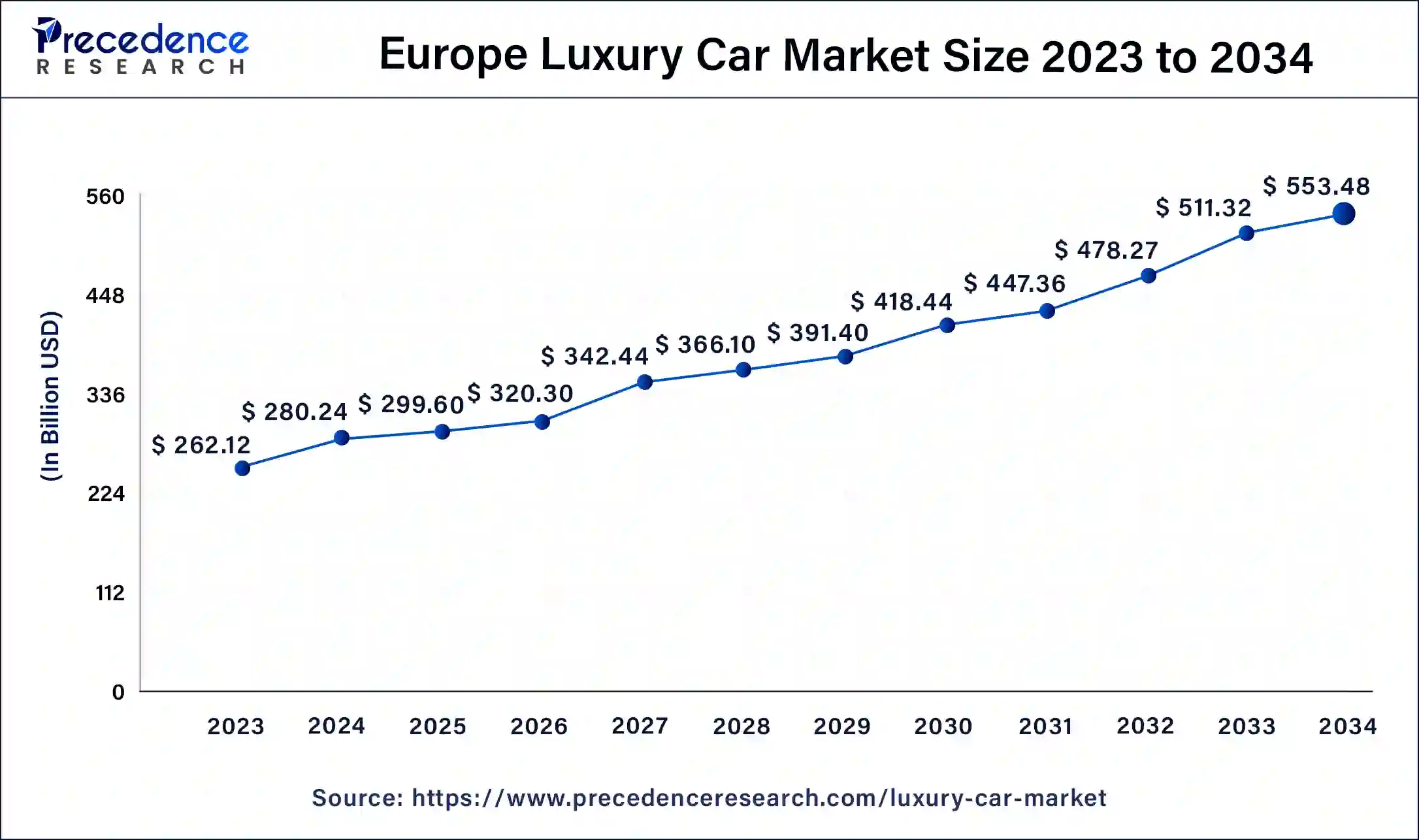
Europe accounted for the largest share of the luxury car market in 2024. The European market is expanding due to factors like the well-established market of automobiles and the presence of major automobile companies, fuelling the growth of the market further. Also, highly advanced industries for automotive manufacturing are supported by government funding and different rules and policies.
- In April 2025, BYD introduced the Denza premium brand in Europe to support expansion. Denza, formerly a joint venture with Mercedes, will spearhead BYD's technological innovations, with features eventually appearing in other BYD models. The European launch will begin with the Z9 GT sport wagon, with hybrid and EV versions.
Germany Market Trends
Germany's market is growing due to its high engineering and car manufacturing capabilities, and an unplayed advantage by a mountain of high-end auto manufacturers such as Mercedes, Porsche, and Audi. Luxury EV sales, high-performance sedans, and technological advancements of the SUV continue to move forward as a result of high-value buyers and corporate consumers. Germany's rise in investment in the infrastructure of e-mobility and incentives to shift to alternative modes of transport will continue to drive higher-value electric vehicle sales in the market.
North America witnessed significant growth in the global luxury car market. This growth is due to leading countries like Canada and the U.S. and the increasing adoption of luxury cars in these countries. A strong economy and a huge proportion of highly affluent consumers fuel the market growth in this region. According to the country, the U.S. has been the top consumer of luxury cars. High disposable income and the prestige of automotive-featured cars in the U.S. are driving the market further.
U.S. Market Trends
The U.S. market is driven by its high consumer purchasing power, an equally strong demand for luxury cars, and quick technological advancements in the automotive industry. The luxury car companies are investing in the next generation of connectivity, AI computing, and AV tech, which is meant to make for tech-savvy customers. Governments' attitudes in support of environmentally friendly modes of transportation and better connectivity at charging stations are responsible for the market growth.
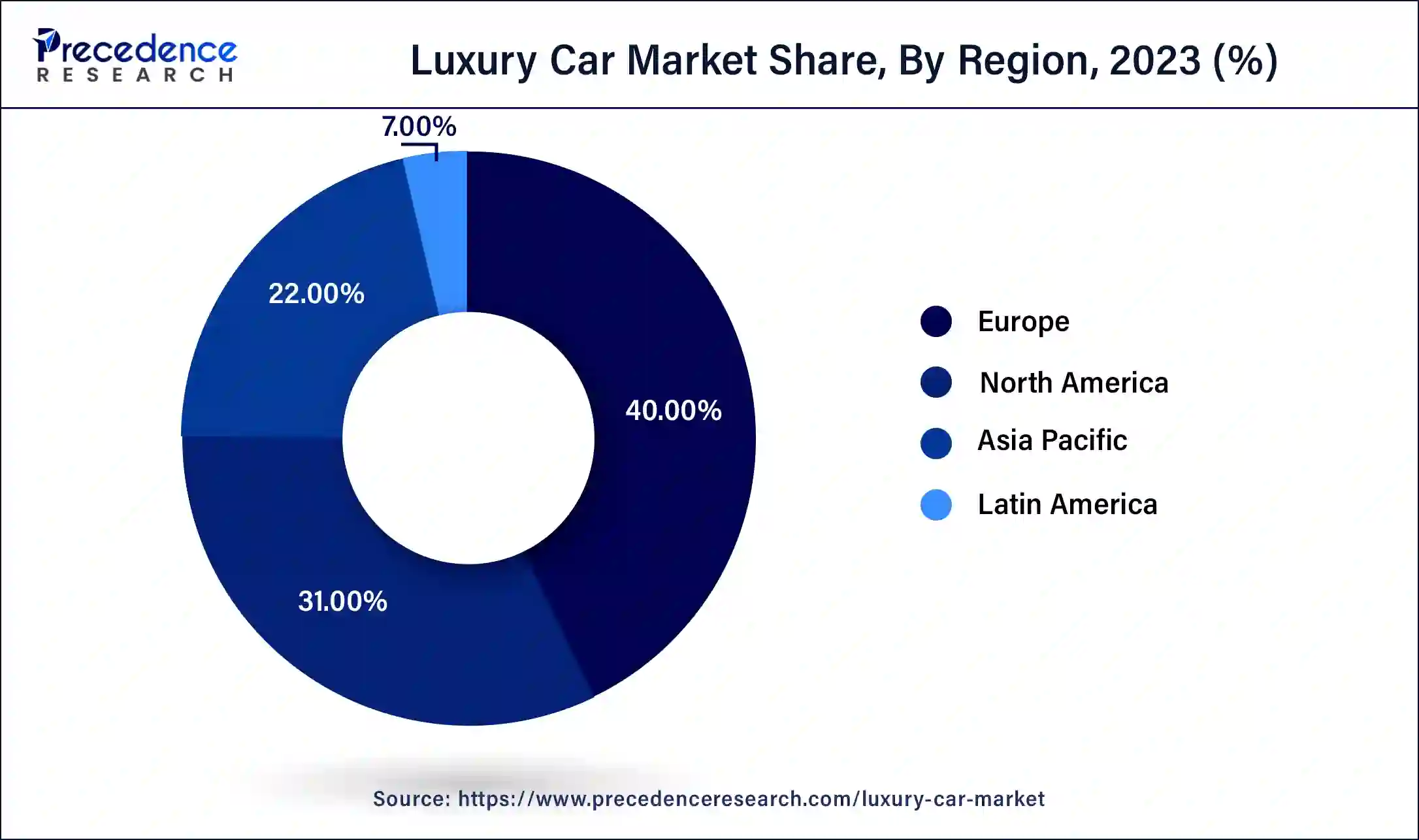
Asia Pacific is expected to host the fastest-growing luxury car market during the foreseeable period. The growth of this region is due to increasing demand for high-tech vehicles, owing to the rising disposable income and GDP in economically growing countries like India, Japan, Korea, and China. The government is also funding electric vehicles to reduce their carbon footprint in terms of combating the global warming issue. By acknowledging this, major market players are gaining traction with high-profile customers by launching innovative luxury models.
- In April 2024, Toyota Motor Corporation introduced a new production line at the Toyota Motor East Japan Inc.'s Iwate Plant in Kanegasaki Town, Iwate Prefecture. This production line is dedicated to manufacturing the Toyota Lexus LBX compact SUV.
China Market Trends
The Chinese market is growing due to the growing number of high-net-worth individuals, urbanization, and high-end mobility solutions. As their customers are driving up the quality of the ownership experience, it has emerged as one of the world's biggest markets for luxury cars. The demand for expensive electric cars, particularly, is very high, largely owing to the government's drive to use new energy vehicles and erect charging stations in the metro areas.
What are the Key Trends in the Luxury Car Market in Latin America?
Latin America is expected to have significant growth in the market, driven by the growing urban population and growing consumer interest in high-quality brands in the region. Demand for luxury SUVs, sedans, and even electric vehicles in these countries, in search of more comfort, performance, and safety, is spurred by rich individuals. The increased recognition of the importance of road transport of goods and passengers as viable emission sources, which supports the transition to more sustainable transport modes.
Brazil Market Trends
The Brazilian market is driven by the increasing affluent population, growing automotive industry, and increased consumer demand for luxury cars. As consumers look for comfort, security, and state-of-the-art technology, the market is seeing more sales of luxury SUVs and high-performance sedans. Auto manufacturers are introducing their own upscale electric and hybrid cars to the country as Brazil transitions to a more sustainable form of transportation and eases environmental restrictions.
How is the Middle East and Africa Region Growing in the Luxury Car Market?
The Middle East and Africa are expected to have significant market growth in the upcoming years, driven by a growing amount of disposable income, urbanization and an appetite for top-of-the-range automobile experiences. These high-net-worth golfers want over-the-top cars offering high-performance and opulent amenities for their high-performance sports cars and luxury SUVs. With action around sustainable development and the new regulations, automakers are focusing on launching their new electric and hybrid luxury vehicles online.
Saudi Arabia Market Trends
The growing economies and appreciation of luxury cars make Saudi Arabia, with its high discretionary spending power, a growing market for luxury cars in the Middle East. Wealthier consumers and younger buyers in the nation have come to favour luxury SUVs, high-performance sports cars, and technologically sophisticated EVs. The plans of the government for 2030 are also encouraging investment in sustainable transport infrastructure and smart mobility hardware.
Luxury Car Market Companies
- Mercedes-Benz Group AG
- BMW Group
- Volkswagen
- Tesla
- TOYOTA MOTOR CORPORATION (Lexus)
- Volvo Car Corporation
- Aston Martin
Recent Developments
- In September 2024, JSW MG Motor India, a joint venture between SAIC, opens a new tab and JSW Group, and it will launch a luxury car brand, aiming to sell its first premium cars by the first three months of 2025. Under the brand, called 'MG Select', the company will launch four products over the next two years.
- In October 2024, Mahindra announced the launch of new electric SUVs entering the luxury car market. The new vehicles will feature advanced Qualcomm chips, which will offer a connected car platform to enhance the user experience. Also, at the vehicle launches, the Mahindra Group is expected to announce plans for EV charging infrastructure.
Segments Covered in the Report
By Vehicle Type
- Hatchback
- Sedan
- Sports Utility
By Propulsion Type
- Internal Combustion Engine (ICE)
- Electric
By Geography
- North America
- Asia Pacific
- Europe
- Latin America
- Middle East & Africa
For inquiries regarding discounts, bulk purchases, or customization requests, please contact us at sales@precedenceresearch.com
Frequently Asked Questions





Ask For Sample
No cookie-cutter, only authentic analysis – take the 1st step to become a Precedence Research client
 Get a Sample




 sales@precedenceresearch.com
 Schedule a Meeting
